

Prices, dates, ages, phone numbers: you can't get through a day in Spanish without numbers. This guide covers cardinal and ordinal numbers, gender agreement, large numbers, everyday uses and spelling, with examples from Spain and Latin America.
Numbers in Spanish: A Quick Overview
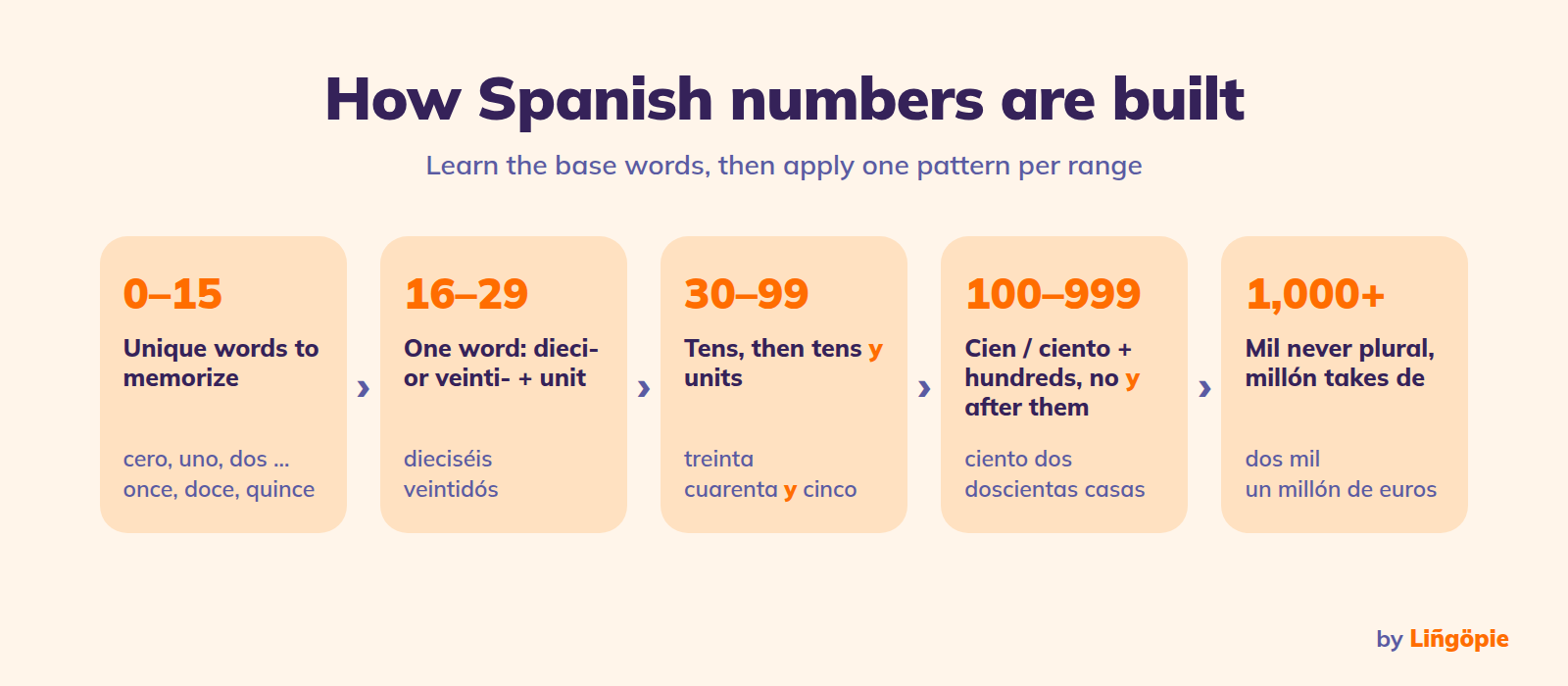
Spanish numbers from 0 to 30 are written as single words. From 31 to 99, Spanish joins tens and units with y: treinta y dos. Uno and the hundreds change with the noun's gender, and mil never takes a plural.
Key Takeaways
- 0–30: one word each (dieciséis, veintidós, treinta).
- 31–99: tens + y + units (cuarenta y cinco).
- 100: cien for exactly 100, before nouns and before mil or millones; ciento for 101–199.
- Gender: uno, veintiuno and the hundreds from 200 agree with the noun (una casa, doscientas casas).
- Billón: a Spanish billón is a million million; the English "billion" is mil millones.
Spanish has two main kinds of numbers. Cardinal numbers (uno, dos, tres) say how many; ordinal numbers (primero, segundo, tercero) say which position. According to the Diccionario panhispánico de dudas of the RAE and ASALE, numerals are classified as cardinal, ordinal, multiplicative or fractional depending on whether they express quantity, order, multiplication or division. You need both kinds for prices, dates, ages, floors and phone numbers.
Spanish Numbers 0–20
These 21 words are the base: together with the tens, the hundreds and mil, they build every other number. According to the RAE and ASALE, the simple cardinals run from cero to quince, plus the tens, cien(to), quinientos and mil; all other numbers are combinations of those.
Number | Spanish | Latin America | Spain |
|---|---|---|---|
0 | cero | SEH-roh | THEH-roh |
1 | uno | OO-noh | same |
2 | dos | dohs | same |
3 | tres | trehs | same |
4 | cuatro | KWAH-troh | same |
5 | cinco | SEEN-koh | THEEN-koh |
6 | seis | sayss | same |
7 | siete | SYEH-teh | same |
8 | ocho | OH-choh | same |
9 | nueve | NWEH-veh | same |
10 | diez | dyess | dyeth |
11 | once | OHN-seh | OHN-theh |
12 | doce | DOH-seh | DOH-theh |
13 | trece | TREH-seh | TREH-theh |
14 | catorce | kah-TOR-seh | kah-TOR-theh |
15 | quince | KEEN-seh | KEEN-theh |
16 | dieciséis | dyess-ee-SAYSS | dyeth-ee-SAYSS |
17 | diecisiete | dyess-ee-SYEH-teh | dyeth-ee-SYEH-teh |
18 | dieciocho | dyess-ee-OH-choh | dyeth-ee-OH-choh |
19 | diecinueve | dyess-ee-NWEH-veh | dyeth-ee-NWEH-veh |
20 | veinte | BAYN-teh | same |
Numbers 11–15: the irregular ones
Once, doce, trece, catorce and quince follow no pattern, so memorize them as five separate words. All five end in -ce, which helps.
Numbers 16–19: one word each
From 16 to 19, Spanish writes one word built from diez plus the unit: dieciséis, diecisiete, dieciocho, diecinueve. Dieciséis takes a written accent on the last syllable. For the full rules, see our guide to Spanish accent marks.
Th or s? How Spain and Latin America differ
In most of Spain, c before e or i, and z, sound like "th": cinco is THEEN-koh and doce is DOH-theh. In Latin America, the Canary Islands and parts of Andalusia, they sound like "s": cinco is SEEN-koh. Both pronunciations are standard, so pick the one that matches the Spanish you hear most.
Three quick examples: Tengo quince años (I'm 15), Son las doce (It's twelve o'clock) and uno, dos, tres when you count out loud.
Spanish Numbers 21–29: The Veinti- Forms
Numbers 21 to 29 are written as one word: veintiuno, veintidós, veintitrés, veinticuatro, veinticinco, veintiséis, veintisiete, veintiocho, veintinueve. Veinte itself stays on its own.
Three of them carry a written accent: veintidós, veintitrés and veintiséis. Veintiún also takes one before a masculine noun.
Treat veinti- as a fixed prefix: add any unit from 1 to 9 and write the result as one word. Veintiuno sounds like bayn-tee-OO-noh: the stress moves to the u, unlike BAYN-teh. In a date, you would say el veintitrés de abril.
Uno becomes un before masculine nouns and una before feminine nouns. Numbers ending in uno agree with the noun's gender: veintiún libros, veintiuna casas. According to the DPD, uno and its compounds have their own feminine forms: una, veintiuna, treinta y una.
You may spot veinte y dos in older texts. That is an outdated spelling; the standard form is veintidós. Try it in context: Mi hermana tiene veintiún años (My sister is 21) and Hay veintiuna sillas (There are 21 chairs).
Spanish Numbers 30–99: Tens and "Y"
The tens
Number | Spanish | Pronunciation |
|---|---|---|
30 | treinta | TRAYN-tah |
40 | cuarenta | kwah-REN-tah |
50 | cincuenta | seen-KWEN-tah (Spain: theen-KWEN-tah) |
60 | sesenta | seh-SEN-tah |
70 | setenta | seh-TEN-tah |
80 | ochenta | oh-CHEN-tah |
90 | noventa | noh-BEN-tah |
Every ten from treinta to noventa ends in -nta, which makes the group easy to recognize.
Adding units with y
From 31 to 99, Spanish joins tens and units with y: treinta y dos. Each of these numbers is three separate words: treinta y uno, cuarenta y cinco, noventa y nueve. Once you know 0–30, this single pattern covers every number up to 99.
When the number ends in uno, it agrees with the noun: treinta y un días, treinta y una semanas. According to the DPD's table of cardinals, 31 is treinta y uno, with the feminine treinta y una.
Here is the pattern at work. Shopping: Cuesta treinta y nueve euros. Age: Mi abuelo tiene ochenta y cuatro años. Sports scores: El equipo ganó cuarenta y cinco a treinta y dos.
Counting in Spanish from 60 to 100 sounds like this: sesenta y uno, sesenta y dos, sesenta y tres … noventa y nueve, cien. If you want to count by tens instead, say diez, veinte, treinta, cuarenta, cincuenta, sesenta, setenta, ochenta, noventa, cien. When you say these numbers aloud, stress the syllable right before -ta: cuaREN-ta, seSEN-ta.
Hundreds in Spanish (100–999): Cien vs. Ciento
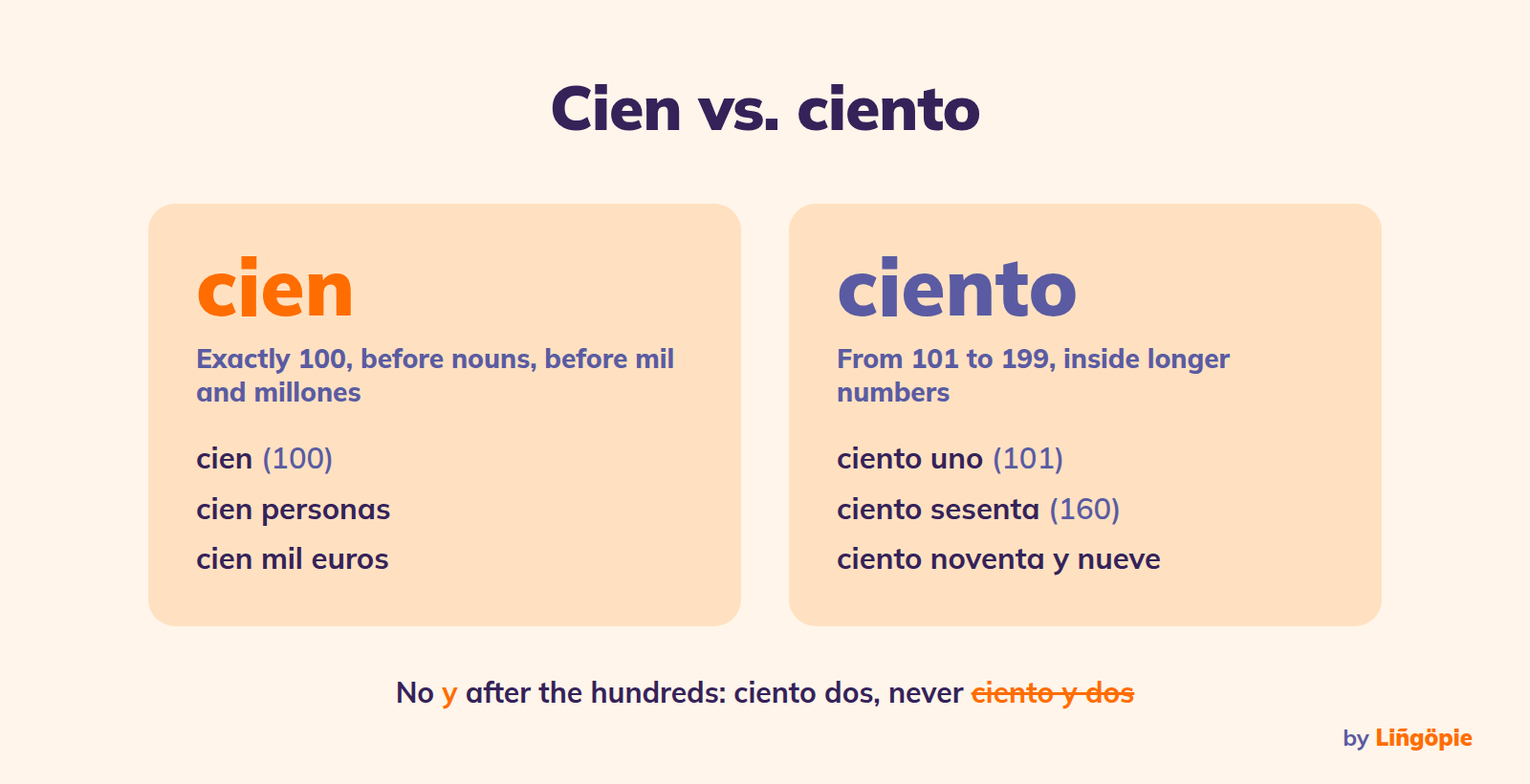
Cien vs. ciento
Cien is used for exactly 100 and before mil or millones; ciento is used from 101 to 199. That gives cien personas, cien mil euros and cien millones, but ciento uno, ciento dos, ciento sesenta and ciento noventa y nueve.
According to the DPD entry for cien, the short form appears alone, before nouns and before mil, millón and larger number words, while the full form ciento appears in the rest of compound numbers. Cien sounds like SYEHN in Latin America and THYEHN in most of Spain.
No y after the hundreds
Spanish never uses y right after the hundreds: ciento dos, not ciento y dos. The y appears only between tens and units, so 132 is ciento treinta y dos.
200–900, masculine and feminine
Number | Masculine | Feminine |
|---|---|---|
200 | doscientos | doscientas |
300 | trescientos | trescientas |
400 | cuatrocientos | cuatrocientas |
500 | quinientos | quinientas |
600 | seiscientos | seiscientas |
700 | setecientos | setecientas |
800 | ochocientos | ochocientas |
900 | novecientos | novecientas |
Three hundreds are irregular and trip up many learners: quinientos (500, not cincocientos), setecientos (700, not sietecientos) and novecientos (900, not nuevecientos). Hundreds agree with the noun: doscientos libros, doscientas casas. A full example: 253 is doscientos cincuenta y tres.
The hundreds combine with tens and units without any joining word, except the y inside the tens. Prices show it clearly: Cuesta ciento veinte euros (120), Cuesta ciento cincuenta pesos (150) and Cuestan trescientos sesenta y cinco soles (365). The gender rule reaches 101 too: ciento una casas, not ciento uno casas.
Large Numbers in Spanish: Mil, Millón and Billón
Mil and millón
Mil (one thousand) never takes a plural and isn't preceded by un: dos mil, diez mil, cien mil. According to the DPD, mil is always written as a separate word in complex numbers. The noun miles is a different word, used for vague amounts: miles de personas.
One million is un millón; it takes de before a noun: un millón de personas. From two million on it is plural: dos millones. Skip the de when another number follows: un millón doscientas mil personas.
Years follow the same logic: 2026 is dos mil veintiséis. Money works too: El coche cuesta veinte mil pesos. For population, try Mi ciudad tiene un millón de habitantes.
Larger amounts stack the same way: 400,000 is cuatrocientos mil and 2,500,000 is dos millones quinientos mil. The DPD's table writes 1,100 as mil cien and 1,000,100 as un millón cien.
Billón is not an English billion
The English "billion" is mil millones in Spanish. A Spanish billón is a million million (10¹²). According to the DPD, the RAE advises against using billón for the American-English "billion" and recommends mil millones or millardo instead.
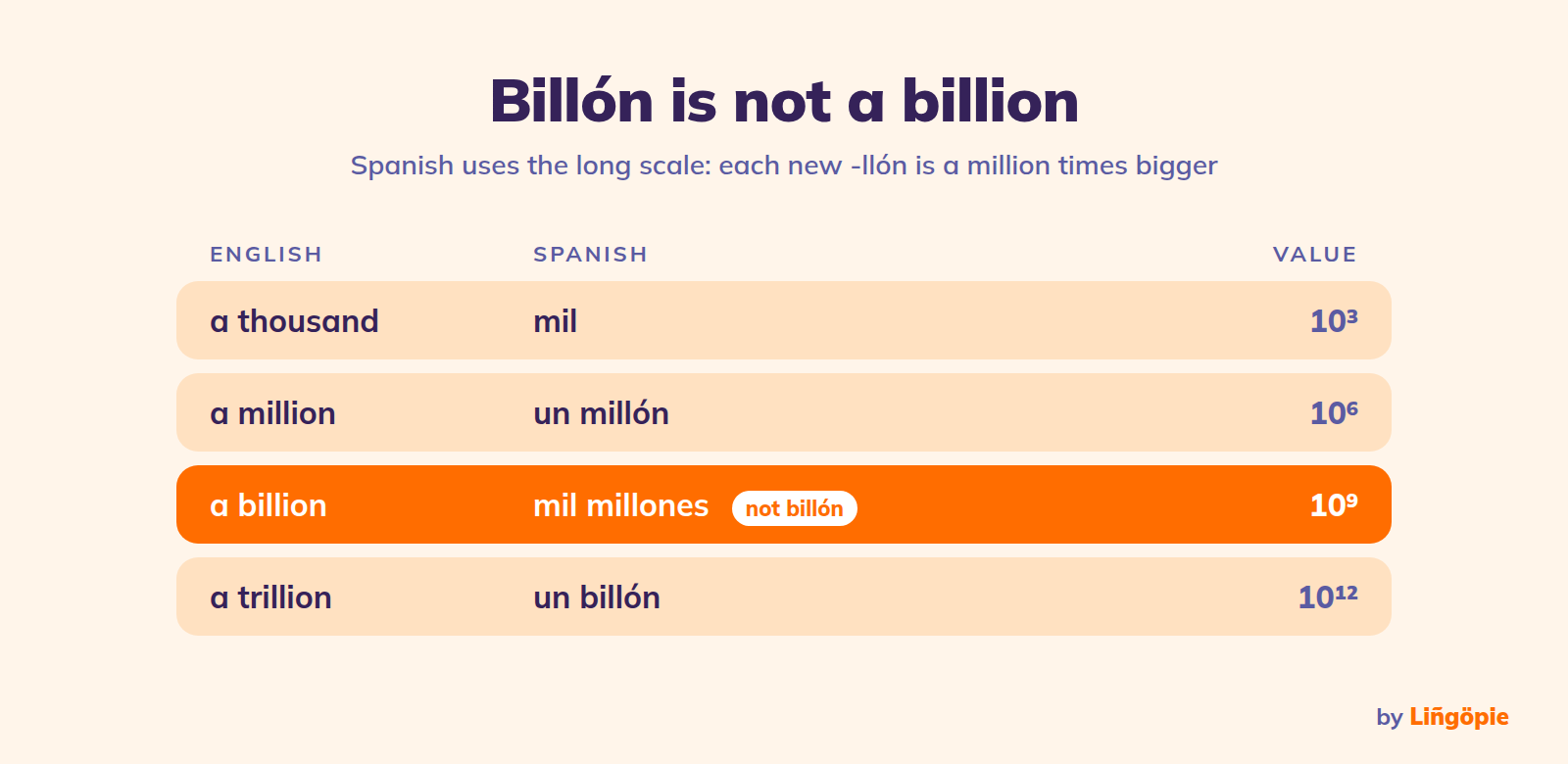
Older British English also used "billion" for a million million (the long scale), but American English and modern British English now use it for a thousand million. That history explains why the two systems still get mixed up.
Following the same logic, the DPD defines a trillón as a million billones (10¹⁸). If you ever read figures in a Spanish newspaper, check which scale the writer means before you convert to English.
Gender of Numbers in Spanish
Most Spanish numbers never change. Only uno and the hundreds from 200 do, because they behave like adjectives. According to the DPD, the feminine of the hundreds from 200 ends in -cientas, and quinientos has the feminine quinientas.
Uno becomes un before masculine nouns and una before feminine nouns, and numbers ending in uno follow the same rule. The table shows what changes.
Numbers | Changes? | Masculine | Feminine |
|---|---|---|---|
Uno and compounds ending in uno | Yes | un perro, veintiún perros, treinta y un perros | una casa, veintiuna casas, treinta y una casas |
Hundreds 200–900 | Yes | doscientos perros | doscientas casas |
100 (cien, ciento) | No | cien perros | cien casas |
All other numbers up to 99 | No | cuarenta perros | cuarenta casas |
Mil | No | mil perros | mil casas |
Millón (a masculine noun) | No | un millón de perros | un millón de casas |
Gender follows the noun, not the people involved: Son doscientas personas uses the feminine because persona is a feminine noun, even for a group of men.
Before mil, usage is split. The DPD notes that both treinta y un mil personas and treinta y una mil personas appear. To decide, find the noun the number describes, then check whether the number ends in uno or is a hundred from 200: quinientas páginas, doscientos kilómetros.
Spanish Ordinal Numbers
Spanish ordinal numbers show position: first, second, third. Unlike most cardinals, they agree with the noun in gender and number.
Position | Masculine | Feminine |
|---|---|---|
1st | primero | primera |
2nd | segundo | segunda |
3rd | tercero | tercera |
4th | cuarto | cuarta |
5th | quinto | quinta |
6th | sexto | sexta |
7th | séptimo | séptima |
8th | octavo | octava |
9th | noveno | novena |
10th | décimo | décima |
Primero and tercero shorten to primer and tercer before a masculine singular noun: el primer día, el tercer piso. The feminine stays whole: la primera vez, la tercera planta. This shortening is covered in the DPD's article on ordinals.
After 10th, Spanish speakers usually switch to cardinal numbers: el siglo veintiuno, el piso quince. Forms such as undécimo and duodécimo exist but mostly appear in formal writing.
Common uses include floors (el tercer piso), rankings (quedó en segundo lugar), chapters (el primer capítulo) and centuries up to the tenth (el siglo quinto). Our guide to Spanish ordinal numbers goes deeper.
Sentences make the pattern stick: Esta es mi tercera clase, Vivo en el quinto piso, Es la segunda vez que viajo a Chile. In writing with digits, ordinals take a raised letter: 1.º, 2.ª and 3.er (for tercer).
Using Numbers in Everyday Spanish
Dates
Most Spanish-speaking countries write dates in day-month-year order, so 5/10/2026 means October 5: el cinco de octubre de dos mil veintiséis. According to the DPD, month-day-year order is typical in the United States and its area of influence. Use cardinal numbers for the days.
The first of the month is the exception. The DPD says the ordinal primero is more common in Latin America (el primero de mayo), while the cardinal uno is more common in Spain (el uno de mayo). Both are correct. Years are read as full numbers: 1995 is mil novecientos noventa y cinco.
Time
Spanish uses son las for most hours and es la una for one o'clock: Es la una, Son las dos, Son las diez. Add y media for half past and y cuarto for quarter past: Son las tres y cuarto.
Age
To say your age in Spanish, use tener: Tengo treinta años. Spanish doesn't use ser for age. To ask, say ¿Cuántos años tienes?
Prices
To ask a price, use costar: ¿Cuánto cuesta? For several items, use ¿Cuánto cuestan? Answers use the local currency: Cuesta veinte euros (Spain), veinte pesos (Mexico, Argentina, Colombia, Chile), veinte soles (Peru) or veinte dólares (Ecuador, El Salvador, Puerto Rico).
Phone numbers
People usually read phone numbers in pairs or small groups, and the grouping varies by country. Digit by digit works everywhere: seis, uno, dos, tres. An eight-digit number such as 61 23 45 67 can also be read in pairs: sesenta y uno, veintitrés, cuarenta y cinco, sesenta y siete.
Addresses
Street numbers are read as cardinals: Calle Mayor siete. The floor is often an ordinal, written with a raised letter: Calle Mayor 7, 3.º B is Calle Mayor siete, tercero B. In some countries people also say the floor as a cardinal: siete, tres B.
Percentages and decimals
To read a decimal, say coma or punto to match the separator: 3,5 is tres coma cinco and 3.5 is tres punto cinco. Percentages use por ciento: el veinte por ciento. For 100 %, the DPD accepts both cien por cien and ciento por ciento. In writing, the RAE separates the % symbol from the number with a space: 20 %.
How to Write Numbers in Spanish
Spelling numbers as words
Numbers from 0 to 30 are single words; from 31 onward they are separate words joined by y between tens and units: veintiocho, treinta y uno, ciento treinta y dos. Hundreds, thousands and millions each stay separate: dos mil quinientos.
The DPD has a dedicated entry on when to write numbers in digits and when in words (números). A common style choice is to spell out short numbers in running text and use digits for prices, measurements and dates. The same entry says the digits of one number should never be split across two lines.
Decimals and thousands separators
Separators vary by country. According to the RAE's Ortografía de la lengua española (2010), the point is recommended as the decimal separator to promote unification, while the comma remains valid. For thousands, the RAE and FundéuRAE recommend a space in numbers longer than four digits (10 000) and no separator in four-digit numbers (2500).
Country | Decimals | Thousands |
|---|---|---|
Spain, Argentina, Chile, Uruguay (common usage) | comma: 3,5 | period: 10.000 |
Mexico, most of Central America, Puerto Rico, Dominican Republic (common usage) | point: 3.5 | comma: 10,000 |
RAE recommendation | point or comma | space: 10 000 |
Check the format before you pay or sign: 1.500 means one thousand five hundred in Spain, but 1.5 in Mexico.
Common Mistakes With Spanish Numbers
Six errors show up again and again. Each one has a simple fix.
Incorrect | Correct | Why |
|---|---|---|
ciento personas | cien personas | Cien is used before nouns. |
un mil | mil | Mil takes no un. |
dos miles | dos mil | Mil never takes a plural as a number. |
ciento y dos | ciento dos | No y after the hundreds. |
billón for English "billion" | mil millones | Billón is a million million. |
veintiuno libros | veintiún libros | Uno shortens before masculine nouns. |
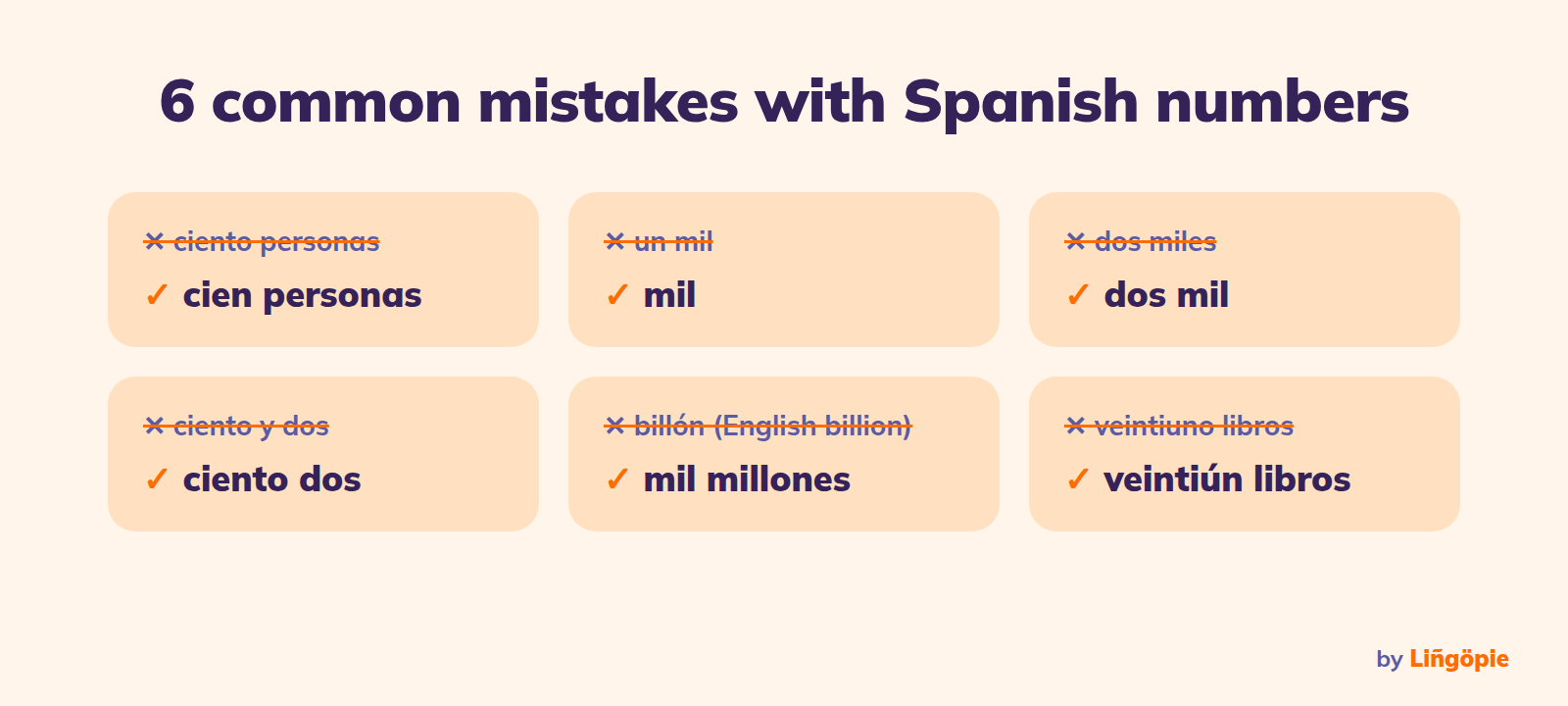
If you remember only one fix, remember the y rule: it belongs between tens and units from 31 to 99, and nowhere else.
Many of these slips come from English. English speakers say "a hundred and one" and want to add y; they say "a thousand" and want to add un; they see "billion" and reach for billón. Spotting the English pattern behind a mistake is the fastest way to stop making it.
Tips to Learn Spanish Numbers Faster
- Learn the patterns, not the lists. Memorize 0–15, the tens and the hundreds; the rest is tens + y + units.
- Chunk your practice. Work through 0–30, then the tens, then the hundreds, then mil.
- Use real prices and phone numbers. Read supermarket prices in euros or pesos aloud, and say your own phone number in Spanish.
- Say numbers out loud. Choose one pronunciation, "th" or "s" for cinco, and stay consistent.
- Listen to numbers in context. Shows give you prices, ages and times at natural speed.
Lingopie is used by more than 2 million learners and rated 4.8/5 on Trustpilot. Its dual subtitles let you hear numbers in real conversations, such as prices, dates and phone numbers, and you can click any word to save it as a flashcard. The catalog has 5,000+ shows, podcasts and books in 17 languages, and Lingopie recommends about 10 minutes a day. If you also want structured Spanish lessons, learning Spanish online with a tutor or course pairs well with this kind of listening.
Two Spanish series to try: Víctor Ros follows a young troublemaker who becomes a leading police inspector in 19th-century Madrid, and suits upper-intermediate learners (B2): Castilian Spanish, period vocabulary and a moderate speech pace. La Peluquería is a light comedy set in a hair salon, where prices and appointment times are likely topics; expect everyday Castilian Spanish, colloquial expressions and quick sitcom dialogue, best from B1. Both are available on Lingopie (Spanish catalog, as of October 2026).
"Absolutely super app for hearing Spanish, I travel a lot and I always feel up my free time with Lingopie. App is also useful when English is your second language because you'll secondly also practise it."
— Šimon Šrám, Czech Republic, August 9, 2026 (Lingopie user review)
"I am so excited to get live lessons at such a reasonable price. I love watching all the videos and reading the books. After only a few days my Spanish is improving."
— Margaret, United States, July 12, 2026 (Lingopie user review)
FAQ: Numbers in Spanish
How do you count to 10 in Spanish?
Uno (OO-noh), dos (dohs), tres (trehs), cuatro (KWAH-troh), cinco (SEEN-koh; THEEN-koh in Spain), seis (sayss), siete (SYEH-teh), ocho (OH-choh), nueve (NWEH-veh), diez (dyess; dyeth in Spain). These ten words are the base for every larger number.
When do you use cien vs. ciento?
Use cien for exactly 100 and before mil or millones: cien personas, cien mil. Use ciento for 101–199: ciento uno, ciento sesenta. In larger numbers, ciento stays in its full form after the thousands: dos mil ciento treinta y cuatro.
Why do some Spanish numbers change for gender?
Uno and the hundreds from 200 act like adjectives and agree with the noun: una casa, doscientas personas. Compounds ending in uno follow the same rule: treinta y una semanas. Other numbers, including mil, don't change.
Is a Spanish billón the same as an English billion?
No. The English "billion" is mil millones in Spanish, while a Spanish billón is a million million (10¹²). The RAE advises against using billón for the English-American billion, so say mil millones to avoid confusion.
How do you write decimals and thousands in Spanish?
It depends on the country. Spain, Argentina, Chile and Uruguay commonly use a decimal comma (3,5) and a period for thousands (10.000); Mexico and others use a decimal point (3.5) and a comma (10,000). The RAE recommends a space for thousands: 10 000.
Where does "y" go in Spanish numbers?
Only between tens and units from 31 to 99, including inside larger numbers: ciento treinta y dos. Never put y after the hundreds or thousands: ciento dos, dos mil cinco. Numbers from 21 to 29 are one word, so they take no separate y.
Conclusion
Numbers in Spanish come down to a few patterns: single words up to 30, tens + y + units up to 99, cien and ciento for hundreds, and gender agreement for uno and the hundreds. Add a mil that never takes a plural and a billón that equals a million million, and you can read prices, dates and phone numbers from Madrid to Mexico City to Buenos Aires.
Your next step: say your age, today's date and your phone number in Spanish, out loud. Then continue with Spanish ordinal numbers and telling time in Spanish, or listen to spanish numbers in real conversations on Lingopie.
Sources
- RAE, Ortografía de la lengua española (2010)
- RAE and ASALE, Diccionario panhispánico de dudas
- FundéuRAE



![How To Say Happy Birthday In Spanish: 17+ Easy Ways [GUIDE]](/blog/content/images/size/w300/2026/03/Happy-Birthday-In-Spanish.jpg)
