


Key Takeaways
- A Spanish conjugation chart maps each subject pronoun to its verb ending across tenses, so learners can find the right form without guessing.
- Spanish verbs fall into three groups by their infinitive ending: -ar, -er, and -ir, each with its own pattern.
- Most Spanish verbs are regular, so three ending patterns (-ar, -er, -ir) cover the majority of verbs you'll meet. The exception is a small group of very high-frequency verbs — ser, estar, ir, tener, hacer — which are irregular and worth memorizing first.
- Irregular verbs like ser, estar, and ir break the standard pattern and need to be memorized individually.
- Regional forms differ across the Spanish-speaking world: Spain uses vosotros for informal "you all," while Latin America uses ustedes for both formal and informal plural "you."
Introduction to Spanish Conjugation Charts
A Spanish conjugation chart is a table that lays out how a verb changes across subject pronouns and tenses. Instead of memorizing each sentence individually, learners can look up the exact ending for yo (I), tú (you), él/ella (he/she), and the rest, for present, past, or future tense.
For Spanish language learners around the world, a chart turns an abstract grammar rule into something visual and searchable. Whether you're studying Castilian Spanish in Spain or Latin American Spanish in Mexico or Colombia, the core -ar, -er, and -ir endings are shared. Two regional differences affect conjugation: Spain uses vosotros for informal "you all," and parts of Latin America — including Argentina, Uruguay, and much of Central America — use vos instead of tú, with its own present-tense endings (vos hablás, vos comés, vos vivís).
Why Use a Spanish Verb Conjugation Chart?
A conjugation chart solves a specific problem: knowing a verb's meaning does not mean knowing how to use it in a sentence. Hablar means "to speak," but a learner still needs to know that yo hablo means "I speak" and ellos hablan means "they speak."
Charts help in three concrete ways:
- They group verb forms by subject pronoun, so the learner sees the full pattern at once instead of one form at a time.
- They separate regular verb patterns from irregular ones, which prevents learners from over-applying a rule that doesn't hold everywhere.
- They make it possible to check a form in seconds during writing or conversation practice, without breaking focus to search for a full explanation.
A chart is a reference tool, not a substitute for practice. Learners still need to produce the forms themselves, in speech and writing, for the patterns to stick.
Understanding Spanish Verb Endings and Tenses
Every Spanish verb in its infinitive form ends in -ar, -er, or -ir, and that ending determines which conjugation pattern it follows.
Verb type | Example | Meaning |
|---|---|---|
-ar verbs | hablar | to speak |
-er verbs | comer | to eat |
-ir verbs | vivir | to live |
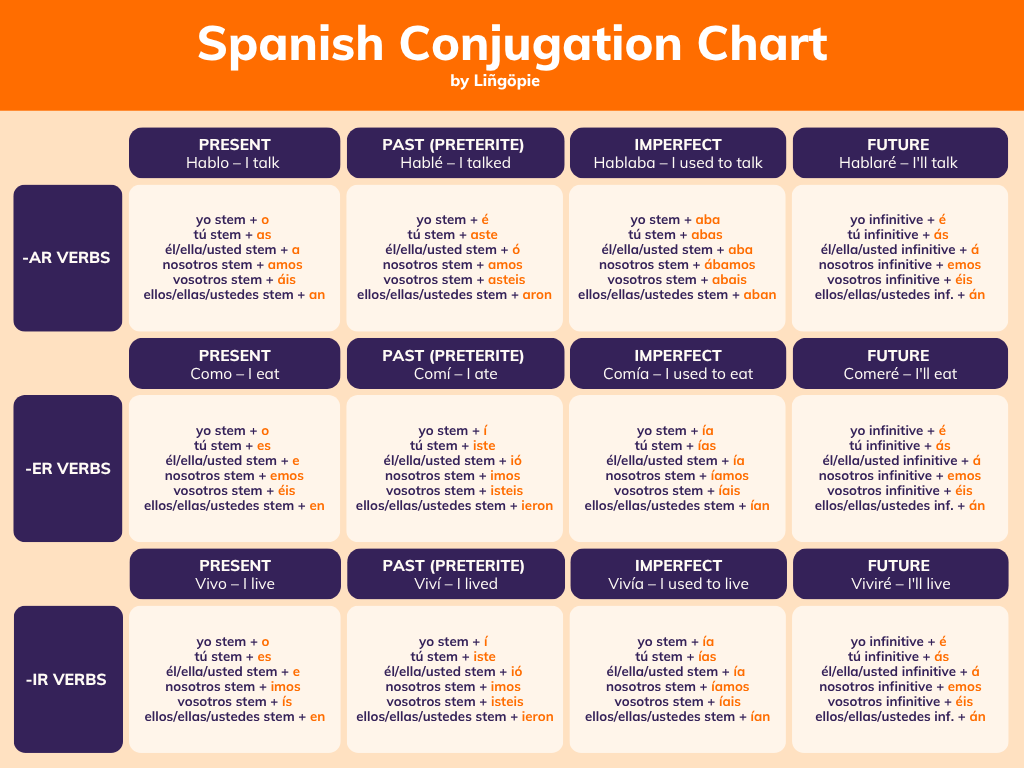
In the present tense, regular -ar, -er, and -ir verbs follow these endings:
Pronoun | -ar (hablar) | -er (comer) | -ir (vivir) |
|---|---|---|---|
yo | hablo | como | vivo |
tú | hablas | comes | vives |
él/ella/usted | habla | come | vive |
nosotros | hablamos | comemos | vivimos |
vosotros | habláis | coméis | vivís |
ellos/ellas/ustedes | hablan | comen | viven |
Past and future tenses follow their own regular endings for each verb group. A full conjugation chart typically covers present, preterite (simple past), imperfect (past habitual), and future tense, since these four cover most everyday communication.
Preterite (completed past actions)
Pronoun | hablar | comer | vivir |
|---|---|---|---|
yo | hablé | comí | viví |
tú | hablaste | comiste | viviste |
él/ella/usted | habló | comió | vivió |
nosotros | hablamos | comimos | vivimos |
vosotros | hablasteis | comisteis | vivisteis |
ellos/ellas/ustedes | hablaron | comieron | vivieron |
Imperfect (ongoing or habitual past)
Pronoun | hablar | comer | vivir |
|---|---|---|---|
yo | hablaba | comía | vivía |
tú | hablabas | comías | vivías |
él/ella/usted | hablaba | comía | vivía |
nosotros | hablábamos | comíamos | vivíamos |
vosotros | hablabais | comíais | vivíais |
ellos/ellas/ustedes | hablaban | comían | vivían |
Future (endings attach to the full infinitive and are the same for all three groups)
Pronoun | hablar | comer | vivir |
|---|---|---|---|
yo | hablaré | comeré | viviré |
tú | hablarás | comerás | vivirás |
él/ella/usted | hablará | comerá | vivirá |
nosotros | hablaremos | comeremos | viviremos |
vosotros | hablaréis | comeréis | viviréis |
ellos/ellas/ustedes | hablarán | comerán | vivirán |
Full present-tense chart for the irregulars:
Pronoun | ser | estar | ir | tener |
|---|---|---|---|---|
yo | soy | estoy | voy | tengo |
tú | eres | estás | vas | tienes |
él/ella/usted | es | está | va | tiene |
nosotros | somos | estamos | vamos | tenemos |
vosotros | sois | estáis | vais | tenéis |
ellos/ellas/ustedes | son | están | van | tienen |
Subject Pronouns and Their Role in Conjugation
Spanish verbs have six forms per tense, one for each grammatical person. The pronouns below share those six forms:
Pronoun | English | Notes |
|---|---|---|
yo | I | |
tú | you (informal, singular) | |
vos | you (informal, singular) | Replaces tú in Argentina, Uruguay, and parts of Central America; own present-tense endings |
él / ella / usted | he / she / you (formal, singular) | |
nosotros / nosotras | we | Gendered form |
vosotros / vosotras | you all (informal, plural) | Spain only |
ellos / ellas / ustedes | they / you all (plural) | Ellos/ellas used everywhere; ustedes is the formal plural in Spain and the only plural "you" in Latin America |
The vosotros form is a key regional difference to flag. Spain uses vosotros as the informal "you all," with its own verb ending, while most of Latin America skips it entirely and uses ustedes for both formal and informal plural "you." A learner focused on Mexican, Colombian, or Argentine Spanish can often deprioritize vosotros conjugations, while a learner headed to Spain needs them.
Regular vs Irregular Verbs: What to Know
Regular verbs follow their group's standard pattern with no exceptions, which is why charts work so well for them. Hablar, comer, and vivir are all regular: every form follows the ending pattern shown above without deviation.
Irregular verbs break that pattern, either partially or completely. Some of the most common Spanish verbs are also the most irregular:
Verb | Meaning | yo form (present) | Irregularity |
|---|---|---|---|
ser | to be (permanent) | soy | Fully irregular across most forms |
estar | to be (temporary/location) | estoy | Irregular yo form; accented endings (estás, está, están); irregular preterite stem (estuve) |
ir | to go | voy | Fully irregular |
tener | to have | tengo | Irregular yo form plus e→ie stem change (tienes, tiene, tienen); irregular preterite (tuve) and future (tendré) |
Because irregular verbs don't follow a shared pattern, they need individual memorization rather than a single rule. A good conjugation chart marks irregular verbs separately from regular ones, so learners know at a glance which forms to double-check.
Irregular verbs stay irregular across the Spanish-speaking world: tener is irregular in Mexico, Spain, Argentina, and Colombia alike. What changes by region is which pronouns are used — vosotros in Spain, vos in the Río de la Plata region and Central America. In voseo regions, even tener shifts: vos tenés instead of tú tienes..
How to Read and Use a Spanish Conjugation Chart
Using a chart effectively comes down to a consistent process:
- Identify the verb's infinitive ending (-ar, -er, or -ir) to find its base pattern.
- Check whether the verb is regular or irregular before assuming the standard endings apply.
- Locate the subject pronoun in the chart's left column.
- Match the pronoun to the correct tense column to find the exact verb form.
- Read the full form aloud, then write a short example sentence using it.
For example, to conjugate comer (to eat) for nosotros in the present tense: the verb is regular and -er, so the chart points directly to comemos, giving the sentence Nosotros comemos a las dos (We eat at two).
Practice Tips and Resources for Spanish Verb Conjugation
A chart works best paired with active recall rather than passive reading. According to Roediger and Karpicke's 2006 study in Psychological Science, students who practiced retrieving information from memory retained significantly more of it a week later than students who spent the same time re-studying. Applied to conjugation, that means covering the chart and trying to reproduce a verb's full conjugation from memory, then checking the answer, builds retention faster than re-reading the same table repeatedly.
A few practical resources support this kind of practice:
- Printable conjugation worksheets that isolate one verb group at a time.
- Flashcard apps that quiz subject pronoun and verb form pairs separately from meaning.
- Short example sentences written by the learner for each new form, using everyday subjects. El perro corre ("the dog runs") is a simple, low-stakes way to practice a new verb before moving to more complex sentences.
- Native-language audio and video with subtitles, which shows conjugated verbs in natural context rather than in isolation. Lingopie's Spanish catalog shows Spanish and English subtitles at the same time, so you see a conjugated verb on screen as you hear it. Clicking any word — including a conjugated form like tenemos — saves it to a flashcard deck for review, and around 10 minutes a day is enough to start noticing patterns.
Common Challenges and How to Overcome Them
Three mistakes come up consistently among Spanish language learners working with conjugation:
- Over-regularizing irregular verbs. Learners often apply the standard -ar/-er/-ir pattern to verbs like ser or ir, producing incorrect forms. Flagging irregular verbs clearly on the chart, and reviewing them separately, reduces this error.
- Confusing similar-looking pronouns. Él (he) and el (the) look almost identical without the accent mark, and tú(you) versus tu (your) causes the same issue. Practicing with full sentences, not isolated pronouns, makes the distinction easier to internalize.
- Skipping regional variants. A learner who only studies Latin American Spanish may be caught off guard by vosotros forms in Spanish media or with speakers from Spain, and the reverse is also true. Reviewing both variants once, even briefly, avoids confusion later.
Consistent, short practice sessions address all three issues faster than infrequent long study sessions, since conjugation is a pattern-recognition skill that improves with repetition.
Conclusion: Mastering Spanish Verb Conjugation with Charts
A Spanish conjugation chart turns verb grammar from a memorization problem into a lookup-and-practice routine. Start with regular -ar, -er, and -ir verbs in the present tense, add the small set of high-frequency irregular verbs like ser, estar, and ir, and build up to past and future tenses once present-tense forms feel automatic. Pair the chart with active recall and example sentences, and revisit it regularly rather than treating it as a one-time reference.
Ready to hear these conjugations in action? With Lingopie, you can learn Spanish through TV shows and movies with dual subtitles, and turn any conjugated verb you click into a flashcard. [Try Lingopie →]




![How To Say Happy Birthday In Spanish: 17+ Easy Ways [GUIDE]](/blog/content/images/size/w300/2026/03/Happy-Birthday-In-Spanish.jpg)