
Spanish cognates are words that share similar meanings and origins with English words, often with nearly identical spellings. In fact, 30 to 40% of all English words have a related word in Spanish. That means you may already recognize hundreds of Spanish words without having studied the language, giving you a head start when building your vocabulary.
But how can you tell which words are cognates and which ones might mislead you? In this guide, you'll discover common Spanish cognates, 11 spelling patterns that make them easier to recognize, and false friends that look familiar but mean something different. You'll also learn how to pronounce these words and use them naturally in everyday Spanish conversations.

Spanish Cognates at a Glance
- Many English and Spanish cognates follow predictable spelling patterns, such as -tion becoming -ción in nation → nación.
- Perfect cognates have identical spellings, while near-perfect cognates have small spelling differences.
- Not all familiar-looking words mean the same thing. For example, embarazada means "pregnant," not "embarrassed."
- Recognising cognates can help you understand Spanish vocabulary faster, but you'll still need to practise pronunciation and learn how to use the words in context.
What Are Spanish Cognates?
Spanish cognates are English and Spanish words that share a common linguistic root, often from Latin or Greek, and have similar meanings. Take information and información, for example. Both come from the same Latin root and mean the same thing, even though the Spanish word uses a different ending and an accent mark.
You can spot these similarities in everyday words like animal and hospital, as well as more academic vocabulary like biology → biología. Some cognates have identical spellings, while others change a few letters or sound different when spoken.
Here are a few examples of English-Spanish cognates:
English | Spanish | Example sentence |
|---|---|---|
Information | Información | Necesito más información. (I need more information.) |
Biology | Biología | Estudio biología. (I study biology.) |
Hospital | Hospital | El hospital está cerca. (The hospital is nearby.) |
Family | Familia | Mi familia es grande. (My family is big.) |
Important | Importante | Tengo una reunión importante. (I have an important meeting.) |
The useful part is that you don't always need to know a Spanish word beforehand to recognise it. If you come across biología in a sentence, for instance, its similarity to biology gives you a clue about the meaning. Linguists and educators call this cognate awareness, a skill that helps language learners connect familiar words with new vocabulary.
Why Spanish and English Share So Many Words
Spanish and English belong to different language families, but they share thousands of words thanks to their connection to Latin. Spanish is a Romance language that developed from the Latin spoken by the Romans, who ruled much of the Iberian Peninsula for around 600 years. This is also why Spanish shares so many similarities with other Romance languages, such as French and Italian.
English, on the other hand, is a Germanic language. However, after the Norman Conquest of England in 1066, French became highly influential in government, law, and education. Over time, thousands of French words with Latin roots entered English, alongside words borrowed directly from Latin.
That's why English words like nation, education, and culture have recognizable Spanish counterparts: nación, educación, and cultura. Although the two languages developed separately, their shared Latin roots explain why so much vocabulary still looks familiar today.
Types of Spanish Cognates
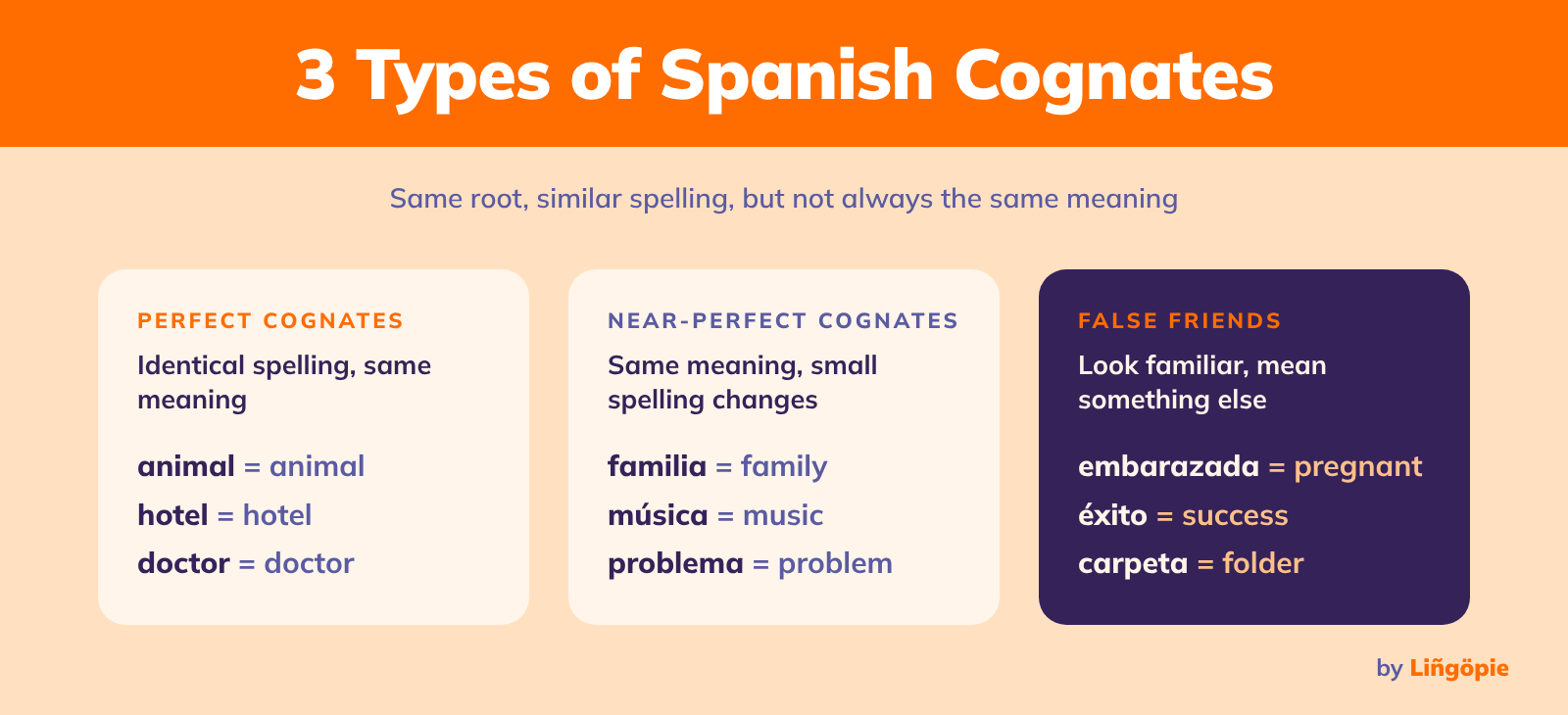
Spanish cognates are commonly grouped into perfect and near-perfect cognates based on their spelling similarities. You'll also encounter false friends, sometimes called false cognates, which look familiar but have different meanings. Understanding all three categories can help you recognise useful vocabulary without making incorrect assumptions.
Perfect Cognates
Perfect cognates have identical spellings and the same or very similar meanings in English and Spanish. However, they may sound different when spoken because each language has its own pronunciation rules.
Here are five common examples:
English | Spanish | Example sentence |
|---|---|---|
Animal | Animal | El animal está durmiendo. (The animal is sleeping.) |
Hotel | Hotel | Nuestro hotel está cerca de la playa. (Our hotel is near the beach.) |
Doctor | Doctor | El doctor trabaja en un hospital. (The doctor works in a hospital.) |
Actor | Actor | Mi hermano quiere ser actor. (My brother wants to be an actor.) |
Color | Color | Mi color favorito es el azul. (My favorite color is blue.) |
Near-Perfect Cognates
Near-perfect cognates share the same meaning but have small spelling differences between English and Spanish. These changes often follow recognizable patterns, such as adding a vowel, changing a word ending, or including a written accent.
For example, family becomes familia, while music becomes música. Once you start noticing these differences, you'll find it easier to recognize new Spanish words.
English | Spanish | Example sentence |
|---|---|---|
Family | Familia | Mi familia vive en Madrid. (My family lives in Madrid.) |
Music | Música | Escucho música todos los días. (I listen to music every day.) |
Problem | Problema | Tenemos un problema. (We have a problem.) |
Important | Importante | Esta reunión es importante. (This meeting is important.) |
Telephone | Teléfono | Perdí mi teléfono ayer. (I lost my phone yesterday.) |
False Cognates
False cognates, also called false friends, are words that look or sound similar in English and Spanish but have different meanings. These can be particularly confusing because you might assume you already know the translation.
For example, embarazada looks like "embarrassed," but it actually means "pregnant." Similarly, éxito means "success," not "exit."
Here are five false friends to watch out for:
English word it resembles | Spanish | Example sentence |
|---|---|---|
Embarrassed | Embarazada (pregnant) | Mi hermana está embarazada. (My sister is pregnant.) |
Exit | Éxito (success) | La película fue un éxito. (The movie was a success.) |
Actual | Actual (current) | Mi trabajo actual es interesante. (My current job is interesting.) |
Library | Librería (bookstore) | Compré un libro en la librería. (I bought a book at the bookstore.) |
Carpet | Carpeta (folder) | Guardé los documentos en una carpeta. (I put the documents in a folder.) |
These examples show why it's worth checking a word's meaning before using it. We'll look at more false friends and their correct translations later in this guide.
11 Spanish Cognate Spelling Patterns to Know
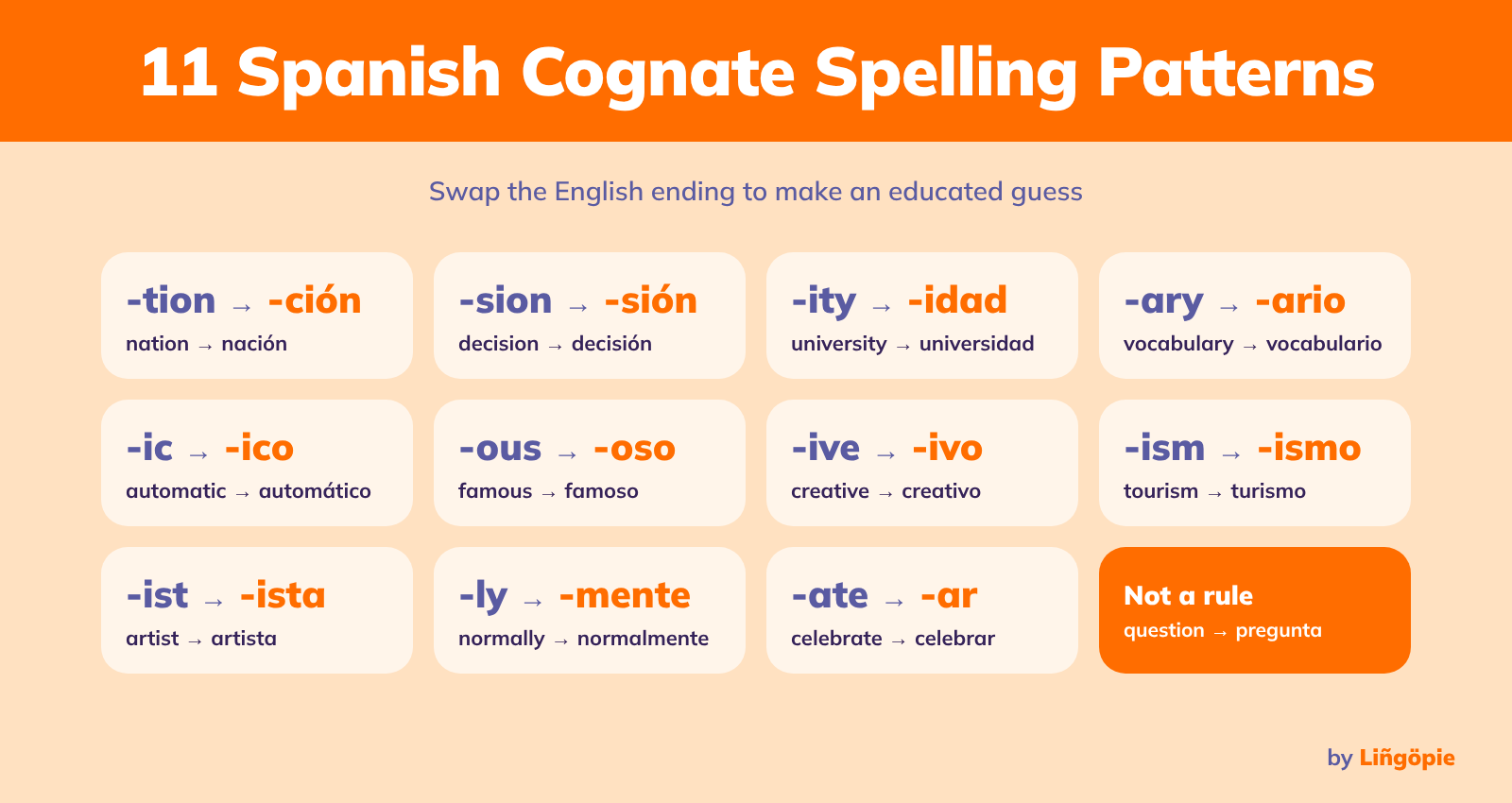
One of the easiest ways to understand Spanish cognates is to look at how English word endings change in Spanish. For example, English words ending in -tion often end in -ción in Spanish, as in nation → nación and education → educación.
However, note that these patterns aren't guaranteed rules. There's just here to help you make educated guesses about unfamiliar words. Here are 11 common spelling patterns, with examples you can start using to expand your Spanish vocabulary.
English -tion to Spanish -ción
Many English nouns ending in -tion have Spanish counterparts ending in -ción. The meaning usually stays the same, but the Spanish spelling includes an accent mark over the ó.
English | Spanish | Example sentence |
|---|---|---|
Nation | Nación | España es una nación europea. (Spain is a European nation.) |
Education | Educación | La educación es importante para todos. (Education is important for everyone.) |
Information | Información | Necesito más información sobre el curso. (I need more information about the course.) |
Celebration | Celebración | La celebración empieza a las ocho. (The celebration starts at eight.) |
Invitation | Invitación | Recibí una invitación a la fiesta. (I received an invitation to the party.) |
Exception: Not every -tion word follows this pattern. For example, question translates to pregunta.
English -sion to Spanish -sión
English nouns ending in -sion often have Spanish equivalents ending in -sión. You'll find this pattern in words related to decisions, discussions, and everyday activities.
English | Spanish | Example sentence |
|---|---|---|
Decision | Decisión | Tomé una decisión importante. (I made an important decision.) |
Television | Televisión | Vemos la televisión después de cenar. (We watch television after dinner.) |
Division | División | La división del trabajo fue justa. (The division of work was fair.) |
Revision | Revisión | El coche necesita una revisión. (The car needs an inspection.) |
Conclusion | Conclusión | Llegamos a la misma conclusión. (We reached the same conclusion.) |
English -ty to Spanish -idad
Many English nouns ending in -ity correspond to Spanish nouns ending in -idad. This pattern is particularly common in words describing qualities, activities, and abstract ideas.
English | Spanish | Example sentence |
|---|---|---|
University | Universidad | Mi hermana estudia en la universidad. (My sister studies at the university.) |
Activity | Actividad | Esta actividad es divertida. (This activity is fun.) |
Community | Comunidad | Nuestra comunidad organiza eventos cada mes. (Our community organizes events every month.) |
Reality | Realidad | Esa es la realidad de la situación. (That's the reality of the situation.) |
Personality | Personalidad | Tiene una personalidad muy alegre. (She has a very cheerful personality.) |
English -ary to Spanish -ario
Some English words ending in -ary have Spanish counterparts ending in -ario. This pattern appears in common nouns and adjectives related to education, work, and everyday life.
English | Spanish | Example sentence |
|---|---|---|
Vocabulary | Vocabulario | Quiero ampliar mi vocabulario en español. (I want to expand my Spanish vocabulary.) |
Dictionary | Diccionario | Busqué la palabra en el diccionario. (I looked up the word in the dictionary.) |
Necessary | Necesario | Es necesario llevar un pasaporte. (It's necessary to bring a passport.) |
Ordinary | Ordinario | Pensé que sería un día ordinario. (I thought it would be an ordinary day.) |
Anniversary | Aniversario | Hoy celebramos nuestro aniversario. (Today we're celebrating our anniversary.) |
English -ic to Spanish -ico
English adjectives ending in -ic often become -ico in Spanish. These words commonly describe people, places, objects, and academic concepts.
English | Spanish | Example sentence |
|---|---|---|
Automatic | Automático | Mi coche tiene un cambio automático. (My car has an automatic transmission.) |
Romantic | Romántico | Preparó una cena romántica. (He prepared a romantic dinner.) |
Fantastic | Fantástico | Tuvimos un viaje fantástico. (We had a fantastic trip.) |
Historic | Histórico | Visitamos un edificio histórico. (We visited a historic building.) |
Classic | Clásico | Es un ejemplo clásico. (It's a classic example.) |
English -ous to Spanish -oso
Many English adjectives ending in -ous have Spanish equivalents ending in -oso. These are especially useful when describing someone's personality, feelings, or experiences.
English | Spanish | Example sentence |
|---|---|---|
Famous | Famoso | Es un cantante famoso en España. (He's a famous singer in Spain.) |
Curious | Curioso | Mi hijo siempre hace preguntas porque es muy curioso. (My son always asks questions because he's very curious.) |
Nervous | Nervioso | Estoy nervioso por el examen de mañana. (I'm nervous about tomorrow's exam.) |
Delicious | Delicioso | Este pastel de chocolate está delicioso. (This chocolate cake is delicious.) |
Mysterious | Misterioso | Escuchamos un ruido misterioso anoche. (We heard a mysterious noise last night.) |
English -ive to Spanish -ivo
English adjectives ending in -ive often have Spanish counterparts ending in -ivo. You'll encounter these when describing attitudes, personalities, and characteristics.
English | Spanish | Example sentence |
|---|---|---|
Active | Activo | Mi abuelo sigue muy activo a los setenta años. (My grandfather is still very active at seventy.) |
Creative | Creativo | Mi hermana tiene un trabajo creativo. (My sister has a creative job.) |
Positive | Positivo | Intento mantener una actitud positiva. (I try to maintain a positive attitude.) |
Negative | Negativo | El resultado de la prueba fue negativo. (The test result was negative.) |
Attractive | Atractivo | Es un lugar atractivo para los turistas. (It's an attractive place for tourists.) |
English -ism to Spanish -ismo
English nouns ending in -ism often have Spanish equivalents ending in -ismo. This pattern is common in words related to beliefs, social movements, artistic styles, and activities.
English | Spanish | Example sentence |
|---|---|---|
Tourism | Turismo | El turismo es importante para la economía local. (Tourism is important for the local economy.) |
Realism | Realismo | Me gusta el realismo en el arte. (I like realism in art.) |
Capitalism | Capitalismo | Estudiamos el capitalismo en clase. (We study capitalism in class.) |
Optimism | Optimismo | Su optimismo ayuda a todo el equipo. (Her optimism helps the whole team.) |
Socialism | Socialismo | El profesor explicó la historia del socialismo. (The teacher explained the history of socialism.) |
English -ist to Spanish -ista
Many English words ending in -ist become -ista in Spanish. These usually describe professions, interests, or people associated with particular activities.
English | Spanish | Example sentence |
|---|---|---|
Artist | Artista | Mi amiga es artista y pinta retratos. (My friend is an artist and paints portraits.) |
Tourist | Turista | El turista pidió indicaciones para llegar al museo. (The tourist asked for directions to the museum.) |
Pianist | Pianista | Mi padre es pianista profesional. (My father is a professional pianist.) |
Dentist | Dentista | Tengo una cita con el dentista mañana. (I have a dentist appointment tomorrow.) |
Optimist | Optimista | Mi hermana es optimista incluso en momentos difíciles. (My sister is optimistic even during difficult times.) |
English -ly to Spanish -mente
Many English adverbs ending in -ly have Spanish counterparts ending in -mente. These words describe how, when, or in what manner something happens.
English | Spanish | Example sentence |
|---|---|---|
Normally | Normalmente | Normalmente desayuno a las siete. (I normally eat breakfast at seven.) |
Completely | Completamente | Estoy completamente de acuerdo contigo. (I completely agree with you.) |
Exactly | Exactamente | Eso es exactamente lo que quería decir. (That's exactly what I wanted to say.) |
Finally | Finalmente | Finalmente encontramos las llaves. (We finally found the keys.) |
Naturally | Naturalmente | Naturalmente, acepté la invitación. (Naturally, I accepted the invitation.) |
English -ate to Spanish -ar
Some English verbs ending in -ate have Spanish counterparts ending in -ar. Recognising this pattern can help you identify unfamiliar verbs, particularly those related to communication, technology, and everyday activities.
English | Spanish | Example sentence |
|---|---|---|
Activate | Activar | Necesito activar mi cuenta antes de entrar. (I need to activate my account before logging in.) |
Celebrate | Celebrar | Vamos a celebrar tu cumpleaños el sábado. (We're going to celebrate your birthday on Saturday.) |
Participate | Participar | Quiero participar en el concurso. (I want to participate in the contest.) |
Communicate | Comunicar | Es importante comunicar tus ideas con claridad. (It's important to communicate your ideas clearly.) |
Decorate | Decorar | Vamos a decorar la casa para Navidad. (We're going to decorate the house for Christmas.) |
20 Everyday Spanish Cognates You Can Use Today
Want to see how many Spanish words you already recognise? Take a look at these 20 everyday cognates and try guessing their meanings before checking the English translations. You might be surprised by how many you already know.
English | Spanish | Example sentence |
|---|---|---|
Restaurant | Restaurante | Comemos en un restaurante italiano. (We're eating at an Italian restaurant.) |
Chocolate | Chocolate | Me encanta el chocolate negro. (I love dark chocolate.) |
Tomato | Tomate | Necesito un tomate para la ensalada. (I need a tomato for the salad.) |
Banana | Banana | Como una banana cada mañana. (I eat a banana every morning.) |
Coffee | Café | ¿Quieres un café? (Would you like a coffee?) |
Taxi | Taxi | Vamos a tomar un taxi. (We're going to take a taxi.) |
Passport | Pasaporte | No olvides tu pasaporte. (Don't forget your passport.) |
Map | Mapa | Necesitamos un mapa de la ciudad. (We need a map of the city.) |
Museum | Museo | El museo cierra a las seis. (The museum closes at six.) |
Center | Centro | Vivo cerca del centro. (I live near the city center.) |
Office | Oficina | Trabajo en una oficina pequeña. (I work in a small office.) |
Class | Clase | Mi clase empieza a las nueve. (My class starts at nine.) |
Idea | Idea | Tengo una idea para el proyecto. (I have an idea for the project.) |
Interesting | Interesante | Este libro es muy interesante. (This book is very interesting.) |
Moment | Momento | Espera un momento, por favor. (Wait a moment, please.) |
Accident | Accidente | Hubo un accidente en la carretera. (There was an accident on the road.) |
Energy | Energía | Hoy tengo mucha energía. (I have a lot of energy today.) |
Special | Especial | Hoy es un día especial. (Today is a special day.) |
Popular | Popular | Este restaurante es muy popular. (This restaurant is very popular.) |
Simple | Simple | La respuesta es simple. (The answer is simple.) |
Try reading the Spanish sentences without looking at their English translations first. See how much you can understand using the cognates and surrounding words as clues. Then check the translations to see whether your guesses were correct.
False Friends: Spanish Words That Don't Mean What You Think
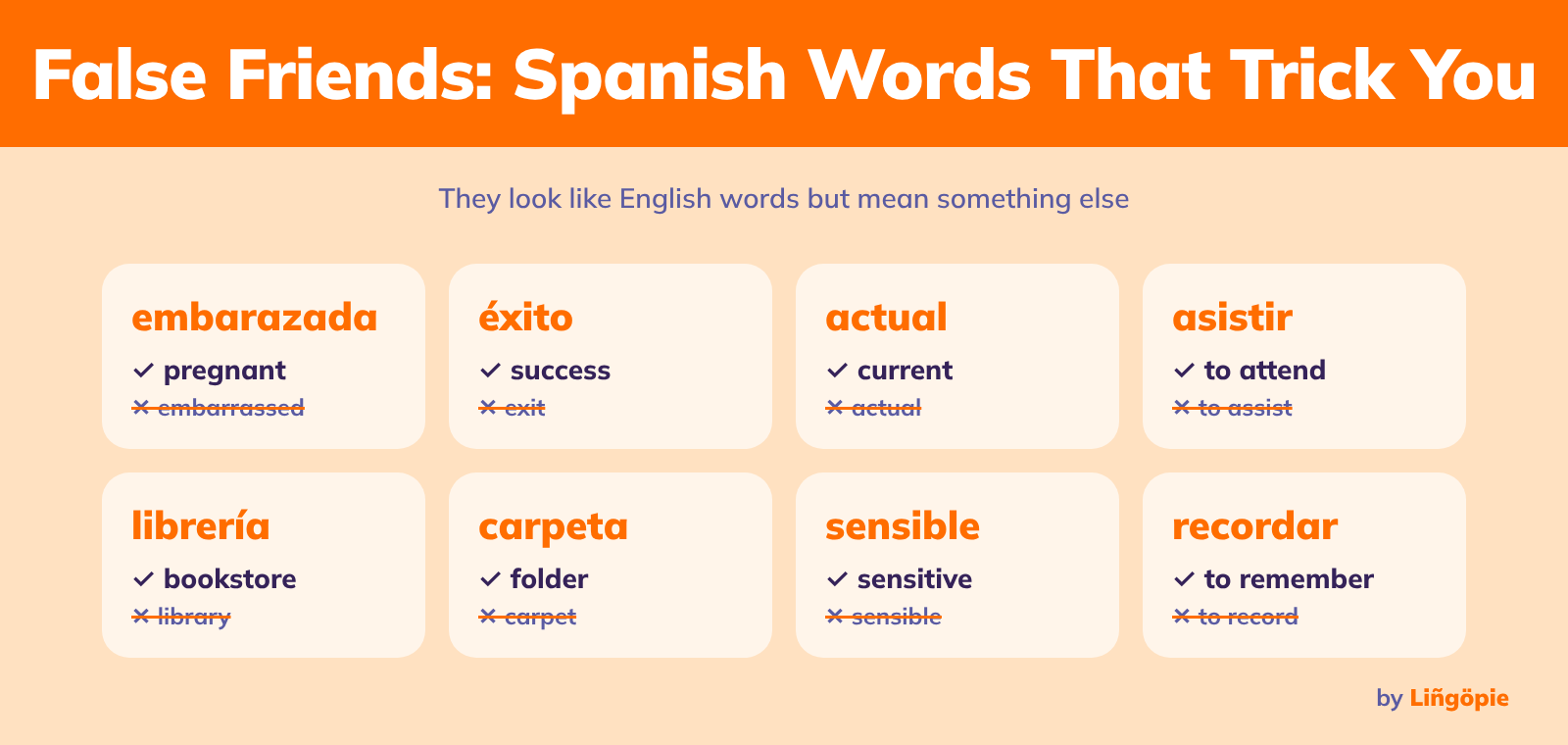
Some Spanish words can catch you off guard, especially when their spelling makes you think you already know the meaning. Take a look at these 12 common false friends and their correct translations to avoid mixing them up in conversation.
Spanish word | What it actually means | Common mistake |
|---|---|---|
Embarazada | Pregnant | Embarrassed (avergonzado/a) |
Éxito | Success | Exit (salida) |
Actual | Current, present | Actual (real) |
Asistir | To attend | To assist (ayudar) |
Librería | Bookstore | Library (biblioteca) |
Carpeta | Folder | Carpet (alfombra) |
Sensible | Sensitive | Sensible (sensato/a) |
Constipado | Having a cold (especially in Spain) | Constipated (estreñido/a) |
Realizar | To carry out, accomplish | To realize or become aware (darse cuenta) |
Molestar | To bother, annoy | To molest (acosar, depending on context) |
Ropa | Clothes | Rope (cuerda) |
Recordar | To remember | To record (grabar) |
Same Spelling, Different Sound: Pronouncing Spanish Cognates
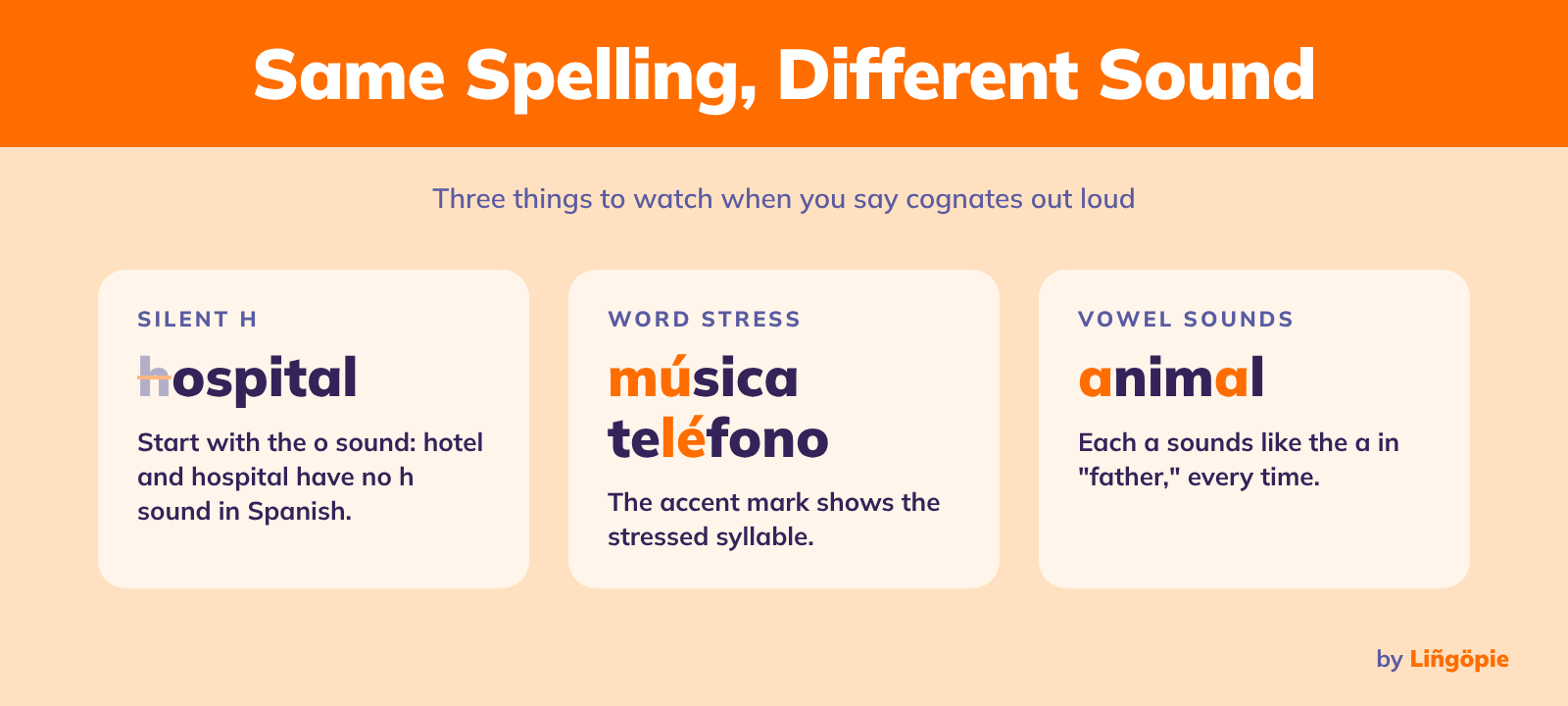
Spanish cognates may look familiar, but they don't always sound like their English counterparts. Differences in silent letters, word stress, and vowel sounds can change how you pronounce them. Here are a few examples to help you get them right.
Pronunciation rule | Spanish cognate | What to remember |
|---|---|---|
Silent H | Hospital | The h is silent, so the word begins with an o sound. |
Silent H | Hotel | Unlike in English, you don't pronounce the initial h. |
Word stress | Música (music) | The accent mark shows that the first syllable (mú) is stressed. |
Word stress | Teléfono (telephone) | Stress the second syllable (lé), as indicated by the accent mark. |
Vowel sounds | Animal | The Spanish a sounds like the a in “father,” not the English a in “animal.” |
Vowel sounds | Doctor | The Spanish o has a more consistent vowel sound than the English o, which varies by accent. |
You can listen to these words using SpanishDictionary's pronunciation tool and practice saying them aloud to get comfortable with the differences.
How to Use Cognates to Learn Spanish Faster
The best way to learn Spanish cognates is to start recognising them in context. Pay attention to familiar spelling patterns when reading, try using new words in sentences, and check their meanings to avoid confusing false friends. The more often you encounter these words, the easier they'll become to remember.
Want to hear how native speakers actually use them? With Lingopie, you can watch Spanish TV shows and movies with interactive subtitles that let you check unfamiliar words and save them as flashcards. Start watching and see how many Spanish cognates you can recognise in real conversations.
Frequently Asked Questions About Spanish Cognates
What are Spanish cognates?
Spanish cognates are words that share a common origin with English words and have similar meanings and spellings. For example, animal, hospital, and información closely resemble their English equivalents.
How many cognates do Spanish and English share?
Spanish and English share thousands of cognates, although there's no universally agreed exact number. According to Colorín Colorado, approximately 30–40% of English words have a related word in Spanish.
What is the difference between perfect and near-perfect cognates?
Perfect cognates have identical spellings and similar meanings, such as animal and hotel. Near-perfect cognates have similar meanings but slightly different spellings, such as family → familia and music → música.
What are false cognates in Spanish?
False cognates, often called false friends, are words that resemble English words but have different meanings. For example, embarazada means “pregnant,” not “embarrassed,” while éxito means “success,” not “exit.”
Are Spanish cognates pronounced the same as in English?
No. Even identically spelled cognates can sound different because Spanish has its own pronunciation rules. For example, the h in hospital is silent in Spanish, and Spanish vowels are generally pronounced more consistently than English vowels.
Do cognates really help you learn Spanish faster?
Yes. Cognates can make unfamiliar Spanish words easier to recognise and remember because you can connect them to English words you already know. However, you'll still need to practise pronunciation, grammar, and using the words in context to communicate confidently.