
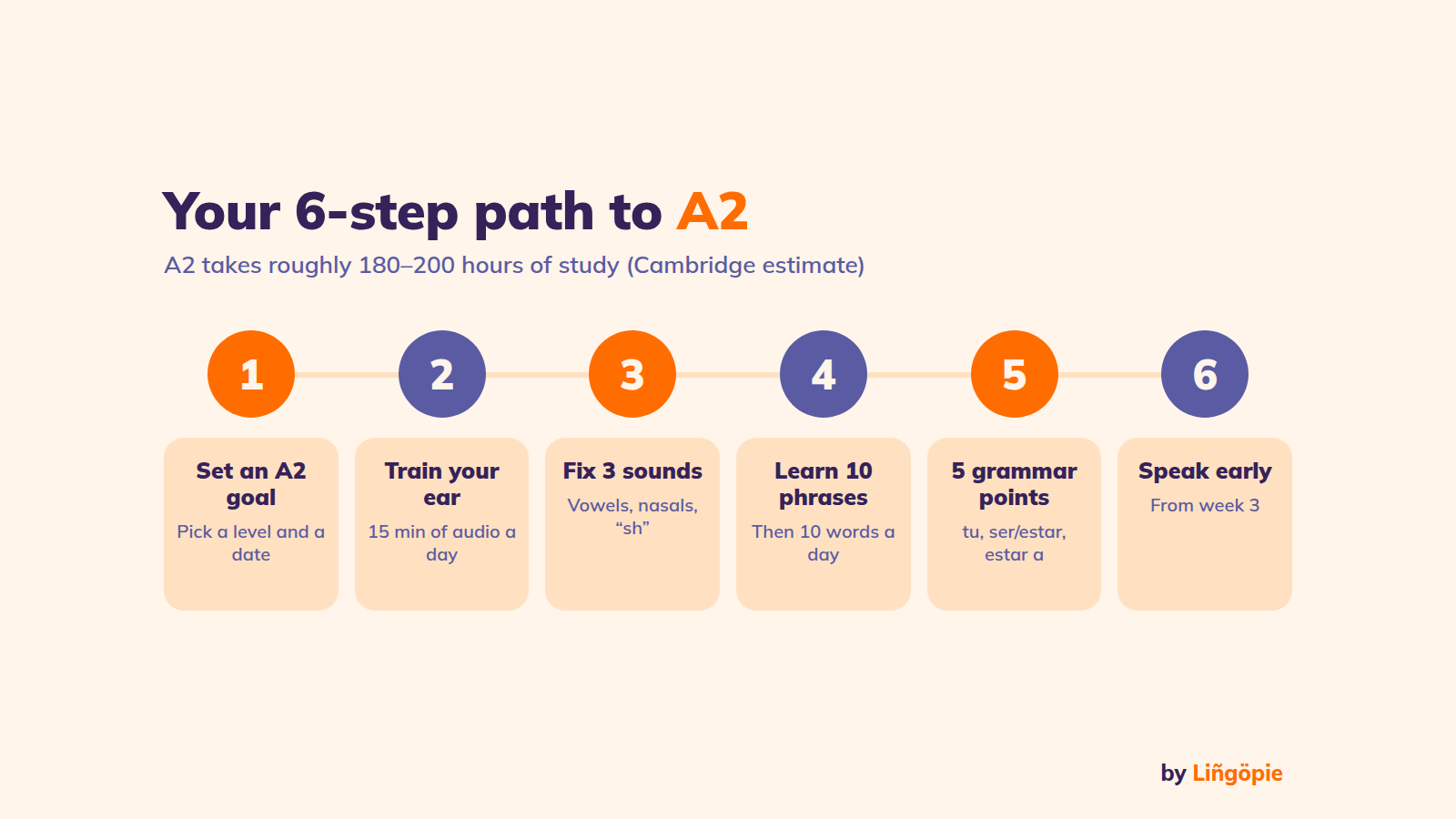
Here is how to learn European Portuguese. Set an A2 goal. Train your ear with audio from Portugal. Then work on sounds, basic phrases, grammar and speaking, in that order.Plan on roughly 180–200 hours of study to reach A2, based on Cambridge estimates. Professional working level takes far longer: the U.S. Foreign Service Institute puts it at 600–750 class hours.
Use materials made for Portugal. Many popular courses teach Brazilian Portuguese, and the two varieties are not the same. Maybe you want to learn Portuguese for a move to Lisbon, for citizenship or for regular trips. Starting with the European variety saves you from relearning sounds and words later. It also lets you speak Portuguese with people in Portugal in a way they will recognise.
This guide has six steps, three tables, four infographicsand a short list of resources. Everything is in the Portuguese spoken in Lisbon, Porto and the rest of Portugal.

Key Takeaways
- European and Brazilian Portuguese differ in sounds, grammar and words. Pick European materials from day one.
- A2 is a good first goal. It covers daily life and is still the language level required for Portuguese citizenship under the 2026 nationality law.
- Start with listening. European Portuguese drops many vowels, and your ear needs time to adjust.
- Learn ten core phrases and the tu forms before you tackle long verb tables.
- Speak early, with tutors or exchange partners from Portugal.
European vs. Brazilian Portuguese: What’s Different
The two varieties share one writing system. Most of the grammar is the same too. But they sound different, and they often use different words.
If you study one and talk to speakers of the other, you will understand a lot. You will also be surprised within the first minute.
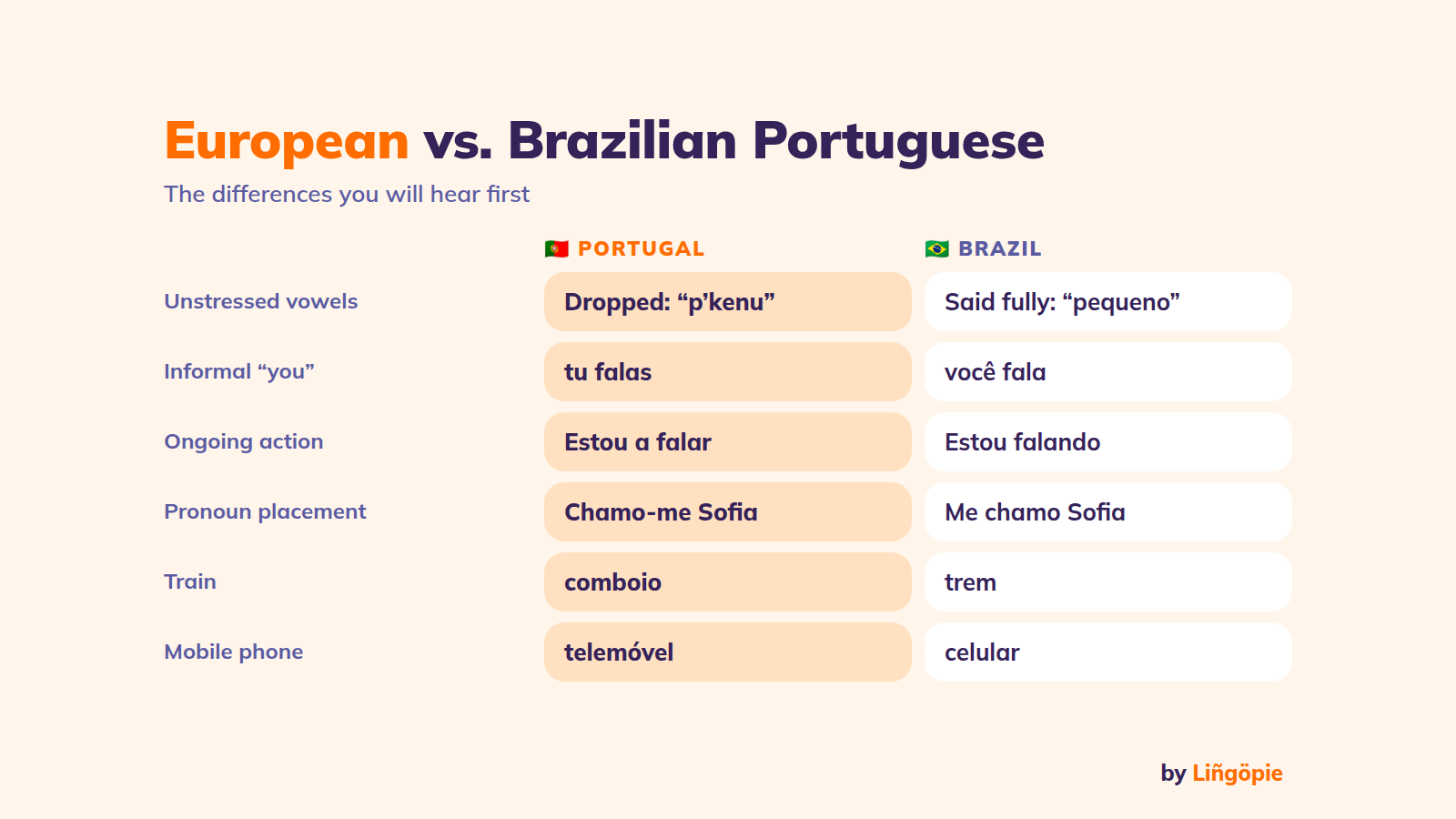
The table shows the differences you will meet first.
Feature | European Portuguese | Brazilian Portuguese |
|---|---|---|
Unstressed vowels | Often dropped or reduced: pequeno sounds close to “p’kenu” | Said more fully |
Informal “you” | tu falas | você fala |
Ongoing actions | Estou a falar | Estou falando |
Pronoun placement | Chamo-me Sofia | Me chamo Sofia |
Train | comboio | trem |
Bus | autocarro | ônibus |
Breakfast | pequeno-almoço | café da manhã |
Mobile phone | telemóvel | celular |
The first row matters most. Unstressed vowels shrink in Portugal. A word like obrigado can sound like a short burst of consonants. That is why Step 2 starts with listening, not grammar.
Pick one variety and stay with it. Mixing both in your lessons and flashcards is confusing. It also confuses your tutor.
Think about where you will use the language. Maybe you plan to live in Portugal, apply for citizenship or travel there often. Then European Portuguese is the clear choice. A Brazilian course is not a waste of time, because much of the grammar carries over. But you will have to retrain your ear and swap many words later.
Step 1: Set Your Goal and Timeline
Many people learn Portuguese with no clear target, and they lose motivation. A goal keeps you going. Choose a level and a date before you open a textbook.For most beginners, A2 on the CEFR (the Common European Framework of Reference, a six-level scale from A1 to C2) is the right first target.At A2 you can order food, ask for directions and introduce yourself. You can follow slow, simple conversations. You can also say what you did yesterday in short sentences. You will not follow the news yet, and that is fine. It is a first real step to speak Portuguese with confidence.
A2 is still the language level required for Portuguese nationality under the 2026 nationality law (Lei Orgânica n.º 1/2026), which also added a test of civic knowledge. Applicants usually prove A2 with the CIPLE exam or a certified PLA language course.CAPLE, the University of Lisbon centre that runs the exam, publishes the format and dates.
For the long view, use a published benchmark. According to the U.S. Foreign Service Institute, Portuguese is a Category I language.English speakers need about 600–750 class hours to reach professional working level. That equals 24–30 weeks only at a full-time pace of about 25 class hours a week. For A2, Cambridge estimates roughly 180–200 guided learning hours from zero.A2 is an early stop on that road, not the end.
Now turn the goal into a schedule.Start with a 12-week first block: 30 minutes a day, five days a week, or 30 hours in total. That builds a solid A1 foundation. To reach A2 in about nine months, work up to an hour a day, five days a week.Add three checkpointsfor the first block:
- Week 2: ten phrases.
- Week 6: 300 words.
- Week 12: a five-minute conversation.
Next, write your own A2 checklist. List six or seven tasks, such as buying a train ticket, ordering a meal or saying what you did yesterday. Tick them off as you go. A visible list shows your progress and tells you what to practise next.
Step 2: Train Your Ear First
European Portuguese is hard to understand at first. Speakers compress it. Vowels shrink and words run together. The rhythm sounds like a stream of consonants. Spanish, by comparison, has clear syllables.
Your ear needs time to separate the words. So listen before you study grammar.Daily practice beats one long weekly session. A review of 317 experiments found that spreading study out improves long-term recall compared with cramming(Cepeda et al., 2006). Do not worry if you understand little at first. That is normal in the first weeks.
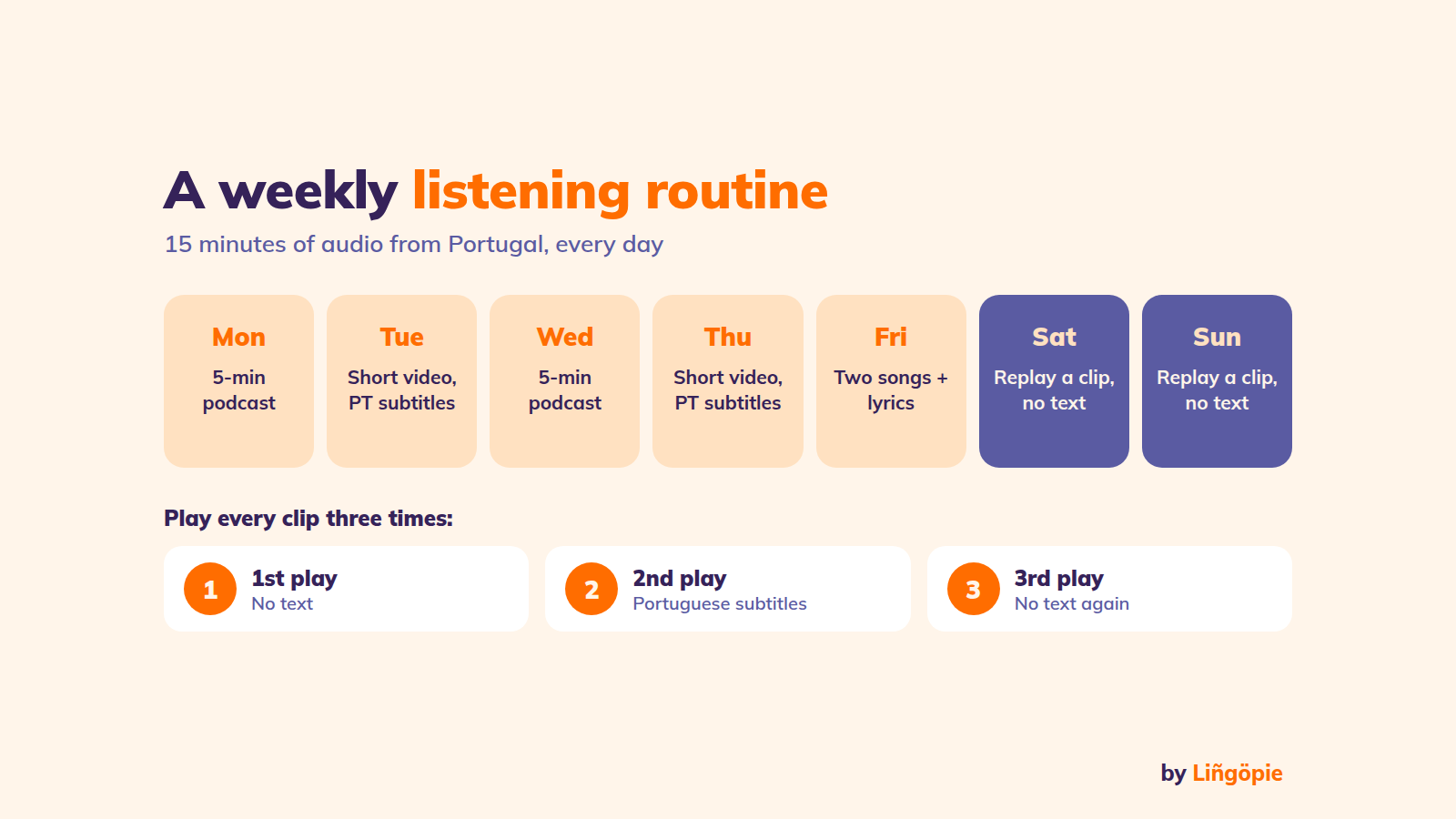
Aim for 15 minutes of audio a day. Use radio, podcasts, shows and music from Portugal. Play each clip three times:
- Once with no text.
- Once with Portuguese subtitles.
- Once more with no text.
You will catch more with every pass. You will also start to notice the short, fast words that carry most conversations: de, que, não and pois.
Real speech also shows you a speed that slow course audio can't.I stood in a street in Lisbon and listened to everyday conversations. I realised how clipped está bem and pois sound. They come out as quick, soft bursts. They look nothing like they do on the page.
Pick content that shows how people in Portugal actually joke, argue and celebrate.It keeps you motivated. Try a fado song, a football commentary, a comedy podcast or a series set in Lisbon or Porto. Choose clips of 2–5 minutes with a transcript. Then you can check what you missed.
Here is a simple weekly routine:
- Monday and Wednesday: one 5-minute podcast episode.
- Tuesday and Thursday: a short video with Portuguese subtitles.
- Friday: two songs, with the lyrics.
- Weekend: replay your favourite clip with no text.
- Write down three new words per session. Step 4 will use them.
Step 3: Get the Pronunciation Right
Three sound patterns do most of the work in European Portuguese. Learn them early. You will be easier to understand, and you will understand more.
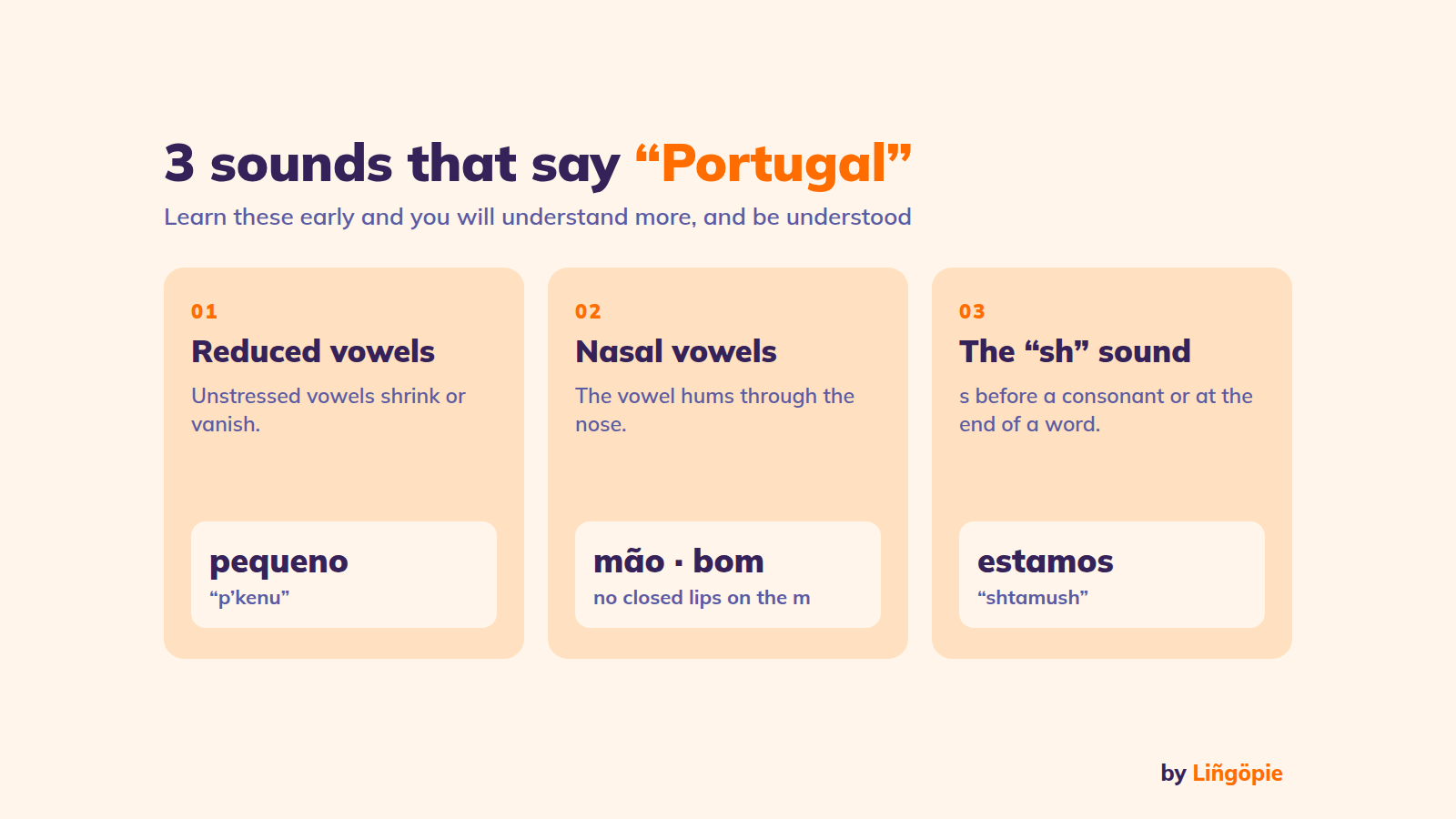
Reduced vowels. Unstressed vowels get weak or disappear. Say the stressed syllable clearly and let the rest fade. Pequeno becomes close to “p’kenu”.Telemóvel loses its first two vowels and sounds close to “t’l’móvel”.
Nasal vowels. Some vowels resonate through the nose, as in mão (hand) and bom (good). In bom, you do not close your lips on the m. The vowel itself is nasal.
The “sh” sound. An s before a consonant or at the end of a word sounds like “sh”. Português ends in “sh”.Estamos sounds close to “shtamush”. Before a voiced consonant such as m or d, it softens to “zh”: mesmo sounds close to “mezhmu”. Most Brazilian accents keep a plain “s” here, but Rio de Janeiro uses “sh” too, so don't rely on this sound alone to tell the two apart.
Good pronunciation does not mean losing your accent. It means being easy to understand. Practise with five words a day. Record yourself. Play the original audio and compare. If you cannot hear the vowels, slow the audio to 0.75x. Then go back to normal speed.
There is one more difference. In Brazilian Portuguese, t and d before an i often turn soft. Dia sounds like “jia”. In Portugal, they stay hard. Dia sounds close to “dee-a”. If you learned from Brazilian videos, this is a habit worth fixing early.
Step 4: Learn Basic Phrases and Core Vocabulary
Start with ten phrases you can use in a first real conversation. Say each one aloud. Spend five minutes a day on the table. Cover the meaning, say the phrase, then check yourself.
Phrase | Meaning |
|---|---|
Olá | Hello |
Bom dia | Good morning |
Como estás? | How are you? (informal) |
Muito prazer | Nice to meet you |
Chamo-me Sofia | My name is Sofia |
Não percebo | I don’t understand |
Pode repetir, por favor? | Can you repeat, please? |
Uma bica, por favor | An espresso, please (Lisbon) |
A conta, por favor | The bill, please |
Obrigado / Obrigada | Thank you (said by a man / a woman) |
I heard several of these phrases while visiting a friend in Porto. One detail surprised me. In Porto, an espresso is a cimbalino. In Lisbon, you ask for a bica. Regional words like this are normal. They are a good reason to listen to real speakers.
Next, build your Portuguese vocabulary from words you have already heard. Words you have heard are easier to remember. Aim for 10 new words a day. Take them from the clips in Step 2.Put them in a flashcard app that schedules reviews around your brain's forgetting curve (spaced repetition).The app shows each card again just before you are likely to forget it.
Review your cards every day. Five minutes is enough. Check that each card uses European spelling and words. Write comboio, not trem.After 300 words, you can handle greetings, orders and simple questions. Keep adding words after week 12; A2 conversations need more.
Step 5: Learn the Grammar That Matters First
Do not try to learn all the Portuguese grammar at once. It can look heavy at first. Five points give you the most for your time.
- Present tense. Start with regular verbs: falar (eu falo, tu falas), comer (eu como, tu comes) and abrir (eu abro, tu abres).
- Ser vs. estar. Ser is for identity and lasting traits: Sou francesa, Ele é simpático. Estar is for states and places: Estou cansada, Estamos em Lisboa.
- Tu forms. Learn the informal tu early. Friends, classmates and younger people use it in Portugal. Use o senhor or a senhora in formal situations.Avoid você with people you don't know well; it can sound blunt in Portugal. Many speakers use the person's name or title instead: O Pedro quer um café?
- Estar a + infinitive. For actions in progress, say Estou a estudar (I am studying). Do not say the Brazilian estou estudando.
- Pronoun placement. In most sentences, the pronoun follows the verb with a hyphen: Chamo-me Ana, Vejo-te amanhã. After words like não, it moves before the verb: Não me esqueço.
Practise each point with five spoken sentences. Then move on. Here is a short exchange that uses most of them:
- Olá, como estás?
- Estou bem, obrigada. E tu?
- Estou cansado, mas estou a trabalhar. Como te chamas?
- Chamo-me Sofia. Prazer!
Read it aloud three times. Then change the details to fit your own life.
A reference book helps. But sentences you say aloud teach you more than rules alone. If your Portuguese grammar feels slow, go back to your Step 2 audio. Listen for these five patterns in real speech. You will hear them more often than you expect.
Step 6: Speak With Native Speakers
Start speaking by week 3, even with only ten phrases. You will make mistakes at first. That is part of the process. Many learners wait until they feel ready. That makes the first conversation feel bigger than it is.Most people you practise with will slow down if you ask. Regular speaking practice is what makes conversations start to feel easier.
You have three good options:
- A tutor from Portugal. A tutor corrects your sounds and grammar in real time. Book two 30-minute lessons a week. Send your tutor a list of topics beforehand.
- A language exchange app.Tandem and HelloTalk match you with native speakers who want to learn your language.Filter for partners from Portugal. Ask them to use European words like telemóvel and autocarro. A language exchange app is free to start, so it suits a small budget.
- Shadowing. Play a 30-second clip. Repeat each sentence half a second after the speaker. Copy the rhythm and the “sh” sounds. Ten minutes a day is enough.
Whichever option you choose, ask for one type of correction per session. For example, ask for help with pronunciation or with verb endings. Too many corrections at once make you stop talking.
Prepare a script for your first session. Include your name, where you live, why you are learning and two questions to ask. Six to eight sentences are enough for 10 minutes. A script lowers the stress of starting. After the session, write down five new words or corrections. Add them to your flashcards.
Best Resources for European Portuguese
Use only resources that teach the variety from Portugal. The table lists six options. Each one offers European Portuguese, based on its own course pages as of October 2026. Check the current course list before you pay.
Resource | Type | Free / paid | Best for |
|---|---|---|---|
Practice Portuguese | Courses and podcast | Free and paid | Beginners who want explanations in English |
Pimsleur | Audio course | Paid | 30-minute audio lessons that get you speaking aloud |
Drops | Vocabulary app | Free and paid | Learning words in short sessions |
RTP Play | Portuguese TV and radio | Free | Listening to real European Portuguese (some shows are geo-blocked outside Portugal) |
Lingopie | Shows with interactive subtitles | Paid | Watching shows with clickable subtitles; the catalog mixes Brazilian and European titles, so pick ones from Portugal (as of October 2026) |
italki | Tutor marketplace | Paid per lesson | Speaking with tutors from Portugal |
If you want structured European Portuguese lessons, you can start with Practice Portuguese or Pimsleur. Add a tutor on italki for feedback. For lighter European Portuguese lessons, use Drops for words and RTP Play for listening.
Free options are enough to start. Pay for a course or a tutor only when you find a gap.
A balanced week mixes three things. Do two listening sessions on RTP Play. Do three short vocabulary sessions. Have one or two conversations with a tutor or exchange partner.That fits inside the 30-minutes-a-day plan from Step 1 and is enough to reach its 12-week checkpoints.
Common Mistakes to Avoid
Using Brazilian courses by accident. Duolingo’s Portuguese course teaches Brazilian Portuguese,as of October 2026. It is a fine next step once you have a base in the European variety. It is not the best starting point. Check the language label before you begin any course.
Relying on Spanish. Spanish helps you read Portuguese. It helps much less with hearing it. European Portuguese reduces vowels in ways Spanish does not. You may know a word on paper and still not recognise it aloud.
Skipping listening. If you go straight to grammar tables, you will struggle to follow answers in a conversation. Keep 15 minutes of listening practice in every study session.
Learning words alone. A word in a sentence is easier to remember than a word on a list. Write each new word inside a short sentence. For example: O comboio está atrasado (The train is late).
Studying in rare, long sessions. One two-hour session on Sunday works less well than five sessions of 25 minutes. Short, frequent practice gives your memory more chances to recall each word(see the study in Step 2). It is also easier to fit around a job.
FAQ
What’s the difference between European and Brazilian Portuguese?
The main differences are sound, grammar and vocabulary. European Portuguese reduces unstressed vowels, uses tu often and says estou a falar. Pronouns usually follow the verb. Brazilian Portuguese says the vowels more fully and usesvocê andestou falando. Words like comboio and trem also differ.
How long does it take to learn European Portuguese?
Plan on roughly 180–200 hours of study to reach A2, based on Cambridge estimates; at an hour a day, five days a week, that is about nine months. Professional working level takes about 600–750 class hours, according to the U.S. Foreign Service Institute. Thirty minutes a day for 12 weeks builds a solid A1 foundation.
Can I learn European Portuguese for free?
Yes, you can reach a solid beginner level for free. RTP Play offers free listening. Practice Portuguese has free podcast episodes. Exchange apps give you free speaking partners. Paid tutors and structured courses speed things up, but you do not need them.
What’s the best app to learn European Portuguese?
No single app does everything. Drops is useful for words. Pimsleur is good for audio and speaking. An exchange app is best for conversation. Choose the one that fixes your weakest skill. Confirm that its course says Portuguese from Portugal, not just “Portuguese”.
Is European Portuguese harder than Brazilian Portuguese?
For most English speakers, European Portuguese is harder to understand at first. The reason is vowel reduction and fast speech. Grammar and spelling are very similar in both varieties. Plenty of listening in the first month is the best fix. Comprehension usually improves quickly after that.
Can I learn European Portuguese if I already speak Spanish?
Yes. Spanish gives you a head start in reading and vocabulary, because many words are close. Listening and speaking take more work. European Portuguese has nasal vowels, the “sh” sound and reduced vowels that Spanish lacks. Treat it as a new language when you practise.
Conclusion: Start With Seven Days of Listening
Here is the short version of how to learn European Portuguese. Pick A2 as your target. Listen every day. Speak early, and make speaking practice a weekly habit.
To keep training your ear with real conversations, try Lingopie. You watch TV series with clickable subtitles, so you can tap any word you don't know and save it to your flashcards. Research on captions with built-in word translations found that learners recalled more than twice as many word meanings as with standard captions (Montero Perez, Peters & Desmet, 2018). The Portuguese catalog mixes Brazilian and European titles, so pick the shows from Portugal.
To keep training your ear with real conversations, try Lingopie. You watch TV series with clickable subtitles, so you can tap any word you don't know and save it to your flashcards. The Portuguese catalog mixes Brazilian and European titles, so pick the shows from Portugal.