
So, you're learning a language? Good for you! Now comes the fun part: figuring out how you actually want to learn it. If you'd rather spend less time staring at textbooks and more time watching something you enjoy, FluentU vs Lingopie is a comparison worth making.
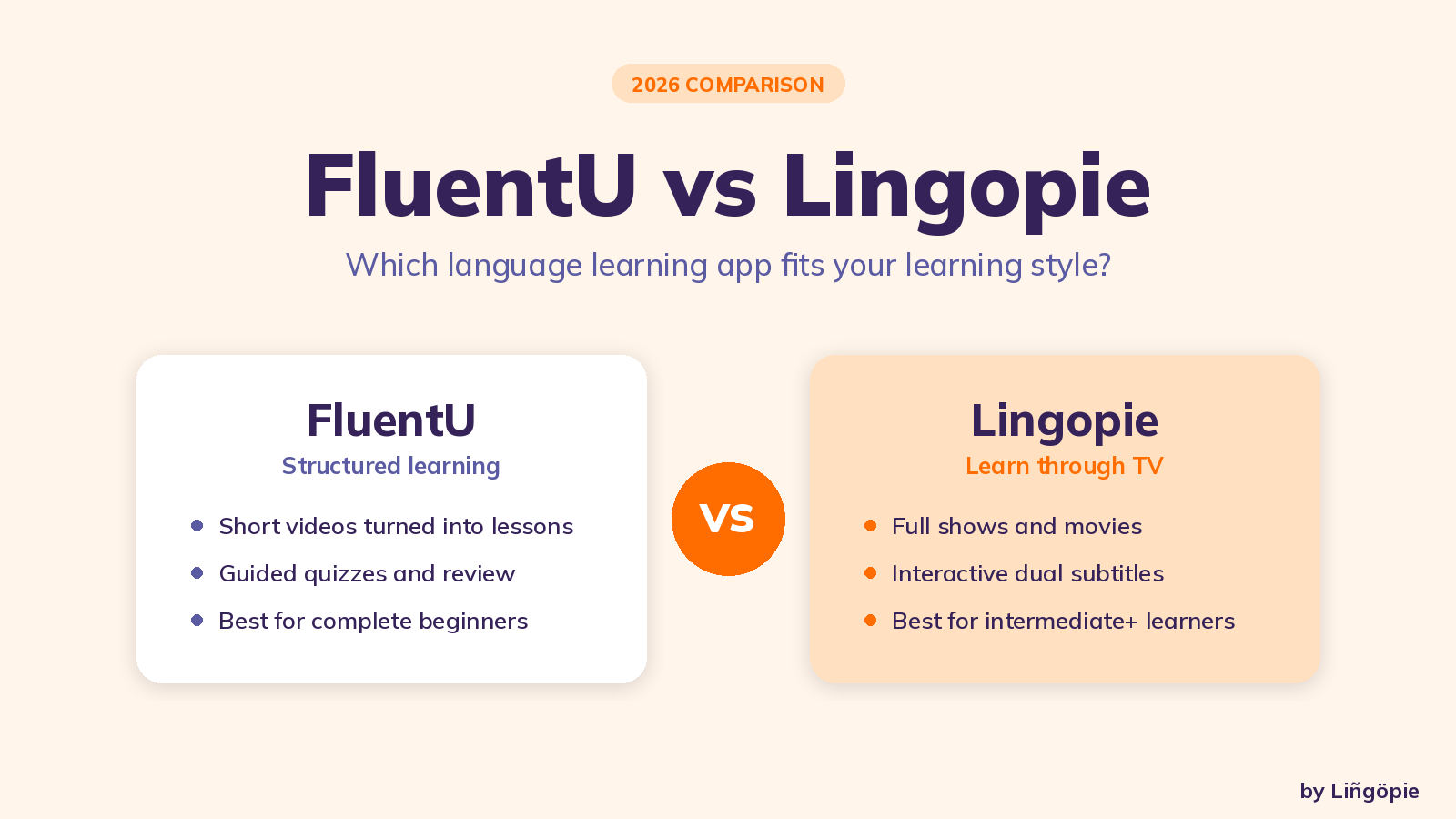
Both use authentic video content to teach a new language, but the experience feels surprisingly different. FluentU turns shorter videos into structured lessons with vocabulary review and quizzes. Lingopie takes the more immersive route, letting you learn through TV shows and movies with interactive subtitles and built-in learning tools.
Below, we compare them across eight categories so you can see which one fits the way you actually like to learn.
Key Takeaways
- Lingopie is built for entertainment-driven immersion, turning full-length shows and movies into lessons with interactive subtitles, grammar support, and vocabulary tools.
- FluentU is better for structured learning, especially if you prefer bite-sized videos, guided vocabulary practice, and a clearer learning progression.
- Lingopie has the edge for learners who struggle to stay interested in traditional language apps, while FluentU may feel more comfortable for beginners who want more guidance.
How We Compared
We used both apps for1week while learning Spanish on web and iOS. We scored them on eight criteria: content library, learning tools, grammar, vocabulary, speaking, learner level, pricing, and platforms. Prices, free trials, and plan details were checked on each official site on October, 2026.
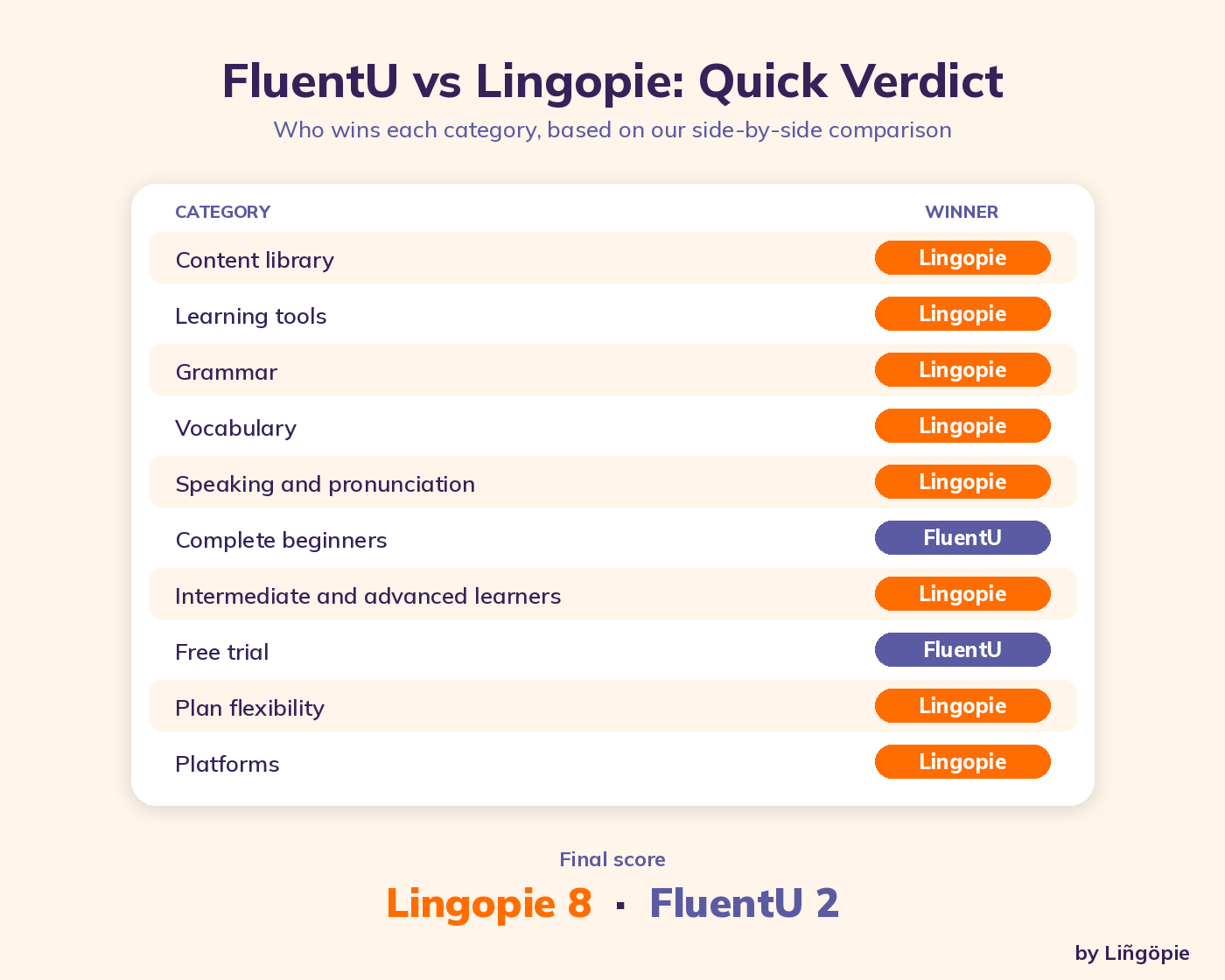
Quick Verdict
Category | Winner |
|---|---|
Content library | Lingopie |
Learning tools | Lingopie |
Grammar | Lingopie |
Vocabulary | Lingopie |
Speaking and pronunciation | Lingopie |
Complete beginners | FluentU |
Intermediate and advanced learners | Lingopie |
Free trial | FluentU |
Plan flexibility | Lingopie |
Platforms | Lingopie |
What Is FluentU?
According to FluentU's About page, the platform was founded by Alan Park in 2011.FluentU is a video-based language learning program built around authentic content. Park came up with the idea after learning Chinese, Japanese, and Korean and wanting something more engaging than conventional study methods.
Today, FluentU turns real-world videos, from music videos and movie trailers to news and talks, into structured lessons with interactive captions, vocabulary tools, quizzes, and spaced repetition. It's like a "video textbook" where you still get the structure of a traditional learning program while using video for the context.
What Is Lingopie?
Lingopie takes almost the opposite approach: start with entertainment, then build the learning tools into it. Launched in 2019, the platform grew from the idea that watching local TV in your target language could turn binge-watching into genuine study time. Today, it offers 5,000+ shows, podcasts, and books across 17 languages, is used by 2M+ learners, and is rated 4.8/5 on Trustpilot.
Its approach, often called Binge Learning, uses real TV shows, movies, and other native-language content alongside interactive subtitles, flashcards, quizzes, and grammar tools. Instead of making entertainment fit around a lesson, the Lingopie program makes the show itself the lesson.
How Do FluentU and Lingopie Compare?
Choosing between FluentU and Lingopie can be tricky because they sit in the same corner of language learning: both are video-based language immersion platforms that use authentic content to bring your target language into context. At first glance, they can even seem like two versions of the same idea.
Spend some time with them, though, and the key differences become much clearer. FluentU adds more structure around shorter videos and guided learning activities, while Lingopie puts immersion first for language learners and builds its learning tools around shows, movies, and other content you actually want to watch. Which approach ultimately works better comes down to your learning style, goals, and preferences.
Let's put them side by side where it actually matters.
Content Libraries and Authenticity
Both FluentU and Lingopie use authentic content, so neither is going to trap you in endless scripted dialogues about ordering coffee. The bigger difference is how each platform organizes that content around learning.
Content | FluentU | Lingopie |
|---|---|---|
Curated video library | Movie clips, music videos, news, talks, commercials, and other real-world videos | TV shows, movies, cartoons, news, and other video content |
Long-form entertainment | Available beyond its curated library through supported video integrations | A core part of the platform, with full TV shows and movies |
Audio and reading | Primarily video-focused | Podcasts, audiobooks, and short stories |
Content discovery | Curated videos organized to make authentic content accessible across levels | Entertainment-led browsing with content for beginner, intermediate, and advanced learners |
Beyond the native library | Browser tools expand what you can learn from online | Lingopie Extension brings its learning tools to compatible online video |
FluentU's strength is curation. Its library pulls together different kinds of real-world video content, from music videos and movie clips to news and talks, so you can jump between topics without having to commit to a full episode. Its content is also designed to make authentic videos approachable at different learning levels.
Lingopie focuses more heavily on entertainment you can settle into.Its library of 5,000+ shows, podcasts, and books includes full TV shows and movies, alongside audiobooks, short stories, cartoons, and news.That means you can spend more time following the same characters, voices, and storylines instead of moving from one unrelated clip to another.
There's another advantage if you exhaust Lingopie's catalog or simply want more choice. The Lingopie Extension expands the experience beyond the platform's own library by adding learning tools to compatible videos you watch online. You can click words and phrases for translations and save new vocabulary to your Lingopie account for later review.
👑 Winner: Lingopie gets our vote for immersion because following actual shows and stories gives you more time with recurring voices, expressions, slang, and context rather than constantly starting over with a new clip.
Learning Tools and Features
Watching authentic content is one thing. Understanding what everyone just said at full speed is another. Fortunately, bothplatformsuse interactive subtitles, so you can click unfamiliar words instead of pausing every few seconds to search for them elsewhere. But once again, they approach the learning process differently.
Learning tool | FluentU | Lingopie |
|---|---|---|
Interactive subtitles | Click words for definitions, examples, and learning support | Click words and phrases for translations plus detailed explanations |
Subtitle approach | Interactive captions built around each video | Dual subtitles for following the target and native languages together |
Playback | Replay sections and control videos while studying | Adjust playback speed from 0.5x to 1.0x, skip back, and replay difficult dialogue |
Comprehension | Videos feed into guided learning activities and quizzes | Practice Comprehension lets you revisit dialogue without relying as heavily on translations |
Learning style | More guided and lesson-like | More exploratory and immersion-led |
FluentU's interactive subtitles are especially useful if you like stopping to investigate a word properly. Clicking a word can bring up its meaning, examples, pronunciation, and other videos where it appears, so you're not learning vocabulary completely out of context. The video then connects with FluentU's other learning tools, giving the whole session more structure than simply watching with subtitles switched on.
Lingopie gives you more control over the viewing itself. Its dual subtitles make it easier to follow fast dialogue, while playback controls let you slow difficult scenes down or replay them until your ears finally catch what the subtitles have been telling you all along, and its advanced features now include AI-powered grammar explanations tied to what you click or watch. You can also hide translations as your listening comprehension improves, so the same show doesn't have to stay equally easy forever.
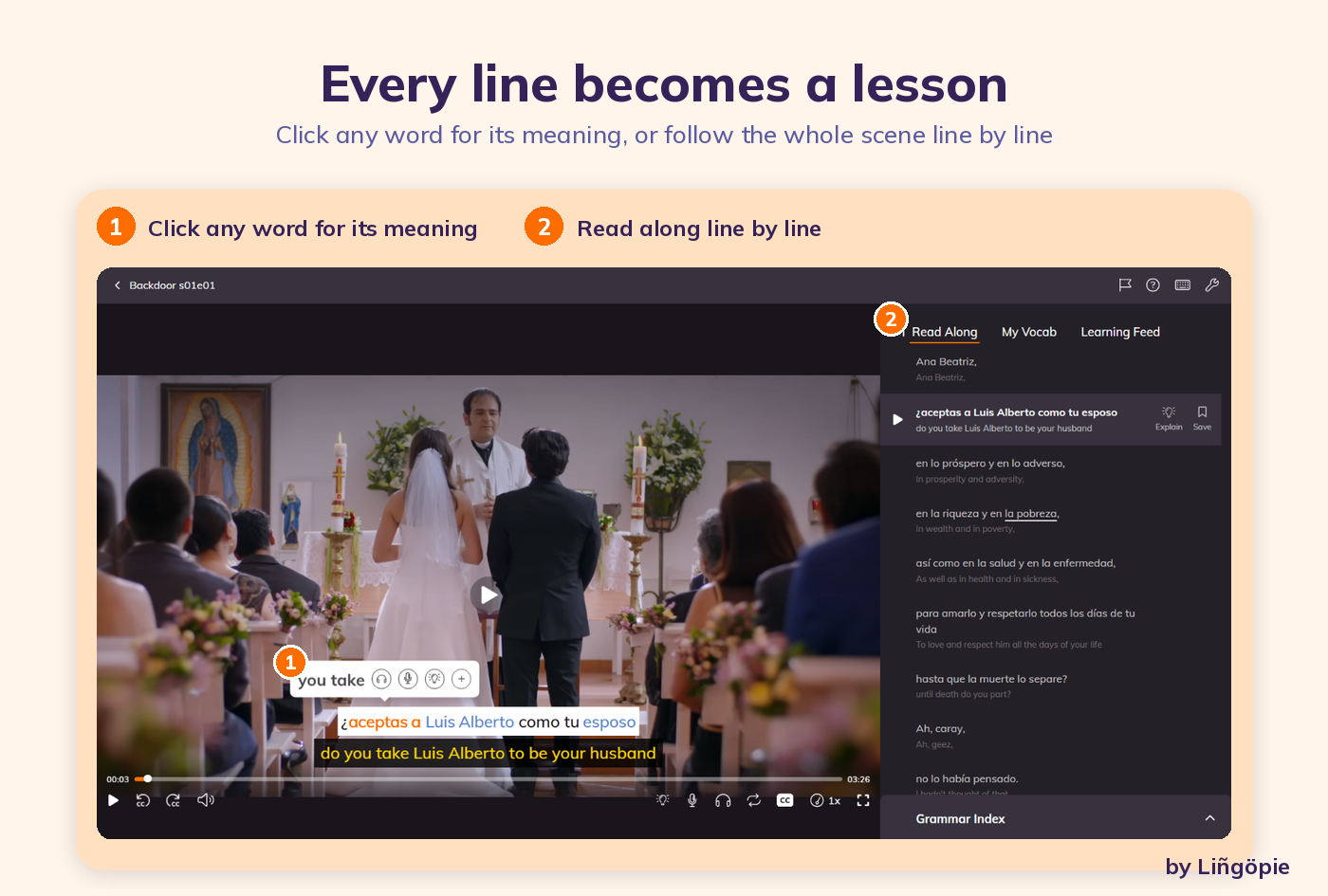
One particularly useful feature is Practice Comprehension, which turns lines from what you've watched into extra listening practice. Each video clip becomes a short review exercise instead of passive watching. Instead of immediately showing you the answer, it pushes you to listen again and work out what was actually said.
👑 Winner: Lingopie's dual subtitles, playback controls, and comprehension tools give you more ways to actively work with what you're watching.
Grammar Instruction
Grammar is where video-first language learning apps can sometimes hit a wall. Hearing a sentence in context is great, but eventually you want to know why it was said that way. Thankfully, both FluentU and Lingopie go beyond simply showing you translated subtitles.
FluentU takes the more familiar route. Its courses include grammar explanations, while videos can introduce grammar rules such as verb tenses, noun gender, cases, and other language-specific patterns. You encounter these concepts through contextual examples and quizzes, giving the FluentU program a more structured, lesson-like feel.
Lingopie flips that process around. Instead of starting with the rule, it lets you encounter grammar naturally in a show and investigate it when something catches your attention. Its grammar tools include:
- Grammar Coach: Provides AI-powered explanations of the grammar behind dialogue you're watching.
- Grammar Index: Color-codes different grammatical elements, such as nouns, verbs, adjectives, and adverbs, so you can visualize how sentences are built.
- Clickable subtitles: Let you select words for definitions, usage examples, and more detailed explanations without leaving the video.
- Context-based learning: Connects grammar to actual dialogue, so you're seeing a rule at work rather than memorizing it in isolation.
This approach can be especially useful when your target language changes across regions. A Spanish learner, for example, might hear different expressions or grammatical choices in content from Spain and Latin America and explore them in the context where they're actually used.
👑 Winner: Lingopie, for learning grammar in context without interrupting what you're watching. FluentU is the better pick if you want rule-first lessons with a clearer structure.
Vocabulary Building and Review
Both FluentU and Lingopie tackle this with contextual vocabulary, flashcards, quizzes, and spaced repetition, so this category is much closer than it first appears.
Vocabulary feature | FluentU | Lingopie |
|---|---|---|
Saving words | Save vocabulary encountered in videos | Click words in subtitles to automatically save them |
Context | Definitions, example sentences, pronunciation, and examples from videos | Words stay connected to the scene where you encountered them |
Flashcards | Personalized flashcards and review | Contextual flashcards linked to video scenes |
Spaced repetition | Yes | Yes |
Review activities | Personalized quizzes and vocabulary exercises | Flashcards, Pop Quiz, and Word Master |
Personalized vocabulary | Saved words become part of your review | My Vocab builds from words you personally click while watching |
FluentU has a strong vocabulary review system. Click a word and you can explore its definition, pronunciation, example sentences, and appearances in other authentic videos, which helps you understand each vocab word in context. Its personalized quizzes and spaced repetition then bring vocabulary back into your learning process until it becomes more familiar.
Lingopie does something similar but keeps the connection to entertainment particularly strong. Words clicked in Lingopie's subtitles are saved to My Vocab and can become contextual flashcards tied to the video where you first encountered them, keeping more detail connected to the scene where the word appeared.Spaced repetition brings difficult words back right before you'd forget them,while Word Master and Pop Quiz turn review into short vocabulary games rather than another stack of flashcards to grind through.
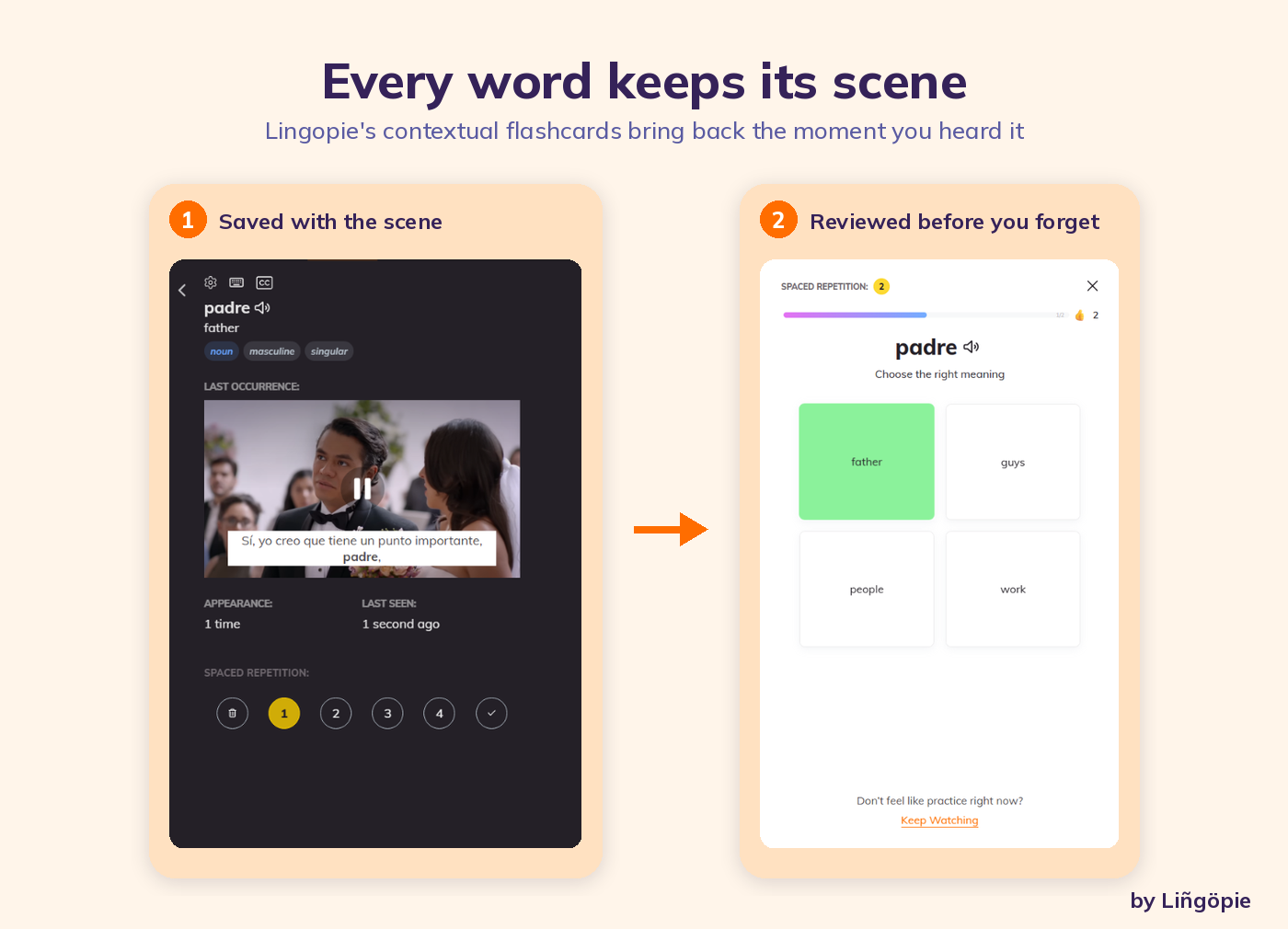
That video context matters more than you might expect.In one study of EFL students, learners who met new words in context retained them longer than learners who studied bilingual word lists. Remembering the argument where you heard a Spanish expression, or the character who kept saying it, gives you that context.
👑 Winner: FluentU has an excellent structured vocabulary system, but Lingopie wins by tying spaced review, contextual flashcards, and word games to the exact scenes where you learned each word.
Speaking and Pronunciation Practice
You can watch hundreds of hours in your target language and still freeze when it's finally your turn to speak. So, for learners who want to turn listening into actual communication skills, speaking and pronunciation tools matter.
Both platforms now offer ways to practice speaking, but they approach it differently.
Speaking feature | FluentU | Lingopie |
|---|---|---|
Speaking practice | AI Tutor plus pronunciation practice within its learning activities | Say It! lets you repeat dialogue directly from videos |
Speech recognition | Available for pronunciation practice | Records your speech and evaluates your pronunciation |
Feedback | AI-assisted speaking practice and pronunciation feedback | Instant feedback with a pronunciation score |
Native-language model | Authentic videos provide examples of natural speech | Repeat phrases directly after actors and native speakers |
Repetition | Rewatch and repeat language from videos | Listen and Repeat, sentence looping, and replay tools |
Connection to video | Speaking complements FluentU's broader learning system | Speaking practice happens directly around the dialogue you're watching |
FluentU's speech recognition technology and AI Tutor give learners guided opportunities to actively use the language rather than only watching videos. Lingopie ties speaking more directly to immersion: with Say It!, you can hear dialogue from a show, record yourself repeating it, and receive instant pronunciation feedback.
Replay and looping make that especially useful for accents. Hear a Mexican Spanish phrase, imitate the actor, check your pronunciation, and try again. It's a simple cycle of hear, imitate, get feedback, repeat that makes Lingopie speaking practice feel like a natural extension of watching.
When we tested Say It! with a line from Backdoor ("porque, fíjese"), we scored 95/100 on the pronunciation check.
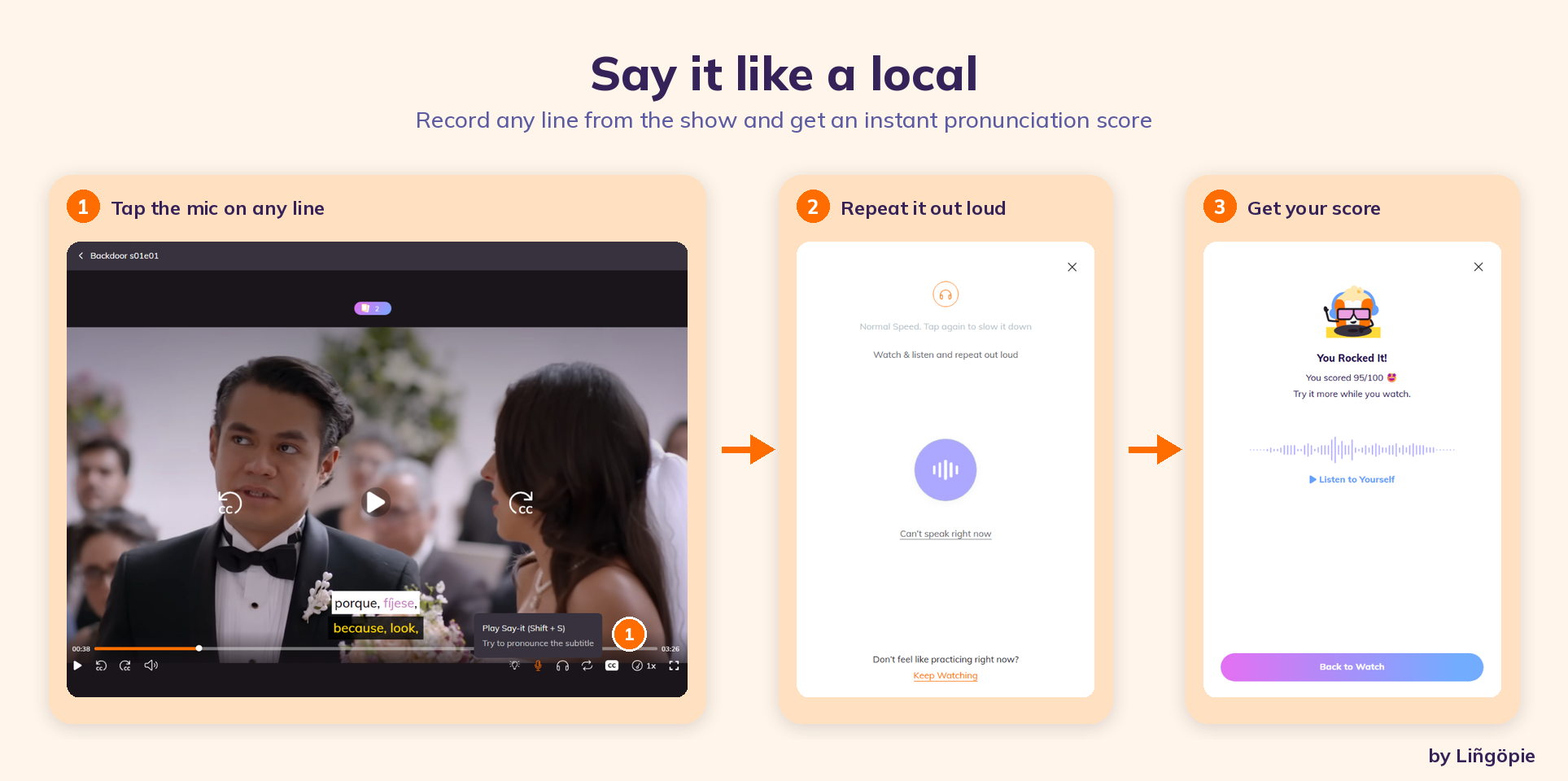
👑 Winner: Lingopie gets the edge for connecting listening, repetition, recording, and pronunciation scoring directly to the dialogue you're already watching.
Best for Different Learner Levels
If you're starting from zero, FluentU is generally the easier platform to settle into because its shorter videos, level-based content, and guided activities give you more structure. Lingopie has beginner-friendly tools too, but its biggest strengths become more noticeable once you can follow at least some real dialogue without needing every sentence explained. For intermediate learners and above, that extra exposure to natural speech, different accents, and full stories can make immersion much more valuable.
Learner level | FluentU | Lingopie | Best fit |
|---|---|---|---|
Complete beginner (A0–A1) | Shorter videos and more guided progression make authentic content easier to approach | Dual subtitles and playback tools help, but full-speed authentic dialogue can feel demanding | FluentU |
Beginner (A1–A2) | Structured activities reinforce vocabulary and comprehension | Beginner content, interactive subtitles, translations, and replay tools provide support | FluentU |
Intermediate (B1–B2) | Useful for expanding vocabulary through increasingly challenging authentic videos | Longer shows and movies provide sustained exposure to natural dialogue and recurring vocabulary | Lingopie |
Advanced (C1+) | Authentic content remains useful, though structured exercises may become less important | Strong fit for following native-speed dialogue, slang, accents, and entertainment with less subtitle support | Lingopie |
For complete beginners,FluentU's shorter videos, difficulty levels, quizzes, and guided progression make authentic content easier to approach. Lingopie still gives beginners plenty of support through dual subtitles, translations, slower playback, and replay controls, but real TV can introduce fast speech, slang, and unfamiliar grammar early.Lingopie works best from around A2; below that, keep dual subtitles on and playback at 0.75x.
The balance shifts for intermediate and advanced learners. Lingopie's longer shows and movies provide sustained exposure to how native speakers actually talk, including recurring vocabulary, accents, slang, and everyday expressions. As your listening comprehension improves, you can rely less on translations and get closer to experiencing the language naturally.
👑 Winner: FluentU for complete beginners and learners who want clearer language study structure and progression; Lingopie for intermediate and advanced learners ready for deeper immersion.
Pricing, Plans, and Free Trials
Lingopie offers more ways to pay: quarterly ($41.97, about $13.99/month), yearly ($83.88, about $6.99/month), and lifetime ($199). FluentU offers monthly or annual billing, from $11.99 to $29.99 per month depending on tier. On an annual plan, Lingopie costs a little over half of FluentU's cheapest rate. FluentU's 14-day free trial is twice as long as Lingopie's 7 days. (Prices as of October 2026. Both apps run frequent sales, so check each site for current rates.)
Pricing feature | FluentU | Lingopie |
|---|---|---|
Monthly option | $11.99 to $29.99 per month | $13.99 per month (mobile app only) |
Multi-month option | No | 3-month plan for $41.97 |
Annual plan | Yes | Yes, $83.88 annually |
Lifetime option | No | Yes, $199 |
Free trial | 14 days | 7 days |
Multiple languages | Included with FluentU plans | All languages with yearly and lifetime plans; some shorter plans are limited to one language |
Family option | No standard family plan | Family plan available |
Free access | Free trial rather than a permanent free plan | No free version, but a limited Freemium preview is available on mobile |
The FluentU pricing vs Lingopie comparison isn't simply about which number is lower.As of October 2026, FluentU's pricing page lists two tiers, Plus and Super, which differ mainly in how much AI Tutor practice you get (AI Tutor is on iOS and Android only).Both include its core language program, such as authentic videos, personalized quizzes, spaced repetition, and the ability to create your own flashcards.
A Lingopie subscription works differently. Shorter plans make sense if you're concentrating onone languagefor a limited period, while the yearly and lifetime optionsincludeall supported languages. The annual plan is the more obvious choice for ongoing study, while lifetime access may appeal to people who expect language learning to remain a long-term hobby.
There is one clear advantage for FluentU before you pay: time. Its 14-day free trial gives you twice as long as Lingopie's standard 7-day trial to explore the key features and decide if the learning experience matches your learning preferences. Lingopie's trial is shorter, although it provides full access to its learning features during that period.
On Trustpilot, Lingopie and FluentU are both rated 4.8/5 (as of October 2026). 👑 Winner: Lingopie for plan flexibility; FluentU for the free trial. If you're comparing Lingopie vs FluentU purely on subscription choice, Lingopie's quarterly, yearly, family, and lifetime options give you more flexibility.
User Experience and Platform Accessibility
If you're going to use a language app several times a week, convenience matters almost as much as the learning tools themselves. FluentU is well suited to learners who like a more structured dashboard and jumping between shorter learning activities, while Lingopie feels closer to the streaming platforms you're probably already used to. Both work across desktop and mobile, but their extensions and big-screen options create some meaningful differences.
Experience | FluentU | Lingopie |
|---|---|---|
Web access | Yes | Yes |
Mobile apps | iOS and Android | iOS and Android |
Browser extension | Chrome extension for supported Netflix and YouTube content | Extension adds Lingopie learning tools to online video |
TV viewing | Primarily web/mobile-focused | Apps for Fire TV, Roku, and Google TV (as of October 2026) |
Offline learning | Downloadable audio and flashcards, but videos are streaming-only | Offline video downloads available on iOS for selected content |
Overall feel | More like a traditional language-learning platform | Its interface resembles Netflix, with a modern design and a learning layer |
FluentU's user interface suits its structured approach, letting you move between videos, courses, flashcards, quizzes, and shorter engaging lessons.Its Chrome extension works with supported Netflix and YouTube videos (Netflix content requires your own subscription). Its dashboard is organized around lessons and quizzes, while Lingopie's is organized like a streaming catalog.
Lingopie feels more like a streaming service with a learning layer. The Lingopie mobile app, TV apps, and browser extension let you move between screens while keeping learning connected to entertainment.Its Chrome extension adds its learning tools to Netflix. As ofOctober 2026, selected titles can be downloaded for offline viewing on iOS,which is handy when traveling.
👑 Winner: Lingopie is available across desktop, mobile, browser, and the biggest screen in the house. If you want language learning to fit naturally around how you already consume entertainment, Lingopie asks you to change fewer habits.
How to Choose Between FluentU and Lingopie
Choose FluentU if you want video-based language learning to still feel like a structured course. Choose Lingopie if you'd rather learn through entertainment and want the learning tools to work around what you're watching. Neither approach is automatically better; the right choice depends on how much structure you need and what will actually keep you coming back.
Choose FluentU if you... | Choose Lingopie if you... |
|---|---|
Prefer shorter videos and engaging lessons you can finish in one sitting | Want to learn through full TV shows, movies, and other entertainment |
Want clearer language study structure and progression | Prefer immersion and more freedom to explore content |
Like guided quizzes, vocabulary review, and spaced repetition | Want contextual flashcards, word games, and review tied to what you watch |
Want authentic content but aren't ready to start with full-length shows | Are comfortable learning from natural dialogue, slang, and faster speech |
Prefer a language learning program that does more of the planning for you | Want grammar, vocabulary, and speaking practice built around authentic dialogue |
Are a beginner who benefits from more guidance | Are an intermediate or advanced learner looking for more exposure to native speakers, accents, and everyday expressions |
Stay motivated by lessons, progression, and defined activities | Stay motivated when learning feels more like entertainment than studying |
There's also the motivation question, and it shouldn't be underestimated. The theoretically perfect app isn't much use if opening it feels like homework. If you thrive on goals, progression, and clearly defined activities, FluentU's more guided learning style may keep you moving. If you've abandoned traditional language apps because the lessons started feeling repetitive, Lingopie's entertainment-first approach may be easier to stick with.
Still torn? Use the free trials strategically. Spend a few sessions with each platform using the same target language. Don't just count features. Notice which one makes you want to keep going after your planned study time is up. That's probably the better app for you.
Adapting Language Learning to Your Region
Languages change depending on where they're spoken, from accents and vocabulary to grammar, slang, and cultural references. Lingopie is particularly useful here because its country-specific shows and movies let youhear these differences in real dialogue.
Regional difference | Example |
|---|---|
Accent and pronunciation | French from France vs. Quebec |
Vocabulary | Spanish coche vs. carro |
Grammar | Vosotros in Spain vs. ustedes in much of Latin America |
Slang | Mexican, Argentine, and Spanish expressions |
Culture | Local humor, etiquette, gestures, and pop-culture references |
If you have a destination in mind, match your viewing to it. Learning Spanish for Mexico City? Watch Mexican shows and get used to local vocabulary and accents. Heading to Paris? Prioritize French productions and listen closely to how native speakers actually communicate.
FluentU also offers authentic media from different regions, but Lingopie's full shows and movies give you longer exposure to the same accents, expressions, and cultural context.
FluentU or Lingopie: Final Verdict
So, FluentU or Lingopie? Pick FluentU if you want shorter videos, structured lessons, and clearer progression. It's especially strong for beginners who want authentic content without giving up the feel of a traditional language learning program.
For our overall winner, though, it's Lingopie. It turns the content you actually want to watch into the lesson, with interactive subtitles, contextual flashcards, spaced repetition, grammar support, and speaking practice built into the experience. Want to give it a spin? Start your 7-day free trial, choose a show you'd watch anyway, and turn your next binge into real language practice!
Frequently Asked Questions
Is Lingopie or FluentU better for complete beginners with no prior language experience?
FluentU may be easier for complete beginners because its shorter videos and structured activities provide more guidance. Lingopie also supports beginners with interactive subtitles, translations, slower playback, and level-appropriate content, but its immersion-first approach may require more independence.
Can I effectively combine FluentU and Lingopie in my language learning routine?
Yes. Use FluentU for structured lessons, vocabulary review, and shorter study sessions, then use Lingopie for longer immersion through shows and movies. Combining them gives you both guided practice and sustained exposure to authentic language.
Which platform provides more comprehensive speaking and pronunciation practice?
Lingopie gets our vote. Its Say It! feature lets you repeat dialogue, record yourself, and receive instant pronunciation feedback, while replay, auto-loop, and slower playback help you practice the same line until it sounds right. FluentU also offers pronunciation practice and an AI Tutor, but Lingopie connects speaking particularly well to authentic dialogue.
How do FluentU and Lingopie support learning multiple languages simultaneously?
Both let you study more than one language. FluentU gives subscribers access to all its supported languages and tracks progress separately as you switch between them. Lingopie's yearly and lifetime subscriptions alsoincludeall supported languages, making either platform practical if you're learning two or more languages.
Are FluentU and Lingopie suitable for learning regional dialects or accents?
Yes, but Lingopie stands out more for regional dialect and accent study and has the stronger regional focus. Its content identifies dialects by country, so you can deliberately watch Spanish from Mexico, Spain, Argentina, or Colombia, for example. That makes it easier to practice regional accents, vocabulary, expressions, and cultural context instead of treating every variety of a language as identical.


%3A%20Which%20Language%20Learning%20App%20Fits%20Your%20Learning%20Style%3F)