
Spanish accent marks (´) may be tiny, but they have a big job! They tell you which syllable to stress when a word breaks the usual pronunciation rules. They can even change a word's meaning entirely, like si (if) and sí (yes). One little mark, two very different messages!
You'll only find these accents above vowels (á, é, í, ó, ú), but Spanish has two other marks worth knowing: the diéresis (ü) and the wavy line in ñ. Ready to make sense of them all? This guide breaks down the four essential accent rules, common mistakes to avoid, and even how to type Spanish accents on any device.

💡 Key Takeaways
- Spanish words ending in a vowel, n, or s usually stress the second-to-last syllable, while words with other endings typically stress the last.
- Spanish words fall into four stress categories called agudas, llanas, esdrújulas, and sobresdrújulas, with the last two always requiring written accents.
- Accent marks can change a word's meaning, as seen in tu (your) vs. tú (you) and papa (potato) vs. papá (dad).
- Spanish question words like qué, cómo, and dónde retain their accents in both direct and indirect questions.
- A stressed í or ú next to a, e, or o takes an accent to separate the vowels into different syllables, as in día and país.
What Is the Accent Mark Called in Spanish?
In Spanish, the accent mark (´) is called la tilde or acento ortográfico. It's the only true accent mark in Spanish. Two other marks appear in Spanish spelling: the diéresis (ü), which tells you to pronounce the u in güe and güi, and the virgulilla, the wavy line that is part of the letter ñ.
Accent marks are important in Spanish because they help you figure out how to pronounce unfamiliar vocabulary, distinguish words with different meanings, and avoid spelling mistakes that could change your message entirely. Think of them as little clues that make reading, writing, and speaking Spanish a whole lot easier.
The Acute Accent (Tilde)
The acute accent (´) appears above the five Spanish vowels: á, é, í, ó, and ú. It indicates stress in words like café (coffee) and música (music), and distinguishes words such as él (he) and el (the).
The Ñ and Its Wavy Line
The wavy line above ñ is called the virgulilla. Unlike an accented n, ñ is a separate letter in the Spanish alphabet with its own sound. For example, año means "year," while ano means "anus," showing how one small mark can completely change a word.
The Diéresis (ü)
The diéresis consists of two dots placed above the letter u in the combinations güe and güi. It tells you to pronounce the u, which would otherwise be silent, as in pingüino (penguin) and vergüenza (embarrassment).Compare guerra (war), where the u stays silent. It's the least common of the three marks, but you'll still see it in everyday words.
What Are the Spanish Stress Rules?
In Spanish, most words have a stressed syllable that's pronounced with greater emphasis than the others. For example, casa (house) is pronounced CA-sa, while perro (dog) is PE-rro, with the stress falling on the first syllable in both words. However, certain grammatical words, such as articles and some pronouns, are normally unstressed in connected speech.
Unlike English, Spanish follows fairly predictable stress patterns based on how a word is spelled. Most words have a natural stress position, but some break the pattern and need a written accent mark to show where the emphasis belongs.
The good news? Once you understand how Spanish stress works, you can pronounce unfamiliar words more confidently without having to memorize each one. The four rules below explain when to use accent marks and why they matter.
Related: 10 Must-Know Spanish Grammar Points for Beginners
The 4 Rules for Using Spanish Accent Marks
Knowing where to place Spanish accent marks isn't just about getting your spelling right. A missing or misplaced accent can change how a word is pronounced, alter its meaning, or make your writing harder to understand.
Fortunately, Spanish accent marks follow a clear set of rules, so you don't have to guess where they belong. From identifying stressed syllables to telling similar-looking words apart, these four rules will help you read, write, and pronounce Spanish with greater confidence.
Rule 1: Accent Marks and Syllable Stress
Every Spanish word belongs to one of four categories based on where its stressed syllable falls. Knowing these categories helps you determine when a word needs a written accent mark instead of relying on guesswork.
Word Type | Where the Stress Falls | When It Needs an Accent | Examples |
|---|---|---|---|
Aguda | Last syllable | When the word ends in a vowel, n, or s | café, canción, jamás |
Llana (grave) | Second-to-last syllable | When the word ends in a consonant other than n or s | lápiz, árbol, fácil |
Esdrújula | Third-to-last syllable | Always | música, teléfono, rápido |
Sobresdrújula | Before the third-to-last syllable | Always | dígamelo, cómpratelo |
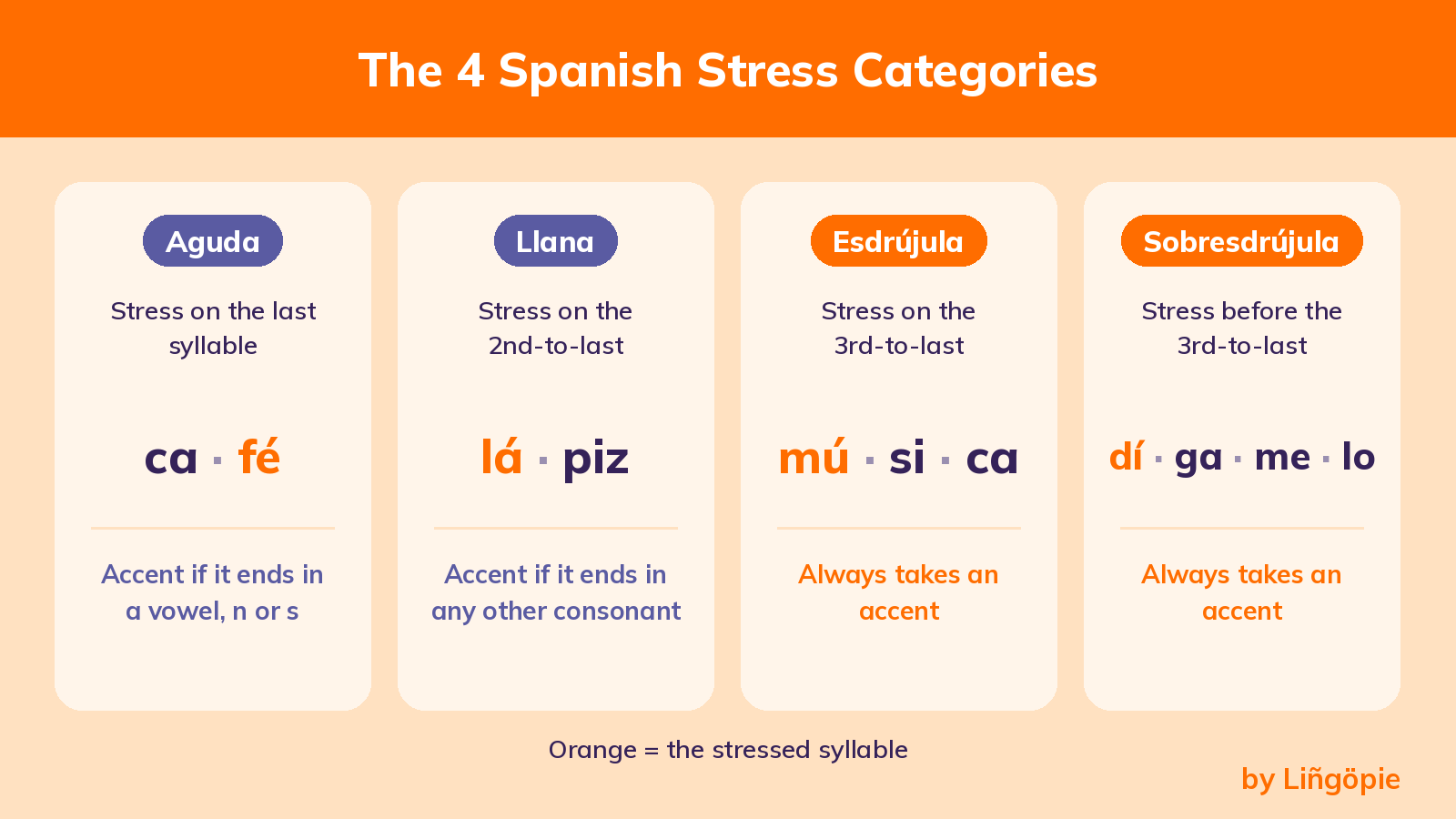
The easiest way to apply these rules is to identify the stressed syllable first, then check how the word ends. For example, café needs an accent because its stress falls on the last syllable and it ends in a vowel, while reloj (clock) doesn't because its final stress follows the normal pattern for words ending in other consonants.
One useful shortcut? Words classified as esdrújulas and sobresdrújulas always take an accent, regardless of their ending.
Rule 2: Accent Marks That Change Word Meaning
In Spanish, some words look and sound alike but have completely different meanings depending on whether they have an accent mark. These are called diacritical accents (tildes diacríticas), and they help distinguish commonly confused words.
For example, tu means "your," while tú means "you." The difference might seem small, but using the wrong one can change what you're trying to say.
Without Accent | Meaning | With Accent | Meaning |
|---|---|---|---|
tu | Your | tú | You |
el | The | él | He |
mi | My | mí | Me |
te | You (object pronoun) | té | Tea |
si | If | sí | Yes |
de | Of/from | dé | Give (form of dar) |
se | Reflexive pronoun | sé | I know / be (command) |
mas | But | más | More |
aun | Even | aún | Still/yet |
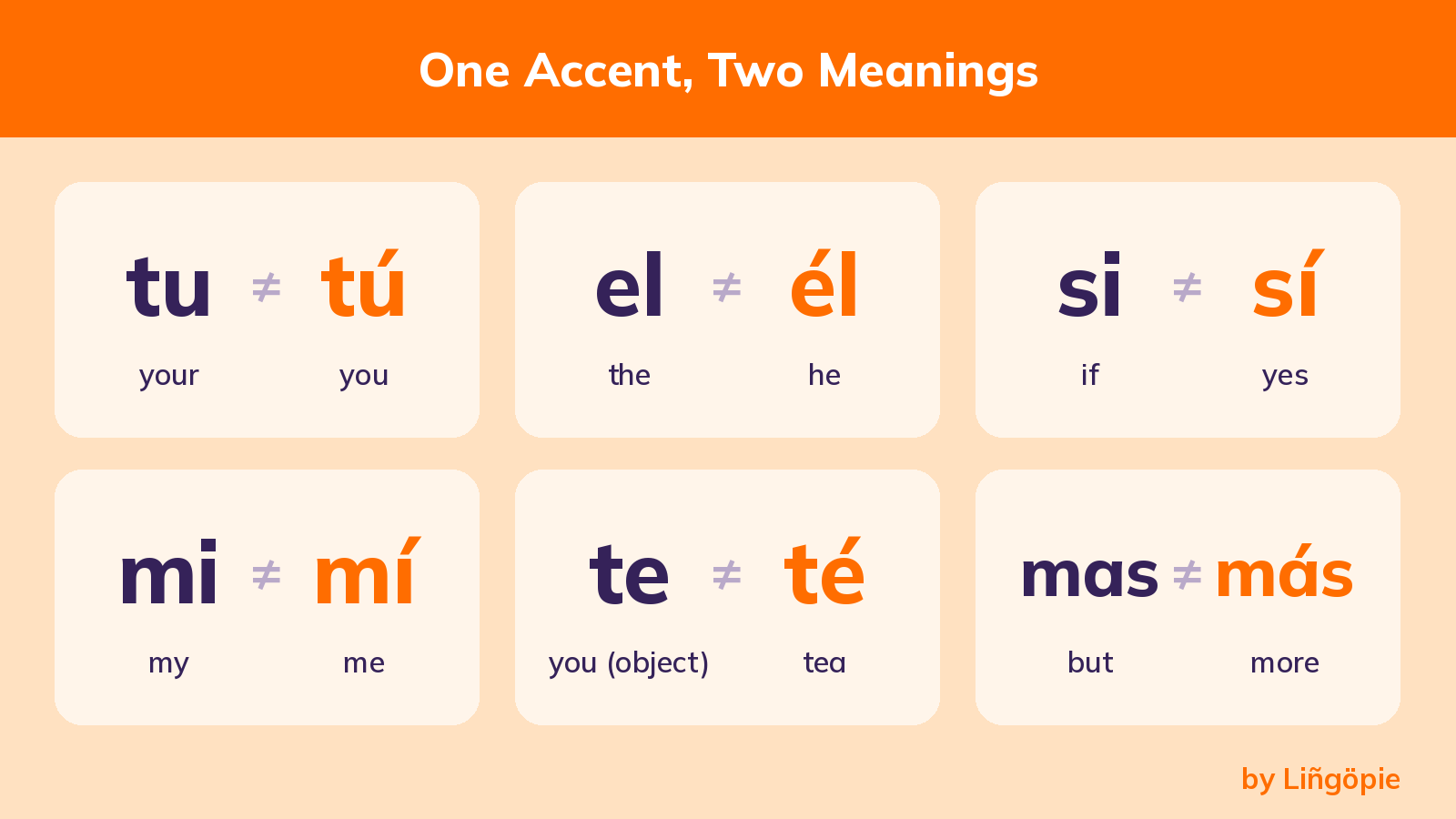
Here are a few examples of how these differences work in everyday Spanish:
- Tu casa es bonita. (Your house is beautiful.) vs. Tú eres amable. (You are kind.)
- El libro es mío. (The book is mine.) vs. Él tiene un libro. (He has a book.)
- Si tienes tiempo, ven. (If you have time, come.) vs. Sí, tengo tiempo. (Yes, I have time.)
According to the Real Academia Española (RAE), solo and demonstratives such as este and esedon't take accent marks when there's no risk of ambiguity. Since March 2023, the RAE has allowed an optional accent when the writer sees a real risk of ambiguity.
Rule 3: Interrogative and Exclamatory Words
In Spanish, interrogative and exclamatory words like qué (what), cómo (how), dónde (where), cuándo (when), quién (who), cuál (which), cuánto (how much), and por qué (why) carry accent marks when used to ask questions or express emotions.For more examples, see our guide to question words in Spanish.
Here's the important part: These words keep their accents even in indirect questions, where no question marks appear.
- ¿Qué quieres comer? (What do you want to eat?)
- No sé qué hacer. (I don't know what to do.)
- Dime cómo lo hiciste. (Tell me how you did it.)
- ¡Qué sorpresa! (What a surprise!)
However, these words lose their accents when they function as connectors rather than question or exclamation words:
- Creo que tienes razón. (I think you're right.)
- Hazlo como quieras. (Do it however you want.)
- La casa donde vivo. (The house where I live.)
How can you tell the difference? Look at the word's role in the sentence rather than checking for question marks alone. If it introduces a direct or indirect question or exclamation, it generally needs an accent; if it connects ideas without that meaning, it doesn't.
Spanish also uses inverted punctuation signs (¿ and ¡) to open direct questions and exclamations, making it easier to recognize them from the start.
Rule 4: Accents That Split Two Vowels
In Spanish, two vowels next to each other sometimes combine into one syllable, forming a diphthong (diptongo). However, when a stressed í or ú appears next to a strong vowel (a, e, or o), it takes an accent mark, and the vowels belong to separate syllables.
This happens regardless of which vowel comes first. For example, día (dí-a) places the stressed í before a, while país (pa-ís) places it after a. This separation is called a hiatus (hiato), and the accent is required even when normal stress rules wouldn't call for one.
Here are some common examples:
Spanish Word | Syllable Breakdown | English Meaning |
|---|---|---|
día | dí-a | Day |
país | pa-ís | Country |
río | rí-o | River |
baúl | ba-úl | Trunk |
For example, día has two syllables instead of one because the accented í is pronounced separately from the a. The same happens in país, where the stress falls on the final syllable.
One more thing to remember: Capital letters don't lose their accents! Names and words like Álvaro and Ética still require them, even when written in uppercase.
How to Type Spanish Accent Marks on Any Device
You don't need a Spanish keyboard to type words like canción, año, or pingüino. Most computers and smartphones have built-in shortcuts for Spanish accent marks, so you can add them without copying and pasting special characters.
Spanish Accent Mark Keyboard Shortcuts for Windows and Mac
You can type Spanish accent marks using built-in keyboard shortcuts, although the method depends on your operating system and keyboard layout. On Windows setups that support numeric-keypad Alt codes, hold Alt and enter the corresponding number using the numeric keypad, with Num Lock enabled where required. On Mac, use the Option key combinations listed below.
If your keyboard doesn't have a numeric keypad, you can also enable a Spanish or US-International keyboard layout for easier typing.
Character | Windows (Alt + Numpad) | Mac |
|---|---|---|
á / Á | Alt + 0225 / 0193 | Option + E, then A |
é / É | Alt + 0233 / 0201 | Option + E, then E |
í | Alt + 0237 | Option + E, then I |
ó | Alt + 0243 | Option + E, then O |
ú | Alt + 0250 | Option + E, then U |
ñ / Ñ | Alt + 0241 / 0209 | Option + N, then N |
ü | Alt + 0252 | Option + U, then U |
¿ | Alt + 0191 | Option + Shift + ? |
¡ | Alt + 0161 | Option + 1 |
For uppercase accented vowels on Mac, hold Shift when typing the letter after the Option shortcut.
Using the US-International Keyboard
If you type in Spanish regularly, switching to the US-International keyboard layout can save time. On Windows, you can enable it through your language and keyboard settings.
Once activated, type an apostrophe (') followed by a vowel to produce á, é, í, ó, or ú. For ñ, press the tilde key (~) followed by n.
How to Type Spanish Accents on iPhone and Android
Typing Spanish accents on your phone is even easier. Simply press and hold a vowel on your keyboard, then select its accented version from the pop-up menu.
The same trick works for ñ, ü, and inverted punctuation marks (¿ and ¡), although the available options depend on your keyboard app.
Practice Makes Perfect
Knowing the rules is one thing, but using Spanish accent marks correctly takes practice. The best way to improve is to make them part of your everyday reading, writing, and speaking habits.
Here are a few simple ways to build your confidence:
- Read Spanish texts aloud. Pay attention to stressed syllables and notice how written accents guide pronunciation.Our list of the hardest Spanish words to pronounce is a good challenge.
- Build vocabulary with accents included. When learning new words, memorize their correct spelling from the start instead of adding accents later.
- Practice with commonly confused words. Write short sentences using pairs like papa (potato) and papá (dad) to understand how accents affect meaning. In Spain, patata is the more common word for potato.
- Use spell-checking tools. Set your device's language to Spanish to catch missing accents and review the corrections.
- Get feedback from a native speaker. Share a short Spanish text with a tutor or native speaker and ask them to check your accent marks.
Try this 5-minute accent challenge: Write two short Spanish sentences for each of these five pairs: tu/tú, el/él, si/sí, mi/mí, and te/té. Use the unaccented word in one sentence and the accented version in the other, then check all 10 sentences against the rules you've learned.
Common Accent Mark Mistakes (and How to Avoid Them)
Even experienced Spanish learners occasionally mix up accent marks. Here are four common mistakes worth watching out for:
- Forgetting accents altogether. Missing an accent can change a word's meaning, as in te (you) versus té (tea).
- Dropping accents in indirect questions. Write No sé qué hacer (I don't know what to do), not No sé que hacer, even though the sentence has no question marks.
- Leaving accents off capital letters. Spanish capital letters follow the same accent rules, so write Álvaro, not Alvaro.
- Adding unnecessary accents. Words like solo and demonstratives such as estedon't need accents unless there's a real risk of ambiguity, in which case the RAE allows an optional one.
Mastering Spanish accents takes time, but consistency makes all the difference. Stay committed to a few minutes of daily practice, keep track of the things you get wrong, and you'll gradually learn to spot mistakes before they happen.
Ready to Start Learning Spanish? Try Lingopie!
You've learned the rules of Spanish accent marks, but can you recognize them when native speakers talk? That's where Lingopie comes in!
With Lingopie, you can watch Spanish TV shows and movies with dual Spanish-English subtitles, making it easier to connect written accents with real pronunciation. Click on unfamiliar words to hear how they're pronounced, then save them as flashcards to practice later.
Captions also make real speech easier to follow: in one study, learners who watched a TV episode with captions improved their listening scores by 16.9 percentage points, versus 7.1 without captions (Birulés-Muntané & Soto-Faraco, 2016).
And you're in good company! Lingopie has helped over 2 million language learners andis rated 4.6/5 on Trustpilot from 3,878 reviews (November 2026).
Ready to put those accent rules to work? Start your 7-day free trial of Lingopie and turn your next Spanish binge-watch into a language lesson!
Frequently Asked Questions About Spanish Accent Marks
What Is the Accent Mark Called in Spanish?
The Spanish accent mark (´) is called la tilde or acento ortográfico. It appears above vowels (á, é, í, ó, ú) to indicate stress or distinguish words. The two other marks used in Spanish spelling are the diéresis (ü) and virgulilla, the wavy line in ñ.
Which Months Have Accents in Spanish?
None of the 12 Spanish months have accent marks: enero, febrero, marzo, abril, mayo, junio, julio, agosto, septiembre, octubre, noviembre, and diciembre. Unlike English, Spanish month names are also written in lowercase unless they begin a sentence.
What Numbers in Spanish Have Accent Marks?
Several Spanish cardinal numbers have accent marks, including dieciséis (16), veintidós (22), veintitrés (23), and veintiséis (26). The shortened form veintiún also takes an accent, as in veintiún libros (21 books).
Some ordinal numbers also require accents, such as décimo (10th), undécimo (11th), and duodécimo (12th). For 13th through 19th, both decimotercero (one word, no accent) and décimo tercero (two words, with an accent) are accepted forms.
Do Capital Letters Need Accent Marks in Spanish?
Yes, Spanish capital letters follow the same accent rules as lowercase letters. For example, Álvaro, Éxito, and ÁFRICA retain their written accents, even when the entire word is capitalized.
Can an Accent Mark Change the Meaning of a Spanish Word?
Yes, adding or removing an accent can completely change a word's meaning. For example, si means "if," while sí means "yes," and tu means "your," while tú means "you." These distinctions are called tildes diacríticas.
How Do You Know Where to Put Accent Marks in Spanish?
First, identify the stressed syllable and check the word's ending. Words ending in a vowel, n, or s usually stress the second-to-last syllable, while other endings typically stress the last. Written accents mark exceptions, distinguish certain words, or separate vowels into different syllables.