
The umlaut meaning in one line: an umlaut is the two-dot diacritical mark placed over a, o and u in German: ä, ö, ü. It signals a changed vowel sound, and it often changes a word's meaning. Compare schon (already) and schön (beautiful).
The word comes from German um (around, changed) and Laut (sound), so "umlaut" means "altered sound." Germany, Austria and Switzerland all use it, and every German-speaking country treats it as part of the spelling, not as decoration.

Key Takeaways
- An umlaut is the two-dot mark over ä, ö and ü, and it means "altered sound."
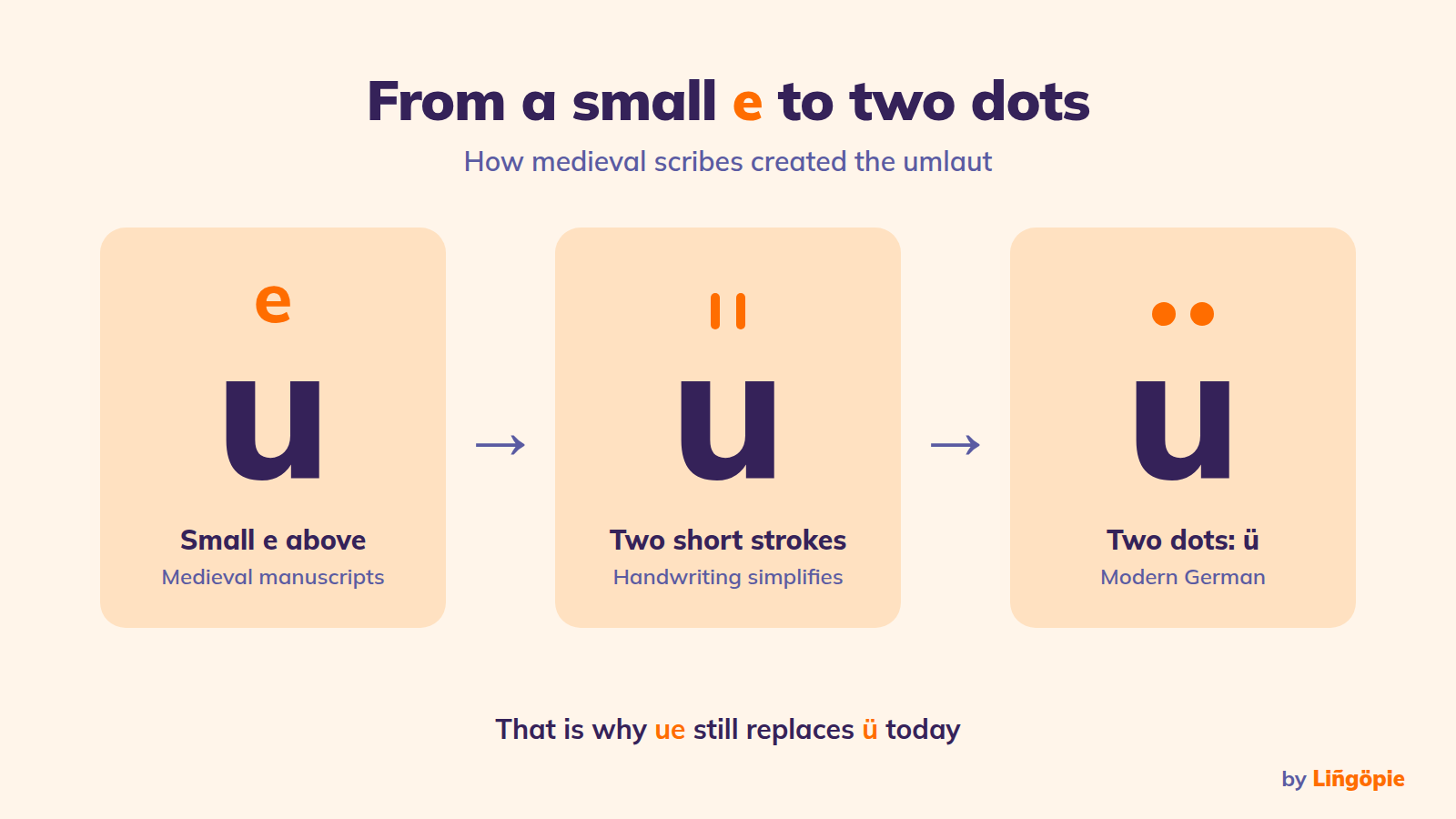
- It began as i-mutation, a sound shift in early Germanic languages. The dots grew from a small e written above the vowel.
- Umlauts change meaning and grammar: schon vs. schön, der Mann vs. die Männer.
- Say ü as "ee" with rounded lips and ö as "ay" with rounded lips. Ä sounds like the e in "bed."
- When the dots are unavailable, write ae, oe and ue. Never just drop them.
In this guide: History · Alphabet · Meaning · Pronunciation · Practice · Grammar · Typing · ae, oe, ue · Diaeresis · Other languages · Metal umlaut · Mistakes · FAQ
The History of the Umlaut
The sound shift: how i-mutation created umlauts
The umlaut began as i-mutation, a sound shift in early Germanic languages. When the next syllable contained an i or j, the vowel before it moved toward the front of the mouth, which made the two syllables easier to say together. Later the i disappeared from many words, but the changed vowel stayed behind and became a signal of plurals and related forms.
English kept traces of the same shift: foot became feet, mouse became mice and man became men. English simply never added a mark to show it.
From a small e to two dots
The two dots developed from a small e written above the vowel by medieval scribes. Over time that tiny letter shrank to two short strokes, then to two dots. This is why ae, oe and ue still stand in for umlauts, and why you will see them in older texts. The scholar Jacob Grimm popularized the term "umlaut" in the 19th century.
Umlauts in the German Alphabet
The German alphabet has the same 26 basic letters as English, plus ä, ö, ü and ß. Ä, ö and ü are usually taught as extra letters, but they are not counted among the 26. Under DIN 5007, the German standard for alphabetical order, dictionaries file them like a, o and u. So Bär (bear) sits next to Bar (bar) in a dictionary, while phone books and name lists sort them as ae, oe and ue.
That differs from Swedish and Finnish, where ä and ö are separate letters at the end of the alphabet. The capital forms are Ä, Ö and Ü.
The German vowels are a, e, i, o and u, and umlauts add three more: ä, ö and ü. Each affected vowel moves toward the front of the mouth, and that shift affects pronunciation. Ä is the front partner of a, ö of o, and ü of u.
One regional difference matters for learners. Swiss Standard German keeps umlauts but does not use ß, and writes ss instead: Straße (street) becomes Strasse in Switzerland. Germany and Austria use ß. For a deeper look, see our guide to the German alphabet [add link, or delete this sentence if the post doesn't exist].
How Umlauts Change the Meaning of German Words
An umlaut can change a word's meaning: schon means "already," schön means "beautiful." According to DWDS, the Digital Dictionary of the German Language, each of these pairs is a separate dictionary entry, which is how you distinguish them in writing.
Without umlaut | Meaning | With umlaut | Meaning |
|---|---|---|---|
schon | already | schön | beautiful |
zahlen | to pay | zählen | to count |
to print | drücken | to press | |
Bar | bar | Bär | bear |
Bruder | brother | Brüder | brothers |
The first four pairs give you two different words. The last pair shows the umlaut as a grammar signal: it turns a singular into a plural.
Umlauts also link word families. Mann (man) gives männlich (male), Person (person) gives persönlich (personal), and Geburt (birth) gives gebürtig (by birth). Spotting the umlaut helps you recognize related nouns, adjectives and verbs.
How to Pronounce German Umlauts
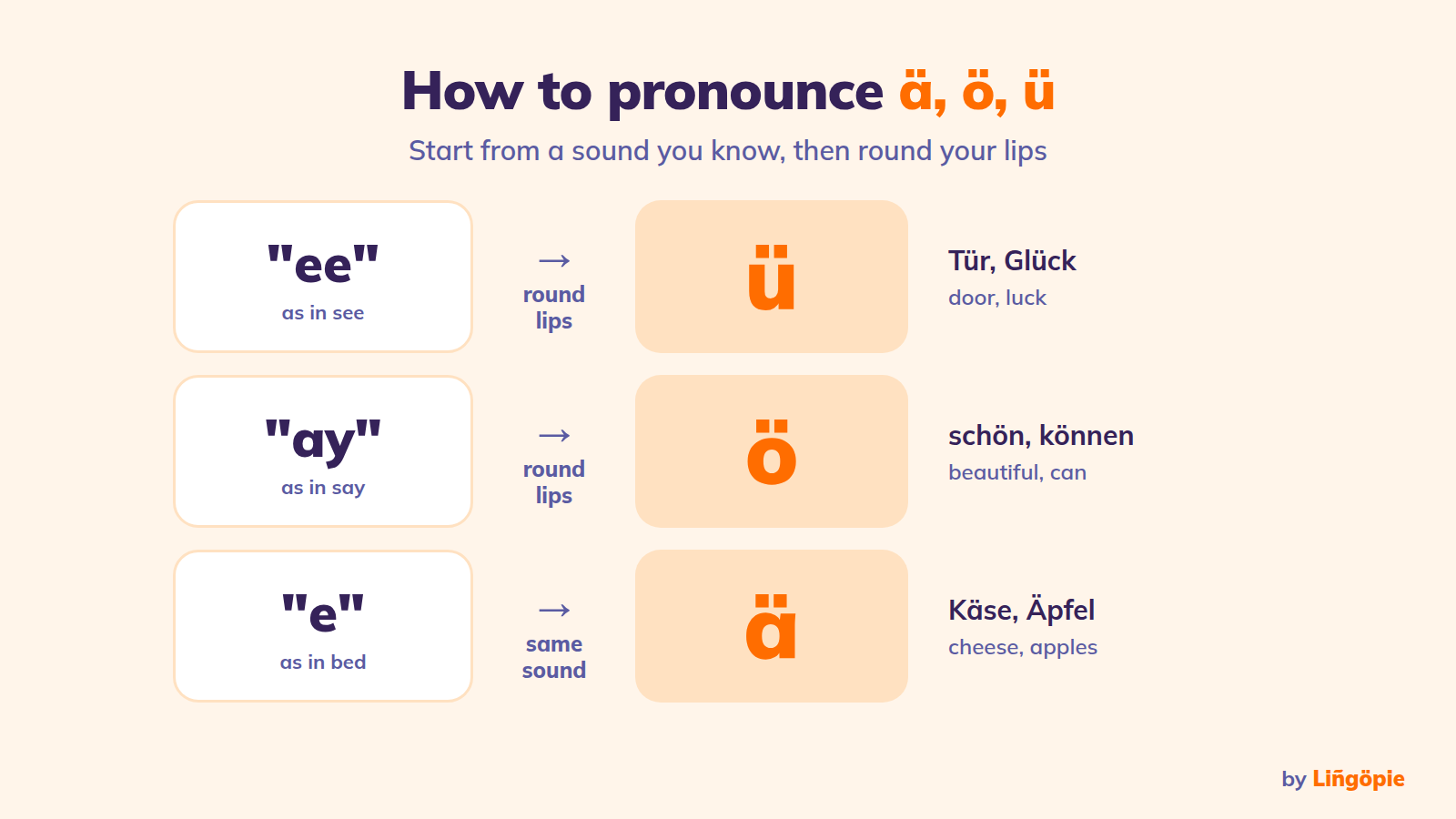
To pronounce German umlauts, start from a vowel you already know, keep your tongue still and change only your lips. Umlauts are new sounds for many English speakers, but not for everyone. French speakers already know ü (French u) and ö (French eu), Turkish and Hungarian speakers use the same letters with similar sounds, and Mandarin speakers know ü from pinyin.
Ä
Ä sounds like the e in English "bed." A long ä is similar but held longer, as in Käse (cheese). A short ä appears in Äpfel (apples).
Many speakers, especially in northern Germany, pronounce long ä almost like long e. So Ähre (ear of grain) and Ehre (honor) can sound alike. Don't let that confuse you when you hear it.
Ö
To pronounce ö, say "ay" with your lips rounded. A long ö, as in schön (beautiful), is close to French eu in deux. The short ö, as in können (can, to be able to), is close to French eu in peur.
Ü
To pronounce ü, say "ee" with your lips rounded, as if you were whistling. It is close to French u in tu. English speakers often turn it into "oo," which makes Mütter (mothers) sound like Mutter (mother).
Letter | IPA | Mouth position | Example word |
|---|---|---|---|
ä (long) | [ɛː] | Like "e" in "bed," held longer | Käse (cheese) |
ä (short) | [ɛ] | Like "e" in "bed" | Äpfel (apples) |
ö (long) | [øː] | "Ay" with rounded lips | schön (beautiful) |
ö (short) | [œ] | Slightly more open, lips rounded | können (can) |
ü (long) | [yː] | "Ee" with rounded lips | Tür (door) |
ü (short) | [ʏ] | Slightly more open, lips rounded | Glück (luck) |
Try this: say "ee" and hold it, then round your lips without moving your tongue. The sound that comes out is ü. Do the same with "ay" to get ö. One exception: äu is not an ä sound at all. It is pronounced like English "oy," as in Häuser (houses) and Träume (dreams).
Practice minimal pairs out loud: Mutter and Mütter, Bar and Bär. Duden and DWDS both offer audio for each entry, so you can compare your sound with a native speaker's. Everyday words are good practice too: the German greetings Grüß Gott and Tschüss both use ü. To see which parts of German take English speakers longest, read our data from 14k learners.
How to Practice Umlauts with German TV
The fastest way to make ä, ö and ü stick is to hear them in real speech, then say them back. Watching German TV with German subtitles lets you do both, because you see each umlaut on screen at the moment you hear it.
Research on captioned video supports this. In one study, subtitles in the language being spoken helped listeners adapt to an unfamiliar accent, while subtitles in their native language made it harder (Mitterer & McQueen, 2009). In another, learners who watched a 68-minute TV episode with captions in the target language improved their listening-test scores by 16.9 percentage points, compared with 7.1 points without captions (Birulés-Muntané & Soto-Faraco, 2016). Both studies tested captioned viewing in general, not Lingopie itself.
That is the method Lingopie is built on. Lingopie is used by 2M+ learners and rated 4.8/5 on Trustpilot. Watching German shows with dual subtitles lets you hear ä, ö and ü in real speech, and you can click any word to hear it again and save it as a flashcard. Lingopie recommends about 10 minutes a day.
A simple routine for umlauts:
- Pick a show at your level, such as one of these German shows for beginners or a German series on Netflix.
- Turn on German subtitles, or dual subtitles if you are below B1. Each time you see ä, ö or ü, click the word and replay it.
- Save the minimal pairs you meet, like schon and schön, as flashcards and say them out loud when you review.
Here is how one learner described it on Trustpilot on July 20, 2026, on his first day (the review was posted on invitation):
"I’m a very new user (started today) who has been trying to learn German. I’ve found this site very helpful, as it allows me to learn the individual meaning of words I don’t know, along with their context in use. I personally use it alongside other programs for that added ability. Incredibly useful!"Lance, Trustpilot review
Catalog contents vary by region and change over time, so check lingopie.com for what is available in your country. For more ways to use shows, see how to learn German with TV.
Umlauts in German Grammar
Umlauts do much of the grammatical work in German.
Function | Base form | Umlaut form |
|---|---|---|
Plural | der Mann (man) | die Männer (men) |
Plural | das Buch (book) | die Bücher (books) |
Plural | die Mutter (mother) | die Mütter (mothers) |
Verb (du, er/sie/es) | fahren (to drive) | du fährst, er fährt |
Verb (du, er/sie/es) | laufen (to run) | du läufst, er läuft |
Subjunctive | war (was) | wäre (would be) |
Subjunctive | hatte (had) | hätte (would have) |
Subjunctive | konnte (could) | könnte (could, might) |
Comparative | alt (old) | älter (older) |
Comparative | groß (big) | größer (bigger) |
Comparative | jung (young) | jünger (younger) |
Diminutive | das Haus (house) | das Häuschen (little house) |
Many German plurals add an umlaut: der Mann, die Männer. Many strong verbs add one in the du and er/sie/es forms. Suffixes such as -chen often bring an umlaut with them, and the diminutive is always neuter, so it takes das (more in our guide to German articles and adjective endings).
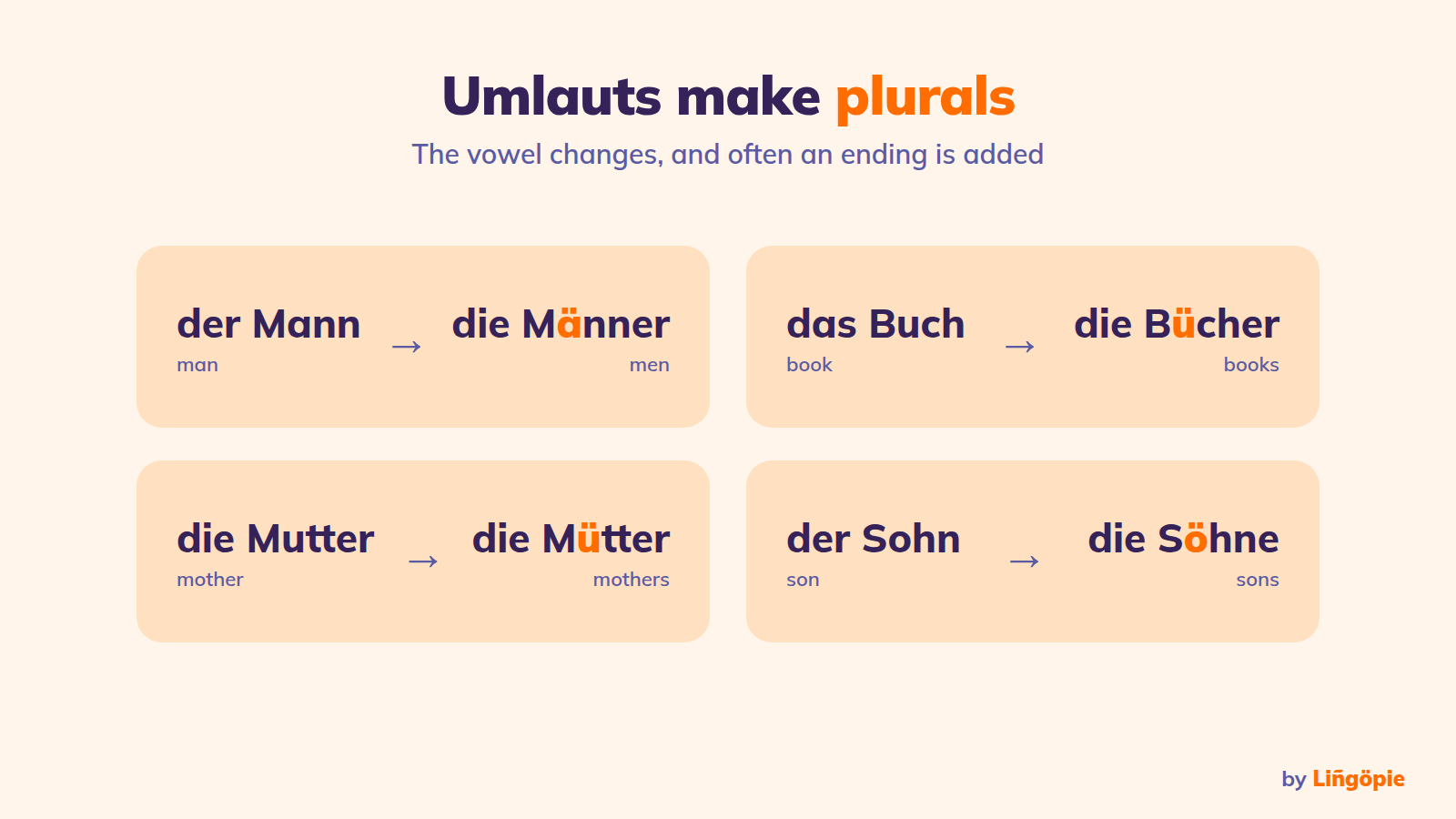
A few more plurals to practice: der Apfel becomes die Äpfel (apples), das Haus becomes die Häuser (houses) and der Sohn becomes die Söhne (sons). Learn each plural together with its noun, because no single rule predicts them all. Our basic German grammar guide lists the common plural endings.
How to Type Umlauts on Any Keyboard
How you type umlauts depends on your device and keyboard layout.
Letter | Windows (Alt + numpad) | Mac |
|---|---|---|
ä / Ä | Alt + 0228 / Alt + 0196 | Option + u, then a / A |
ö / Ö | Alt + 0246 / Alt + 0214 | Option + u, then o / O |
ü / Ü | Alt + 0252 / Alt + 0220 | Option + u, then u / U |
ß | Alt + 0223 | Option + s |
On a Mac, type an umlaut with Option + u, then the vowel. On Windows, hold Alt and type the code on the numeric keypad.
- Phones and tablets: press and hold the vowel, then pick the umlaut from the pop-up menu.
- German keyboard: the QWERTZ layout has dedicated ä, ö and ü keys. The Swiss keyboard has umlaut keys too, shared with é, è and à.
- US-International layout: type " and then the vowel, so " + a gives ä.
- New keyboard: if you type German often, add a German keyboard in your device settings and switch to it when needed. On an iPhone, go to Settings > General > Keyboard > Keyboards > Add New Keyboard and choose German. On Android, add German in your keyboard's language settings.
- US and UK layouts: these have no dedicated umlaut keys, so use one of the methods above. Windows Alt codes need a numeric keypad.
Writing Umlauts Without the Dots: ae, oe, ue
When umlauts aren't available, German writes ae, oe and ue instead. This is the standard fallback, and it goes back to the small e the dots came from. You will meet them in URLs, email addresses, crosswords and some forms. Capitals follow the same rule: Ä becomes Ae, as in plain-text forms that only accept basic letters.
Names are the exception. Goethe is always written with oe, and Müller and Mueller are different surnames, so never swap them freely. And never just drop the dots: without them, schön (beautiful) turns into schon (already), which is a different word.
Umlaut vs. Diaeresis: What's the Difference?
An umlaut and a diaeresis look the same, but an umlaut changes a vowel's sound, while a diaeresis shows that two vowels are pronounced separately. The Unicode Standard encodes both with one character, the combining diaeresis (U+0308), which is why they are easy to confuse.
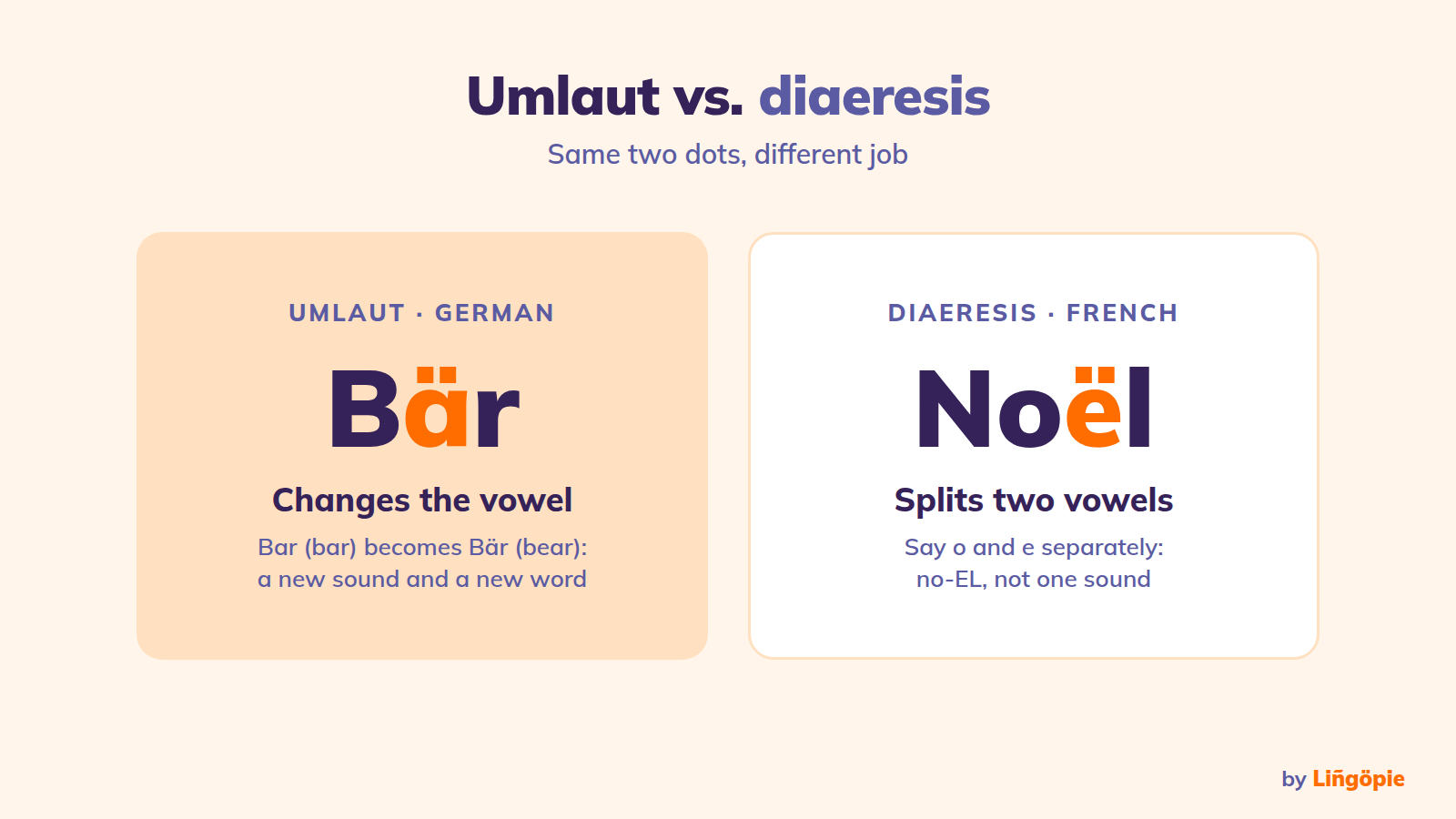
- Umlaut: changes the vowel itself, as in German ü.
- Diaeresis: splits two neighboring vowels, as in French Noël and naïve, or English naïve and the older spelling coöperate.
Properly speaking, "umlaut" names the sound change and the German letters that show it, and "diaeresis" names the mark that separates vowels.
Umlauts in Other Languages
Several languages use the same two dots, with different rules. Among Germanic languages, Swedish and Icelandic also have ö, while Danish and Norwegian use other letters for similar sounds.
- Swedish and Finnish: ä and ö are separate letters, placed at the end of the alphabet.
- Hungarian: uses ö and ü, plus the long ő and ű, as in köszönöm (thank you), tükör (mirror), idő (time) and tűz (fire).
- Turkish: uses ö and ü with sounds similar to German, as in göz (eye) and güneş (sun).
- Danish and Norwegian: write the ö sound as ø.
- French: uses the mark as a diaeresis (tréma), not as an umlaut.
- Mandarin pinyin: ü has the same sound as German ü, as in nǚ (woman).
If your native language is one of these, you already have a head start.
The "Metal Umlaut"
Some bands add umlauts purely for style, such as Motörhead and Mötley Crüe. In band names, logos and song titles, the dots do not change the pronunciation. German speakers often find this funny, because the dots appear where German spelling would never put them.
Common Mistakes and Misconceptions
- "The umlaut is just decoration." It changes meaning: schon and schön are different words, and a missing umlaut is a spelling error.
- Dropping the dots instead of using ae, oe, ue. Write Schoen or schön, never schon for "beautiful."
- Pronouncing ü like English "oo." Say "ee" with rounded lips, and Mütter will no longer sound like Mutter.
- Assuming every German plural takes an umlaut. Many don't: das Brot (bread) becomes die Brote (breads).
- Calling the French or English diaeresis an umlaut. The mark is the same, but the job is different: it separates vowels instead of changing one.

FAQ
What does umlaut mean in German?
Umlaut means "altered sound," from um (around, changed) and Laut (sound). It names the two-dot mark over a, o and u (ä, ö, ü) and the vowel change it signals. See the full explanation.
How do you pronounce German umlauts?
Say ä like the e in "bed," ö like "ay" with rounded lips, and ü like "ee" with rounded lips. Keep your tongue still and change only your lips. Details are in the pronunciation section.
Why are umlauts important in German?
Umlauts change both pronunciation and meaning: schon means "already," schön means "beautiful." They also mark plurals and verb forms, so leaving them out causes misunderstandings and spelling errors.
How do umlauts affect the meaning of German words?
They can create a different word (zahlen, to pay; zählen, to count) or a grammatical form, such as a plural (Bruder, Brüder) or a verb form (er fährt). The vowel change is part of the correct spelling.
How can I type umlauts on my keyboard?
On Windows, hold Alt and type a numpad code, such as 0252 for ü. On a Mac, press Option + u, then the vowel. On phones, press and hold the vowel and pick the umlaut. See the typing table.
Are umlauts used in other languages?
Yes. Swedish, Finnish, Hungarian and Turkish use ä, ö or ü, among others. French and English use the same mark as a diaeresis, which does a different job. See other languages.
What's the difference between an umlaut and a diaeresis?
They look identical, but an umlaut changes a vowel's sound, while a diaeresis shows that two neighboring vowels are pronounced separately, as in French Noël or English naïve.
Can umlauts change the plural of German nouns?
Yes: der Mann becomes die Männer, and das Buch becomes die Bücher. But not every plural takes an umlaut: das Brot becomes die Brote. Learn each plural with its noun.
Conclusion
Umlauts are small marks with a big job. They signal a changed vowel, separate words like schon and schön, and build plurals, verb forms and comparatives. Pronouncing them comes down to rounded lips and a steady tongue.
The best way to make the sounds stick is to practice them: read the minimal pairs out loud, then listen for ä, ö and ü in a German show. To keep going, explore our guides to basic German grammar and the 100 most common German words, or visit the main Learn German page. You can also try Lingopie and watch a German show with dual subtitles.