

You hear a line of Japanese, catch half of it, and glance down to check what it meant. That's what Japanese English subtitles are for: Japanese and English text on screen at the same time (dual subtitles), so you can match what you hear to what it means. The term also covers adding English subtitles to a Japanese video you made yourself.
Maybe you're learning Japanese, maybe you just want to follow your favorite anime or drama, or maybe you want viewers who don't read Japanese to understand your videos. Either way, this guide shows you where to watch with both subtitles, how to learn from them, and how to make your own.

Key Takeaways
- Dual subtitles show Japanese and English text on screen at the same time.
- Netflix shows one subtitle track at a time, so seeing both takes a browser extension.
- Research favors same-language subtitles for listening, so use English as a bridge.
- Learn in stages: dual subtitles, then Japanese only, then none.
- Creators can add English subtitles with an SRT, VTT or ASS file.
In this guide: Types · Research · Where to watch · Method · Limits · For creators · FAQ
Japanese Subtitles vs. English Subtitles vs. Dual Subtitles
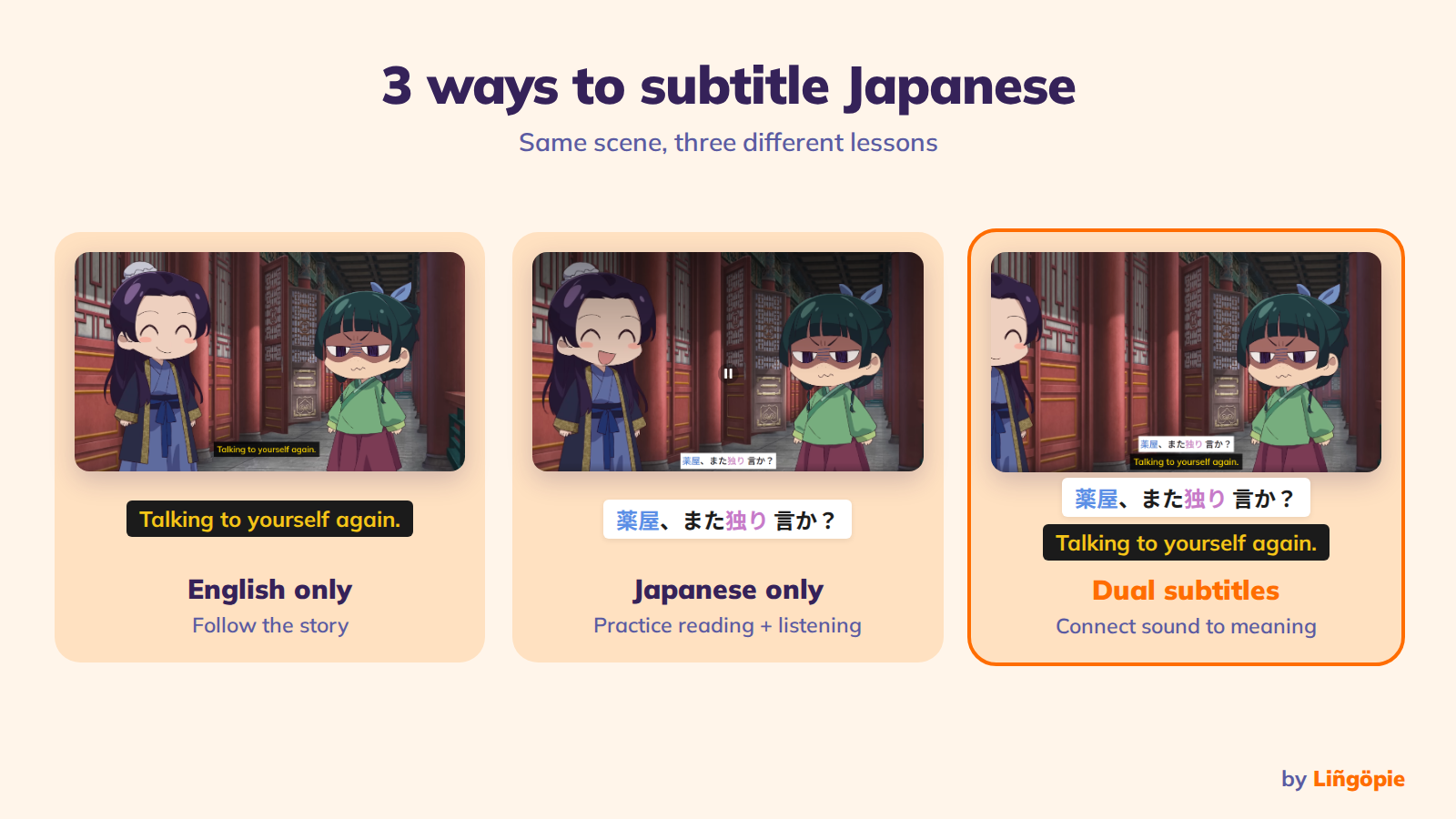
Dual subtitles show Japanese and English text on screen at the same time. Here is how the three options differ.
Type | What you see | Best for |
|---|---|---|
English subtitles | English translation only | Following the story |
Japanese subtitles | Japanese text (kanji and kana) matching the audio | Intermediate learners practicing reading and listening |
Dual subtitles | Japanese and English together | Connecting what you hear to its meaning |
Japanese subtitles mix kanji, hiragana and katakana, so beginners often rely on furigana or dictionary lookups. Kanji are characters borrowed from Chinese, and hiragana and katakana are the two phonetic scripts. Furigana are the small kana readings printed above kanji. Katakana is the easiest place to start reading, because many katakana words are English loanwords (see our guide to Japanese English words).
Do Dual Subtitles Help You Learn Japanese?
A study by Mitterer and McQueen (2009) found that subtitles in the language being spoken helped listeners understand an unfamiliar accent, while native-language subtitles made it harder. According to the paper in PLoS ONE, the clips were in English and the listeners were Dutch, so treat the result as a signal for Japanese, not proof.
A meta-analysis by Montero Perez, Van Den Noortgate and Desmet (2013) in the journal System reviewed 18 studies of captioned video and linked captions to better listening comprehension and vocabulary learning.
The closest evidence to dual subtitles is a 2018 study of 227 learners: captions that showed translations of key words led to more than double the recall of word meanings compared with standard captions (Montero Perez, Peters & Desmet, 2018). None of these studies tests full dual subtitles directly.
The takeaway: dual subtitles are a useful bridge, but the goal is Japanese-only subtitles, then none. In practice, use the English line to check meaning after you listen, not before.
How to Watch Japanese Shows With Japanese and English Subtitles
Catalogs differ by country, so a title with Japanese subtitles in one region may lack them in another. Check each title where you live.
Netflix
Netflix shows only one subtitle track at a time, so seeing Japanese and English together requires a browser extension such as Language Reactor, Lingopie's Chrome extension, or Immersive Translate. Check which browsers and streaming services each one supports before you install it. According to the Netflix Help Center, subtitle options vary by title, so look at the title's audio and subtitle choices first.
YouTube
Look for creator-uploaded Japanese captions. According to YouTube Help, captions can be uploaded by creators or generated automatically, and automatic ones can contain errors. YouTube also shows one track at a time.
Lingopie
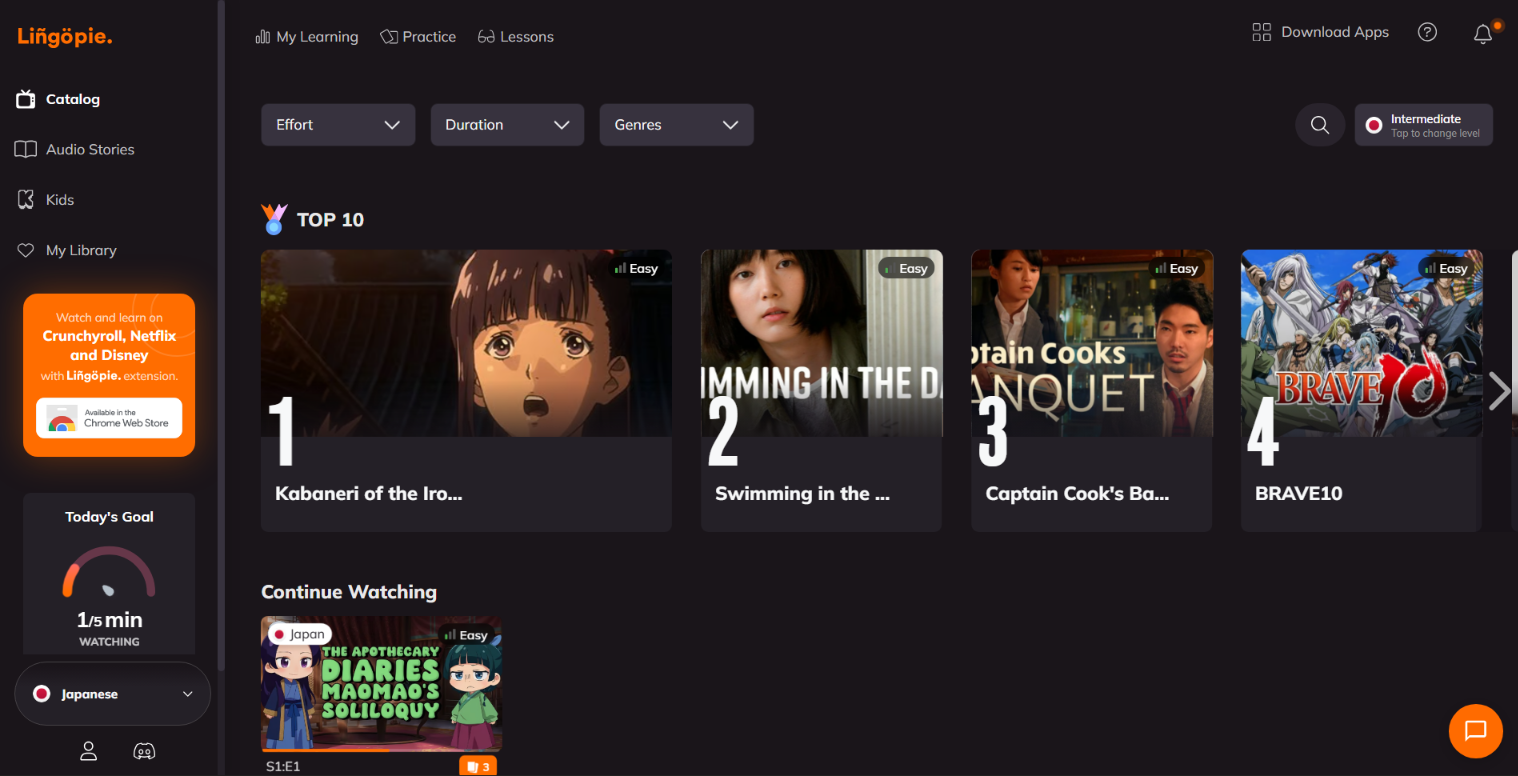
Lingopie is used by 2M+ learners and rated 4.8/5 on Trustpilot. It shows Japanese and English subtitles together, lets you click any word for a translation and save it as a flashcard, and works as a Chrome extension for Netflix. Click-for-translation is the feature closest to the 2018 word-translation study above, and rōmaji subtitles help beginners who can't read kana yet. Japanese is one of its 17 languages; check lingopie.com for the Japanese catalog in your country. It is best for beginner to intermediate learners (about A2–B1, with dual subtitles recommended below B1), and Lingopie recommends about 10 minutes a day. For titles to start with, see the best Japanese TV shows to learn Japanese.
Anime platforms
Netflix and Crunchyroll carry large anime catalogs, and Netflix and Rakuten Viki carry Japanese dramas. Tubi offers free, ad-supported Japanese movies and dramas in some countries, and the Japan Foundation runs JFF Theater, a free online film service available in selected countries. Japanese services such as TVer are generally available only inside Japan. Check the subtitle options for each title before you commit to a series.
How to Learn Japanese With Subtitles: A Step-by-Step Method
- Watch a scene with dual subtitles.
- Rewatch it with Japanese subtitles only.
- Rewatch it with no subtitles.
- Shadow 3–5 lines out loud, copying rhythm and pitch.
- Save new words as flashcards.
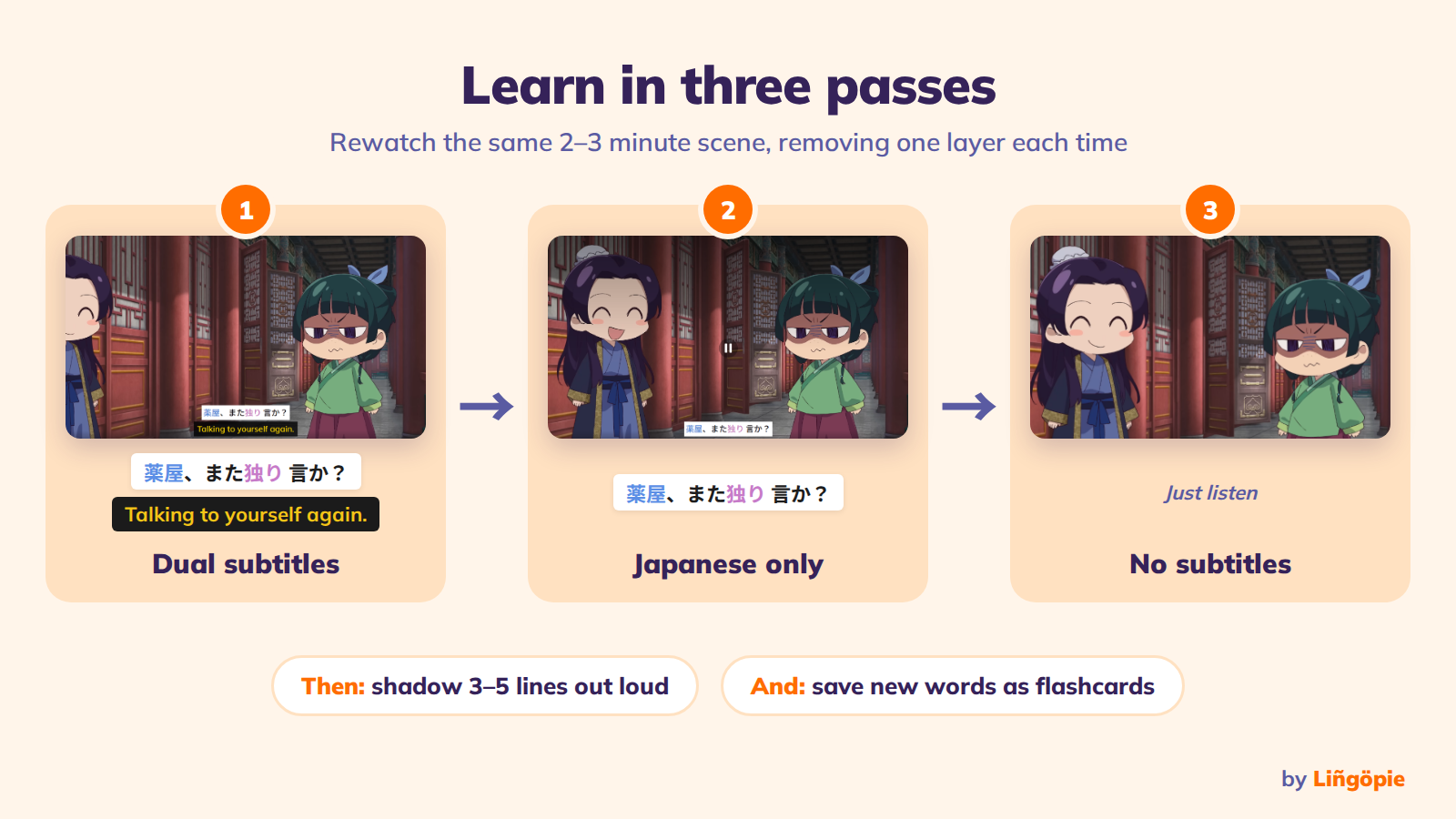
Keep each scene to 2–3 minutes so the loop stays quick enough to repeat daily. On Lingopie, steps 1 and 5 happen in the same player: click a word in the dual subtitles and save it as a flashcard.
Pick shows at your level: slice-of-life dramas use everyday speech and are easier than fantasy anime. When a kanji stops you, use furigana or a dictionary pop-up instead of pausing to hand-copy it. If you want show ideas, see our guides to learning Japanese with TV, beginner-friendly anime and Japanese dramas and short films for learners. New to the scripts? Start with our hiragana and katakana guides.
When English Subtitles Hurt Your Listening
Reading English pulls your attention away from the audio, which is the effect the Mitterer and McQueen study points to. Use English only on the first viewing, or hide it and reveal it when you get stuck. Your ears get the practice, and the translation stays available as a safety net. A simple test: after a scene, write down what you understood, then turn English on and check what you missed.
What English Subtitles Miss: Cultural Context
English subtitles often drop Japanese honorifics such as -san and senpai. 田中さん is usually rendered as just "Tanaka," which hides the respectful distance the speaker keeps (see our guide to Japanese honorifics). Three other gaps show up often:
- Keigo (polite speech): 食べる (to eat) becomes 召し上がる when honoring someone, a shift English cannot mirror.
- Dropped subjects: 行く? can mean "Are you going?" or "Do you want to go?", so translators must guess who is involved.
- Wordplay: puns like ふとんがふっとんだ ("the futon flew away") rarely survive translation.
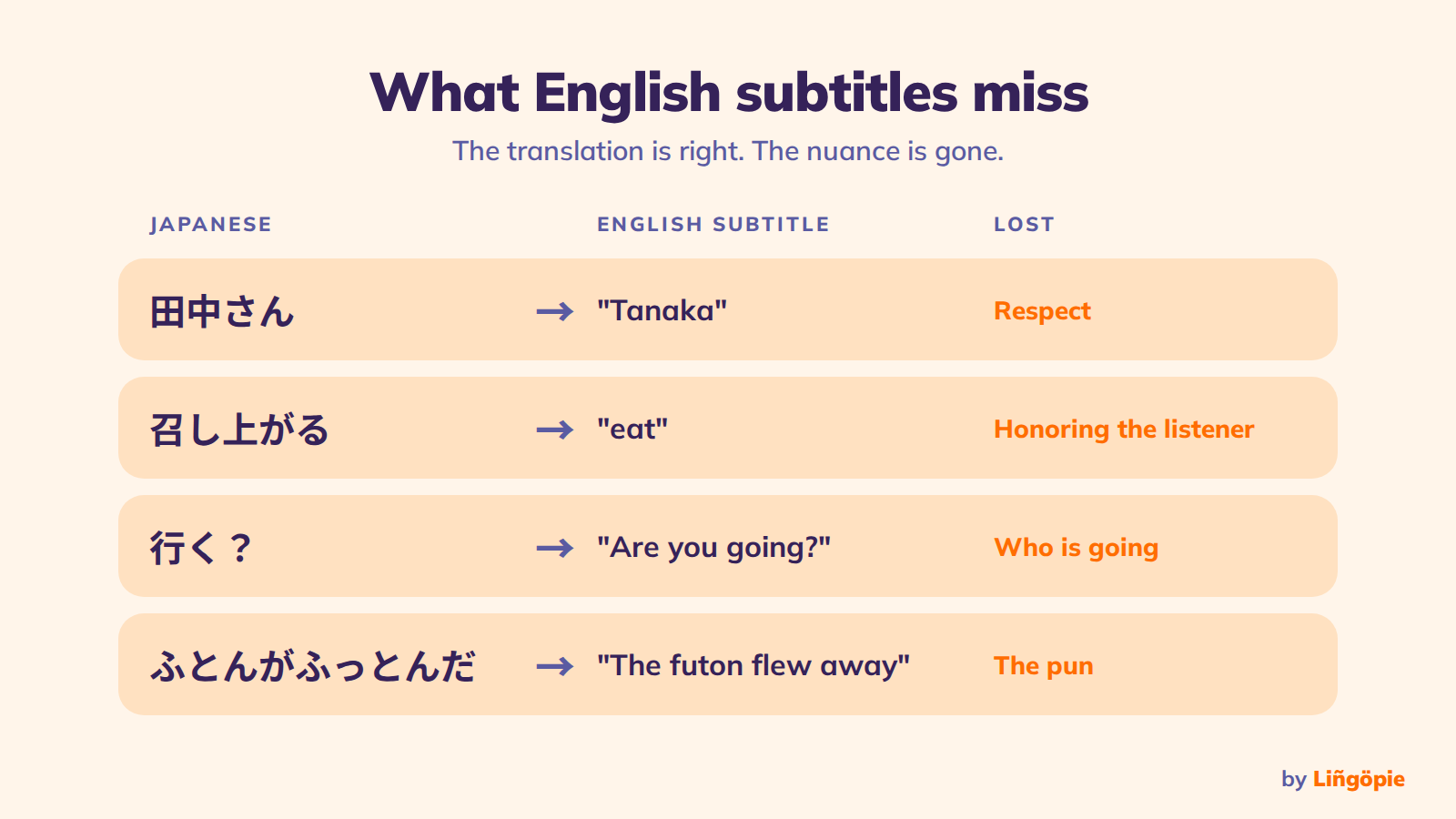
This is why Japanese subtitles teach things English ones cannot.
How to Add English Subtitles to Your Own Japanese Videos
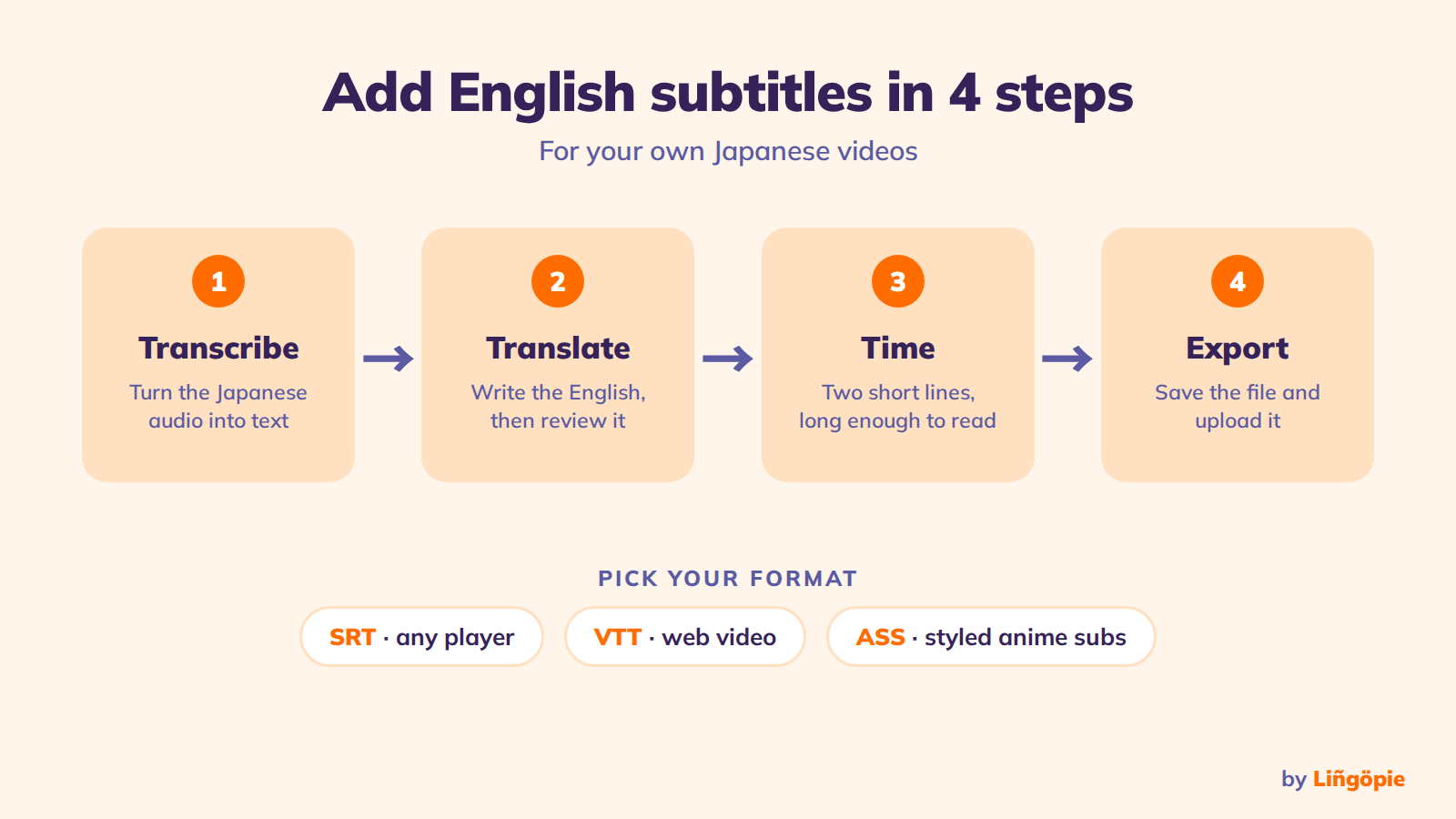
You can add English subtitles to a Japanese video in four steps, with free or paid tools:
- Transcribe the Japanese audio: upload the video or audio file and set Japanese as the source language.
- Translate the lines into English and review the translated text.
- Adjust timing and line length so each cue is readable.
- Export the file and download it, or upload it to your video platform.
OpenAI's open-source Whisper model can transcribe Japanese, and Subtitle Edit is a free editor for timing and exporting. Paid online editors such as Kapwing can also transcribe, translate subtitles and export SRT or VTT files, and some add dubbing.
Human vs. AI translation
AI is fast and low-cost, but it often misses honorifics, tone and context. A good translator can speed up the first pass, but have a fluent reader review anything you publish. Treat vendors' accuracy percentages as marketing claims, not independent tests.
Subtitle formats
SRT is the most widely supported subtitle format; ASS supports styling and is common for anime.
Format | Best for | Notes |
|---|---|---|
SRT | Almost any player or platform | Plain text and timing only |
VTT | Web video and YouTube | Similar to SRT, built for browsers |
ASS | Anime and styled subtitles | Controls fonts, colors and position |
Whichever format you choose, keep each cue to two short lines and leave it on screen long enough to read comfortably.
FAQ
Can I watch Netflix with Japanese and English subtitles at the same time?
Not natively. Use a browser extension such as Lingopie's Chrome extension, and check that the title offers Japanese subtitles in your region before you start watching. Both tracks only appear if the show carries a Japanese one.
Do dual subtitles help you learn Japanese?
They help connect what you hear to its meaning. Research favors same-language subtitles for listening, so treat dual subtitles as a stage and move toward Japanese-only subtitles over time. See the research section.
How can I add English subtitles to a Japanese video for free?
Use a free transcription tool, translate the text, edit the timing and export an SRT file. Review the translation by hand, because automatic translation often misses honorifics, tone and context.
What's the difference between SRT, VTT and ASS subtitle files?
SRT is the simplest and most widely supported. VTT is built for web video. ASS supports styling and positioning, which is why anime fans use it. See the format table.
Can I watch anime with Japanese subtitles?
Sometimes, but it is less common than English subtitles. Check the subtitle options for each title, and remember that availability changes by country and over time, as licenses start and expire.
Can I pair Japanese audio with Spanish or French subtitles?
Yes, on platforms that offer those tracks. Learners whose first language is not English can read subtitles in their own language while hearing Japanese, then switch to Japanese subtitles as they improve.
Conclusion
Japanese English subtitles work best as a bridge: dual subtitles first, then Japanese only, then none. English subtitles help you follow the story, but they hide details like honorifics and tone. Japanese subtitles show you the words the actors actually say.
Try the method from the step-by-step section on one episode this week, or start a Japanese show on Lingopie.