

You've probably memorized the same 20 flashcards four times this month. Not because you're bad at languages, but because memorization was never built to survive real conversation. Words drilled in isolation sit in a separate mental drawer from the ones you actually reach for mid-sentence. If you've been chasing the best way to learn vocabulary through repetition alone, the problem was never your memory. It was the method.
This article breaks down why context, not repetition, is one of the best ways to learn vocabulary that actually sticks, and what the research says about why your brain treats a word differently when it shows up inside a story versus a spreadsheet. You'll get the science in plain terms, a handful of techniques you can start using today, and a look at how immersing yourself in real content, even from your couch, quietly rebuilds your vocabulary without another study session in sight.
The science behind remembering words longer
If you've spent hours memorizing word lists over the years, why do so few of those words show up when you actually need them? The answer is that your brain was never designed to hold onto information it doesn’t understand.
Hermann Ebbinghaus proved this back in 1885, and later researchers replicated his forgetting curve with strikingly similar results: we lose roughly 42% of newly learned material within 20 minutes, and that number climbs to 67% within a single day. Whatever you crammed last night is already halfway gone by breakfast.
- Ebbinghaus found that people forget about half of newly learned information within 30 minutes, and 70 to 80% within 24 hours, a pattern confirmed by modern replications of his original experiment.
- A meta-analysis covering 184 studies and 317 experiments found that spaced repetition consistently beat cramming by 10 to 30%, across every study type and age group.
- Craik and Lockhart's Depth of Processing Theory holds that the more deeply a learner engages with what a word means, rather than just its form, the more likely that word is to be remembered. That’s exactly what happens when you meet a word inside a sentence instead of a list.
- Brain imaging research shows that regions associated with semantic processing, such as the left inferior frontal gyrus, light up more when learners focus on meaning rather than rote repetition, suggesting that meaning-first learning aligns with how the brain is wired to acquire language.
- A reading-based vocabulary study found that encountering words in a real context, where meaning had to be inferred or recalled, measurably increased retention compared to words seen with no context at all.
None of this means repetition is useless. Spacing your review sessions still matters enormously for word retention. But repetition alone, divorced from meaning, is fighting an uphill battle against a brain that's built to let go of anything it doesn't understand.
That's where context changes the equation.
Psycholinguistic research has repeatedly found that words learned in context are recalled more easily and used more accurately in both speech and writing, because the brain isn't just storing a word, it's storing the situation, the emotion, and the sentence that gave that word a job to do.
That's a very different kind of memory trace than "cat = gato," and it's part of why the best way to learn foreign vocabulary tends to involve some form of real, meaningful exposure rather than pure drilling.
What does context actually mean in language learning?
Context is the information around a word that shows you what it means and how it's used: the sentence it's in, who's saying it, and the situation it's said in. A flashcard gives you a word and a translation. Context gives you the word plus its grammar, tone, and typical use, all at once.
This applies whether you're picking up a word from a show, a conversation, or a resource like learning Spanish. The difference is whether you're learning the word in isolation or learning it the way it's actually used.
Learn vocabulary in context, not in isolation
So context works. The more useful question is what it's actually doing differently. A flashcard gives you a word and a translation, two facts sitting next to each other with nothing holding them together. Context gives you a word tangled up with grammar, tone, timing, and the specific moment you needed it. That tangle is what makes a word usable later, not just recognizable.
Here's what each approach actually hands you:
| Word lists and flashcards | Context (reading, shows, conversation) | |
|---|---|---|
| What you get | The word and a translation | The word, its grammar, and its tone |
| What's missing | Usage, connotation, natural phrasing | Nothing structural, but requires more exposure |
| How it's recalled | You retrieve the list itself | The scene or sentence brings the word back |
| Where it shows up | Recognition tests, quick recall | Real speech, listening, natural conversation |
| Speed of use | Often requires mental translation | Closer to instant, native-like recall |
This is really why effective ways to learn English vocabulary, or any language, tend to move learners past the flashcard stage eventually. A list can get you to recognize manzana on a test. Only having heard it in a dozen real sentences gets you to reach for it mid-conversation without pausing to translate.
That gap between recognizing a word and reaching for it is the whole reason best ways to learn new vocabulary almost always end up pointing back to some form of real exposure, not more repetition of the same list.
Practical techniques you can use today
Knowing that context works is one thing. Actually building it into your routine is another. The good news is you don't need a classroom, a tutor, or hours of free time to start. The best way to learn foreign vocabulary fast isn't a single trick, it's a small set of habits that all lean on the same idea: put words in front of you already wrapped in meaning, then let repetition do the rest.
Here are seven that fit into a normal day.
Sentence mining
Instead of adding single words to a flashcard app, pull whole sentences from things you’re already reading or watching, then turn each one into a card. When you open the app later, you'll see it inside the exact phrase that gave it meaning the first time. Practicing active recall on a full sentence forces your brain to reconstruct grammar, tone, and word order together, not just a translation pair.
Over time this turns your review sessions into small bursts of meaningful exposure instead of rote drilling, and paired with spaced repetition it builds the kind of retention that actually survives a real conversation.
The best sentences to mine are the ones you almost understood but not quite, a line from a show, a comment on an article, something a friend said that made you pause. Pull it the moment it happens, even mid-episode or mid-scroll, before the context fades.
This matters because second language acquisition research consistently points to comprehensible input. Basically, it states that language just slightly above your current level is one of the strongest drivers of real progress, and sentences you half-understand on your own sit right in that zone.
- From subtitles or shows: pause on a line that stood out and jot it down before it's gone.
- From articles or books: highlight a sentence with a new word instead of just looking up the word alone.
- From conversations: write down a phrase a native speaker used that you didn't quite catch the first time.
- From song lyrics or social media: capture short, punchy lines, they tend to stick fastest.
- Say it out loud before you save it: reading the sentence aloud engages speech production, which reinforces the word more than silent copying ever will.
Keep a "moments" journal
At the end of the day, write one or two sentences about something that happened to you, using a new word you picked up. A word tied to your own life sticks better than one copied from a list.
Keep it low-effort: a notes app or small notebook, just enough to capture the moment.
This is one of the simplest foreign language vocabulary tips because it turns everything else you're doing into raw material. Every show or article you consume through native media immersion becomes a source of journal entries, since the words were never abstract to begin with. That's contextual vocabulary learning at its most personal: the context is your actual day.
- Be specific: "I burned the rice while texting" beats "I cooked today."
- Reuse words from earlier entries: this spaces out review naturally.
- Don't correct every mistake: getting it down matters more than getting it perfect.
- Read old entries out loud: doubles as review and pronunciation practice.
Read or watch with target-language subtitles
When you watch a show or read something in your target language, keep the subtitles in that same language, not your native one. Reading along while hearing it spoken forces your brain to connect sound, spelling, and meaning in one pass, instead of quietly translating everything back to English first.
Here's how to start:
- Pick something you'd watch anyway: a sitcom, true crime, cooking show. Interest matters more than difficulty.
- Turn on same-language subtitles from episode one: don't wait until you feel "ready."
- Don't pause for every word: let vocabulary in context wash over you; understanding builds with repetition, not perfection.
- Revisit a scene you liked: rewatching locks in words faster than moving forward blindly.
Most platforms make this harder than it should be, offering only native-language subtitles or none at all.
Here's what that gap looks like in practice, and how Lingopie fills it:
| Typical streaming | Lingopie |
|---|---|
| Subtitles in your native language only | Interactive same-language subtitles |
| Words shown with no extra context | Tap any word mid-scene for its meaning, without pausing your target language immersion |
| Passive watching | Words sit inside full semantic context, the sentence, the tone, the character speaking |
| No reinforcement built in | Repeated exposure across episodes builds real word retention |
The result is a depth of processing that passive viewing never reaches. Instead of hearing a word float by, you're engaging with it right where it lives, inside real-world language use you were going to watch anyway.
Say it out loud, in a sentence
When you hit a new word, don't just read it silently, say it out loud inside a full sentence you make up on the spot. Reading out loud engages a different part of your brain than silent scanning does, and building your own sentence forces you to actually use the word, not just recognize it.
To try this, pick three or four new words from your day, whether from a show, an article, or a conversation, and say a sentence with each one before you move on to anything else.
This works best when it isn't random. Try to group your words into thematic word sets, food, travel, work, whatever fits your week, so the sentences you build actually connect to each other instead of sitting in isolation. It's also the easiest place to fold in idioms and phrases, since saying "I'm all ears" out loud in context teaches you far more than seeing it defined in a list.
A few habits to keep this sticking:
- Keep it to real sentences, not fragments: "The train was late again" beats just repeating "late."
- Use the word differently each time: this builds flexible recall instead of sentence-level memorization of one fixed phrase.
- Say it before you write it down: speech reinforces memory faster than typing or copying.
- Revisit old themes weekly: cycling back through past word sets is what turns this into something with real language learning sustainability, rather than a habit that fades after a few days.
Group new words by theme
Learn "kitchen words" the day you cook, "travel words" the week you're planning a trip. Group new vocabulary by what you're actually doing, not by list order. This mirrors how your brain naturally clusters related concepts, so one word helps you recall the next.
- Build sets around real plans: an upcoming trip, a recipe, a work project.
- Keep sets small: 5 to 8 words per theme is easier to hold onto than 20.
- Revisit a theme when it's relevant again: cooking words resurface next time you cook.
Predict before you check
The next time you come across an unfamiliar word in a TV show, article, or conversation, don't look it up immediately. Pause for a moment and make your best guess using the clues around it. Ask yourself:
- Who is speaking?
- What's happening?
- Is the word describing an action, a person, or an object?
Even if your guess is only partly correct, you're training the same inference skills you'll need in real conversations, where nobody pauses to give you a translation.
| If you see... | Ask yourself... | Possible guess |
|---|---|---|
| "I'm starving. Let's grab lunch." | Is the person talking about food? | Very hungry |
| "She borrowed my laptop yesterday." | Did she give it to someone or receive it? | Received temporarily |
| "The train was delayed because of the storm." | What usually happens to trains during bad weather? | Running late |
| "This bag is fragile." | What warning would be useful on a package? | Breaks easily |
After you've made your prediction, check the definition and compare it with your guess. If you were close, great—that reinforces your understanding. If you were wrong, don't worry. Your brain is much more likely to remember the correct meaning because it had to work for the answer first.
Shadow short audio clips
Shadowing is one of the fastest ways to improve your pronunciation, listening skills, and speaking confidence all at once. Choose a short clip of native speech, around 5 to 10 seconds, play it once to understand the overall meaning, then replay it and imitate the speaker before moving on.
Don't worry if you can't match every sound perfectly at first. The goal is to copy how the speaker naturally connects words, stresses syllables, and changes their intonation, not just to pronounce individual words correctly.
| Step | What to do | Example |
|---|---|---|
| 1. Play | Listen to a 5–10 second clip without speaking. | A line from a TV show or podcast. |
| 2. Pause | Stop the audio immediately after the sentence. | Don't let the next sentence play. |
| 3. Repeat | Say the entire sentence out loud, copying the speaker as closely as possible. | Match the speed, rhythm, and emotion. |
| 4. Replay | Listen again and compare your version. | Notice any sounds or words you missed. |
| 5. Repeat 2–3 times | Practice until the sentence feels natural before moving on. | Then continue with the next clip. |
How to immerse yourself without leaving home
Immersion sounds like something that requires a plane ticket, moving abroad, or living with native speakers for months. It doesn't. What actually matters isn't geography, it's how much of your day is spent hearing, reading, and using the language in ways that feel real. You can get a meaningful version of that from your couch, as long as the content you're consuming is authentic rather than built for a classroom.
The options are more varied than most people expect.
Watching shows with target-language subtitles, listening to podcasts made for native speakers rather than learners, following creators who post in your target language, or even switching your phone's interface for a week all count. None of these require travel, and stacked together, they can fill the same hours a trip abroad would, just spread across evenings instead of a vacation.
How Lingopie helps you learn vocabulary naturally
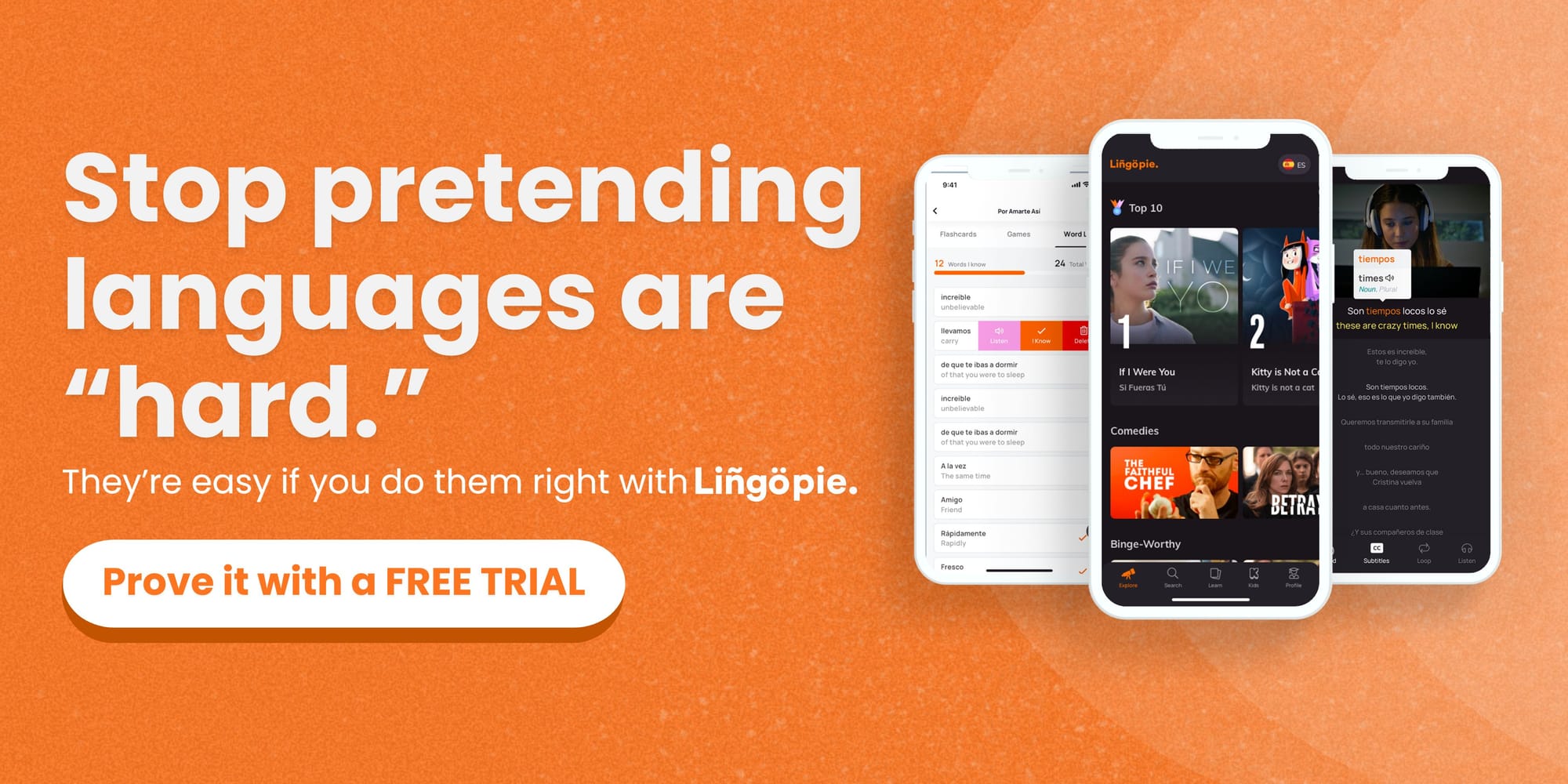
Everything in this article points to the same conclusion: vocabulary sticks when it arrives wrapped in real context, not stripped down to a word and a translation. Lingopie was built around that idea! Every show and movie in the library comes in its original form, with interactive subtitles in your target language, so new words show up the way they actually get used, inside jokes, arguments, casual asides, not textbook dialogue written to be easy.
If you've been stuck rebuilding the same flashcard deck for months, it might be worth spending that same time watching something good instead. Try Lingopie free and see how much vocabulary sinks in without a single drill.
FAQs
How many words do you need to know to be fluent in a language?
Most conversational fluency starts around 3,000 word families, though everyday conversation often relies on just a few hundred high-frequency words. If you're learning Spanish specifically, see how hard Spanish actually is to learn for a realistic timeline.
What is the best method for vocabulary retention?
Learning words inside real sentences and revisiting them through spaced repetition beats memorizing isolated word lists. For a hands-on breakdown, check out how to practice Spanish vocabulary.
Can you learn a language just by watching TV?
Watching alone won't get you fluent, but pairing shows with target-language subtitles and active engagement builds real vocabulary and listening skills over time. It works best as one part of a broader routine, not the only one.
What is the difference between passive and active vocabulary?
Passive vocabulary is what you recognize when you hear or read it; active vocabulary is what you can recall and use unprompted in speech or writing. Most learners have a much larger passive vocabulary than an active one.
Does Lingopie work for complete beginners or only intermediate learners?
Lingopie works for both, since shows span multiple difficulty levels and interactive subtitles let beginners look up words without losing the plot. You can start with beginner-friendly content and explore Spanish learning resources as you progress.
Does Lingopie have a free trial?
Yes, Lingopie offers a free trial so you can test the platform before committing to a subscription. You can sign up directly on the Lingopie website.