
Ever learned a new word, only to forget what it means the next day? Turns out, how often you review a word matters just as much as learning it in the first place. A 2006 meta-analysis by Cepeda and colleagues reviewed 317 experiments and found that spreading out learning sessions helps people remember information longer than cramming. That's why many of the best vocabulary apps use spaced repetition and regular reviews to help new words stick.
However, not every app teaches vocabulary the same way. Some help you prep for English exams, while others use games, videos, or real conversations to make learning more engaging. So, which one is worth your time? We've rounded up 10 vocabulary apps, comparing their features, strengths, limitations, and prices to help you find the right fit.
Disclosure: Lingopie publishes this article and is one of the apps on this list. We evaluated it using the same criteria as the other apps.
Key Takeaways
- Vocabulary.com is best for English vocabulary, while Lingopie is our best pick for learning vocabulary in a new language.
- Spaced repetition, real-world examples, and adaptive practice help you learn and remember new words.
- Daily practice and regular reviews are more effective than memorizing large word lists at once.

Best Vocabulary Apps at a Glance
If you're looking for the best vocabulary apps, Vocabulary.com is our top pick for English vocabulary and test prep, thanks to its adaptive quizzes and personalized word practice. For learning a new language, Lingopie is our pick, especially if you want to learn vocabulary naturally through TV shows, interactive subtitles, and flashcards.
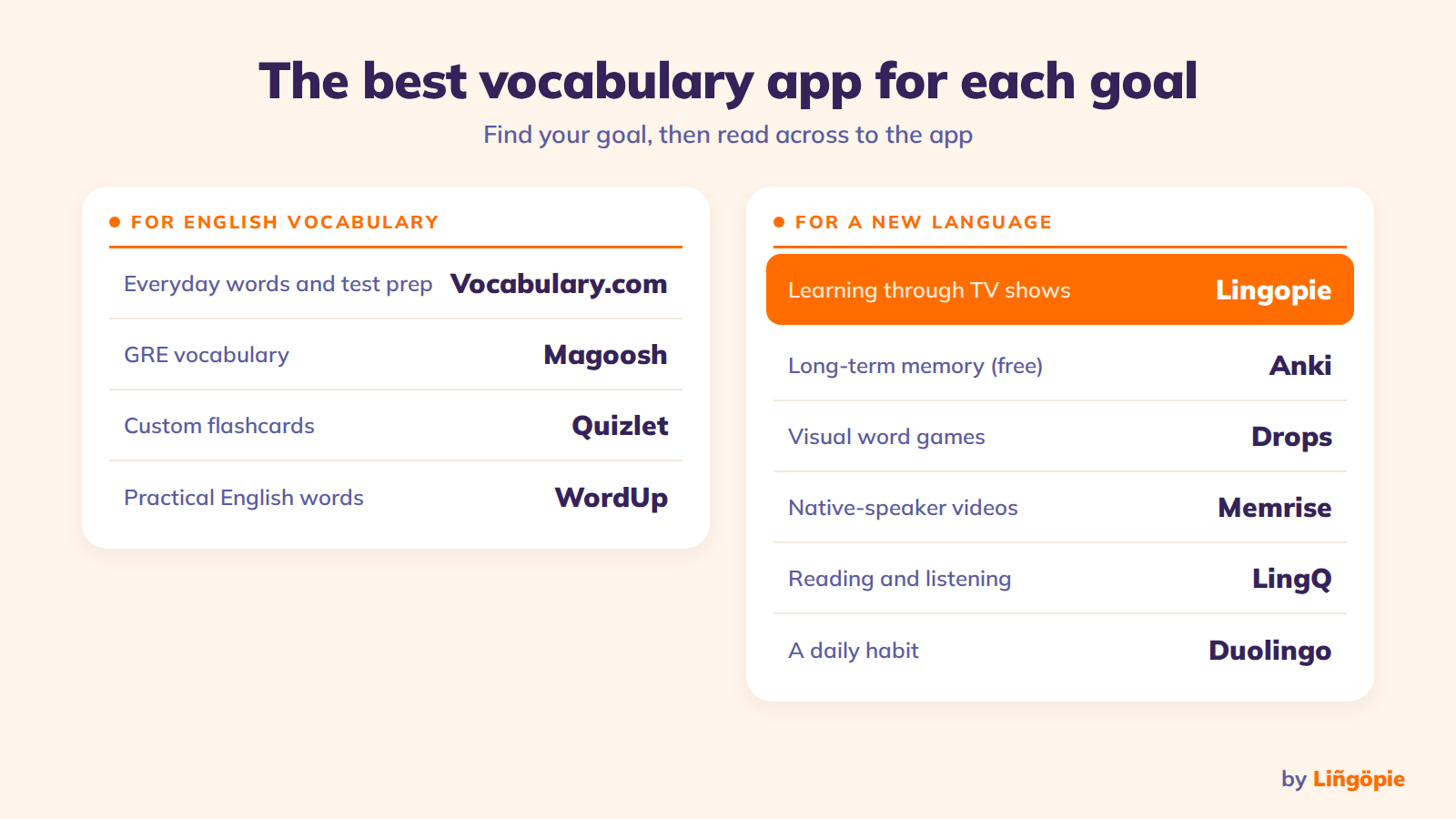
Of course, these aren't your only options. We've also included eight other vocabulary apps worth considering, each with its own strengths and limitations. To help you find the right fit, we've compared their learning methods, features, free versions, and pricing.
App | Best for | Best level | Learning method | Free version | Paid price (USD) |
|---|---|---|---|---|---|
Vocabulary.com | English vocabulary and test prep | Intermediate–advanced | Adaptive quizzes, word lists | 10 quiz questions/day | $59.99/year |
Magoosh GRE Vocabulary Flashcards | GRE vocabulary preparation | Advanced | Flashcards, spaced repetition | Fully free | Free |
Quizlet | Custom vocabulary flashcards | All levels | Flashcards, study sets, practice tests | Yes, with limits | Plus: $35.99/year |
WordUp | Practical English vocabulary | Intermediate–advanced | Knowledge Map, videos, examples | Yes, with limits | Regional pricing |
Anki | Long-term vocabulary retention | All levels | Custom flashcards, spaced repetition | Free on desktop, web, Android | iOS: $24.99 one-time |
Drops | Visual vocabulary learning | Beginner | Illustrated word games | 5 minutes every 10 hours | Varies by plan |
Memrise | Everyday vocabulary and pronunciation | Beginner–intermediate | Native-speaker videos, reviews | Yes, with limits | Varies by plan |
Duolingo | Daily vocabulary practice | Beginner | Gamified lessons, short exercises | Yes, with ads and limits | Super: regional pricing |
LingQ | Reading and listening vocabulary | Intermediate–advanced | Interactive reading, saved words | 20 saved words, 5 imports | $120/year |
Lingopie | Vocabulary through TV shows | Beginner–advanced | Interactive subtitles, flashcards | 7-day free trial | Varies by plan |
Prices checked in October 2026, in US dollars. They can change and may vary by country and app store.
How We Chose These Apps
To narrow down our picks, we compared each app's vocabulary exercises, review methods, free version limitations, and subscription prices using official product information, checked in October 2026. We also considered which learning goals and skill levels each app supports.
Best Vocabulary Apps for English and Test Prep
Did you know that you don't need to memorize every word in the dictionary to understand everyday conversations? According to research by linguist Paul Nation, knowing around 3,000 common word families can cover roughly 95% of the words used in spoken English. The trick is knowing which words to focus on and reviewing them often enough to remember them.
If you're looking to improve your English vocabulary, the right app can help you practice useful words, understand their meanings in context, and build stronger reading and writing skills. Here are four options worth considering, including apps designed specifically for exam preparation.
Vocabulary.com
Best for: Intermediate to advanced English learners, students, and test preparation.
Vocabulary.com makes learning new English words more interactive through adaptive quizzes and personalized practice. Instead of simply memorizing definitions, you answer questions about word meanings and usage examples. The app adjusts your practice based on your answers, giving you more opportunities to review words you haven't mastered yet.
It also includes Vocabulary Lists that let you study words related to books, school subjects, and standardized tests. You can also explore definitions, example sentences, and related words to build a stronger understanding of each word.
Pros
- Adaptive quizzes focus on words you find difficult.
- Thousands of ready-made word lists for books, school subjects, and exams.
- Concise explanations and instant feedback help reinforce learning.
- Progress measurement and vocabulary games make practice more enjoyable.
Cons
- The free version limits VocabTrainer to 10 questions per day.
- Focuses on English rather than learning multiple languages.
- Less suitable for practicing real-life speaking and conversation.
Magoosh GRE Vocabulary Flashcards
Best for: GRE Preparation
Preparing for the GRE? Magoosh GRE Vocabulary Flashcards helps you build vocabulary with expert-selected words commonly found on the exam. Each flashcard includes a definition and example sentence, so you can understand a word's meaning and how it's used in context.
Magoosh's biggest strength is its spaced repetition system. You rate how well you know each word, and the app brings back words you haven't mastered. It's a straightforward way to practice vocabulary regularly without creating your own word lists.
Pros
- Free access to GRE vocabulary flashcards.
- Organized word decks for different difficulty levels.
- Spaced repetition helps make vocab learning easier.
- Simple interface makes short learning sessions easy.
Cons
- Focuses on GRE vocabulary rather than everyday communication.
- Limited practice for pronunciation, speaking, and writing.
- Flashcards alone won't prepare you for every part of the GRE.
Quizlet
Best for: Students and English learners who want to create their own word lists and study sets.
Named one of TIME's 100 Most Influential Companies of 2026, Quizlet started in 2005 when 15-year-old Andrew Sutherland created a study tool for his French vocabulary test. Today, it lets learners make flashcards with words, definitions, and examples, or explore millions of study sets shared by other users.
Quizlet's biggest strength is its flexibility. You can practice English vocabulary, prepare for exams, or study other school subjects using flashcards and review activities. However, because much of its content is user-generated, some definitions may be inaccurate. It's a convenient tool for memorizing words, but less useful for learning how to use them naturally in conversations.
Pros
- Create and share personalized vocabulary flashcards.
- Large library of existing study sets.
- Supports different subjects and learning goals.
- Convenient for quick reviews on mobile or desktop.
Cons
- User-created sets may have incorrect definitions.
- Several advanced study features require a paid subscription.
- Less focused on teaching words in real-life conversations.
WordUp
Best for: Intermediate and advanced English learners who want to expand their everyday vocabulary.
Launched in 2019 by entrepreneurs Paymon Khamooshi and Somayeh Aghnia, WordUp has grown to over 6 million users worldwide. Its best feature is the Knowledge Map, which identifies the English words you already know and those you still need to learn. It then creates a personalized learning plan to help you focus on useful vocabulary rather than memorizing random words.
WordUp also goes beyond basic definitions by showing words in context through videos, usage examples, and pronunciation audio. This makes it easier to understand how words are actually used in everyday communication. Regular reviews help reinforce learning, although some features require a paid subscription.
Pros
- Knowledge Map helps identify words you need to learn.
- Real-world examples make word meanings easier to understand.
- Personalized practice supports different vocabulary levels.
- Audio pronunciation helps improve listening and speaking skills.
Cons
- Focuses on English rather than multiple languages.
- Some learning features require a paid subscription.
- Less suitable for complete beginners who need structured grammar lessons.
Best Vocabulary Apps for Learning a New Language
Ever learned a bunch of words in a new language, only to go blank when someone actually speaks to you? Knowing what a word means is one thing. Recognizing it in a conversation and knowing how to use it yourself is another.
That's why the right vocabulary app should help you learn words in context, hear how native speakers pronounce them, and practice regularly so they stick. Here are six apps worth trying to build vocabulary and improve your language skills.
Anki
Best for: Learners who want customizable flashcards and long-term vocabulary retention.
First released in 2006, Anki has become a popular flashcard app among language learners who want to remember vocabulary long-term. Its biggest strength is spaced repetition, which schedules reviews based on how well you remember each flashcard. You rate each answer as Again, Hard, Good, or Easy, and Anki uses that feedback to decide when you should review the word next.
One of Anki's biggest advantages is its flexibility. You can make flashcards with definitions, audio recordings of pronunciation, images, and words in context, or download shared decks for your target language. It's especially useful for learners who want to build vocabulary at their own pace, though setting up and organizing cards can take some effort.
Pros
- Spaced repetition helps words stick and improve long-term recall.
- Customizable flashcards with audio, images, and example sentences.
- Large collection of shared vocabulary decks.
- Supports virtually any language and learning level.
Cons
- Interface and settings can feel complicated for beginners.
- Creating quality flashcards takes time.
- Limited built-in lessons for grammar, speaking, and everyday communication.
Lingopie
Best for: Learners at any level, especially from A2, who want to learn new words through real conversations.
Ever picked up a new word while watching a TV show and remembered it better than something you studied in a textbook? That's the idea behind Lingopie. Instead of memorizing word lists, you learn vocabulary through TV shows and movies in 17 languages, including Spanish, French, Italian, Japanese, and Korean.
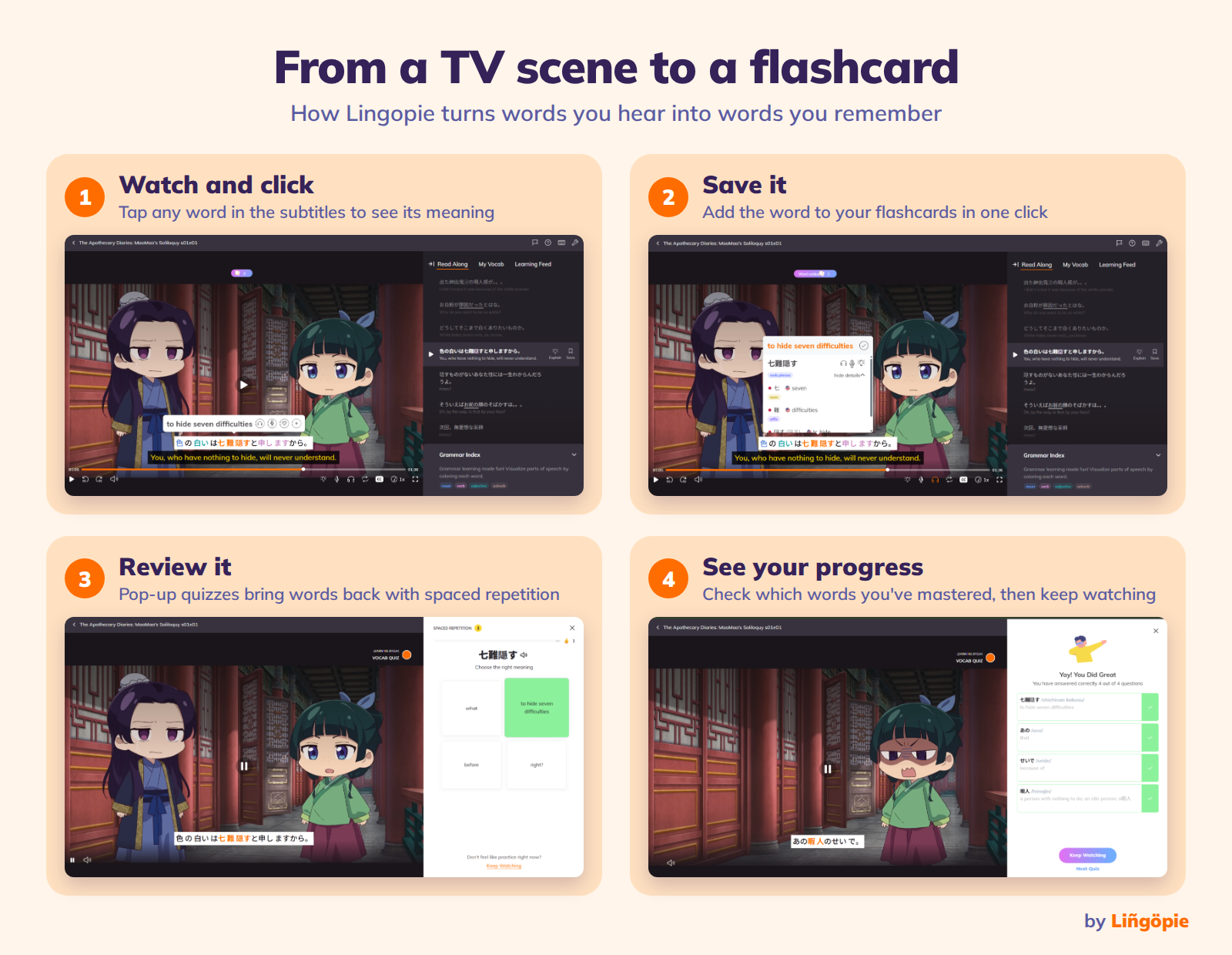
What makes Lingopie stand out is its dual interactive subtitles. You can click an unfamiliar word to see its meaning and save it for later. Those saved words become flashcards, and you can practice them through spaced repetition and vocabulary games. This helps you understand words in context, hear how native speakers use them, and reinforce what you've learned.
Research supports learning words this way. A review of 49 experiments found that learners picked up more vocabulary when videos had same-language captions (Kurokawa, Hein & Uchihara, 2025). In a study of 227 learners, captions that translated key words led to more than double the recall of word meanings compared with standard captions (Montero Perez, Peters & Desmet, 2018). These studies tested captioned video in general, not Lingopie itself.
Pros
- Real TV shows and movies teach vocabulary within meaningful contexts.
- Dual subtitles and instant translations make unfamiliar words easier to understand.
- Flashcards and vocabulary games help reinforce learning.
- Supports 17 languages and different learning levels.
Cons
- Not ideal for learners who prefer structured, grammar-first lessons.
- Full access requires a paid subscription after the trial (see plans and pricing).
- Watching videos alone won't provide enough speaking practice.
Drops
Best for: Beginners and visual learners who enjoy quick, game-based vocabulary practice.
Drops takes a visual approach to learning vocabulary. Instead of studying traditional flashcards, you match words with illustrations, swipe through quick exercises, and listen to audio pronunciations. The activities are simple and engaging, especially if you find memorizing word lists boring.
One useful factor to consider is how little time Drops asks of you. Five minutes is enough to complete a practice session, and the vocabulary covers practical topics like food, travel, and everyday communication.
However, there's a trade-off: you'll learn plenty of individual words, but get limited practice putting them into sentences or using them in real conversations. That makes Drops a useful vocabulary-building tool, but not a complete language course.
Pros
- Visual games make learning new vocabulary engaging.
- Short lessons make it easier to practice regularly.
- Vocabulary organized by practical, everyday topics.
- Audio pronunciation supports listening practice.
Cons
- Free users get only five minutes of practice every 10 hours.
- Limited grammar instruction and conversation practice.
- Picture-based exercises offer less depth for advanced learners.
Memrise
Best for: Beginners and intermediate learners who want to improve vocabulary, listening, and pronunciation.
Founded in 2010 by Ed Cooke, Ben Whately, and Greg Detre, Memrise was built around the idea that learning a language should reflect how people actually speak. Its top feature is its collection of native-speaker videos, which let you hear new vocabulary in real conversations rather than relying on textbook pronunciations.
Memrise combines these videos with spaced repetition, personalized lessons, and AI conversation practice. You can learn useful words and phrases, go over them at regular intervals, and practice saying them aloud. The videos are particularly helpful for understanding different accents and how words sound in everyday communication. However, Memrise is less comprehensive in its grammar instruction, so it works best alongside other learning tools.
Pros
- Native-speaker videos teach vocabulary through meaningful contexts.
- Spaced repetition helps improve word learning.
- Personalized lessons cover useful words and everyday phrases.
- AI conversations provide additional speaking practice.
Cons
- Limited grammar explanations compared with structured language courses.
- Free version restricts access to vocabulary lessons, videos, and conversations.
- Some speaking features and full word lists require a paid subscription.
LingQ
Best for: Intermediate and advanced learners who want to improve vocabulary and reading skills using real-world content.
Comprehensible input is the idea that you learn a language by reading and listening to material you can mostly understand. It's the approach behind LingQ, a language-learning app founded by polyglot Steve Kaufmann and his son Mark in 2007. Rather than following traditional lessons, you build vocabulary through stories, podcasts, articles, and other content in your target language.
LingQ makes this process easier with its interactive reader. Unfamiliar words are highlighted, and you can tap them to see translations, save them, and track how well you know them. You can even import content you're interested in, making it useful for exploring words in relevant contexts. The downside: LingQ requires more independent learning, especially if you're used to guided lessons and games.
Pros
- Learn vocabulary through authentic reading and listening materials.
- Save unfamiliar words and track your vocabulary growth.
- Import articles, podcasts, and other content that interests you.
- Supports more than 50 languages.
Cons
- Less structured than traditional language-learning apps.
- Can feel overwhelming for complete beginners.
- Free version has strict limits on saved words and imported lessons.
- Limited guided speaking and grammar practice.
Duolingo
Best for: Beginners and casual learners who enjoy short, game-based language lessons.
With its sassy green owl mascot, Duo, reminding you to keep your streak alive, Duolingo makes learning vocabulary seem like a game. Its bite-sized lessons combine word matching, translations, listening exercises, and speaking activities with XP points, rewards, and daily streaks. You also get instant feedback on your answers, making it easy to practice vocabulary and track your progress.
Duolingo sometimes uses funny or unusual sentences to make vocabulary and grammar more memorable. While these exercises can help words stick, they don't always reflect how people speak in everyday conversations. That's why it's worth combining Duolingo with listening and speaking practice.
Pros
- Fun, gamified lessons encourage daily vocabulary practice.
- Short exercises are easy to fit into a busy schedule.
- Repeated exposure helps reinforce new words.
- Free version offers access to language courses.
Cons
- Ads and usage restrictions can interrupt free lessons.
- Limited practice with spontaneous, real-world conversations.
- Less suitable as a standalone resource for advanced learners.
What Makes a Vocabulary App Effective
The best vocabulary apps do more than teach new words. They help you remember what you've learned and understand how to use those words correctly. Here are three features worth looking for.
Spaced repetition
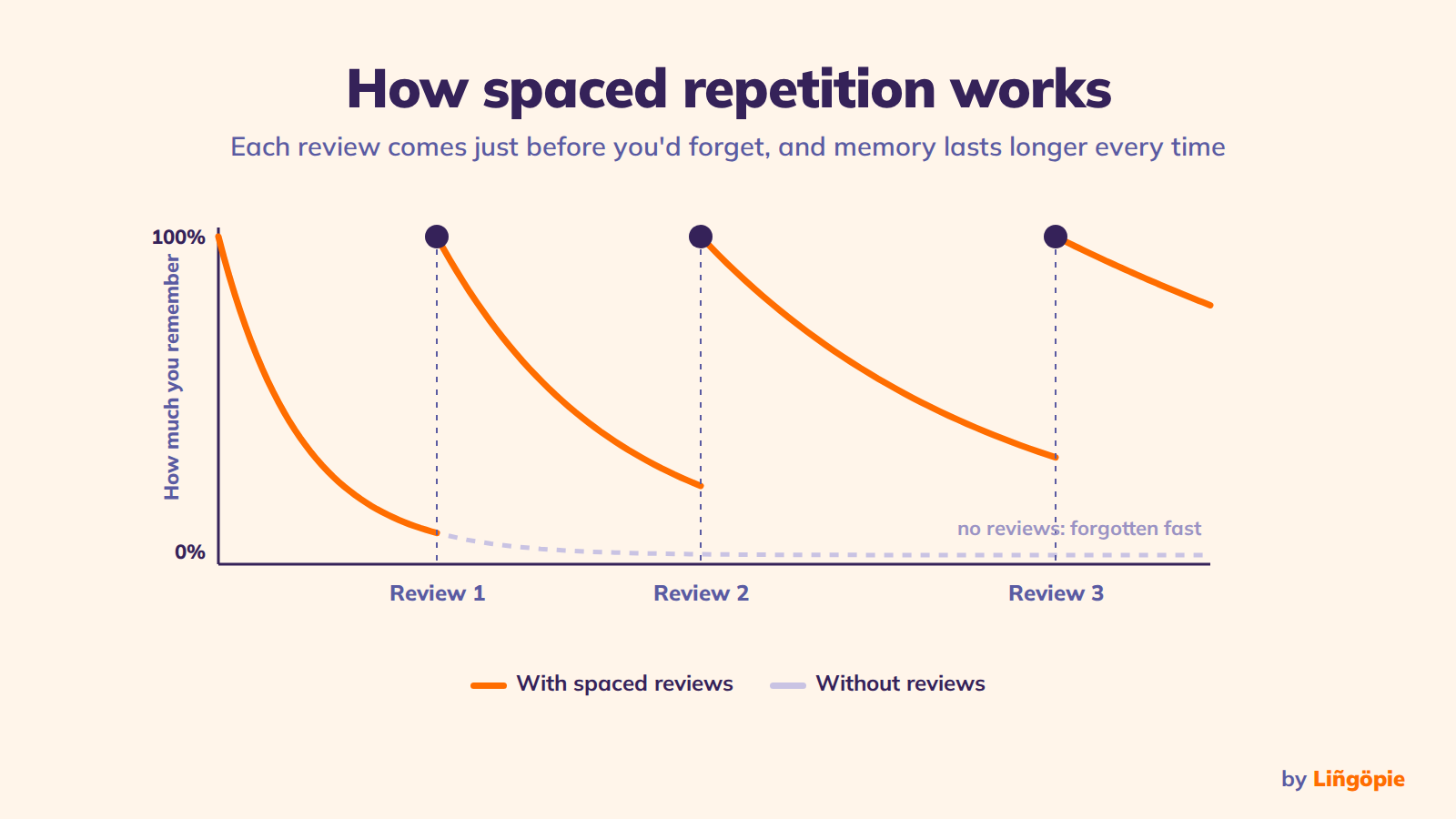
Spaced repetition brings back words at increasing intervals instead of making you review everything at once. This helps strengthen long-term memory and gives you extra practice with words you tend to forget.
Context and example sentences
Knowing a word's definition isn't always enough. Example sentences, videos, and real conversations show you how a word is used, including its meaning, tone, and common expressions.
Adaptive practice
Adaptive practice adjusts exercises based on your progress. If you keep getting a word wrong, you'll see it more often. Words you've already mastered need less attention, so you can focus on vocabulary that still needs work.
How to Choose the Right Vocabulary App for Your Goal
The right vocabulary app depends on what you're trying to achieve. Some are better for memorizing English words, while others help you understand vocabulary through reading, listening, or real conversations.
Here's a quick guide to help you choose.
If you want to... | Try... |
|---|---|
Improve your English vocabulary | Vocabulary.com or WordUp |
Prepare for the GRE | Magoosh GRE Vocabulary Flashcards |
Create your own vocabulary lists | Quizlet or Anki |
Remember new words long-term | Anki |
Learn vocabulary through TV shows | Lingopie |
Practice with native-speaker videos | Memrise |
Learn words through reading and listening | LingQ |
Build a daily learning habit | Duolingo |
Learn basic vocabulary through visual games | Drops |
Before paying for a subscription, try the free version or trial. Check if the lessons suit your level, the exercises match your learning style, and the app offers enough practice to keep you interested. If you want a full language course rather than a vocabulary tool, see our guide to the best language learning programs.
How to Make Vocabulary Practice a Daily Habit
You don't need to spend hours memorizing words. A few minutes of focused practice every day can help you build vocabulary more consistently.
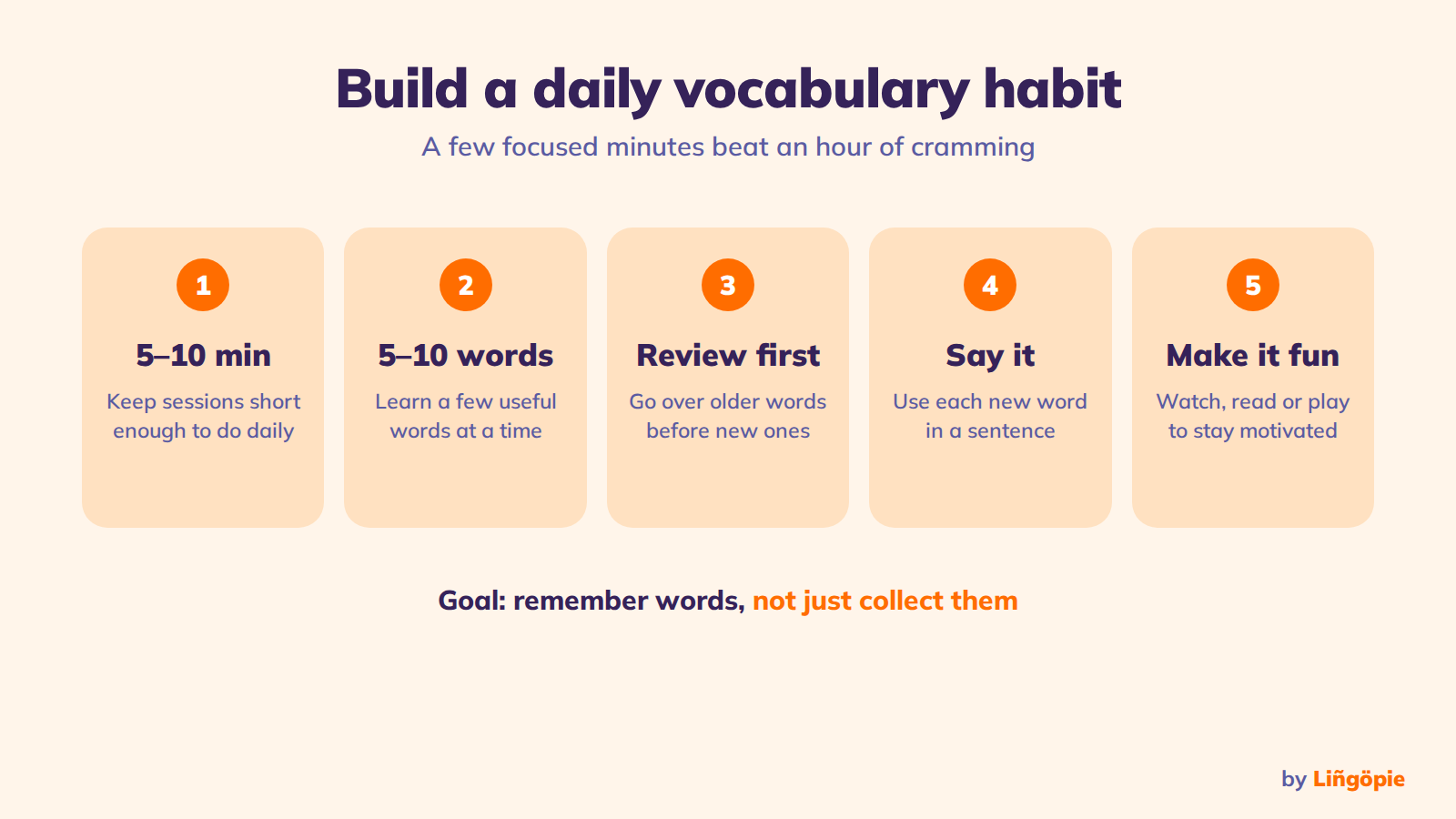
- Start with 5–10 minutes a day. Keep your sessions short enough to fit into your routine.
- Learn 5–10 useful words at a time. Focus on vocabulary you're likely to encounter in conversations, reading, or work.
- Review older words regularly. Use spaced repetition or flashcards so you don't forget what you've already learned.
- Use new words in sentences. Write a short sentence or say one aloud to practice using each word correctly.
- Make practice enjoyable. Watch a short video, read something interesting, or play a vocabulary game to keep yourself motivated.
The goal isn't to memorize as many words as possible in one sitting. It's to remember them and feel confident using them when you need them. For more research-backed tips, see how to learn a language fast.
FAQ
What is the best free vocabulary app?
Anki is best for long-term vocabulary retention and is free on desktop, web, and Android. Magoosh GRE Vocabulary Flashcards is completely free for GRE preparation, while Drops offers free five-minute sessions every 10 hours.
How do spaced repetition apps help you remember words?
Spaced repetition apps help you remember words by scheduling reviews at increasing intervals. A 2006 meta-analysis by Cepeda and colleagues found that spacing out study sessions improves long-term retention.
How many new words should I learn per day?
Start with 5–10 new words a day, or fewer if you're a beginner. Focus on reviewing older words before adding more.
Can vocabulary apps improve reading comprehension?
Yes. Vocabulary apps can improve reading comprehension by teaching word meanings and usage examples. Research by Hu and Nation (2000) shows that understanding more words in a text supports better reading comprehension.
Are vocabulary apps enough to become fluent?
No. Vocabulary apps help you remember words, but fluency also requires listening, speaking, and reading practice. Combine them with books, TV shows, podcasts, and real conversations.
Should I use one vocabulary app or several?
Start with one app for flashcards and vocabulary reviews, then add another for reading, listening, or watching content in your target language.
Do vocabulary apps actually work?
Yes. A 2006 meta-analysis supports spaced repetition for long-term retention, while a 2024 study of 86 university students (Heliyon, 2024) found that digital flashcards improved vocabulary learning compared with paper flashcards and word lists. However, you'll still need real-world practice to use those words confidently.
The Bottom Line
The best vocabulary app depends on your learning goals and how you prefer to practice. If you're improving your English vocabulary, Vocabulary.com is a great place to start. For long-term memorization, Anki is hard to beat. But if you're learning a new language, Lingopie is our top pick for understanding how words are used in real conversations.
Want to learn vocabulary without memorizing endless word lists? Try Lingopie and discover new words through TV shows and movies, save them with interactive subtitles, and review them with flashcards. Start your 7-day free trial and see how much you can learn while watching something you enjoy.