


With around 321 million speakers, French is the 5th most widely spoken language in the world, according to the Organisation internationale de la Francophonie (OIF), so it’s easy to see why so many people want to learn it. But as nice as it would be to snap your fingers, say voilà!, and suddenly speak fluent French, it doesn’t quite work that way. One of the biggest hurdles? The French grammar, especially all those verbs and their ever-changing endings.
That’s why we’re taking French verb groups one at a time, starting with French -RE verbs. This guide breaks down French -RE verb conjugation, including regular patterns, irregular verbs, pronunciation, common examples, and key tenses. By the end, you’ll know the rules, spot the patterns, and actually know what to do when an -RE verb shows up.
Key Takeaways
- Regular French -RE verbs follow a predictable pattern: drop -re and add -s, -s, nothing, -ons, -ez, or -ent.
- Not all -RE verbs are regular: être, faire, prendre, mettre, boire, and dire all follow their own patterns, and many irregular verbs come in families that share a stem change.
- -RE verb pronunciation often differs from spelling because several written endings and final consonants are silent.
- French -RE verbs change across tenses, with different patterns for the passé composé, imparfait, and futur simple.

What Are French -RE Verbs?
French -RE verbs are verbs whose infinitive form, or dictionary form, ends in -re. Reference grammars such as the Bescherelle place them in the third of the three main French verb groups. The first group mainly contains regular -er verbs, the second regular -ir verbs, and the third group includes -RE verbs plus several other verb types. You may also see this group called verbes du troisième groupe.
But the infinitive ending alone does not tell you how a verb behaves. Some -RE verbs follow a standard pattern, while irregular ones have their own stem changes or conjugation patterns.
Common regular-pattern examples include:
- vendre — to sell
- attendre — to wait
- perdre — to lose
- répondre — to answer
- entendre — to hear
- descendre — to go down or descend
For these regular verbs, remove the final -re to find the verb stem, then add the appropriate ending. Vendre, for example, gives you vend-. Irregular verbs such as prendre (to take), mettre (to put), dire (to say), and boire (to drink), and even the two most common French verbs, être (to be) and faire (to do or make), do not follow that same pattern consistently.
So the best learning order is simple: master the regular pattern first, then learn the major irregular families.
How to Conjugate Regular French -RE Verbs in the Present Tense
Wondering how to conjugate -RE verbs in French? Regular -RE verbs use a two-step process: remove the final -re, then add the ending that matches the subject.
With vendre (to sell): vendre → vend- → add the correct ending.
Subject | Ending | Vendre | English |
|---|---|---|---|
je | -s | je vends | I sell |
tu | -s | tu vends | you sell |
il / elle / on | — | il vend | he sells |
nous | -ons | nous vendons | we sell |
vous | -ez | vous vendez | you sell |
ils / elles | -ent | ils vendent | they sell |
The basic present-tense pattern for regular -RE verbs is therefore -s, -s, nothing, -ons, -ez, -ent. For regular -RE verbs, the je and tu forms both take -s, while the third-person singular form takes no extra ending. The nous form takes -ons, the vous form takes -ez, and the plural third person takes -ent.
What Happens With the Singular Forms?
The singular forms are easy to spot: je vends, tu vends, il vend. The stem stays the same, and only the conjugation endings change. The same rule gives you j’attends, tu attends, and elle attend. In everyday French, on also uses the third-person singular form and is often used to mean “we.”
What About the Plural Forms?
For the plural forms, add -ons, -ez, or -ent: nous vendons, vous vendez, ils vendent. Once you know these endings, you can choose the appropriate ending for many regular verbs without memorizing six unrelated forms.
To make the grammar practical, imagine you sell books online and at a weekend market in Paris: Je vends des livres en ligne et au marché le samedi (I sell books online and at the market on Saturdays). The sentence uses the same simple rule: vend- + -s for je.
How Are French -RE Verbs Pronounced?
Here’s where pronunciation gets interesting: the written form and spoken form do not always match. In je vends, tu vends, and il vend, the final consonants are silent, so the three conjugated forms sound the same in standard Metropolitan French. The subject pronoun tells you who is doing the action.
Form | What to notice | Sounds like (IPA) |
|---|---|---|
je vends | final consonants are silent | /ʒə vɑ̃/ |
tu vends | final consonants are silent | /ty vɑ̃/ |
il / elle / on vend | final d is silent | /il vɑ̃/ |
nous vendons | -ons is pronounced | /nu vɑ̃dɔ̃/ |
vous vendez | -ez is pronounced | /vu vɑ̃de/ |
ils / elles vendent | -ent is silent; the stem-final d is heard | /il vɑ̃d/ |
That last contrast matters. In il vend, the final d is silent, while in ils vendent the consonant is heard even though the written -ent is silent. You’ll notice a similar contrast with il attend / ils attendent and il répond / ils répondent.
Two more things to watch for. In questions with inversion, the silent d is pronounced as a [t] through liaison: vend-il? sounds like /vɑ̃.til/ (“von-teel”). And with prendre, the vowel itself changes in the plural: il prend /il pʁɑ̃/ has a nasal vowel, while ils prennent /il pʁɛn/ sounds like “pren.”
Accents also vary across the French language. Quebec French can differ from Metropolitan French in vowel quality and rhythm, and you will hear other regional accents in Belgium and Switzerland. Those differences do not change the verb conjugation rules, so focus first on recognizing the stem, subject, and ending even when a native speaker’s accent sounds unfamiliar.
Want to train your ear? With Lingopie, you can hear French in real shows while following along with interactive subtitles, making it easier to connect what you see on the page with what you actually hear.
Common Regular French -RE Verbs to Learn First
You do not need a giant verb list to get started. These common regular -RE verbs follow the same basic pattern as vendre, making them useful for building vocabulary without learning a new conjugation system each time.
French -RE verb | Meaning | Present-tense example |
|---|---|---|
rendre | to return / give back | je rends |
tondre | to mow | il tond la pelouse |
défendre | to defend / forbid | nous défendons |
fondre | to melt | la glace fond |
mordre | to bite | le chien mord |
confondre | to confuse / mix up | je confonds |
tendre | to stretch / hold out | vous tendez |
pendre | to hang | il pend |
répandre | to spread / spill | ils répandent |
prétendre | to claim | elle prétend |
dépendre | to depend | ça dépend |
correspondre | to correspond / match | cela correspond |
A few examples show how these forms work in context:
- Le chocolat fond au soleil. — The chocolate melts in the sun.
- J’entends la musique des voisins. — I hear the neighbors’ music.
- Je rends les clés demain. — I’m returning the keys tomorrow.
- Ça dépend du prix. — It depends on the price.
These examples are a good starting point, but verbs tend to stick better when you hear them used in real conversations. In [Show name], for example, a character snaps “J’attends depuis une heure !” (I’ve been waiting for an hour!). On Lingopie, you can click attends in the subtitles to see what it means, then save it as a flashcard to review later. Hearing the same forms in real scenes helps connect grammar with the way native speakers actually use them.
Irregular French -RE Verbs and Their Patterns
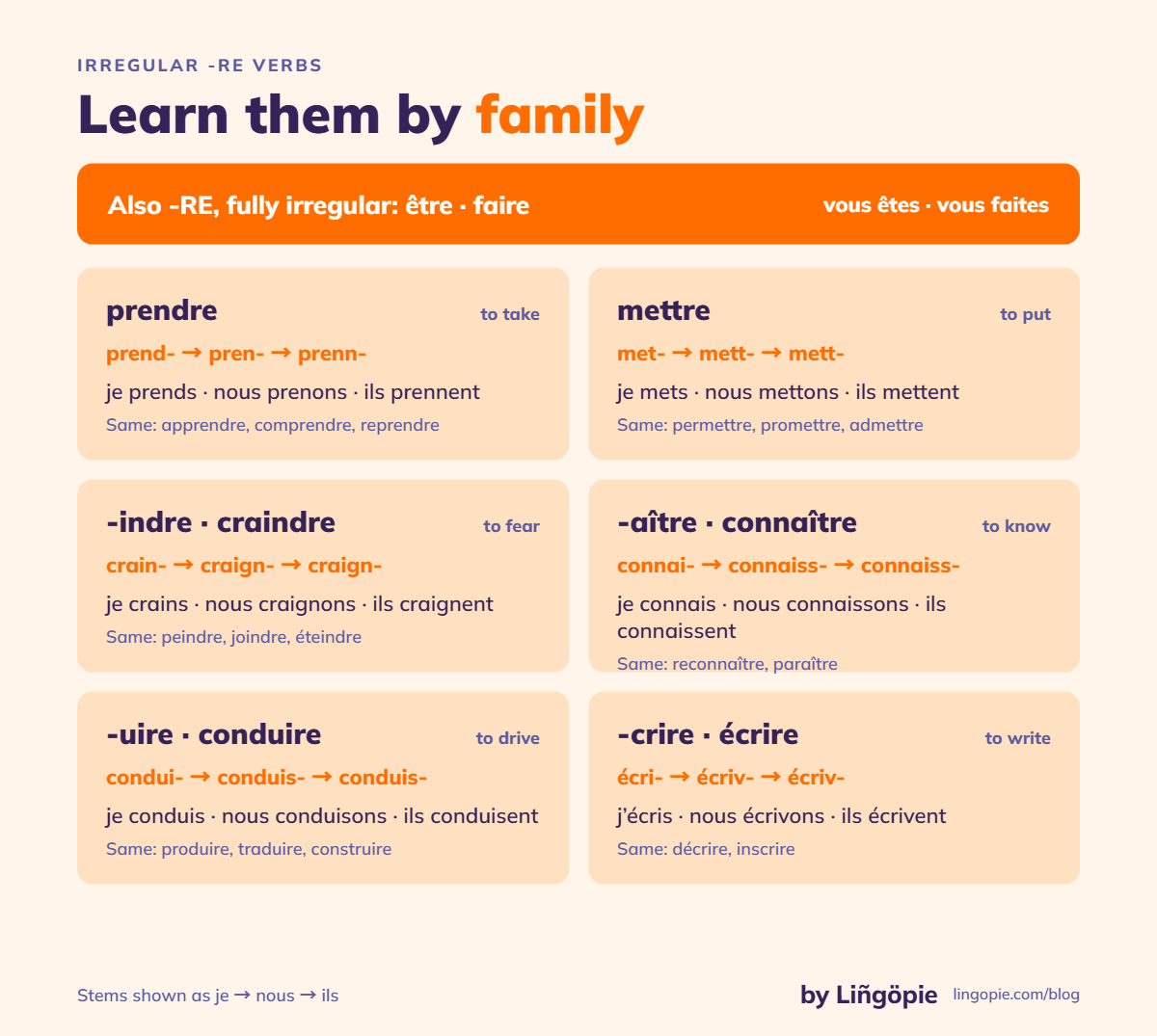
Once the regular pattern feels familiar, it’s time for the verbs considered irregular. Fortunately, irregular -RE verbs are not all random. Many belong to families that share the same stem changes.
Four common French -RE verbs worth learning early are prendre (to take), mettre (to put), boire (to drink), and dire (to say or tell):
Subject | Prendre | Mettre | Boire | Dire |
|---|---|---|---|---|
je | prends | mets | bois | dis |
tu | prends | mets | bois | dis |
il / elle / on | prend | met | boit | dit |
nous | prenons | mettons | buvons | disons |
vous | prenez | mettez | buvez | dites |
ils / elles | prennent | mettent | boivent | disent |
Do not try to force these into the standard regular pattern. Instead, compare the singular, nous, vous, and ils/elles forms and look for the stem change.
The Prendre Family
Prendre gives you je prends, tu prends, il prend, nous prenons, vous prenez, and ils prennent. The d disappears in nous and vous, while the ils/elles form doubles the n. Several prendre family verbs follow the same core pattern: apprendre (to learn), comprendre (to understand), and reprendre (to take again or resume). If you can conjugate prendre, you already have a map for several related verbs.
The Mettre Family
Mettre gives you je mets, tu mets, il met, nous mettons, vous mettez, and ils mettent. The double tt appears in the plural forms. Useful mettre family verbs include permettre (to allow), promettre (to promise), admettre (to admit), soumettre (to submit), and transmettre (to pass on or transmit).
What Happens With Boire and Dire?
Boire shifts among boi- → buv- → boiv-: je bois, nous buvons, ils boivent. Dire has another unique pattern: je dis, nous disons, vous dites, ils disent. The form to remember is vous dites, not vous disez.
Some verbs derived from dire also vary. Redire has vous redites, while prédire and interdire use vous prédisez and vous interdisez. This is a good reminder that verb families are useful shortcuts, not permission to guess every form.
What Other Irregular -RE Verbs Should You Know?
Two of the most frequent verbs in French, être (to be) and faire (to do or make), also end in -re. Both are highly irregular and are usually learned on their own: je suis, tu es, il est, nous sommes, vous êtes, ils sont / je fais, tu fais, il fait, nous faisons, vous faites, ils font. Notice that vous faites follows the same -tes ending as vous dites.
Several other common -RE verbs come in families with a shared stem change:
Family | Example | je | nous | ils / elles | Related verbs |
|---|---|---|---|---|---|
-indre | craindre (to fear) | crains | craignons | craignent | peindre, joindre, éteindre |
-aître | connaître (to know) | connais | connaissons | connaissent | reconnaître, paraître |
-uire | conduire (to drive) | conduis | conduisons | conduisent | produire, traduire, construire |
-crire | écrire (to write) | écris | écrivons | écrivent | décrire, inscrire |
-ttre | battre (to beat) | bats | battons | battent | combattre, débattre |
croire | croire (to believe) | crois | croyons | croient | — |
lire | lire (to read) | lis | lisons | lisent | relire, élire |
For regular practice, learn irregular verbs by family and put them into short sentences. Je prends le métro à Montréal (I take the metro in Montreal) is easier to remember than an isolated form because it connects meaning, place, and conjugation.
Still getting tripped up by irregular verbs? Lingopie lets you encounter them naturally in French shows and movies, so repeated exposure does some of the memorizing for you.
French -RE Verbs in the Passé Composé
The passé composé is a common past tense for completed actions. For -RE verbs in the passé composé, use a helping verb, or auxiliary, plus the past participle: subject + avoir or être + past participle
Most regular -RE verbs use avoir. Their past participle usually follows another simple pattern: remove -re and add -u. For example, vendre → vendu, attendre → attendu, and perdre → perdu. So j’ai vendu means “I sold,” while nous avons vendu means “we sold.”
What About Irregular Past Participles?
Verb | Past participle | Example |
|---|---|---|
prendre | pris | j’ai pris |
mettre | mis | j’ai mis |
boire | bu | j’ai bu |
dire | dit | j’ai dit |
être | été | j’ai été |
faire | fait | j’ai fait |
naître | né | je suis né(e) |
The structure has not changed: you still use an auxiliary plus a past participle. What changes is the participle itself, so these irregular forms need to be learned separately.
Why Can Descendre Use Both Être and Avoir?
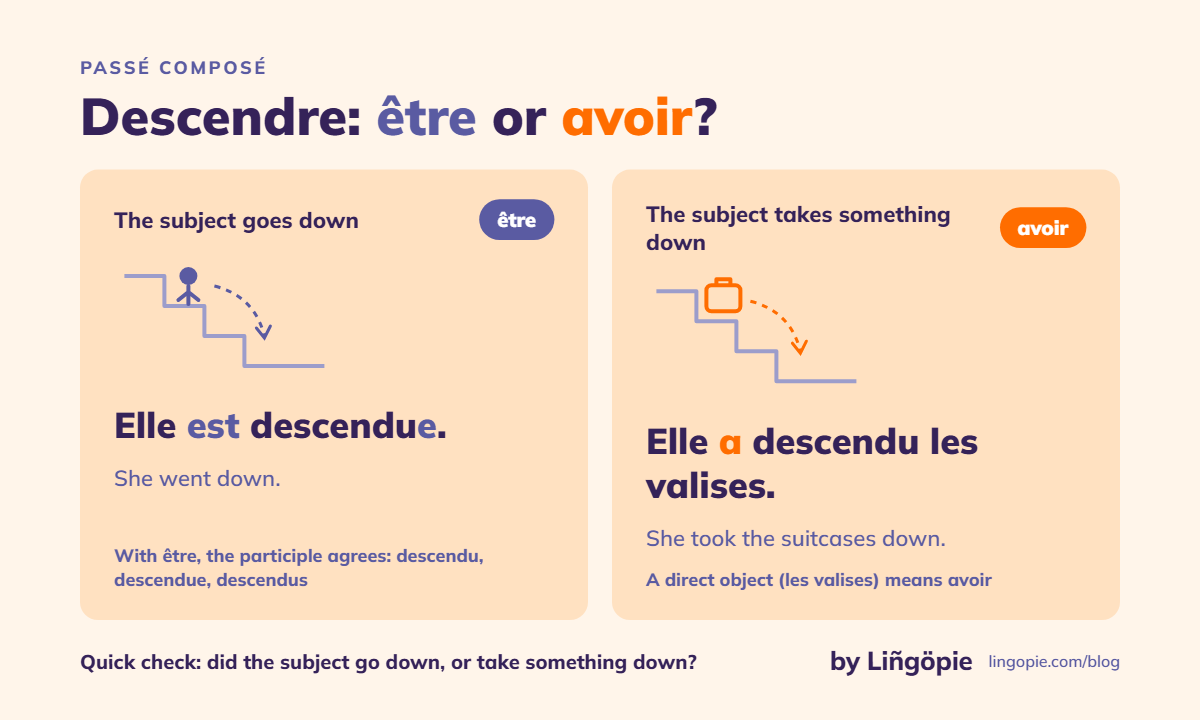
Descendre is a good way to understand when to use être vs. avoir. When the subject itself goes down, use être: Elle est descendue (She went down). Notice the extra -e on descendue: with être, the past participle agrees with the subject (il est descendu, elle est descendue, ils sont descendus).
When the subject takes something else down, descendre takes a direct object and uses avoir: Elle a descendu les valises (She took the suitcases down). A quick check is to ask: did the subject go down, or did the subject take something down?
Which Other -RE Verbs Use Être?
Descendre is not the only one. Naître (to be born) always takes être: je suis né (I was born). And every pronominal -RE verb, the ones used with a reflexive pronoun, takes être too: elle s’est perdue (she got lost), nous nous sommes rendus à Paris (we went to Paris), ils se sont entendus (they got along). The same agreement rule applies.
For -RE verbs in the passé composé, remember three things: use an auxiliary + past participle, expect -u with many regular -RE verbs, and learn the important exceptions, including the verbs that take être.
French -RE Verbs in the Imparfait and Futur Simple
Once you know the present and passé composé, two more useful tenses are the imparfait and futur simple. They let you describe what used to happen and what will happen.
How Do -RE Verbs Work in the Imparfait?
The imparfait is used for ongoing or repeated actions in the past, descriptions, and habits. Think “was doing” or “used to do.” Start with the present-tense nous form, remove -ons, then add -ais, -ais, -ait, -ions, -iez, -aient.
For example: nous vendons → vend- → je vendais. Je vendais des livres quand j’étais étudiant à Lyon means “I used to sell books when I was a student in Lyon.” The same process works with many irregular verbs because the stem comes from the nous form: nous prenons → pren- → je prenais.
How Do -RE Verbs Work in the Futur Simple?
The futur simple works differently. For regular -RE verbs, remove only the final -e and add -ai, -as, -a, -ons, -ez, -ont. That gives you vendre → vendr- → je vendrai.
Nous vendrons nos vieux livres en ligne demain means “We will sell our old books online tomorrow.” Good news: most irregular -RE verbs still follow this rule in the futur simple: prendre → je prendrai, mettre → je mettrai, dire → je dirai, boire → je boirai. The big exceptions are être (je serai) and faire (je ferai).
The easiest distinction is this: the imparfait looks back at an ongoing or repeated past situation, while the futur simple looks ahead to what will happen.
How to Use French -RE Verbs Naturally
Knowing the correct conjugation is only part of speaking naturally. Many verbs in French come with particular prepositions or sentence structures, and their meaning can shift with context.
Répondre normally uses à before the person or thing being answered: Je réponds à Marie and Il répond à la question. Attendre, however, takes its object directly: J’attends mon ami. French does not add the equivalent of the English “for” here.
Rendre also changes with context. Rendre un livre means “to return a book,” while rendre visite à quelqu’un means “to visit someone.” Learning the whole phrase is more useful than memorizing only an English translation.
Descendre, covered in the passé composé section above, is the clearest example: the same verb means “get off” in elle descend du train and “take down” in elle a descendu les valises.
These examples point to a useful habit: learn the verb together with its preposition, common phrase, or sentence pattern. That gives you grammar you can actually use in everyday conversation, not just a list of isolated translations.
How to Learn French -RE Verbs Faster
If you want to learn -RE verbs without drowning in tables, focus on patterns and active recall. A little regular practice is more useful than one long memorization session.
- Group verbs by pattern. Learn regular verbs together, then study irregular families such as prendre and mettre. This makes -RE verb conjugations easier to predict.
- Learn verbs in sample sentences. Instead of memorizing only attendre = to wait, learn J’attends le bus. You get meaning, context, and conjugation at the same time.
- Say the forms aloud. Because final consonants and written endings are not always pronounced, speaking helps connect what you hear with the spelling you see.
- Hack your forgetting curve. Review each form right before you’d forget it: put an infinitive and subject on the front of a flashcard and produce the conjugated form before checking the answer.
- Listen to different kinds of French. Use French podcasts, shows, films, or interviews from France, Quebec, Belgium, and Switzerland. Try to identify the subject, tense, and verb before checking subtitles or a transcript.
- Use structured resources when helpful. Alliance Française centers and local language schools can give you speaking practice and exposure to teachers or learners from different Francophone backgrounds.
Most importantly, practice retrieving the form instead of simply rereading it. Seeing prendre → prends ten times can feel productive, but producing je prends without looking is a better test of what you actually know. Research backs this up: in a well-known study on retrieval practice, Roediger and Karpicke (2006) found that students who tested themselves remembered more a week later than students who reread the same material.
Practice: Test Yourself on French -RE Verbs
Fill in each blank with the correct form, then check your answers below. Try to say each sentence aloud too.
- Nous ______ (attendre) le bus.
- Elle ______ (prendre) un café chaque matin.
- Vous ______ (dire) toujours la vérité.
- Ils ______ (écrire) des messages à leurs amis.
- Hier, ils ______ (vendre) leur voiture. (passé composé)
- Elle ______ (descendre) du train à 8 h. (passé composé)
- Demain, je ______ (mettre) un manteau. (futur simple)
Answers: 1. attendons · 2. prend · 3. dites · 4. écrivent · 5. ont vendu · 6. est descendue · 7. mettrai
Final Thoughts on French -RE Verbs
French -RE verbs look less intimidating once you separate the regular pattern from the irregular families. Start with the present-tense endings, connect the written forms with pronunciation, then build into the passé composé, imparfait, and futur simple.
You do not need to master every verb at once. If you want to learn French -RE verbs efficiently, look for patterns, learn useful phrases in context, and keep listening to French from different parts of the Francophone world. With repetition, forms such as je vends, nous prenons, and vous dites stop feeling like rules to decode and start feeling like French you can actually use.
Put Your French Into Practice With Lingopie
Knowing the rules is a great start, but the real test is recognizing French when it’s spoken at natural speed. Lingopie bridges that gap by turning French TV shows and movies into an interactive learning experience, with clickable subtitles that help you understand unfamiliar words without constantly interrupting what you’re watching.
Choose something you actually want to watch from a library of 5,000+ shows, podcasts and books, sharpen your listening skills, and pick up French as it’s used on screen. Around 10 minutes a day is enough to start hearing -RE verbs everywhere. And since Lingopie offers a 7-day free trial, you can see if this style of learning works for you before committing.
Start your 7-day free trial with Lingopie and put your French into practice.
Frequently Asked Questions About French -RE Verbs
Are All French Verbs Ending in -RE Irregular?
No. Some verbs ending in -re, including vendre, attendre, and perdre, follow a regular present-tense pattern. Others, such as prendre, mettre, boire, and dire, are irregular and have stem or ending changes.
Are Être and Faire -RE Verbs?
Yes. Both infinitives end in -re, but they are highly irregular and don’t follow the vendre pattern: je suis, nous sommes, vous êtes, ils sont / je fais, nous faisons, vous faites, ils font.
How Do You Conjugate Regular -RE Verbs in the Present Tense?
Remove -re from the infinitive and add -s, -s, nothing, -ons, -ez, -ent. For example, to conjugate vendre, use je vends, tu vends, il vend, nous vendons, vous vendez, and ils vendent. To conjugate rendre, apply the same pattern: je rends, tu rends, il rend, nous rendons, vous rendez, and ils rendent.
What Are Some Common Irregular -RE Verbs I Should Know?
Start with être (to be), faire (to do or make), prendre (to take), mettre (to put), boire (to drink), and dire (to say). Then learn related prendre and mettre family verbs so you can reuse their conjugation patterns, followed by families such as craindre, connaître, conduire, and écrire.
How Do You Form the Past Participle of -RE Verbs for Passé Composé?
For many regular -RE verbs, remove -re and add -u: vendre → vendu, attendre → attendu, and perdre → perdu. Irregular verbs can use different participles, such as prendre → pris, mettre → mis, être → été, and faire → fait.
When Do -RE Verbs Use Être Instead of Avoir in Passé Composé?
Most -RE verbs use avoir. The main exceptions are naître (je suis né, “I was born”), descendre when the subject itself goes down (elle est descendue), and all pronominal verbs such as se perdre or se rendre (elle s’est perdue, “she got lost”). With être, the past participle agrees with the subject: il est descendu, elle est descendue, ils sont descendus.




![How to Pronounce Paris in French Correctly [With Audio Examples]](/blog/content/images/size/w300/2026/03/How-to-Pronounce-Paris-in-French.jpg)
