
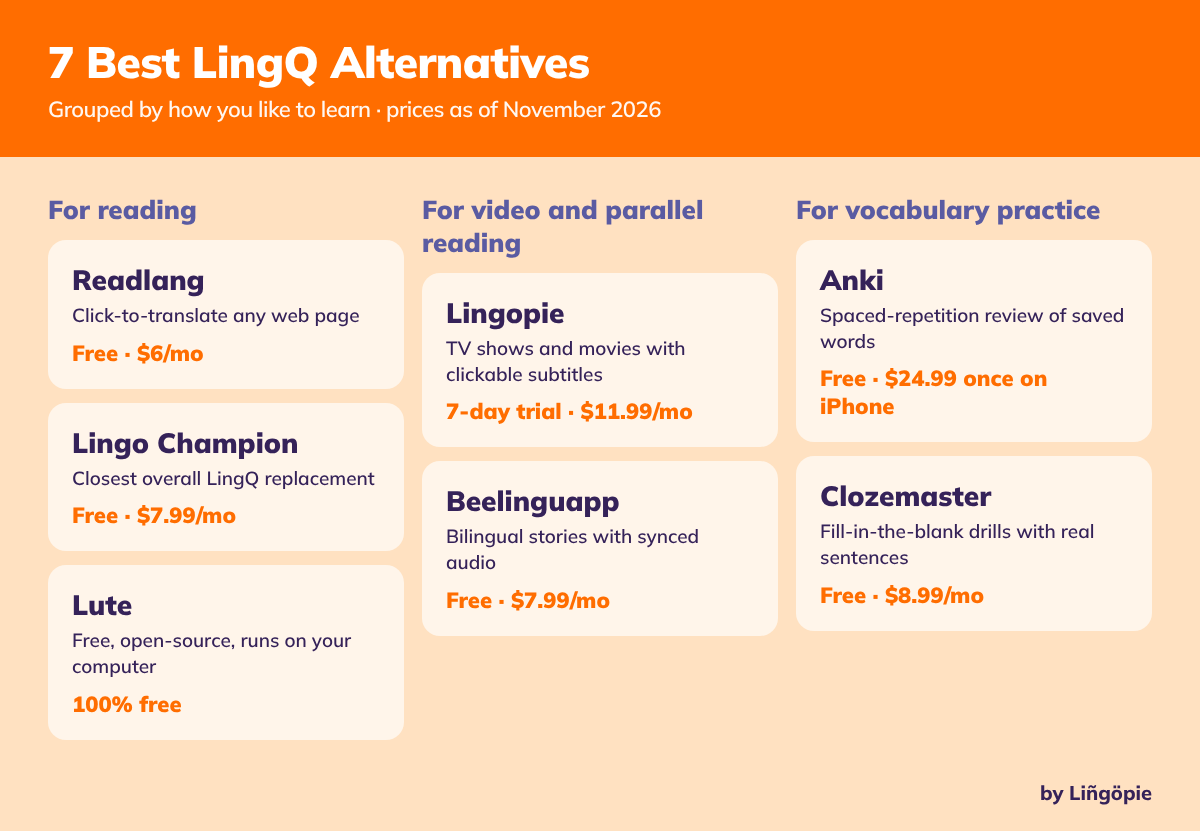
LingQ is great for learning languages through reading and listening, two methods research has shown can help learners build vocabulary. However, its limited free plan and focus on reading may not suit everyone. Fortunately, there are plenty of alternatives to LingQ, including Lingo Champion for similar features, Lute for free reading, and Lingopie for learning through TV shows.
So, what's the best LingQ alternative for you? Whether you're interested in Readlang for simpler reading,Anki for reviewing new words, or a tool that lets you import your own content, this guide compares seven options to help you find the right fit.
Disclosure: Lingopie is a language-learning app and a LingQ competitor. We included it in the video section and reviewed it with the same criteria, format and honest cons as every other app. Prices were checked on each app's own pricing page or app store listing in November 2026 and may change.
Key Takeaways
- Lingo Champion is the closest overall LingQ replacement, with importing, word tracking and AI explanations for $7.99/month.
- Lingopie is a great LingQ alternative for video-based learning, offering TV shows and movies with interactive dual subtitles, flashcards, and vocabulary games.
- Readlang and Lute are idealfor reading-focused learners, with tools for importing personal content, translating unfamiliar words, and tracking vocabulary.
- Lute is the best free LingQ alternative, offering open-source reading and vocabulary tracking without subscription fees, although it requires some technical setup.

The Best LingQ Alternatives at a Glance
Not all LingQ alternatives offer the same learning experience. Some focus on reading and importing your own content, while others make it easier to learn through videos, TV shows, and interactive subtitles. To help you compare your options, here's a quick look at LingQ and seven alternatives.
App | Best for | Type | Free plan or trial | Paid from | Vocabulary tools |
|---|---|---|---|---|---|
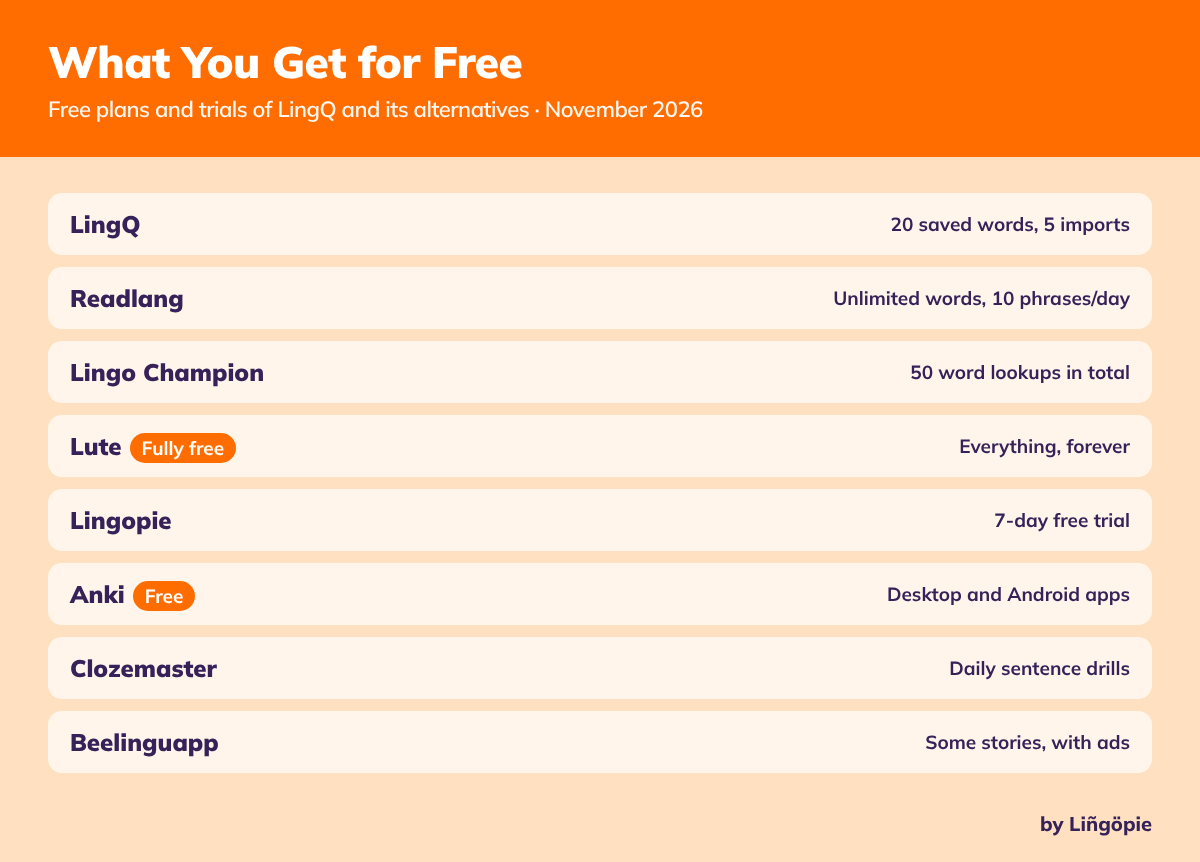
LingQ (reference) | Reading and listening to your own content | Web and mobile app | Free plan (20 saved words, 5 imports) | $14.99/month | Known-word tracking, flashcards |
Readlang | Reading web pages and personal texts | Web reader, browser extension | Free plan | $6/month | Flashcards, Anki export |
Lingo Champion | Closest overall LingQ replacement | Web app, browser extension, iOS app | Free plan (50 word lookups) | $7.99/month | Word tracking, AI explanations |
Lute | Free, private reading | Self-hosted web app | Completely free | Free | Word tracking, word statuses |
Lingopie | Learning through TV shows | Web and mobile app | 7-day free trial | $11.99/month | Interactive subtitles, flashcards, games |
Anki | Reviewing the words you save | Desktop and mobile app | Free on desktop and Android | $24.99 once (iPhone) | Spaced-repetition flashcards |
Clozemaster | Learning words in context | Web and mobile app | Free plan | $8.99/month | Fill-in-the-blank drills, listening (Pro) |
Beelinguapp | Beginner-friendly bilingual reading | Mobile app | Free plan (with ads) | $7.99/month | Glossary, flashcards, synced audio |
Why Look for a LingQ Alternative?
LingQ uses comprehensible input to help learners build vocabulary through authentic content immersion, including articles, podcasts, and other real-world materials. You can import your own texts, build a personal content library, and use its known-word tracking tools to categorize words as known or new.
However, LingQ's free plan limits you to 20 saved words and five imports, while Premium costs $14.99 per month ($119.99 billed yearly). Although its reading and listening tools are useful, some learners may prefer a simpler reader, easier ways to discover content, or better video integration. Others may simply want a completely free option without the restrictions of paid tiers.
How We Picked These Apps
To compare these apps fairly, we researched their features, pricing, and limitations on each app's own website or app store listingas of November 2026. We focused on five key factors:
- Content importing: Whether you can add your own articles, texts, and other learning materials.
- Vocabulary tracking: How each app identifies and tracks known and unknown words.
- Vocabulary tools: Availability of translations, dictionaries, flashcards, and spaced repetition.
- Free tier: What you can access without paying and any usage restrictions.
- Price and learning style: Subscription costs and how well each app fits different learning routines.
Best LingQ Alternatives for Reading
Reading is one of the most effective ways to build vocabulary in a new language. In fact, a 2025 meta-analysis of more than 70 studies found that extensive reading had positive effects on vocabulary, reading comprehension, and overall language proficiency.
If you enjoy learning through articles, stories, and other written content, Readlang, Lingo Champion, and Lute are worth considering. These apps let you study texts in your target language while offering different tools for translating unfamiliar words, tracking vocabulary, and reviewing what you've learned.
Readlang — Best for Reading Your Own Articles
- Best for: Learners who enjoy reading websites, articles, and personal texts.
- Price: Free plan; Premium at $6/monthor $48/year.
- Languages:Supports over 100 languages.
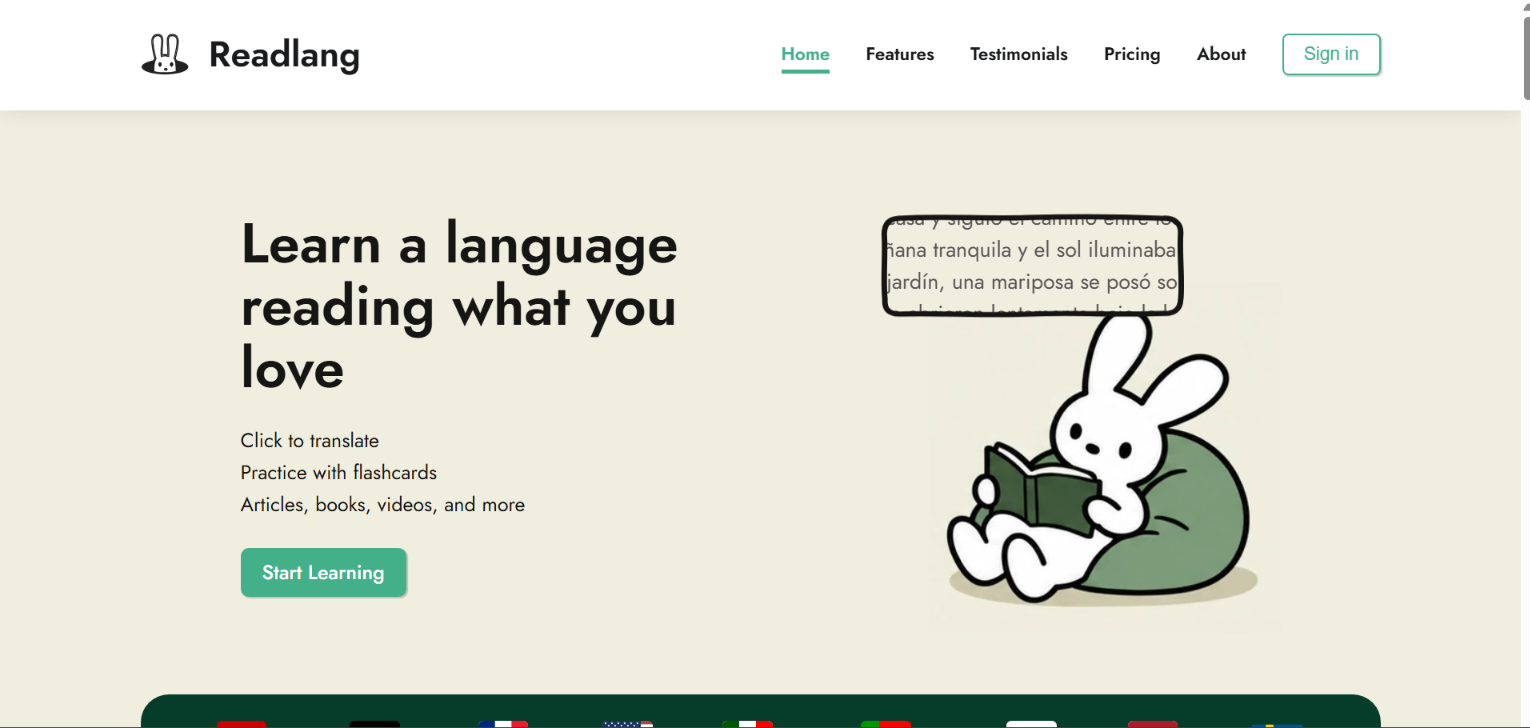
Readlang makes it easy to learn languages through real content you actually want to read. Its browser extension lets you collect articles, translate unfamiliar words with a click, and save vocabulary for later review.You can also turn saved words into flashcards and export them to Anki.
Compared to LingQ, Readlang offers a simpler interface without as many vocabulary-tracking features. Its free plan includes unlimited single-word translations, although you're limited to 10 phrase translations per day. This makes it a practical choice if you mainly want to read in your target language without paying for a subscription.
Pros:
- Translate words instantly while reading web pages.
- Create flashcards and export vocabulary to Anki.
- Unlimited single-word translations on the free plan.
Cons:
- Only 10 phrase translations per day on the free plan.
- Less comprehensive vocabulary tracking than LingQ.
Lingo Champion — Best Overall LingQ Replacement
- Best for: Learners who want to combine reading, listening, and vocabulary tracking.
- Price: Free plan; Premium at $7.99/month or $79.99/year.
- Languages:Supports 15+ languages, including Spanish, French, German, and Vietnamese.
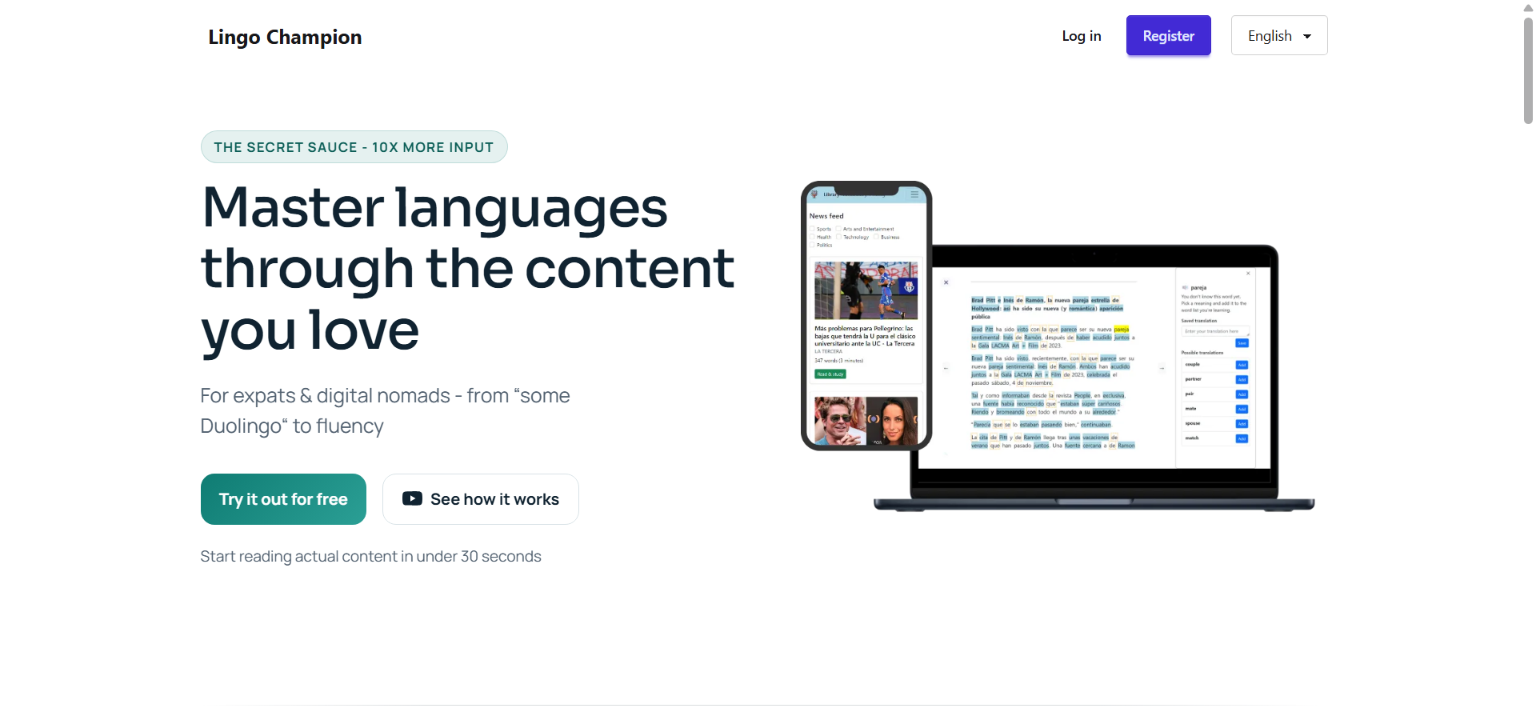
Lingo Champion is one of the closest options to LingQ, letting you import articles, books, and videos or explore its existing content library. It also tracks your vocabulary, provides AI explanations for unfamiliar words, and generates learning materials suited to your level.
As a LingQ replacement, it offers a similar reading and listening experience with additional AI tools. However, its free plan limits you to50 word lookups in total, making Premium more practical for regular use.
Pros:
- Browser extension for translating web pages.
- AI explanations and content generation.
- Reading, listening, and video integration.
Cons:
- Limited free word lookups.
- Some advanced features require Premium.
Lute — Best Free and Open-Source LingQ Alternative
- Best for: Learners who want a free, private reading tool.
- Price: Completely free and open source.
- Languages: Over 50 predefined languages, with options to add more.
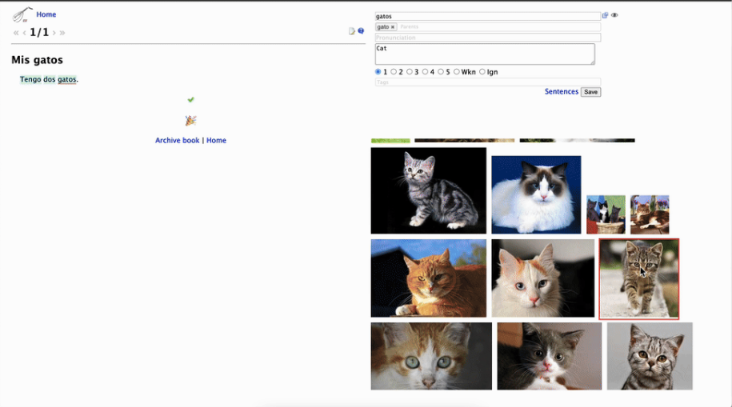
Lute (Learning Using Texts) is one of the apps like LingQ that lets you import your own reading materials, look up unfamiliar words, and track vocabulary as you read. You can create a personal library, save definitions, and mark words according to how well you know them. Since it runs locally on your computer, you also have control over your learning data.
Like LingQ, Lute focuses on learning through authentic texts and vocabulary tracking. However, as the best free LingQ alternative, it requires more effort to set up. You'll need to install it using Python or Docker, making it less convenient than a ready-to-use app.
Pros:
- Completely free, with no subscription fees.
- Customizable dictionariesand word tracking.
- Local storage for greater data control.
Cons:
- Requires technical installation and setup.
- No dedicated, ready-to-use mobile app.
Bonus: Lingopie Stories for Reading Practice
If you like Lingopie's approach but also want to read, Lingopie includes a library of short stories alongside its shows. You can browse fairy tales, fables, comedy, mystery, and more, and filter them by Beginner, Intermediate, or Advanced level. Many take just a couple of minutes to read.
Each story comes with audio narration you can slow down, and you can click any phrase to see its translation along with a word-by-word breakdown of gender, number, and part of speech. Words you save go to your vocabulary list, and a quick spaced-repetition quiz helps you review them before you move on.
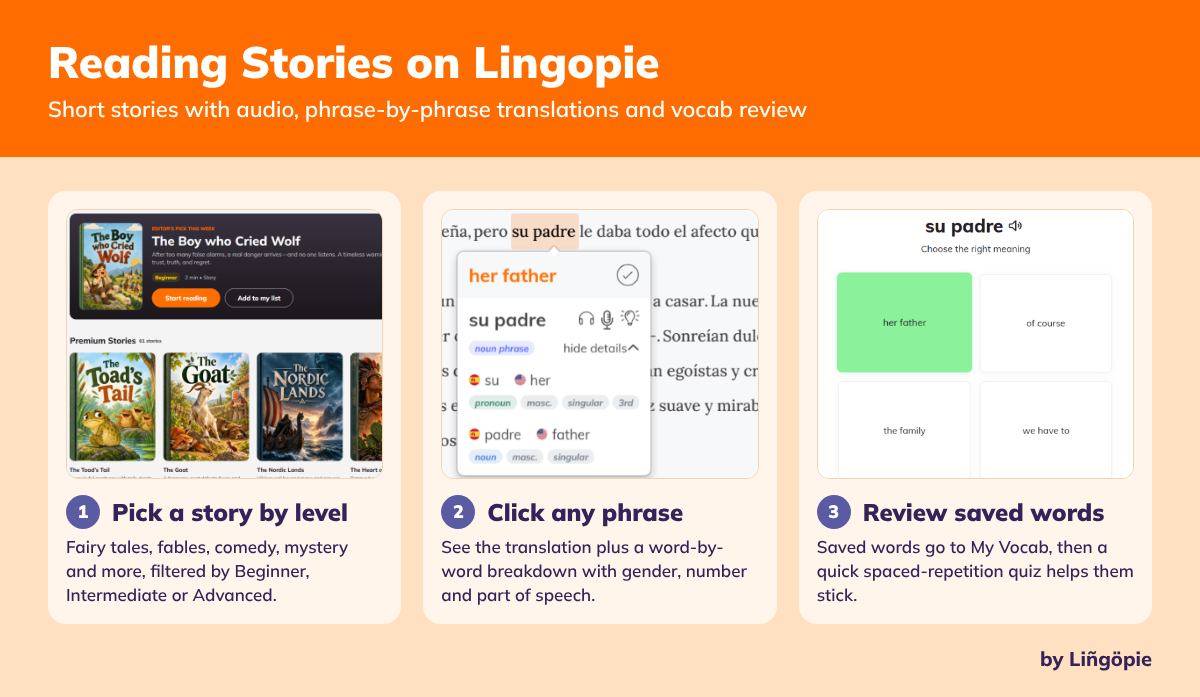
Unlike LingQ or Lute, you can't import your own texts, so Lingopie Stories works best as a structured reading companion to its video library rather than a replacement for a personal reading library.
Best LingQ Alternative for Video Learning
Watching videos can help you pick up new vocabulary while hearing how native speakers use the language in everyday conversations. In fact, a 2025 meta-analysis of 49 experiments found that watching videos with captions led to better vocabulary learning than watching without them.As Oxford researcher Robert Vanderplank put it, "there is really nothing to compare with film and TV as resources for language learning" (2016).
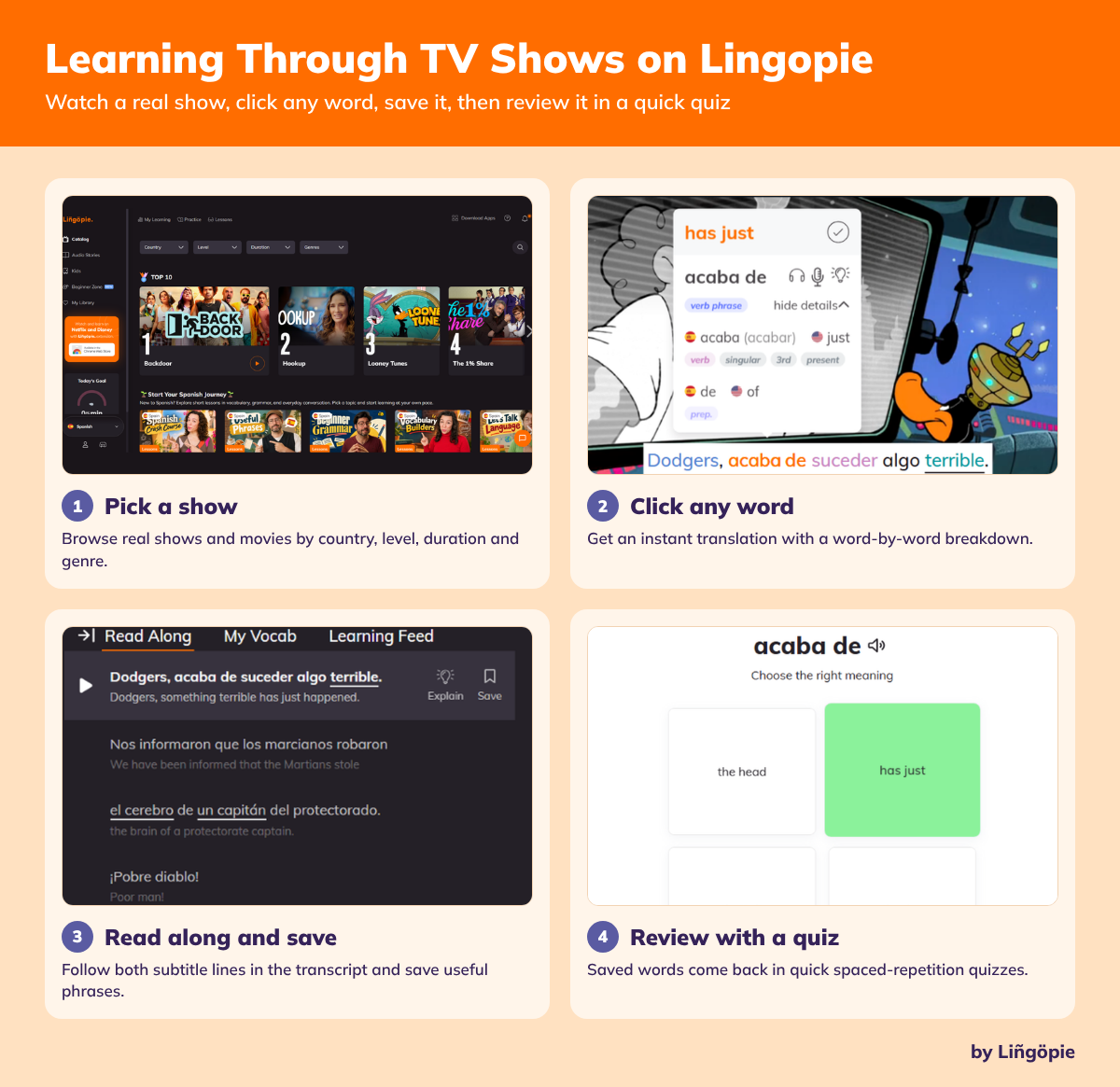
If you prefer learning through TV shows and movies, Lingopie is worth exploring.It turns real shows into language practice with interactive subtitles, word translations, and vocabulary exercises.
Lingopie — Best for Learning Through TV Shows
- Best for: Learners who enjoy studying languages through TV shows and movies.
- Price: 7-day free trial; from $11.99/month or $59.99/year.
- Languages: 17 languages, including Spanish, French, Japanese, and Korean.
Lingopie offers a curated library of TV shows and movies designed for language learning.Its interactive dual subtitles let youclick unfamiliar words for instant translations, save vocabulary as flashcards, andpractice with games and quizzes.Research backs this up: learners who used captions with built-in word translations recalled more than twice as many word meanings as with standard captions(Montero Perez et al., 2018).
Unlike LingQ, which focuses on importing your own content, Lingopie provides ready-to-watch shows with built-in learning tools. It's a good fit for learners who prefer video immersion, but less suitable for those who primarily want to read articles or manage their own texts. See what else Lingopie includes.
Pros:
- Interactive dual subtitles and clickable translations.
- Flashcards and vocabulary games.
- Curated TV shows and movies.
Cons:
- Cannot import your own reading materials.
- Content availability varies by language, and the free tier allows only 8 minutes a week.
Best LingQ Alternatives for Vocabulary Practice
Reading and watching introduce new words, but reviewing them is what makes them stick.If you want a dedicated tool for vocabulary practice, Anki and Clozemaster pair well with any reader or video app.
Anki — Best for Reviewing the Words You Save
- Best for: Learners who want to remember the vocabulary they find while reading or watching.
- Price: Free on desktop and Android; AnkiMobile for iPhone costs $24.99 once.
- Languages: Works with any language, since you build or download your own decks.
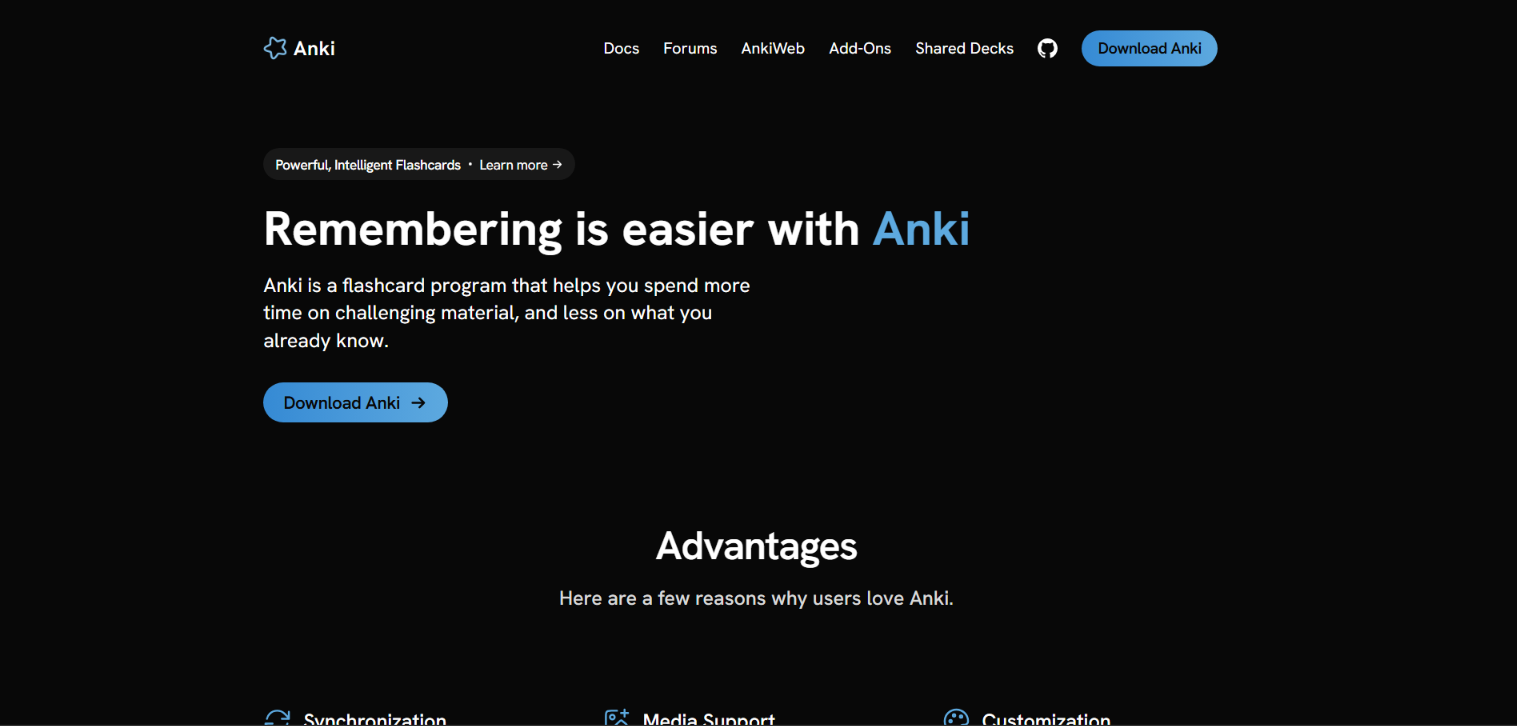
Anki is a free flashcard app that schedules each card based on how well you remembered it last time. It doesn't come with lessons or texts, but it pairs well with a reader: Readlang can export your saved words to Anki, so you can review them with spaced repetition on every device.
Compared to LingQ, Anki only covers the review side of learning. It's ideal if you already read or watch content elsewhere and want one place to review every new word, but building decks takes time.
Pros:
- Free on desktop and Android, with free syncing between devices.
- Proven spaced-repetition scheduling.
- Works with vocabulary exported from Readlang and other tools.
Cons:
- No built-in reading or listening content.
- Setup and deck-building take time.
Clozemaster — Best for Learning Words in Context
- Best for: Learners who want short daily drills with real sentences.
- Price: Free plan; Pro from $8.99/month or $69.99/year.
- Languages: 50+ languages, with over 170 language pairings.
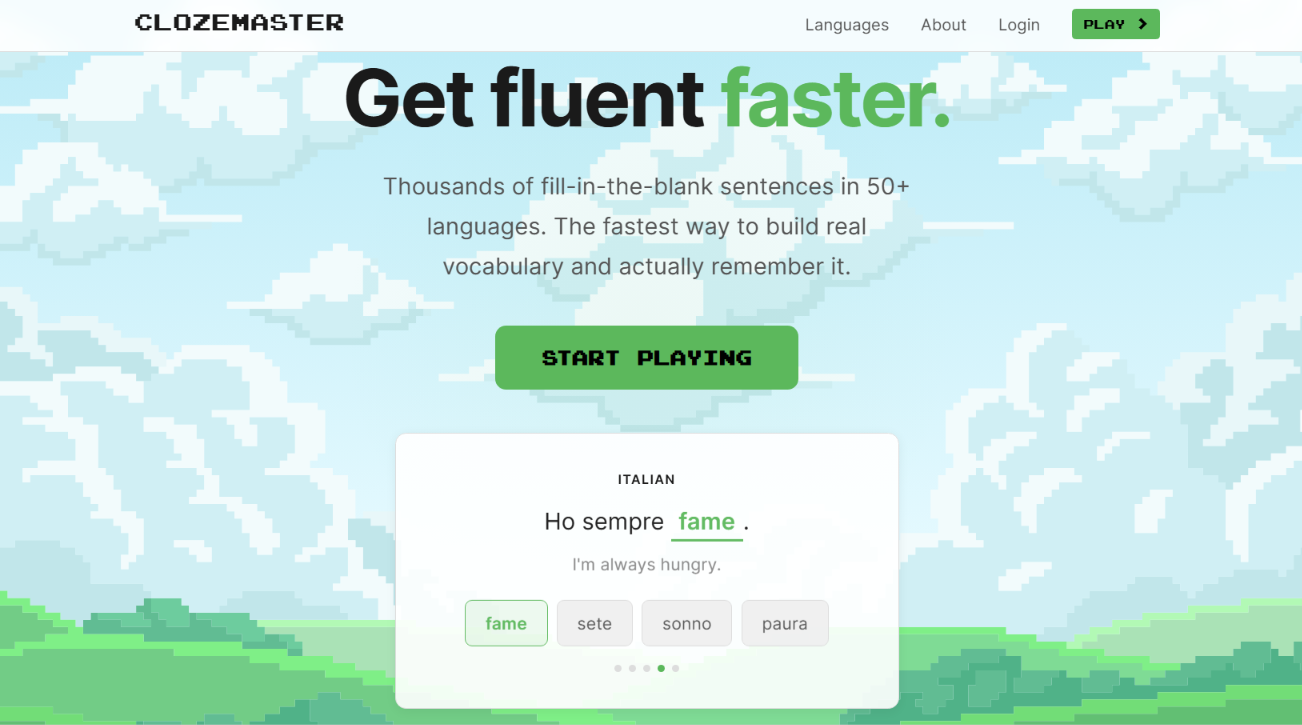
Clozemaster teaches vocabulary through fill-in-the-blank sentences. Each round shows a sentence with one word missing, and you pick or type the right word, so you learn common words in context rather than in isolation.
Unlike LingQ, Clozemaster doesn't use long texts or audio stories, so it works best alongside a reading or video app. Pro adds listening practice in over 30 languages and offline play in the mobile apps.
Pros:
- Quick daily sessions built on real sentences.
- Many language pairs, including non-English base languages.
- Available on the web, iOS, and Android.
Cons:
- No long texts or imported content.
- Drills can feel repetitive over time.
Best LingQ Alternative for Parallel Reading
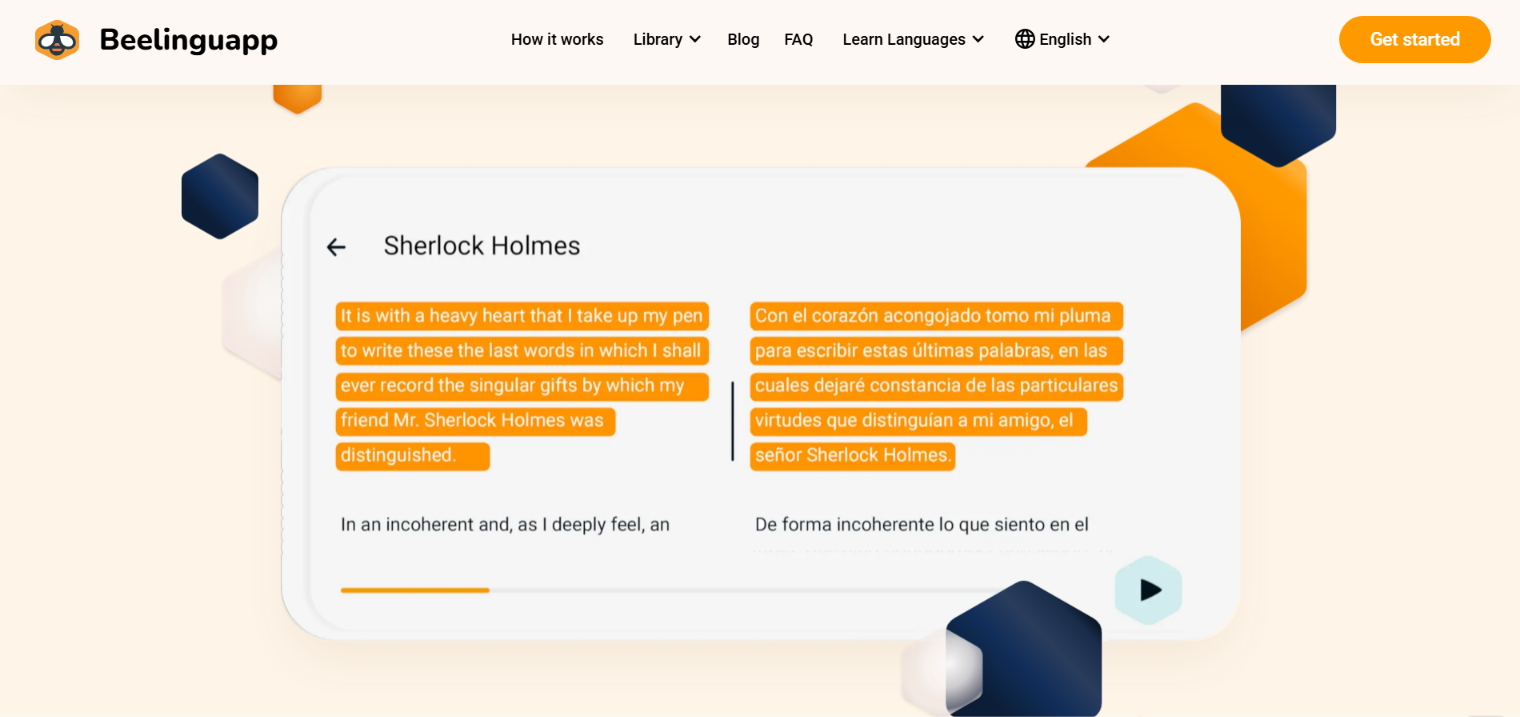
Parallel reading lets you read a story in your target language alongside a translation in your native language. Instead of stopping to look up every unfamiliar word, you can compare both versions to understand the meaning and follow the story more easily.
This approach is particularly helpful for beginners who want to start reading authentic texts without feeling overwhelmed. Some apps also include audio narration and vocabulary support to help youpractice pronunciation, listening, and new words.
Beelinguapp — Best for Beginners Reading Side by Side
- Best for: Beginners who want to read bilingual stories with translations.
- Price: Free plan with ads; Premium at $7.99/month or $49.90/year.
- Languages: Supports 23 languages, including Spanish, French, Japanese, and Korean.
Beelinguapp makes reading in a new language easier by displaying stories alongside translations in your native language. You canfollow synchronized audio narration, check unfamiliar words, and save vocabulary to a glossary for flashcard practice.
Unlike LingQ, which lets you import texts and track known words, Beelinguapp focuses on its own library of bilingual stories. It's particularly useful for beginners who want to understand what they're reading without constantly switching to a dictionary.
Pros:
- Side-by-side translations for easier comprehension.
- Synchronized audio narration.
- Beginner-friendly stories and flashcards.
Cons:
- Limited options for importing personal content.
- Less detailed vocabulary tracking than LingQ.
Which LingQ Alternative Should You Choose?
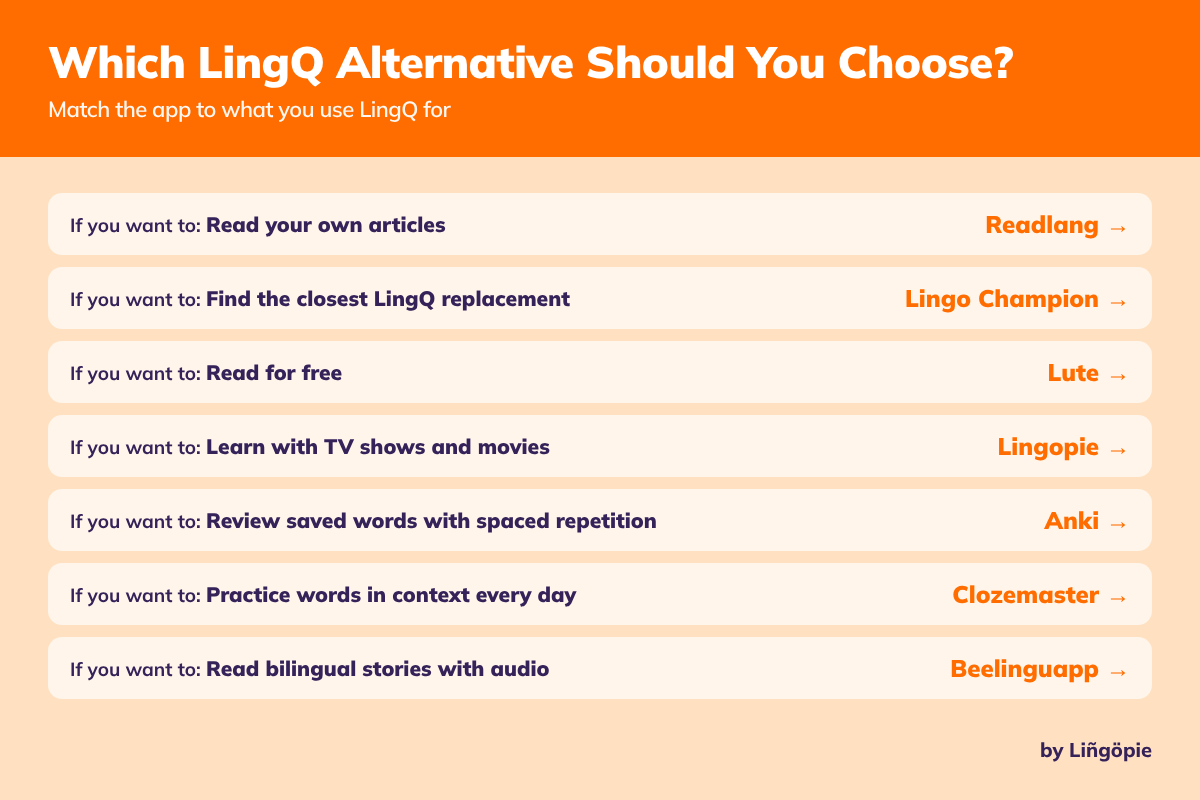
The best LingQ alternative depends on your learning style and how you prefer to study. Some apps work better for reading articles and tracking vocabulary, while others focus on videos, TV shows, or bilingual stories. Here's a quick guide to help you decide.
If you want to... | Choose |
|---|---|
Read your own articles and web pages | Readlang |
Find the closest overall LingQ replacement | Lingo Champion |
Read and track vocabulary for free | Lute |
Learn through TV shows and movies | Lingopie |
Review saved words with spaced repetition | Anki |
Practice words in context every day | Clozemaster |
Read bilingual stories with audio | Beelinguapp |
For most learners, the right choice is the app that fits their existing learning routine. Consider the content you enjoy, your target language, and the vocabulary tools you'll actually use. If your goal is to build vocabulary and improve fluency, consistent practice matters more than having the longest feature list.
It's also worth thinking about how you'll measure your progress. Do you need detailed word tracking, flashcard reviews, or simply a way to understand more of what you read and watch? Just remember that at the end of the day, no single app replaces every LingQ feature. The better choice depends on what you use LingQ for most often.If you're still comparing tools, our roundup of the best language learning apps covers more options.
Frequently Asked Questions
What is the best LingQ alternative?
Lingo Champion is the best LingQ alternative for learners who want similar reading, listening, and vocabulary-tracking features. Readlang is a simpler option for reading articles, whileLingopie is better suited to learners who prefer studying through TV shows and movies.
Is there a free alternative to LingQ?
Lute is the best free LingQ alternative if you want unlimited reading and vocabulary tracking without a subscription, although it requires installation.Readlang, Anki, and Clozemaster also offer free versions, but some features and usage limits are restricted.
Is Anki a good LingQ alternative?
Anki isn't a full LingQ replacement, because it has no reading library or importing. It works best alongside one: look up words in Readlang or Lute while you read, then review them in Anki with spaced repetition. The desktop and Android apps are free, and the iPhone app costs $24.99 once.
Which LingQ alternative lets me import my own content?
Readlang, Lingo Champion, and Lute all support importing personal content. Readlang makes it easy to read articles and web pages, Lingo Champion combines imported materials with reading and listening tools, and Lute lets you manage your own reading library locally.
Is LingQ worth paying for?
LingQ Premium can be worth paying for if you regularly import articles, books, or other learning materials and use its vocabulary tracking and listening features. However, learners who mainly want simple reading tools or video lessons may find better value in alternatives that match their learning habits.
Can I learn from TV shows like LingQ?
Yes.Lingopie gives you a curated library of TV shows and movieswith interactive dual subtitles, so you can click any word for a translation, save it as a flashcard, and review it with games. It's built for watching rather than importing texts, so pair it with a reader like Readlang or Lute if you also want to study articles.
Sources
- Sangers, N. L., et al. (2025). Learning a language through reading: A meta-analysis of studies on the effects of extensive reading on second and foreign language learning. Educational Psychology Review, 37.
- Kurokawa, S., Hein, J., & Uchihara, T. (2025). Captioned video and vocabulary learning: A meta-analysis. Language Learning.
- Montero Perez, M., Peters, E., & Desmet, P. (2018). Vocabulary learning through viewing video: The effect of two enhancement techniques. Computer Assisted Language Learning.
- Vanderplank, R. (2016). Captioned Media in Foreign Language Learning and Teaching. Palgrave Macmillan.
- Pricing and plan limits: LingQ, Readlang, Lingo Champion, Lute, Lingopie, Anki, Clozemaster, Beelinguapp, checked November 2026.