

Norwegian slang is the informal language locals use to add humor, attitude, and personality to everyday speech. For instance, people might say halla (hey) instead of hei (hello), serr? (seriously?) to express disbelief, or digg (awesome) instead of bra (good) when something is especially enjoyable.
If you're learning Norwegian or just want to follow casual conversations more easily, knowing slang helps you understand how people actually speak, avoid literal-translation mistakes, and sound more natural yourself. Some expressions are playful, some are regional, and a few can come across as rude, so context matters.
In this post, we'll go over more than 60 Norwegian slang words and phrases—their English meanings, real-life examples, intensifiers, youth slang, swear words, cultural expressions, idioms, and practical usage tips—so you know what to say, when to say it, and what to avoid.

Key Takeaways
- Everyday expressions like halla, digg, and kjipt help you understand casual conversations in Norwegian.
- Intensifiers like sykt and drit- make compliments stronger, although some expressions contain profanity.
- Norwegian sayings and idioms often have meanings that differ considerably from their literal English translations.
- Cultural expressions like koselig and fredagstaco aren't technically slang, but they reveal everyday Norwegian traditions.
- Context matters when using informal expressions, especially youth slang, regional vocabulary, and swear words.
Norwegian Slang at a Glance
The Norwegian word for slang is slang, and according to Store norske leksikon, it refers to informal expressions often associated with particular social groups. Norwegian slang develops through playful word choices, shortened expressions, and influences from other languages. For example, sykt (literally “sick”) can mean “incredibly,” while helt Texas describes something completely wild or chaotic.
What makes Norwegian slang interesting is how much context matters. Kult means “cool,” kjipt describes something disappointing, and gidder ikke means “can’t be bothered.” Some expressions are widely understood, while others reflect regional speech, younger generations, or multilingual communities. Knowing the difference helps you understand how Norwegians actually communicate.
What Counts as Slang in Norwegian?
Not every casual Norwegian expression is slang. For example, koselig (cozy or pleasant) is an everyday word, while å ha is i magen (to stay calm under pressure) is an idiom. Slang, on the other hand, often gives familiar ideas a more playful or informal twist. Take dritbra, which combines drit (literally “shit”) with bra (good) to mean “really great.”
It's also worth knowing that Norwegian dialects aren't slang. Dialects have distinct pronunciations, grammars, and vocabularies shaped by regional history. Norway also has two official written standards, Bokmål and Nynorsk, which are used in education, government, and publishing. Neither is a slang variety.
The easiest way to tell the difference is to pay attention to context. A word might be perfectly normal in one region, sound outdated to younger speakers, or feel too colloquial for a workplace conversation.
Norwegian Slang Greetings and Everyday Reactions
Don't expect Norwegians to strike up conversations with strangers as readily as Americans do. Small talk is less common, especially on public transportation. Funny enough, the rules change when you're hiking, where greeting strangers with a friendly hei (hi) is perfectly normal. Among friends, though, you'll hear more playful greetings and reactions.
Here are some common Norwegian slang phrases to help you keep up with casual conversations.
Norwegian | Meaning | Example (Norwegian + English) |
|---|---|---|
Halla | Hey! (casual greeting) | Halla, hva skjer? (Hey, what's up?) |
Skjer? | What's up? (short for Hva skjer?) | Skjer, eller? (What's up?) |
Serr? | Seriously? (short for seriøst) | Serr? Fikk du jobben? (Seriously? You got the job?) |
Kødder du? | Are you kidding me? | Kødder du? Vant vi? (Are you kidding me? We won?) |
Hæ? | Huh? / What? | Hæ? Hva sa du? (Huh? What did you say?) |
Uff | Oh no! / Oof! (sympathy or frustration) | Uff, det var leit å høre. (Oh no, I'm sorry to hear that.) |
Æsj / Fysj | Ew! / Yuck! (disgust) | Æsj, den maten lukter vondt! (Ew, that food smells bad!) |
Ha det! | Bye! | Ha det, vi snakkes! (Bye, talk soon!) |
Er du gira? | Are you up for it? / Are you in? | Vi skal på kino. Er du gira? (We're going to the movies. Are you in?) |
Hils! | Say hi for me | Hils mamma fra meg! (Say hi to your mom for me!) |
Quick tip: Halla is great with friends, but hei is the safer choice when greeting someone you don't know. And while hæ? is common in casual speech, it can sound abrupt depending on your tone.
Norwegian Slang for Good and Bad
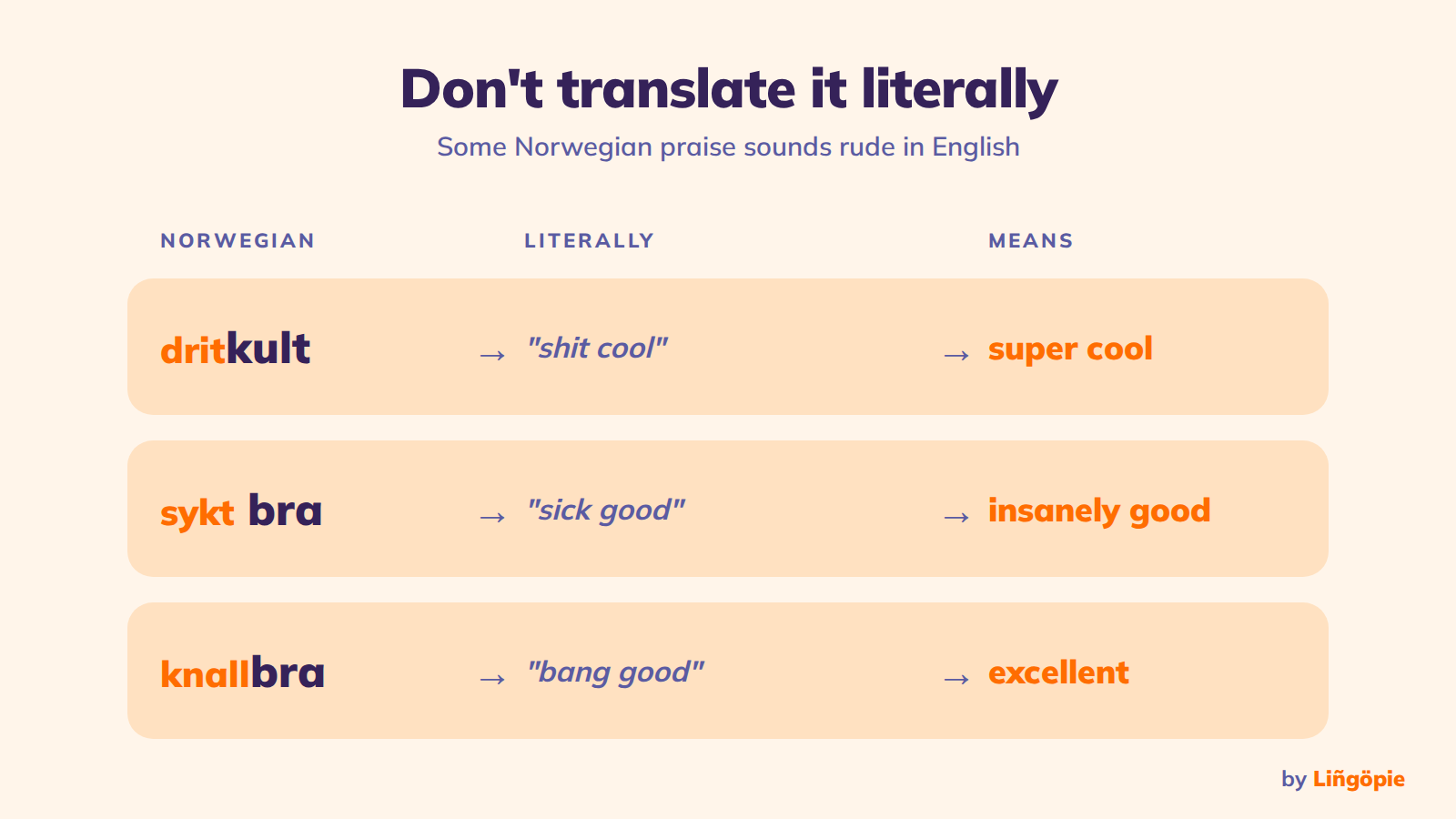
Norwegians have plenty of colorful ways to say something is amazing, disappointing, or just plain awkward. Interestingly, some positive expressions sound negative when translated literally. Dritkult, for example, combines drit (shit) with kult (cool) to mean "super cool." So don't be surprised if a Norwegian uses a seemingly negative word to give something a glowing review!
Here are some Norwegian slang words you'll hear when people are sharing opinions, giving compliments, or reacting to something that didn't go quite as planned.
Norwegian | Meaning | Example (Norwegian + English) |
|---|---|---|
Digg | Awesome, really nice, or delicious | Denne pizzaen er digg! (This pizza is delicious!) |
Kult | Cool, nice | Så kult at du kommer! (So cool that you're coming!) |
Fett | Cool, awesome (informal) | Det var en fet konsert! (That was an awesome concert!) |
Dritkult | Super cool, really awesome | Den nye filmen var dritkul! (The new movie was super cool!) |
Knallbra | Excellent, fantastic | Du gjorde en knallbra jobb! (You did a fantastic job!) |
Sykt bra | Insanely good, incredibly good | Den sangen er sykt bra! (That song is insanely good!) |
Kjipt | Lame, disappointing, or unfortunate | Så kjipt at du ikke kan komme! (That sucks that you can't come!) |
Kleint | Awkward, embarrassing | Det ble litt kleint etterpå. (Things got a little awkward afterward.) |
Døll | Boring, dull | Festen var ganske døll. (The party was pretty boring.) |
God s | Good vibes (god stemning), sometimes sarcastic | Ingen snakker sammen. God s! (Nobody's talking to each other. Great vibes!) |
Just note that Drit- is a mildly vulgar intensifier, so save it for casual conversations. God s is especially dependent on inflection and context, and its sarcastic use may not be obvious to beginners.
Norwegian Intensifiers
Want to make a compliment sound stronger? In Norwegian grammar, intensifiers are words that increase the strength of an adjective or adverb, much like “really,” “super,” or “incredibly” in English. In spoken Norwegian, some even attach directly to adjectives. For example, bra (good) becomes kjempebra (really good) or dritbra (damn good).
Here are five common Norwegian intensifiers and how to use them in a complete sentence.
Norwegian | Meaning | Example (Norwegian + English) |
|---|---|---|
Sykt | Insanely, incredibly | Det er sykt kaldt i dag! (It's insanely cold today!) |
Drit- | Really, extremely (mildly vulgar) | Den filmen var dritbra! (That movie was damn good!) |
Kjempe- | Super, very | Vi hadde det kjempegøy! (We had so much fun!) |
Mega- | Extremely, super | Det var megakult! (That was super cool!) |
Jævla | Damn, freaking (strong swear word) | Det var en jævla dårlig idé! (That was a damn bad idea!) |
Grammar tip: Sykt and jævla are written as separate words in these examples, while drit-, kjempe-, and mega- typically attach to the adjective. Also, jævla is a strong swear word, so avoid using it in professional or formal conversations.
Norwegian Spoken Contractions
Written Norwegian has no contractions, but spoken Norwegian runs words together all the time, especially verbs followed by ikke (not). You'll hear these forms constantly in TV shows and see them in texts, but don't use them in formal writing.
Spoken form | Full form | Meaning | Example |
|---|---|---|---|
Kan'ke | kan ikke | can't | Jeg kan'ke i dag. (I can't today.) |
E'kke | er ikke | isn't / aren't | Det e'kke så farlig. (It's no big deal.) |
Ha'kke | har ikke | haven't | Jeg ha'kke tid. (I don't have time.) |
Ska'kke | skal ikke | won't / not going to | Jeg ska'kke dit. (I'm not going there.) |
Va'kke | var ikke | wasn't | Det va'kke meg! (It wasn't me!) |
Tip: Spellings vary (e'kke, ekke), because these are spoken forms, not official words.
Norwegian Slang for Party and Social Life
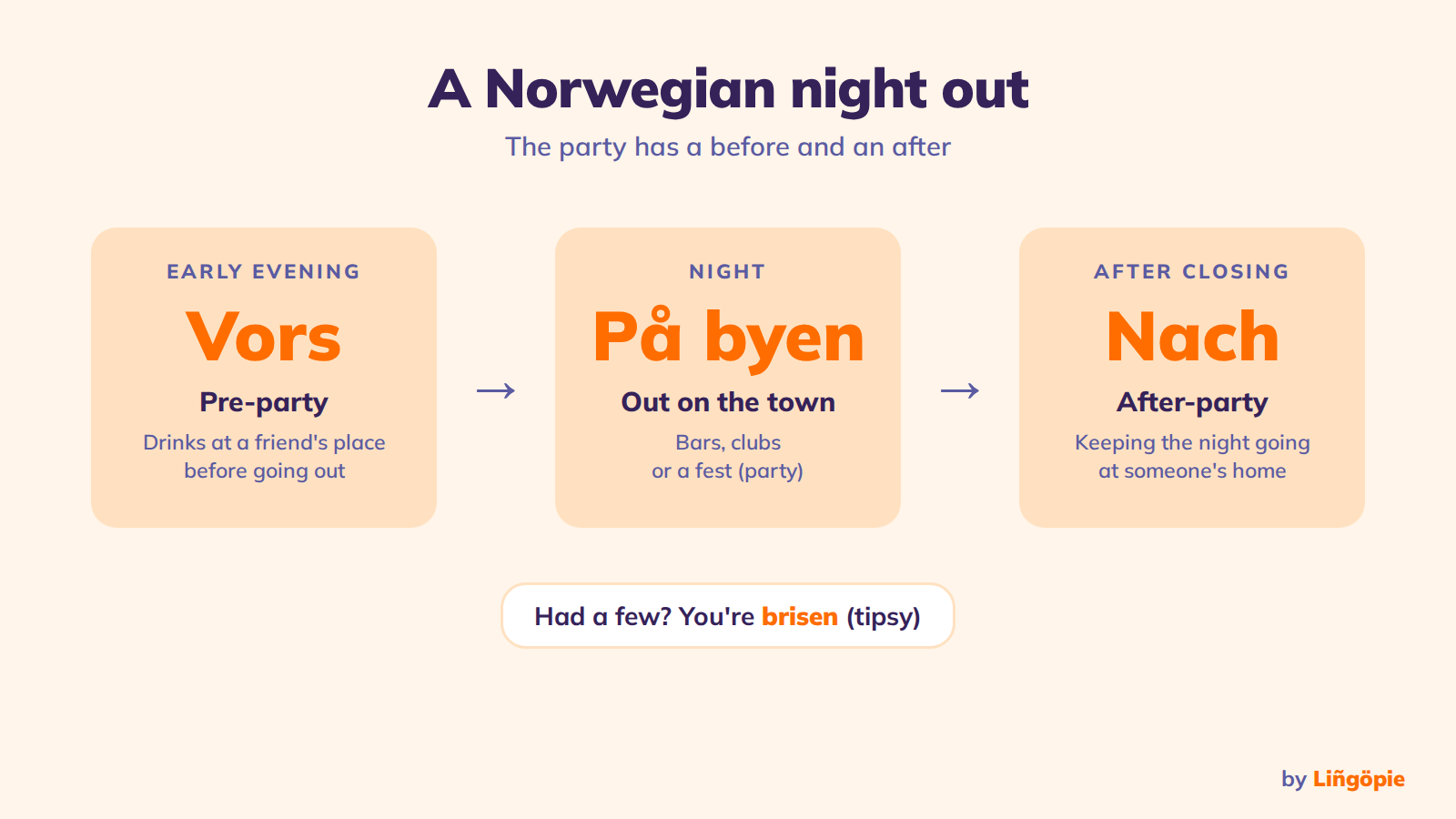
Planning a night out in Norway? You might get invited to a vors, a pre-party where friends gather for drinks before heading to a bar or club. And the fun doesn't necessarily end there. A nach is an after-party that keeps the social gathering going. Both terms come from German, but they're well established in Norwegian social vocabulary.
Here are some casual slang expressions you'll hear when Norwegians talk about parties, drinking, and celebrations.
Norwegian | Meaning | Example (Norwegian + English) |
|---|---|---|
Vors (vorspiel) | Pre-party, usually before going out | Vi skal på vors hos Emma i kveld. (We're going to a pre-party at Emma's tonight.) |
Nach (nachspiel) | After-party | Skal vi på nach etter festen? (Should we go to an after-party after the party?) |
Brisen | Tipsy, slightly drunk | Han var litt brisen i går kveld. (He was a little tipsy last night.) |
Russ | Student celebrating the end of upper secondary school | Søsteren min er russ i år. (My sister is celebrating her final year of upper secondary school this year.) |
Russ isn't simply another word for a partygoer. It refers to students taking part in russefeiring, Norway's distinctive graduation-season celebrations, traditionally associated with special outfits, decorated vehicles, and social events.
Everyday Norwegian Words Worth Knowing
Some Norwegian words are worth learning even though they aren't technically slang. They capture everyday habits, social traditions, and attitudes that don't always have a direct English translation. Take fredagstaco, for example. Taco Friday has become a popular family tradition in Norway, with many households gathering for a taco dinner to kick off the weekend.
Here are five cultural words that can help you understand everyday life in Norway.
Norwegian | Meaning | Example (Norwegian + English) |
|---|---|---|
Koselig | Cozy, pleasant, or heartwarming | Det var en koselig kveld med familien. (It was a lovely evening with the family.) |
Kos | Coziness, comfort, or an enjoyable moment | Vi hadde litt kos med film og snacks. (We enjoyed a cozy time watching a movie with snacks.) |
Fredagstaco | Taco Friday, a popular Friday dinner tradition | Vi har fredagstaco hver uke. (We have Taco Friday every week.) |
Utepils | A beer enjoyed outdoors, often in nice weather | Endelig sol! Skal vi ta en utepils? (Finally, sunshine! Shall we grab a beer outside?) |
Matpakke | Packed lunch, often sandwiches brought to school or work | Jeg tar med matpakke på jobb. (I bring a packed lunch to work.) |
Norway's outdoor traditions are reflected in sayings like Ut på tur, aldri sur (roughly, “Out on a hike, never grumpy”) and Det finnes ikke dårlig vær, bare dårlige klær (“There's no bad weather, only bad clothing”). Both reflect the value many Norwegians place on spending time outdoors, even when the weather isn't perfect.
Norwegian Idioms That Sound Local
Ever heard someone say they're out picking berries when they're clearly nowhere near a forest? Norwegian sayings can be surprisingly funny when translated literally. Many use everyday images to describe confusion, patience, or chaotic situations. The trick is knowing what the expression actually means, rather than translating each word.
Here are six Norwegian slang phrases and idioms that can make conversations more colorful.
Norwegian | Meaning | Example (Norwegian + English) |
|---|---|---|
Helt Texas | Completely crazy, wild, or chaotic | Det var helt Texas på festen! (The party was completely crazy!) |
Å være på bærtur | To be completely mistaken or way off track | Du er helt på bærtur! (You're completely off track!) |
Å ha is i magen | To stay calm and patient under pressure | Du må ha is i magen og vente. (You need to stay calm and wait.) |
På null komma niks | In no time, very quickly | Jeg er tilbake på null komma niks. (I'll be back in no time.) |
En slikk og ingenting | Almost nothing, next to nothing | Jeg fikk den for en slikk og ingenting. (I got it for next to nothing.) |
I huttiheita | In the middle of nowhere | Hytta ligger helt i huttiheita. (The cabin is in the middle of nowhere.) |
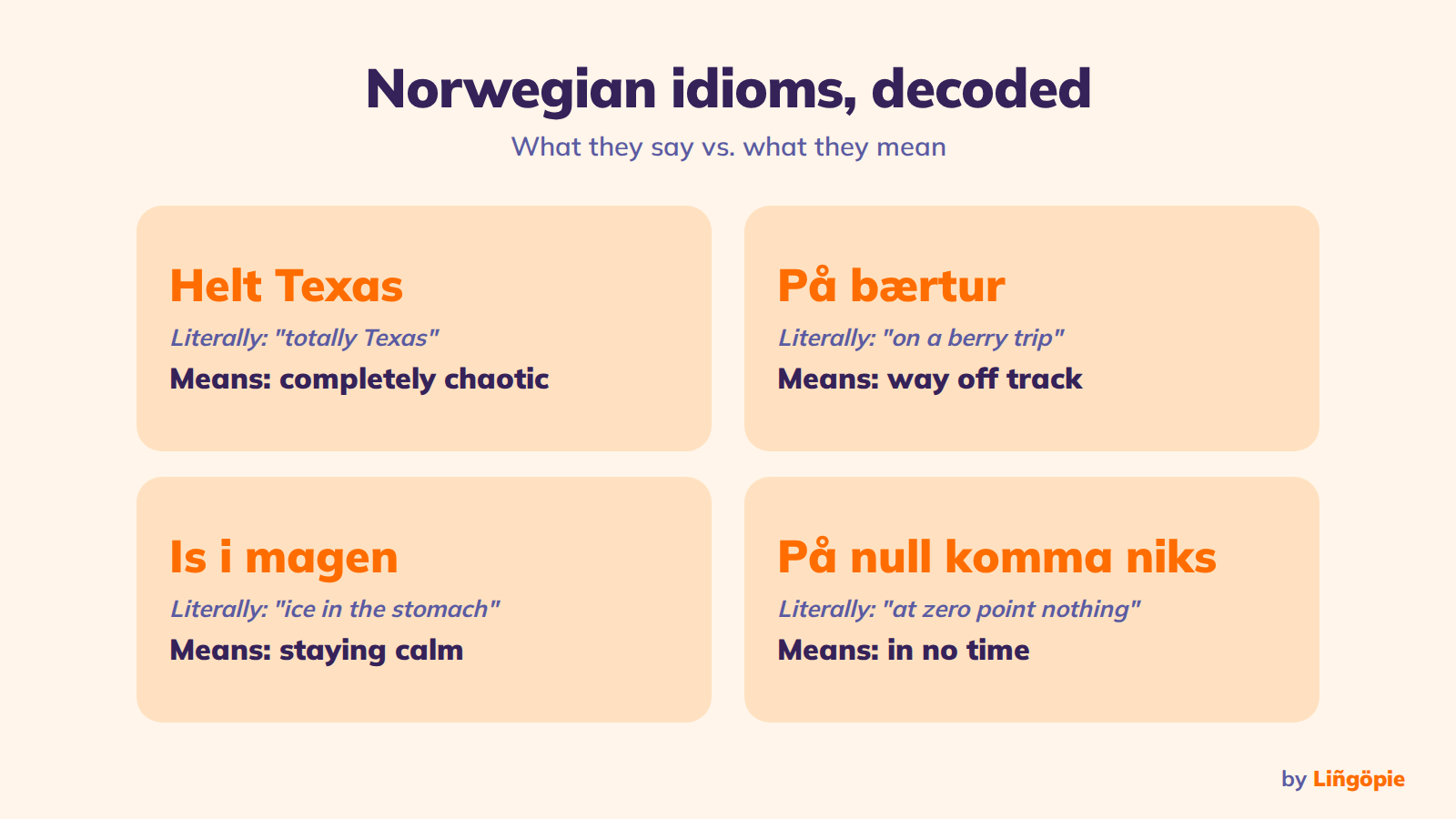
Note: Helt Texas uses the American state of Texas as a metaphor for something chaotic. Meanwhile, å være på bærtur literally means “to be out picking berries,” but it's used when someone is completely wrong or has misunderstood something. And don't confuse null og niks (nothing at all) with på null komma niks (in no time). They sound similar but mean different things.
Norwegian Youth Slang
Norwegian youth slang is especially interesting in multicultural urban areas like Oslo, where young people mix Norwegian with expressions influenced by languages such as Arabic, Turkish, and Urdu. Linguists call this a multiethnolect, a speech style defined by contact between different languages and communities. You might also hear the term kebabnorsk, although some consider it stereotypical or offensive.
Social media and texting have also introduced shortened expressions and phonetic spellings. Here are five examples of Norwegian youth slang, including some that may sound dated to younger speakers today.
Norwegian | Meaning | Example (Norwegian + English) |
|---|---|---|
Wolla | I swear, seriously (Arabic-origin expression) | Wolla, jeg snakker sant! (I swear, I'm telling the truth!) |
Sjofe | To see or look (urban youth slang) | Sjof den bilen! (Look at that car!) |
Chille | To chill, relax | Vi skal bare chille hjemme. (We're just going to chill at home.) |
DLEG | You only live once (du lever én gang) | DLEG! Vi gjør det! (YOLO! Let's do it!) |
Ins | Nothing special (ikke noe spesielt) | Hva skjer? Ins. (What's up? Nothing special.) |
Don't assume every young Norwegian uses these expressions. For instance, wolla and sjofe are associated with particular urban speech communities, while DLEG and ins are documented texting abbreviations whose current popularity is uncertain. Understanding them is more useful than forcing them into your own conversations.
Playful Norwegian Insults
Not every Norwegian insult is offensive. Many are teasing words that friends and family use with a laugh.
Norwegian | Meaning | Example (Norwegian + English) |
|---|---|---|
Dust | Idiot, dummy (often affectionate) | Du er en dust! (You're such a dummy!) |
Teit | Stupid, silly | Ikke vær teit. (Don't be silly.) |
Klossmajor | Klutz | Jeg er en sånn klossmajor! (I'm such a klutz!) |
Sutrekopp | Whiner, crybaby | Slutt å være en sutrekopp. (Stop being a crybaby.) |
Sofagris | Couch potato | Broren min er en skikkelig sofagris. (My brother is a real couch potato.) |
Heldiggris | Lucky dog | Vant du? Din heldiggris! (You won? You lucky dog!) |
Grammar tip: when you call someone a name, Norwegians use din or ditt rather than du. So it's Din dust! or Ditt svin!, not Du dust!
Norwegian Swear Words: Use With Care
Swear expressions like faen and helvete are common in Norwegian, especially when someone is angry, frustrated, or surprised. Both have religious origins, but what matters most is when you use them. Norwegians also tend to swear more casually than English speakers. Words that would raise eyebrows in English are often heard in everyday speech. They're fine among friends, but best avoided at work.
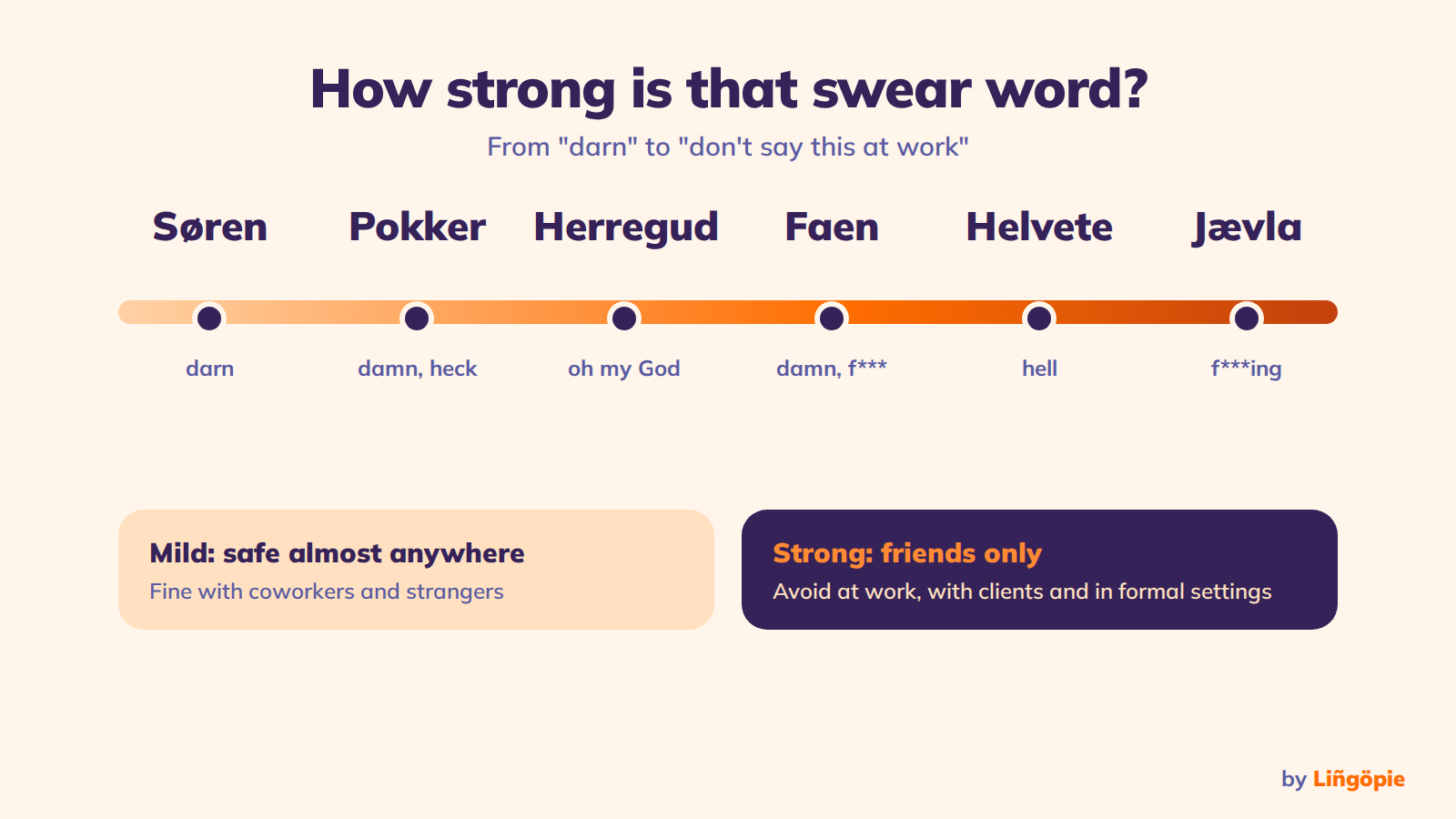
Here are six Norwegian expressions, ranging from relatively mild exclamations to stronger profanity.
Norwegian | Meaning | Example (Norwegian + English) |
|---|---|---|
Søren | Darn, dang (mild) | Søren, jeg glemte nøklene! (Darn, I forgot my keys!) |
Pokker | Damn, darn (mild) | Hva i pokker skjer her? (What the heck is going on here?) |
Herregud | Oh my God (mild to moderate) | Herregud, så fint det er! (Oh my God, it's so beautiful!) |
Faen | Fuck, damn (strong) | Faen, jeg mistet mobilen! (Fuck, I dropped my phone!) |
Helvete | Hell; used as a strong curse | Hva i helvete gjør du? (What the hell are you doing?) |
Jævla | Damn, fucking (strong) | For en jævla dårlig dag! (What a fucking awful day!) |
Søren and pokker are generally better options when you're frustrated. Save stronger terms such as faen, helvete, and jævla for situations where you understand the tenor and the people you're speaking with. Also, herregud can reveal excitement or surprise without necessarily sounding angry. For more, see our guide to Norwegian curse words and insults.
How to Learn Norwegian Slang
Knowing 60+ Norwegian slang words is a great start, but the real challenge is understanding when to use them. After all, serr? can express genuine surprise or disbelief, depending on someone's tone. The best way to get comfortable with these expressions is to hear them in real conversations.
Here are three ways to make Norwegian slang part of your everyday vocabulary:
- Watch Norwegian shows: Try Skam, the popular NRK teen drama, to hear informal conversations, youth slang, and everyday expressions in context. It streams on NRK TV, and availability outside Norway varies.
- Listen to native speakers: Pay attention to how Norwegian friends use slang, especially their tone, facial expressions, and reactions. Don't be afraid to ask what an unfamiliar phrase means.
- Practice with Lingopie: Lingopie lets you learn Norwegian through TV shows and videos, using interactive subtitles to help you understand unfamiliar expressions and build vocabulary while watching.
Research backs up learning slang from TV. In a seven-week study, students who watched the sitcom Friends with subtitles in the language they were learning did better on tests of slang and colloquial expressions than students who watched with subtitles in their own language (Frumuselu et al., 2015). Another study found that captions helped viewers remember multiword expressions, the fixed phrases that idioms like helt Texas are made of (Majuddin, Siyanova-Chanturia & Boers, 2021). Both studies tested learners of English, not Norwegian, and neither tested Lingopie.
On Lingopie, dual subtitles show the Norwegian line and its English translation together, so you can see whether digg means "delicious" or "awesome" in that scene. Click any word for its meaning, save phrases like helt Texas as flashcards, and replay a line to hear the tone behind serr?. New to the language? Start with how to learn Norwegian as a beginner; the good news is that Norwegian is one of the easier languages for English speakers.
Ready to sound more natural in Norwegian? Start watching Norwegian content on Lingopie and turn the slang you've learned into expressions you can actually recognize and use.
FAQ
What is the most common Norwegian slang word?
There's no official ranking, but drit- is a common intensifier meaning “really” or “extremely.” You'll hear it in words like dritbra (really good) and dritkult (super cool). Other popular expressions include digg (awesome), kjipt (lame), and serr? (seriously?).
What does "helt Texas" mean?
Helt Texas means “completely crazy,” wild, or chaotic. For example, Det var helt Texas på festen! means “The party was completely crazy!” The expression references the American state of Texas and describes situations that get particularly hectic or out of control.
Can beginners use Norwegian slang?
Yes! Start with easy expressions like halla (hey), kult (cool), and digg (awesome). Listen to how native speakers use them before trying them yourself. Save stronger swear words and unfamiliar youth slang until you're comfortable with their meanings and tone.
Is it okay to use Norwegian slang at work?
Yes, in casual conversations with coworkers. Words like kult and kjipt are generally fine in relaxed workplaces, but avoid strong slang and profanity in formal meetings, professional emails, or client conversations.
What's the difference between slang and dialect in Norwegian?
Slang refers to informal expressions, while dialects are regional varieties of Norwegian with their own pronunciation, grammar, and vocabulary. People speaking different dialects can use the same slang. Bokmål and Nynorsk, meanwhile, are written standards, not dialects or slang.
How do I know if a Norwegian slang word is rude?
Check its meaning and how people use it. Faen, helvete, and jævla are strong swear words, while søren is relatively mild. If you're unsure, look up the expression in a Norwegian dictionary or ask a native speaker before using it.