
If you're comparing Yabla vs. Lingopie, the biggest difference is how you'll spend your study time. Lingopie lets you learn through TV shows and movies, with interactive subtitles and grammar explanations. Yabla focuses on shorter, authentic videos, with listening exercises, games, and daily learning goals. Both make it easier to learn a language with videos, but they offer different experiences.
So, which one deserves a spot in your study routine? We’ll compare their content, languages, learning tools, and pricing to help you decide. We’ll also look at where each platform falls short, so you can choose based on how you actually like to learn.
Key Takeaways
- Lingopie is better for learning through entertainment. Its TV shows, movies, interactive subtitles, and grammar tools help you study while watching content you enjoy.
- Yabla is better for short, focused practice. Its authentic video clips, dictation exercises, games, and leaderboards make it easy to build a daily learning routine.
- Both platforms offer interactive learning tools. You can use clickable subtitles, save vocabulary, review flashcards, and practice pronunciation, although the features work differently.
- Your learning style matters more than the overall winner. Choose Lingopie for longer viewing sessions and more language options, or Yabla for bite-sized lessons and game-based practice.
What Is Yabla?
Yabla is a video-based language learning app that uses authentic clips of native speakers to help you improve your listening, vocabulary, and pronunciation. Its library includes interviews, music videos, documentaries, and everyday conversations, with videos organized by difficulty level and regional accent.
Each video comes with interactive subtitles, clickable translations, and playback controls that let you slow down or repeat tricky sentences. You can also practice with Scribe dictation exercises, pronunciation games, and flashcards. For a more structured routine, Yabla's Fluency Club offers guided daily activities that take around 10 minutes.For a closer look, see our full Yabla review.
What Is Lingopie?
Lingopie is a language learning platform that turns watching TV shows and movies into an interactive study session. Instead of following traditional textbook lessons, you learn through real conversations, everyday expressions, and stories in your target language.It's used by more than 2 million learners and rated 4.6/5 on Trustpilot from 3,878 reviews (November 2026).
While watching, you can click on unfamiliar words in the dual subtitles to see their meanings and save them as flashcards. Lingopie also includes a Grammar Coach that explains sentence structures in context, plus a Say It! feature for practicing pronunciation. With content for different proficiency levels, you can choose what to watch based on your interests and language skills.
Yabla vs Lingopie: Head-to-Head Comparison
Both apps use videos to teach languages, but their content, learning tools, and study experiences differ. To see how they compare, we'll look at eight key areas, including video content, vocabulary tools, grammar support, speaking practice, and pricing. We'll also highlight which app does better in each category and why.
Video Content and Length
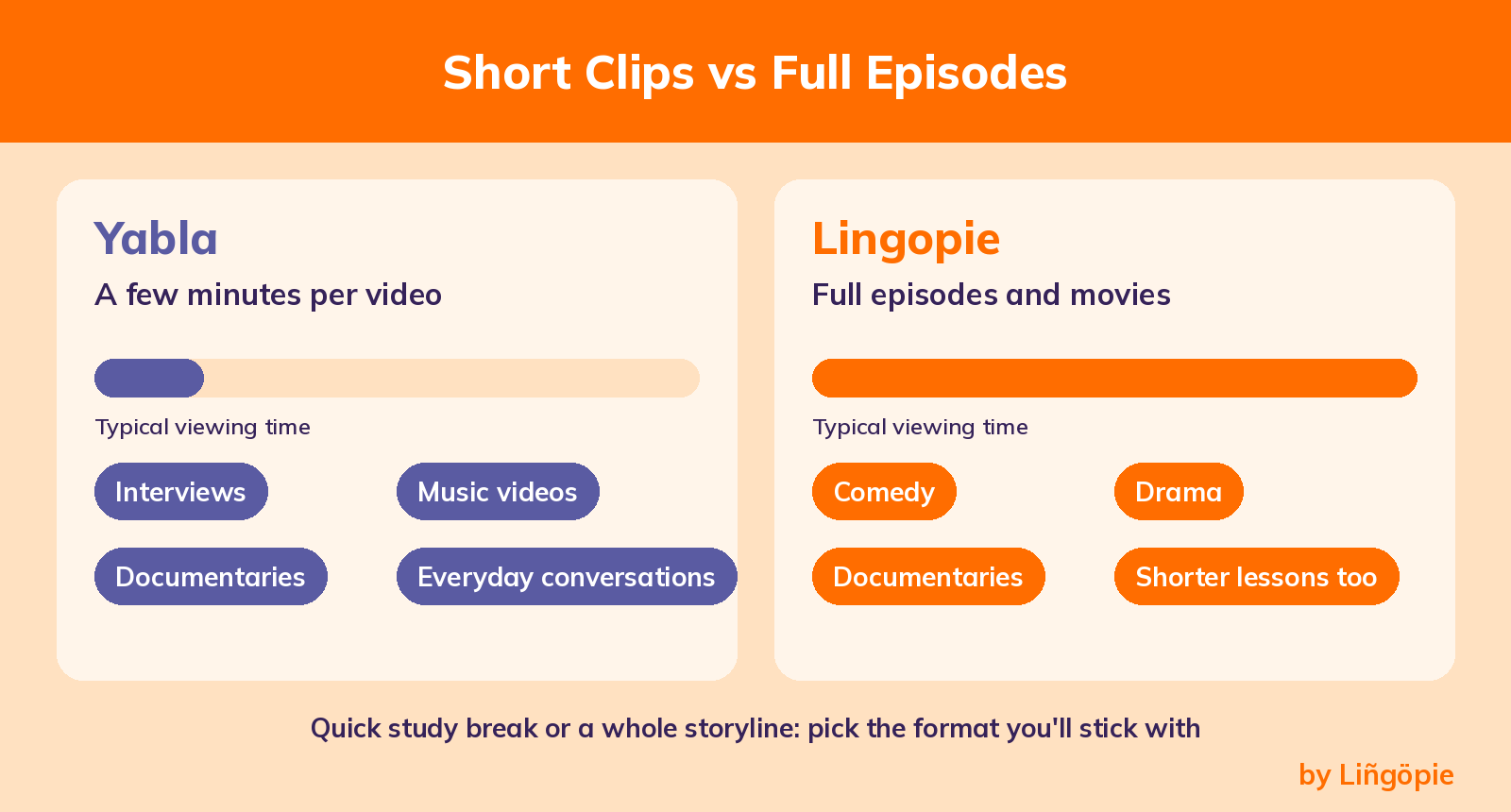
Yabla focuses on short, authentic videos, usually just a few minutes long. You can watch interviews, music videos, documentaries, and everyday conversations featuring native speakers. Videos are organized by topic, difficulty, and regional accent, making it easy to find something that matches your level and practice during a quick study break.
Lingopie offers a different viewing experience, with full-length TV shows and movies across genres such as comedy, drama, and documentaries. You can follow a storyline over several episodes, giving you more time to hear recurring vocabulary, natural dialogue, and expressions in context. Shorter content is also available when you don't have time for a full episode.
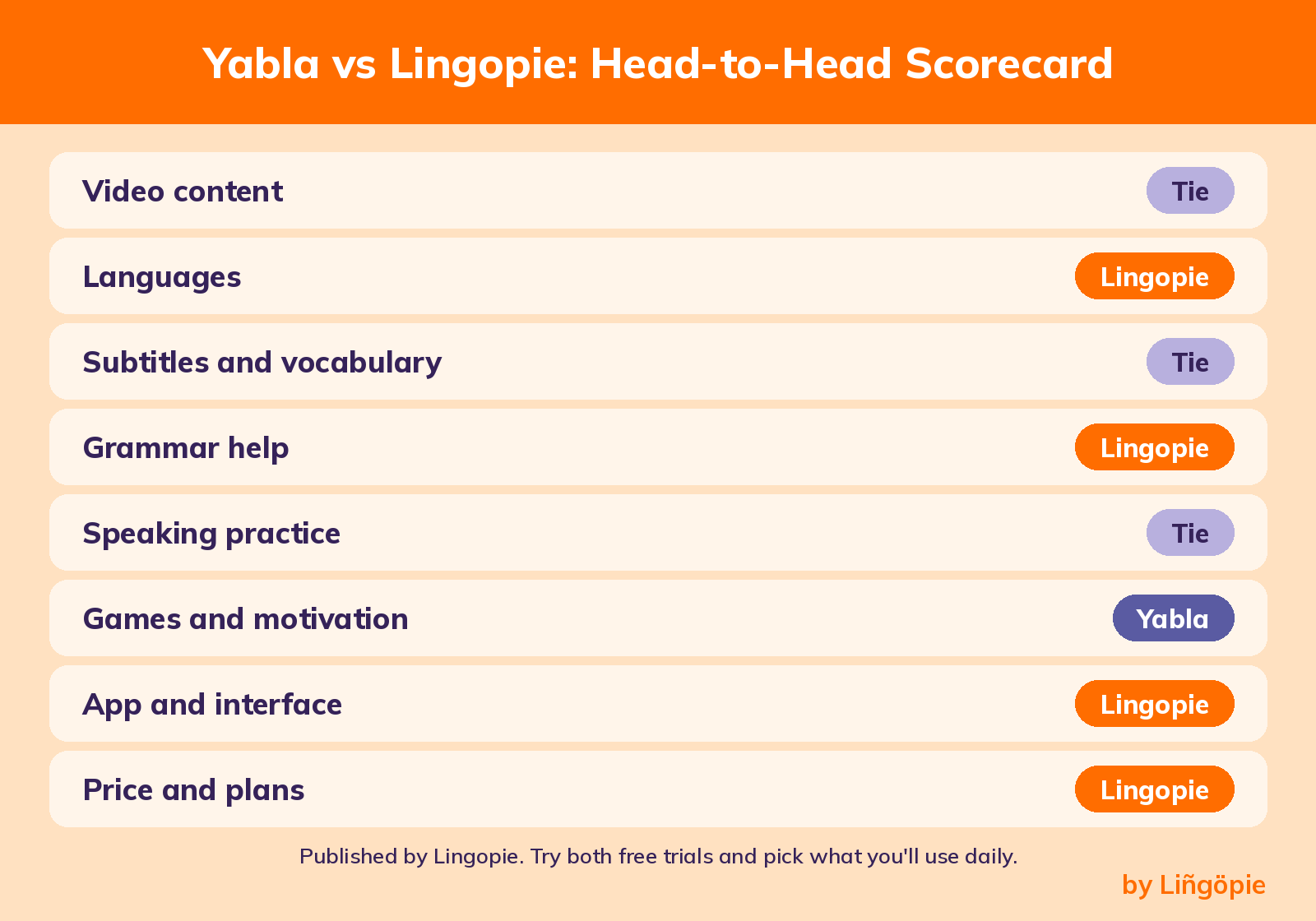
Winner: Tie. Yabla is better for short, varied clips, while Lingopie wins for full-length entertainment and extended viewing sessions.
Available Languages
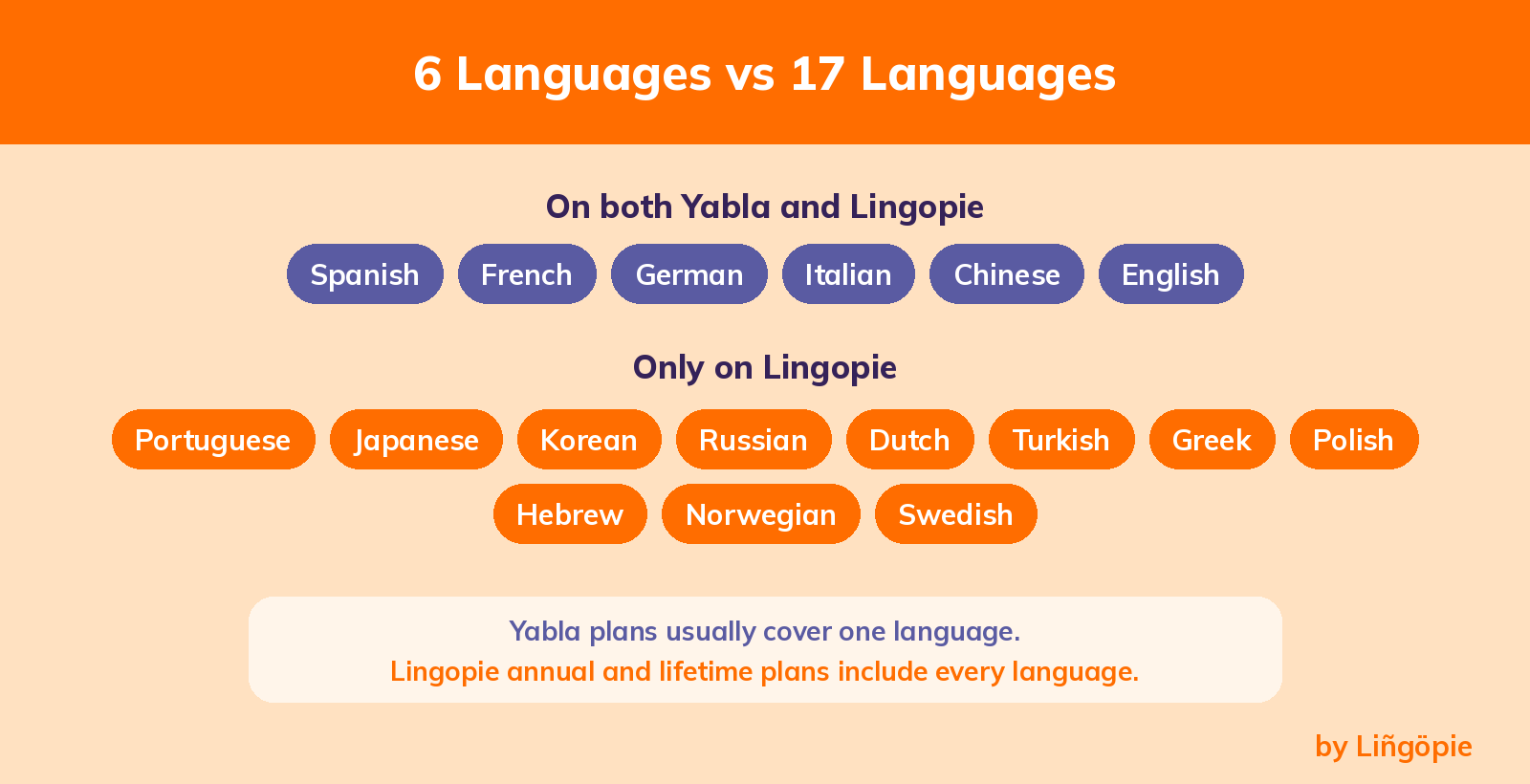
Lingopie offers a wider language selection, with 17 languages compared to Yabla's six. Both platforms teach Spanish, French, German, Italian, Chinese, and English, so you'll find plenty of learning material for these popular languages on either app.
Yabla focuses exclusively on those six languages, with dedicated video libraries featuring different accents, dialects, and cultural topics. Lingopie also offers Portuguese, Japanese, Korean, Russian, Dutch, Turkish, Greek, Polish, Hebrew, Norwegian, and Swedish. This makes it a more flexible option if you're interested in learning a language outside Yabla's selection.
There's also a difference in subscription access. Yabla subscriptions generally cover one language at a time, while Lingopie's annual and lifetime plans let you explore multiple languages under one subscription.
Winner: Lingopie. It supports more languages and offers greater flexibility for learners interested in studying more than one.
Subtitles and Vocabulary Tools
Both Yabla and Lingopie let you click on subtitles to translate unfamiliar words, save vocabulary, and review what you've learned. The main difference is how their tools fit into the viewing experience.
Feature | Yabla | Lingopie |
|---|---|---|
Dual subtitles | Target-language and translated subtitles | Target-language and translated subtitles |
Clickable translations | Opens a dictionary with word definitions | Shows instant translations while watching |
Vocabulary saving | Saves clicked words to flashcards | Automatically adds clicked words to My Vocab |
Flashcards | Word sets with audio and progress tracking | Flashcards and quizzes based on saved words |
Sentence replay | Loop individual captions and slow playback | Auto-loop subtitles and adjust playback speed |
Vocabulary review | Review saved words in a separate flashcard section | Review meanings, pronunciation, and the episode where a word appeared |
Yabla's tools are well suited to focused vocabulary study, especially when you want to replay individual sentences and test yourself afterward. Lingopie makes it easier to revisit words you've picked up during a show, including where you first encountered them.Clickable translations have research behind them: in a study of 227 learners, captions with word translations more than doubled word-meaning recall compared with standard captions (Montero Perez, Peters & Desmet, 2018).Still, neither app guarantees you'll remember new vocabulary without regular review.
Winner: Tie. Both offer strong subtitle and vocabulary tools. Yabla suits focused review, while Lingopie makes it convenient to learn and revisit words from TV shows and movies.
Grammar Help
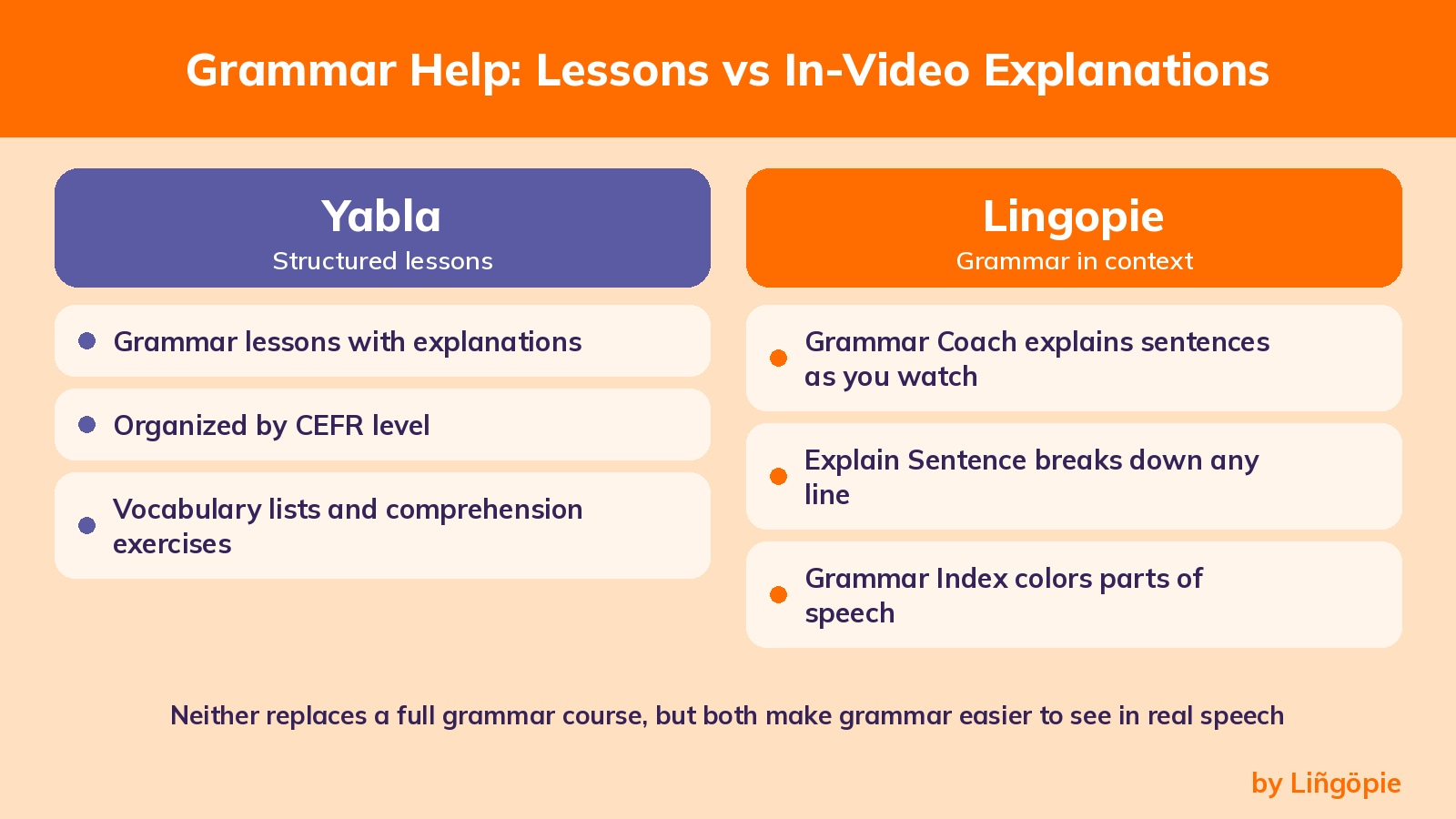
Both apps help you understand grammar through real videos, but they explain it differently. Yabla offers structured lessons with grammar explanations, vocabulary lists, and comprehension exercises. Lessons are organized by CEFR level, so you can work on grammar suited to your proficiency rather than relying on subtitles alone.
Lingopie takes a more contextual approach with its Grammar Coach and Grammar Index. While watching a show, you can get explanations of unfamiliar sentence structures and see nouns, verbs, adjectives, and adverbs highlighted in different colors. Its Explain Sentence feature also breaks down dialogue, helping you understand why a particular expression or grammatical form is used.
Yabla is useful if you prefer dedicated lessons with clear learning objectives. Lingopie makes grammar easier to explore as questions come up during a show, although neither platform replaces a comprehensive grammar course.
Winner: Lingopie. Its in-video grammar explanations make it more convenient to understand sentence structures in context, while Yabla is a strong alternative for structured grammar practice.
Speaking Practice
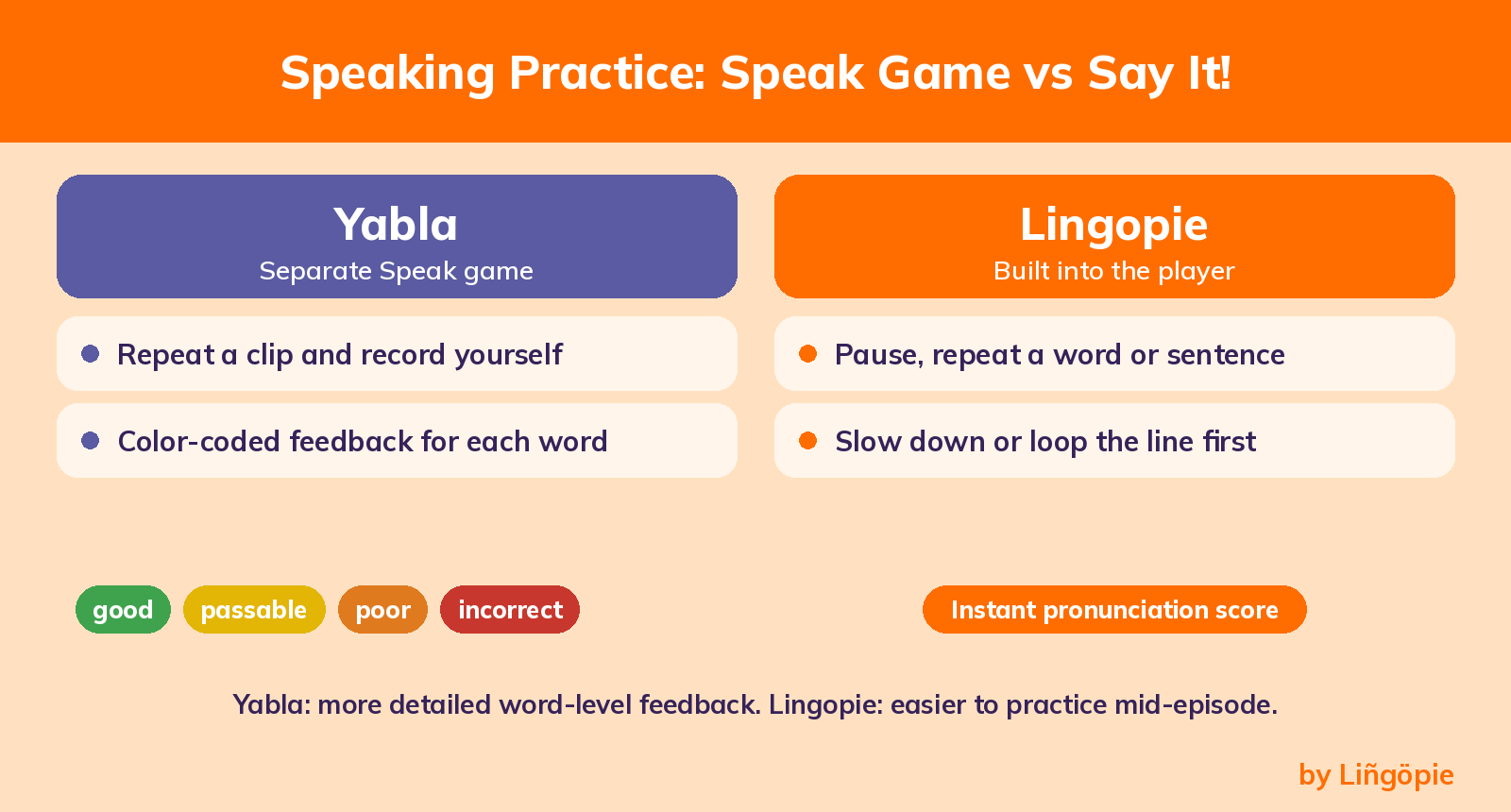
Both apps let you practice speaking aloud and get feedback on your pronunciation. Yabla has a separate Speak game where you listen to a video clip, record yourself repeating it, and receive color-coded feedback for each word. Your pronunciation is rated as good, passable, poor, or incorrect, so you can see which words need another attempt.
Lingopie builds speaking practice into its video player through the Say It! feature. You can pause a show, repeat a word or full sentence, and receive an instant pronunciation score. You can also slow down or loop the dialogue to hear how native speakers pronounce difficult sounds before trying again.
Yabla's word-by-word feedback is useful for identifying specific pronunciation mistakes. Lingopie makes speaking practice more convenient during regular viewing, although neither app replaces real conversations with native speakers.
Winner: Tie. Lingopie's in-player toolsmake it easier to practice pronunciation while watching, while Yabla offers more detailed word-level feedback.
Games and Motivation
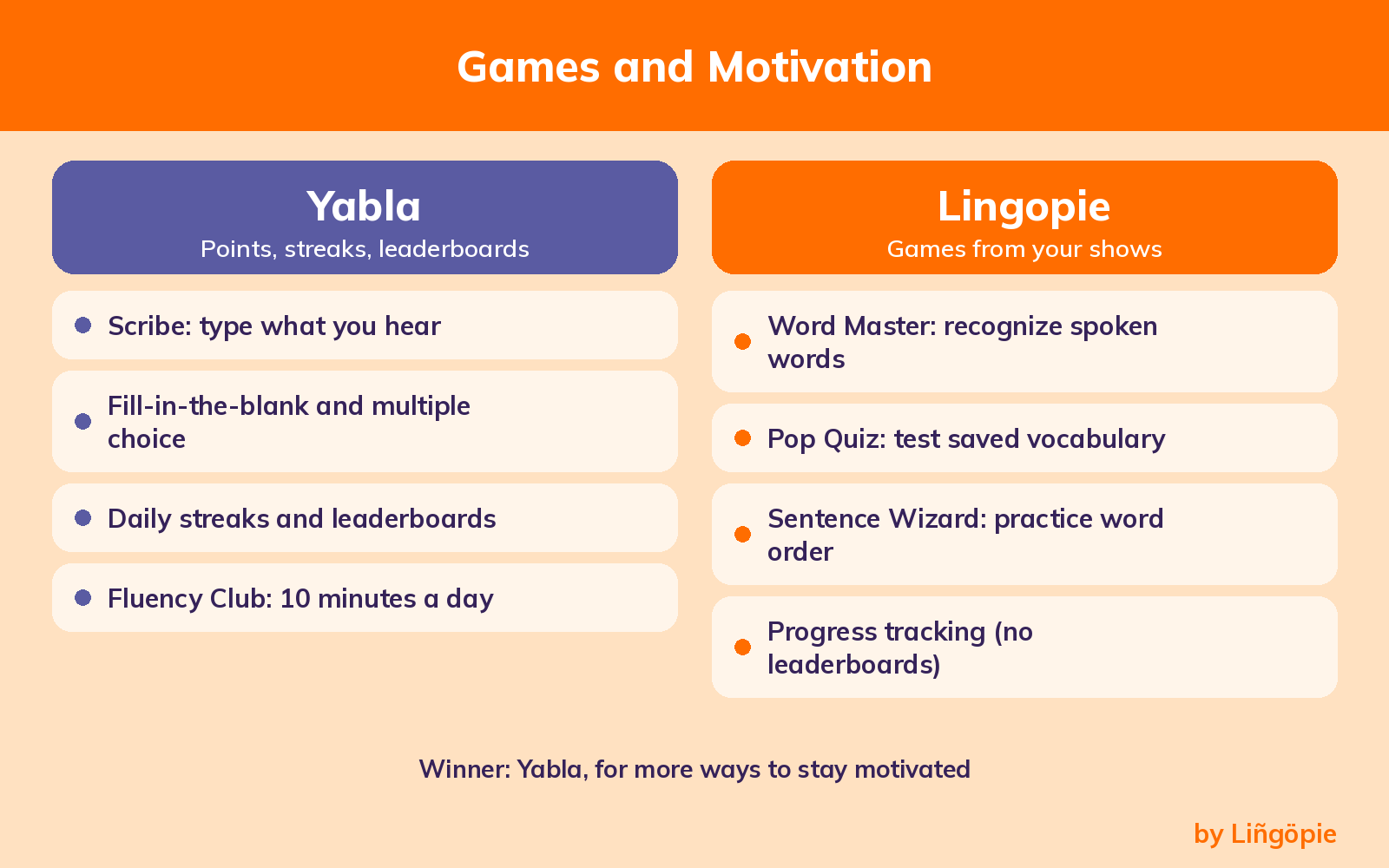
Yabla has the edge when it comes to keeping learners motivated through games and daily goals. Its Scribe game challenges you to type what you hear in a video, while fill-in-the-blank and multiple-choice exercises test your listening and vocabulary skills. You can also earn points, maintain learning streaks, and compete on leaderboards. Its Fluency Club adds a guided 10-minute daily routine for learners who prefer a little structure.
Lingopie also offers interactive games, including Word Master for recognizing spoken words, Pop Quiz for testing vocabulary, and Sentence Wizard for practicing word order. These activities use clips and vocabulary from the shows you've watched, making them useful for reviewing what you've learned. You can track your progress, although Lingopie doesn't offer the same competitive leaderboards and streak-based motivation as Yabla.
Winner: Yabla. Its wider range of exercises, daily streaks, and leaderboards give learners more ways to stay motivated and measure their progress.
App and Interface
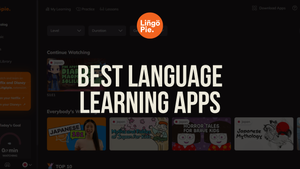
Lingopie has a more familiar streaming-style interface, with a layout similar to Netflix. You can browse TV shows and movies by genre, language, or difficulty level, making it easy to find something interesting to watch. The video player also keeps learning tools close at hand, so you can check translations, save vocabulary, or practice pronunciation without leaving your show.
Yabla has a more traditional learning interface, with videos organized by topic and difficulty level. Its dashboard also gives you access to games, flashcards, and progress tracking. While the layout is more focused on study activities than entertainment, it's practical for learners who want to jump straight into a lesson.
Both platforms work on desktop and mobile devices, but Lingopie also has dedicated TV apps for Roku, Fire TV, and Google TV,plus a Chrome extension for learning with Netflix. Your viewing progress and saved vocabulary sync across devices, making it easier to continue learning on a bigger screen.
Winner: Lingopie. Its Netflix-like interface and wider TV support make the viewing experience more convenient, especially for learners who prefer watching shows over navigating traditional lessons.
Price and Free Trial
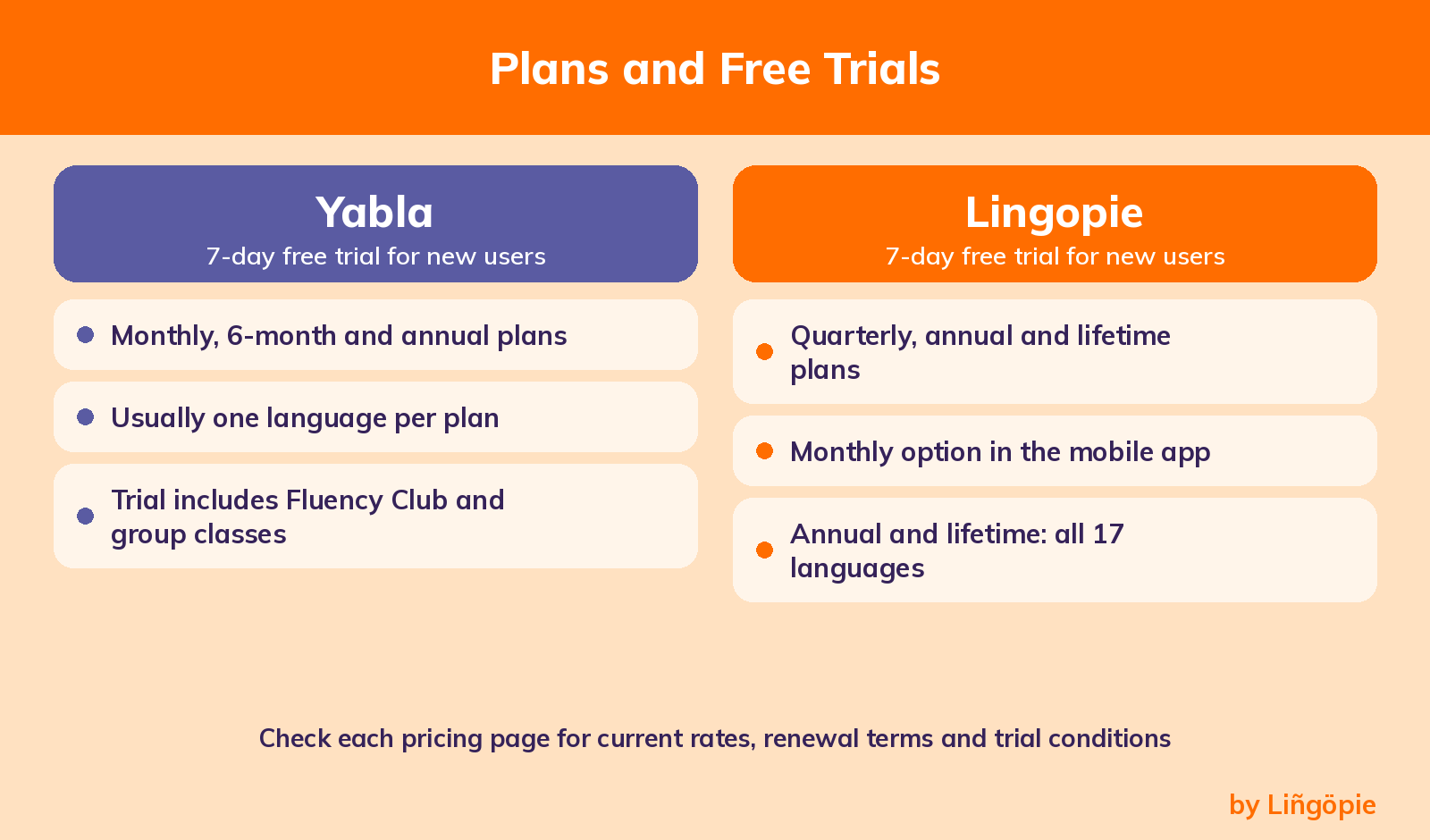
Both Yabla and Lingopie offer a seven-day free trial for new users, giving you time to explore their videos and learning tools before committing to a subscription.Yabla's trial also includes its Fluency Club and group classes.Trial eligibility and billing conditions can vary depending on where and how you sign up.
Yabla offers monthly, six-month, and annual subscriptions, generally covering one language at a time. Lingopie has quarterly, annual, and lifetime plans, with a monthly option available through its mobile app. Its annual and lifetime subscriptions include access to all supported languages, making them more flexible if you plan to study more than one.
For the latest rates, check Yabla's subscription page and Lingopie's pricing page. Pay attention to the total amount billed, renewal terms, and trial conditions before subscribing.
Winner: Lingopie. Its annual and lifetime plans offer greater flexibility for studying multiple languages, although Yabla's monthly option may suit learners who prefer a shorter commitment.
Which Should You Choose?
The best choice depends on how you prefer to learn and what keeps you motivated. Both apps can help you build your listening skills and vocabulary, but their different approaches make them better suited to certain study habits.
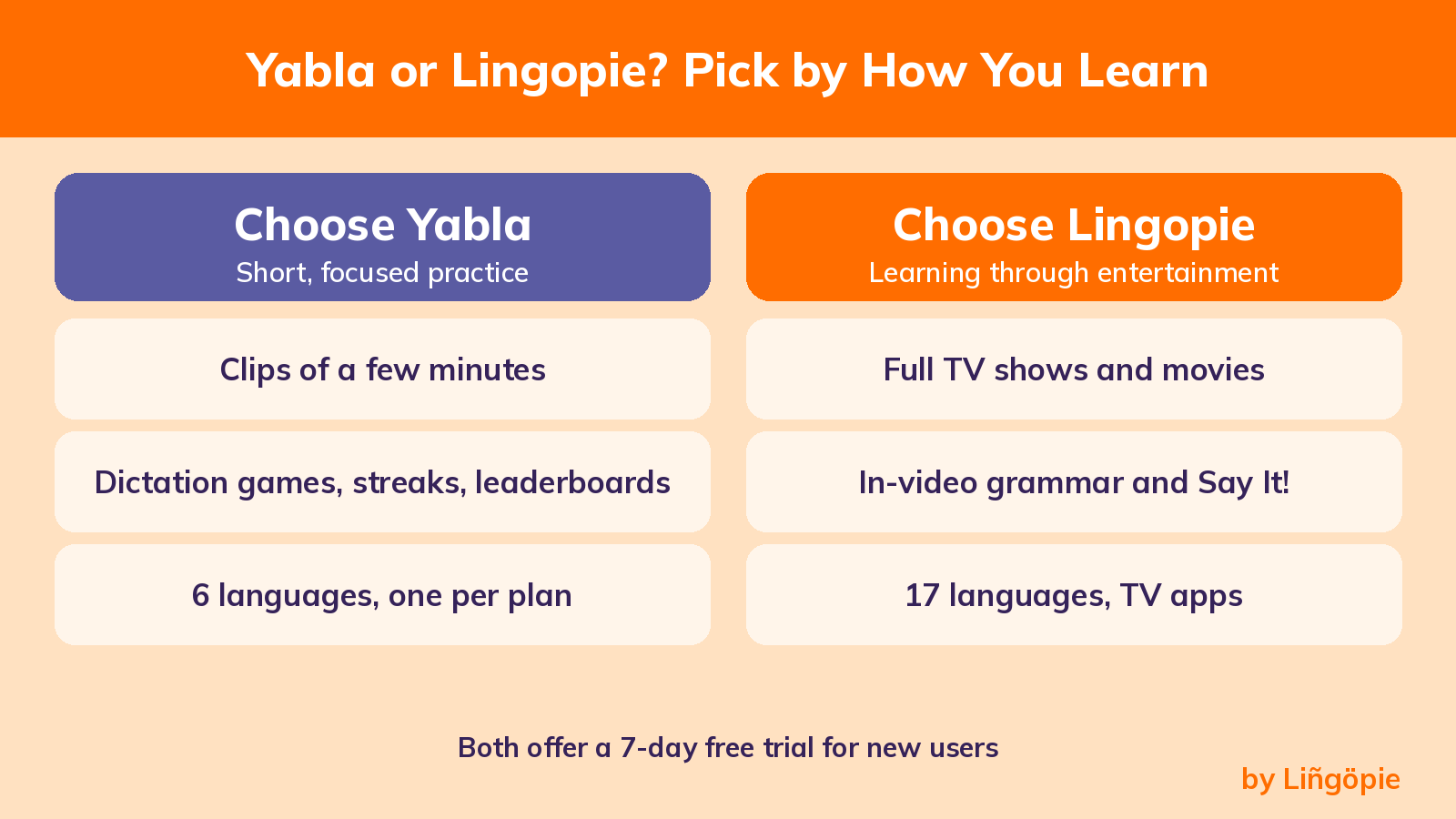
Choose Yabla if… | Choose Lingopie if… |
|---|---|
You prefer short videos that fit into a 10-minute study break. | You enjoy learning through full-length TV shows and movies. |
You like dictation exercises, games, and daily learning goals. | You want to pick up vocabulary and grammar through stories and dialogue. |
You prefer structured lessons organized by difficulty level. | You want to practice pronunciation while watching your favorite shows. |
You enjoy tracking streaks and competing on leaderboards. | You prefer a familiar, Netflix-like viewing experience. |
You're focused on learning one of its six supported languages. | You want to explore several languages under one subscription. |
If you're still undecided, take advantage of the free trials and try watching a video on each platform. Pay attention to which one makes you want to keep learning. After all, the most useful language app is one you'll actually enjoy using regularly.
Our Verdict: Is Lingopie Better Than Yabla?
Lingopie is the better choice if you enjoy learning through TV shows and movies. Its interactive subtitles, grammar explanations, and speaking tools make it easy to practice while watching something you enjoy. With more languages and a familiar streaming-style interface, it's also a flexible option for learners who want entertainment to be part of their study routine.
However, Yabla is worth choosing if you prefer shorter, more structured sessions. Its authentic videos, listening exercises, and daily challenges give you plenty of opportunities to practice without committing to a full episode.
Ultimately, both apps can support your language-learning goals. Choose Lingopie for entertainment-based learning or Yabla for focused daily practice.If entertainment-based learning sounds right for you, try Lingopie free.
Frequently Asked Questions
What is the difference between Yabla and Lingopie?
Yabla focuses on short, authentic videos with structured lessons, listening exercises, and games. Lingopie uses TV shows and movies to teach vocabulary, grammar, and pronunciation through interactive subtitles. Both support video-based language learning, but Yabla is more exercise-focused, while Lingopie offers a streaming-style experience.
Is Lingopie better than Yabla?
Lingopie is better for learners who enjoy watching TV shows and movies while building their language skills. It also supports more languages and offers in-video grammar explanations. However, Yabla is a better fit if you prefer short lessons, dictation exercises, and game-based motivation.
Which is cheaper, Yabla or Lingopie?
Neither app is consistently cheaper, as the cost depends on your subscription plan and any available promotions. Yabla offers monthly, six-month, and annual subscriptions, while Lingopie has quarterly, annual, and lifetime options. Compare their latest prices and consider how many languages you want to study before subscribing.
Which languages do Yabla and Lingopie teach?
Yabla teaches six languages: Spanish, French, German, Italian, Chinese, and English.Lingopie offers 17 languages, including those sixplus Portuguese, Russian, Japanese, Korean, Dutch, Turkish, Greek, Polish, Hebrew, Norwegian, and Swedish. Lingopie is the more flexible choice if your target language isn't available on Yabla.
Is Yabla good for beginners?
Yes, Yabla is suitable for beginners because its videos are organized by difficulty level, with subtitles, translations, and playback controls to help you follow along. It also offers beginner-friendly lessons, vocabulary flashcards, and listening exercises, so you can gradually build your understanding of spoken language.