

Language barriers are more common than you might think, especially whentravelingabroad, studying in another country, or working with people who speak different languages.They can even affect how much people believe you: in one University of Chicago study, listeners rated trivia statements as less true when the speaker had a foreign accent, simply because accented speech took more effort to process.But you don't need to speak another language fluently to communicate effectively.
Sometimes, slowing down, choosing simpler words, or asking someone to repeat themselves can make all the difference.
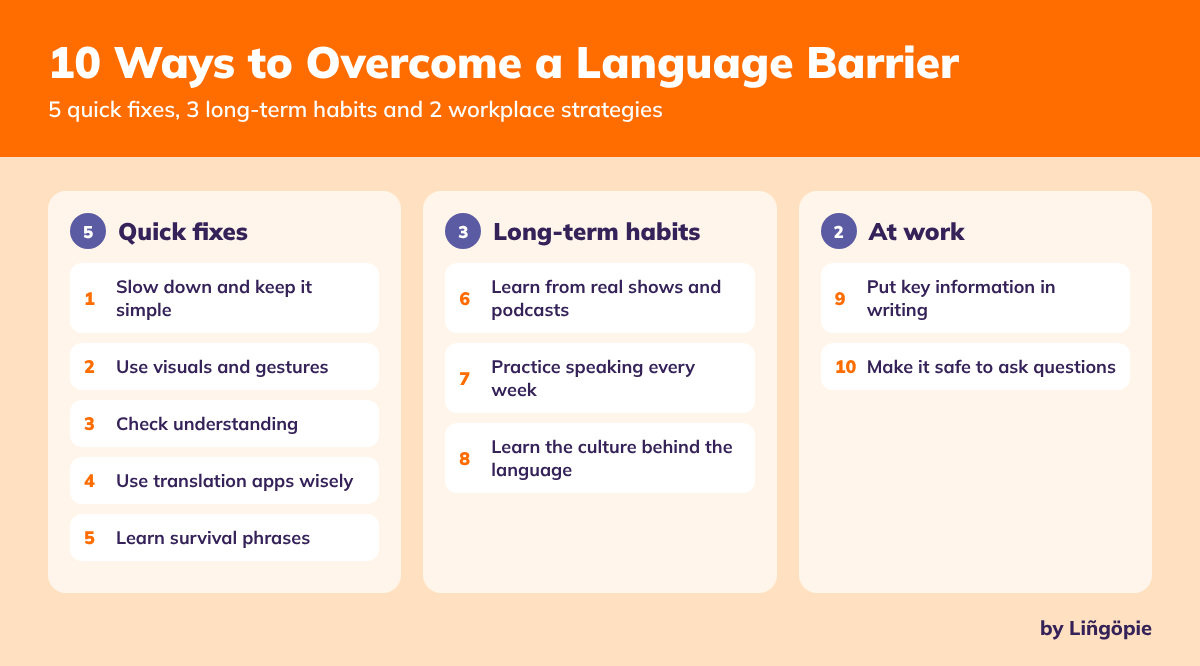
So, how do you overcome a language barrier? Whether you're learning a new language or trying to communicate with someone who doesn't speak yours, this guide covers 10 practical strategies to help you understand and be understood: five quick fixes for everyday conversations, three long-term language-learning habits, and two ways to reduce language barriers at work.
Key Takeaways
- To overcome a language barrier right away, slow down, use simple words, show visuals, check understanding, and lean on a few survival phrases or a translation app.
- Language barriers occur when differences in language, pronunciation, vocabulary, or communication styles prevent people from understanding one another.
- Language barriers aren't always about speaking different languages, as unfamiliar accents, regional slang, and cultural differences can also cause misunderstandings.
- Linguistic Relativity and Social Identity Theory help explain how language can influence people's thinking, perceptions, and interactions with others.
- Krashen's Affective Filter Hypothesis suggests that anxiety, low confidence, and fear of making mistakes can interfere with language learning.
- Overcoming language barriers in the long run involves practicing regularly through real conversations and authentic content.

What Is a Language Barrier?
A language barrier is anything that makes communication difficult because people speak different languages or use unfamiliar words, accents, or expressions. For example, an English speaker learning Spanish might struggle to understand native speakers, while two people who speak English may still misunderstand each other because of regional slang or cultural differences.
However, language barriers aren't always caused by limited vocabulary or grammar knowledge. The Sapir-Whorf Hypothesis, also known as linguistic relativity, suggests that language can influence how people perceive and interpret the world. This helps explain why people may interpret the same situation differently, even when they understand the individual words being used.
Language barriers can also involve how people perceive one another. Social Identity Theory helps explain how accents and language differences can lead people tocategorizeothers as belonging to different social groups. These perceptions may contribute to stereotypes, exclusion, or reduced trust, making communication more difficult.
5 Types of Language Barriers
Language barriers can appear in everyday conversations, classrooms, workplaces, and online interactions. Here are five common types, with examples and practical ways to overcome them.
Type | Example | Quick fix |
|---|---|---|
Different languages | An English speaker struggles to ask for directions in Japan. | Learn essential phrases or use a translation app. |
Accents and dialects | A language learner has trouble understanding an unfamiliar regional accent. | Ask the speaker to slow down or repeat unfamiliar words. |
Jargon and idioms | A non-native English speaker misunderstands expressions like "hit the ground running." | Use simpler words and explain unfamiliar expressions. |
Cultural and non-verbal differences | A gesture or indirect response is interpreted differently across cultures. | Ask for clarification instead of assuming the meaning. |
Written and digital communication | An international colleague misunderstands an email filled with abbreviations. | Use plain language and confirm important details in writing. |
5 Quick Ways to Overcome a Language Barrier Right Now
You don't need to be fluent in another language to communicate effectively. Even when you don't share a common language, simple communication strategies can help you express yourself, avoid misunderstandings, and understand what others are saying.
Here are five practical ways to overcome language barriers in everyday situations, whether you'retravelingabroad, studying, or speaking with someone who doesn't know your language.
Slow Down and Use Simple Language
Speak at a moderate pace and use short, clear sentences to make your message easier to understand. When communicating with someone who is still learning your language, avoid complicated vocabulary, idioms, and slang that may confuse them. You don't need to speak unnaturally slowly or raise your voice, as neither guarantees better understanding.
For example, instead of saying, "Could you give me a heads-up when you're done?", try "Please tell me when you finish." Focus on communicating one idea at a time, and pause between important points to give the other person time to process what you've said.
Use Visuals, Gestures, and Body Language
Use pictures, gestures, and other visual cues to communicate when words aren't enough. For example, if you're asking for directions in a foreign country, show the location on your phone's map instead of trying to explain the address. You can also point to objects, draw simple pictures, or write down numbers to make your message clearer.
However, remember that gestures and body language don't always mean the same thing across cultures. A hand gesture that's friendly in one country may be considered rude in another. When in doubt, use simple visuals and ask the other person to confirm what they understood.
Check That You Understand Each Other
Confirm what the other person means instead of assuming you've understood everything correctly. One effective technique is paraphrasing, which means repeating what someone said in your own words to check your understanding. For example, if someone gives you directions, you might ask, "So, I turn left at the traffic lights, then walk straight for two blocks?"
You can also ask open-ended questions or encourage the other person tosummarizeimportant information. Instead of simply asking, "Do you understand?", try "Can you tell me what we'll do next?" This helps identify misunderstandings early and gives both speakers a chance to clarify their message without embarrassment.
Use Translation Apps Wisely
Use translation apps to communicate when you don't know the right words or phrases in another language. These tools can help you ask for directions, understand signs, read menus, or have basic conversations with native speakers. Some even support voice translation, allowing two people to speak in different languages and understand each other in near real time.
Here are two useful translation apps to try:
- Google Translate: Supports text, speech, camera translation, and conversation features, making it useful for travel and everyday interactions.
- DeepL: Offers text and document translation, along with spoken conversation translation through DeepL Voice on supported plans.
However, translation apps aren't always accurate, especially with idioms, slang, cultural context, and technical terminology. For medical appointments, legal matters, or important contracts, use a qualified professional interpreter rather than relying solely on automated translations.
Learn 10 Survival Phrases That Save a Conversation
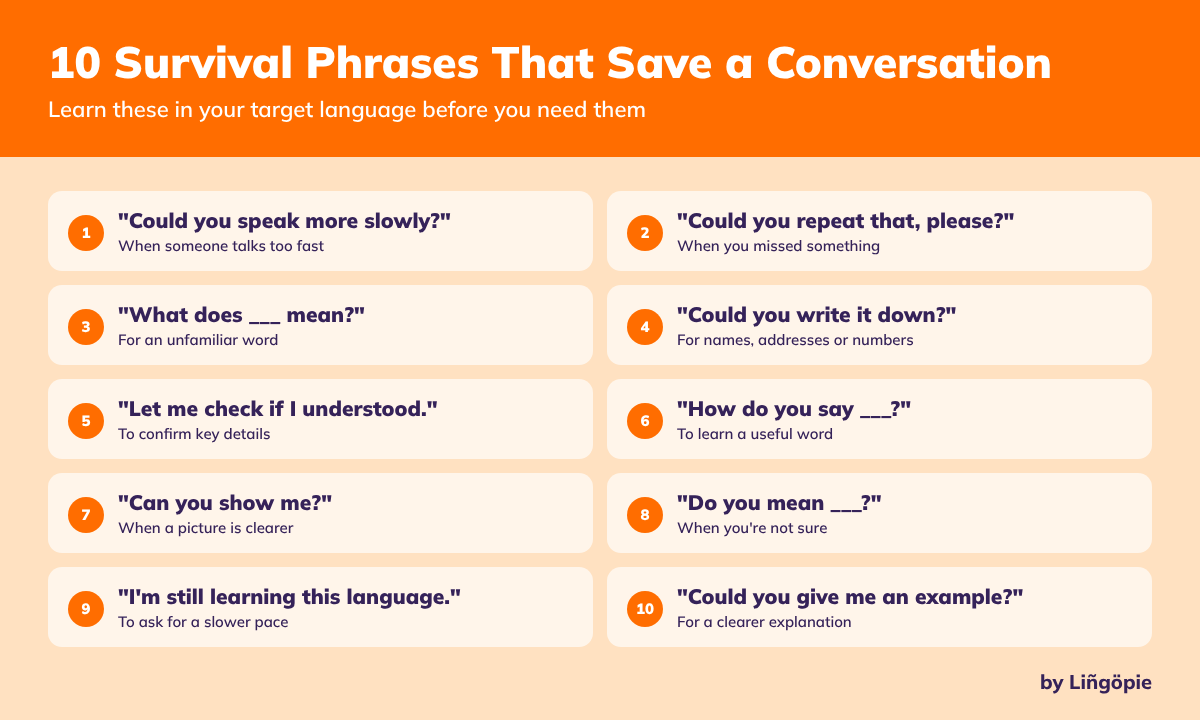
Sometimes, knowing a few simple phrases is enough to overcome a language barrier and keep a conversation going. Whether you're learning a foreign language,travelingabroad, or speaking with non-native speakers, these expressions can help you ask for clarification, avoid misunderstandings, and communicate more effectively.
Phrase | When to use it |
|---|---|
"Could you speak more slowly?" | When someone is speaking too fast for you to follow. |
"Could you repeat that, please?" | When you didn't hear or understand something. |
"What does ___ mean?" | When you encounter an unfamiliar word or expression. |
"Could you write it down?" | When you need to confirm names, addresses, or numbers. |
"Let me check if I understood correctly." | When you want to confirm important information. |
"How do you say ___ in your language?" | When you want to learn a useful word or phrase. |
"Can you show me?" | When a picture, object, or demonstration would be clearer. |
"Do you mean ___?" | When you're unsure what someone is trying to say. |
"I'm still learning this language." | When you want someone to adjust their speaking pace. |
"Could you give me an example?" | When you need a clearer explanation. |
If you're learning a new language, try translating these phrases into your target language andpracticing them aloud. Start with expressions like "Could you repeat that?" and "What does this mean?" so you can use them during real conversations. You don't need perfect grammar or a large vocabulary to ask for help, clarify unfamiliar words, andkeep practicing with native speakers.
3 Long-Term Strategies to Overcome Language Barriers
While translation apps and simple communication techniques can help you get through a conversation, learning the language itself can make future interactions easier. A 2022 meta-analysis found that spaced practice, or spreading learning sessions over time, benefits second-language development and long-term retention.This suggests that practicing regularlymay be more effective than trying to learn everything in one sitting.
So, how can you overcome language barriers in the long run? The following three strategies focus on building your language skills through real-world content, regular speaking practice, and cultural understanding.
Learn the Language Through Real-World Content
Expose yourself to authentic content like TV shows, movies, podcasts, and everyday conversations to understand how people actually speak. Unlike textbook dialogues, real-world content introduces you to natural pronunciation, slang, idioms, and expressions that native speakers use in different situations.Subtitles help too: a 2025 meta-analysis of 49 experiments found that watching videos with captions led to better vocabulary learning than watching without them.
To make the most of this approach, start with a short video or podcast suited to your language level. Listen once for the general meaning, replay unfamiliar parts, and write down three useful expressions.Then, practice saying them aloudand try using at least one in your next conversation.
You can also use Lingopie to learn languages through TV shows and movies, with interactive subtitles that help you follow dialogue and review unfamiliar vocabulary.
Related: 10 Best Vocabulary Apps (2026): Free and Paid
Practice Speaking With Other People Every Week
Make time for real conversations at least once a week, even if you're still learning basic vocabulary and grammar. Speaking with native speakers or fellow language learners helps you improve your pronunciation,practice forming sentences, and get comfortable responding naturally. Here are a few ways to build regular speaking practice into your routine:
- Find a language exchange partner: Use apps like HelloTalk or Tandemto practice with other language learnersand native speakers.
- Schedule short conversations: Start with 15–20 minutes a week discussing familiar topics like hobbies, food, or daily routines.
- Practice with a language tutor: Ask for feedback on your pronunciation, grammar, and recurring mistakes.
- Join a conversation group: Participate in online language communities or local meetupswhere you can practice speakingin a supportive environment.
Don't worry about making mistakes during these conversations. Krashen's Affective Filter Hypothesis suggests that anxiety and fear of negative evaluation can interfere with language acquisition. Choosing supportive conversation partners and focusing on getting your message across may help you become more comfortable using your target language.
Related: How the Shadowing Technique Boosts Language Learning
Learn the Culture Behind the Language
Learn how cultural norms influence the way people speak, behave, and interpret messages. Even if you know the right vocabulary and grammar, differences in politeness, formality, and communication styles can still lead to misunderstandings.
For example, Spanish speakers may use tú or usted depending on the relationship and social context, while Japanese speakers often adjust their language based on formality and social relationships.
To communicate more naturally, pay attention to these cultural differences:
- Formality and politeness: Learn when to use formal or informal language, especially when speaking with strangers, older people, or colleagues.
- Direct and indirect communication: Notice how people make requests, express disagreement, or decline invitations without always saying exactly what they mean.
- Body language and eye contact: Observe how gestures, personal space, and eye contact are interpreted in different social settings.
- Idioms and everyday expressions: Learn common sayings and slang in context rather than translating them word for word.
Remember that cultural norms are general tendencies, not rules that apply to everyone. When you're unsure about someone's meaning or intentions, ask politely for clarification instead of making assumptions. This can help you avoid unnecessary misunderstandings while building stronger connections with people who speak your target language.
How to Overcome Language Barriers in the Workplace
Language barriers in the workplace can affect more than everyday conversations.A 2014 study of multinational teams found that language differences can interfere with trust formation between colleagues.This makes clear communication especially important when employees have different levels of language proficiency.
Here are two ways employees and managers can reduce misunderstandings and make communication more inclusive.
Put Important Information in Writing
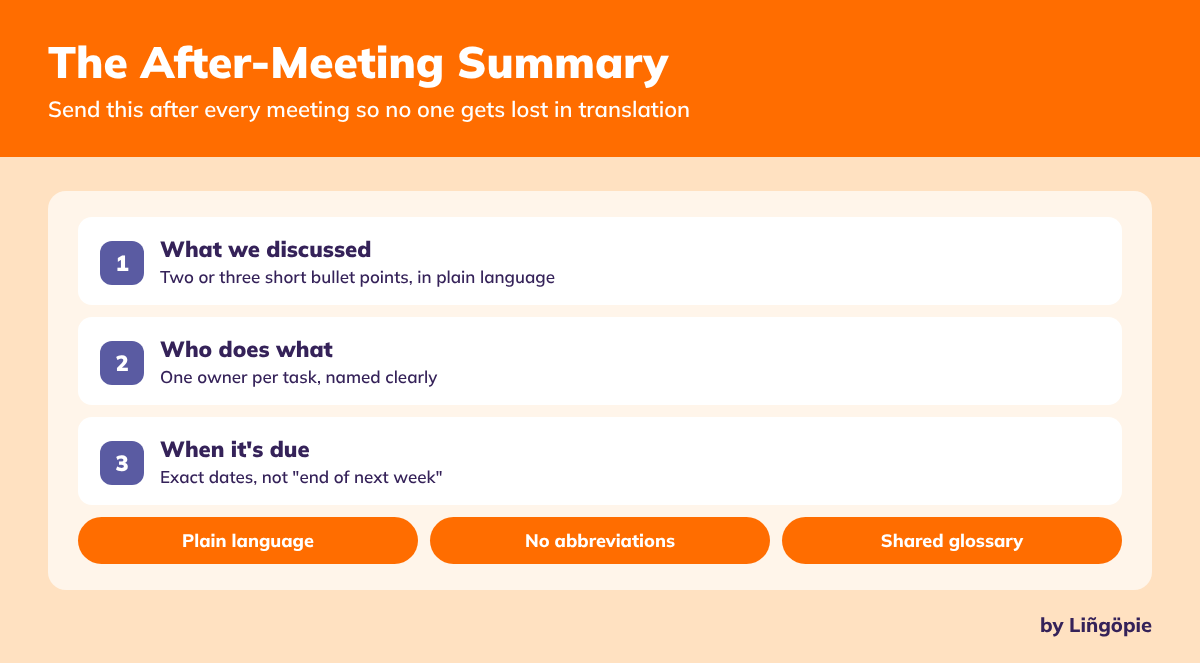
Document important instructions, decisions, and deadlines so everyone can refer to them later. Verbal communication can be difficult to follow when colleagues speak quickly, use unfamiliar accents, or include technical jargon. Written records give non-native speakers more time to process information and check unfamiliar terms.
For example, after a team meeting, send a short summary covering what was discussed, who's responsible for each task, and when it's due. Use plain language, avoid unnecessary abbreviations, and create a shared glossary for industry-specific terms that employees may notrecognize.
Create a Workplace Where People Feel Comfortable Asking Questions
Encourage employees to ask questions and request clarification without worrying about being judged for their language skills. Managers can support effective communication by giving everyone time to speak, avoiding unexplained idioms, and checking that important instructions are understood.
For example, instead of asking, "Does everyone understand?", invite team members to share questions or explain the next steps in their own words. As Tsedal Neeley explains in Global Teams That Work, language differences can contribute to social distance in global teams. Creating opportunities for everyone to participate can help reduce this divide and build stronger working relationships.

Final Thoughts on Overcoming Language Barriers
Overcoming language barriers doesn't mean you need to speak another language perfectly. Simple strategies like slowing down, checking understanding, and using translation tools can make everyday communication easier. Over time, regular speaking practice, exposure to authentic content, and cultural awareness can help you become more confident communicating with others.
Frequently Asked Questions About Language Barriers
What are the main types of language barriers?
The five main types of language barriers are differences in languages, accents and dialects, jargon and idioms, cultural and non-verbal communication, and written or digital communication.
How do you communicate with someone who doesn't speak your language?
Use simple words, speak slowly, rely on gestures or visual aids, and use translation apps when necessary to help both people understand each other.
Are translation apps good enough to overcome a language barrier?
Translation apps are useful for everyday conversations, but they can misinterpret context andspecializedterminology, so professional interpreters are recommended for medical, legal, and other high-stakes situations.
How can managers reduce language barriers at work?
Managers can reduce language barriers in the workplace by using plain language, providing written instructions, encouraging questions, and giving non-native speakers enough time to respond.
How long does it take to overcome a language barrier when moving abroad?
It can take months or years to become comfortable communicating in another language, depending on your starting proficiency, the language you're learning, andhow often you practice.
Sources
- Lev-Ari, S., & Keysar, B. (2010). Why don't we believe non-native speakers? The influence of accent on credibility. Journal of Experimental Social Psychology, 46(6), 1093–1096.
- Tenzer, H., Pudelko, M., & Harzing, A.-W. (2014). The impact of language barriers on trust formation in multinational teams. Journal of International Business Studies, 45, 508–535.
- Kim, S. K., & Webb, S. (2022). The effects of spaced practice on second language learning: A meta-analysis. Language Learning, 72(1).
- Kurokawa, S., Hein, J., & Uchihara, T. (2025). Captioned video and vocabulary learning: A meta-analysis. Language Learning.
- Neeley, T. (2015). Global Teams That Work. Harvard Business Review.