
Ever wondered why a car is called coche in Spain but carro in Mexico? Or why Spaniards say vosotros while Mexicans use ustedes? These are just a few examples of Spain Spanish vs Mexican Spanish differences. Although both countries speak the same language, pronunciation, grammar, and everyday vocabulary can sound surprisingly different.
But does it really matter which variety you learn? With over 640 million potential Spanish speakers worldwide, according to the Instituto Cervantes, understanding regional differences can help you communicate more naturally. This guide explores 12 key differences, including slang and expressions that don't always translate the same way, to help you decide which Spanish suits your learning goals.

Spain Spanish vs Mexican Spanish at a Glance
Wondering how different Spanish can be between Spain and Mexico? The key differences are easier to spot when you compare how people pronounce words, form sentences, and talk about everyday things. Here's a quick look at 12 Spain Spanish vs Mexican Spanish differences you'll come across.
Difference | Spain Spanish | Mexican Spanish |
|---|---|---|
1. C and Z sounds | Often pronounced like "th" in think | Pronounced like "s" |
2. J sound | Often has a stronger, throaty sound | Often has a softer sound |
3. S sound | May be softened or dropped in southern regions | Often pronounced clearly in central Mexico |
4. Rhythm and intonation | Varies across regions | Has distinct regional speech patterns |
5. Plural "you" | Vosotros (informal), ustedes (formal) | Ustedes for both |
6. Past tenses | ¿Qué has hecho hoy? | ¿Qué hiciste hoy? |
7. Tú vs usted | Tú is common in informal situations | Usted is often used to show respect |
8. Object pronouns | Le vi is common in parts of Spain | Lo vi is generally preferred |
9. Diminutives | Café, un momento | Cafecito, momentito |
10. Everyday vocabulary | Coche, ordenador, móvil | Carro, computadora, celular |
11. Nahuatl influence | Cacahuete (peanut) | Cacahuate (peanut) |
12. English loanwords | Alquilar, comprobar | Rentar, checar |
These are general patterns, not strict rules. As the FundéuRAE explains, Spanish also varies between regions within the same country. For example, speakers in the Canary Islands and parts of southern Spain use ustedes instead of vosotros, just as Mexicans do.
Are Spain Spanish and Mexican Spanish the Same Language?
Yes, Spain Spanish and Mexican Spanish are two varieties of the same language, and they're mutually intelligible. Think of it like British and Australian English. You might notice different accents, slang, or everyday expressions, but native Spanish speakers can generally understand each other without much difficulty.
Spanish spoken in Spain is often called Castilian Spanish (castellano), although the term can also refer to the Spanish language as a whole. And while Spain is where the language originated, Mexico actually has more native Spanish speakers. In fact, Mexico has approximately 130 million native-proficiency Spanish speakers, compared with 47 million in Spain.
Spain Spanish | Mexican Spanish |
|---|---|
Often called Castilian Spanish | A variety of Latin American Spanish |
Spoken across Spain, with regional differences | Spoken across Mexico, with regional differences |
Generally understood by Mexican speakers | Generally understood by Spanish speakers |
Just note that neither variety is more correct or authentic than the other. Both follow the same core grammar rules, and most vocabulary is shared. The differences become more noticeable in pronunciation, informal conversations, and certain regional expressions.
Why Do Spain Spanish and Mexican Spanish Sound Different? A Short History
To understand why Spanish sounds different in Spain and Mexico, it helps to look at where the language began. Spanish developed from Vulgar Latin, the everyday language spoken across the Iberian Peninsula during the Roman Empire. Over time, it evolved into one of the Romance languages, alongside French, Italian, and Portuguese. Centuries of Arabic influence also introduced words like aceite (oil), almohada (pillow), and ojalá (hopefully), which are still used in both countries today.
Spanish arrived in Mexico during the Spanish conquest of 1519–1521, where it came into contact with Nahuatl and other indigenous languages. According to research from UNAM, this linguistic exchange introduced words like chocolate, tomate, and aguacate into Spanish, many of which eventually spread beyond Mexico.
Historical influence | Spain Spanish | Mexican Spanish |
|---|---|---|
Latin origins | Developed from Vulgar Latin | Inherited the same Latin roots |
Arabic influence | Adopted words like aceite and almohada | Retained the same Arabic-derived vocabulary |
Indigenous languages | Limited direct influence from Mexican indigenous languages | Borrowed words from Nahuatl and other native languages |
Regional development | Evolved across different regions of Spain | Developed through contact with indigenous languages and regional communities |
Over the centuries, pronunciation, vocabulary, and everyday expressions continued to evolve in both countries. As UNAM linguist Concepción Company explains, Mexico's history and geography helped shape its distinct regional varieties. Neither form is more original or correct than the other. They're simply different ways of speaking the same language.
Pronunciation Differences Between Spain Spanish and Mexican Spanish
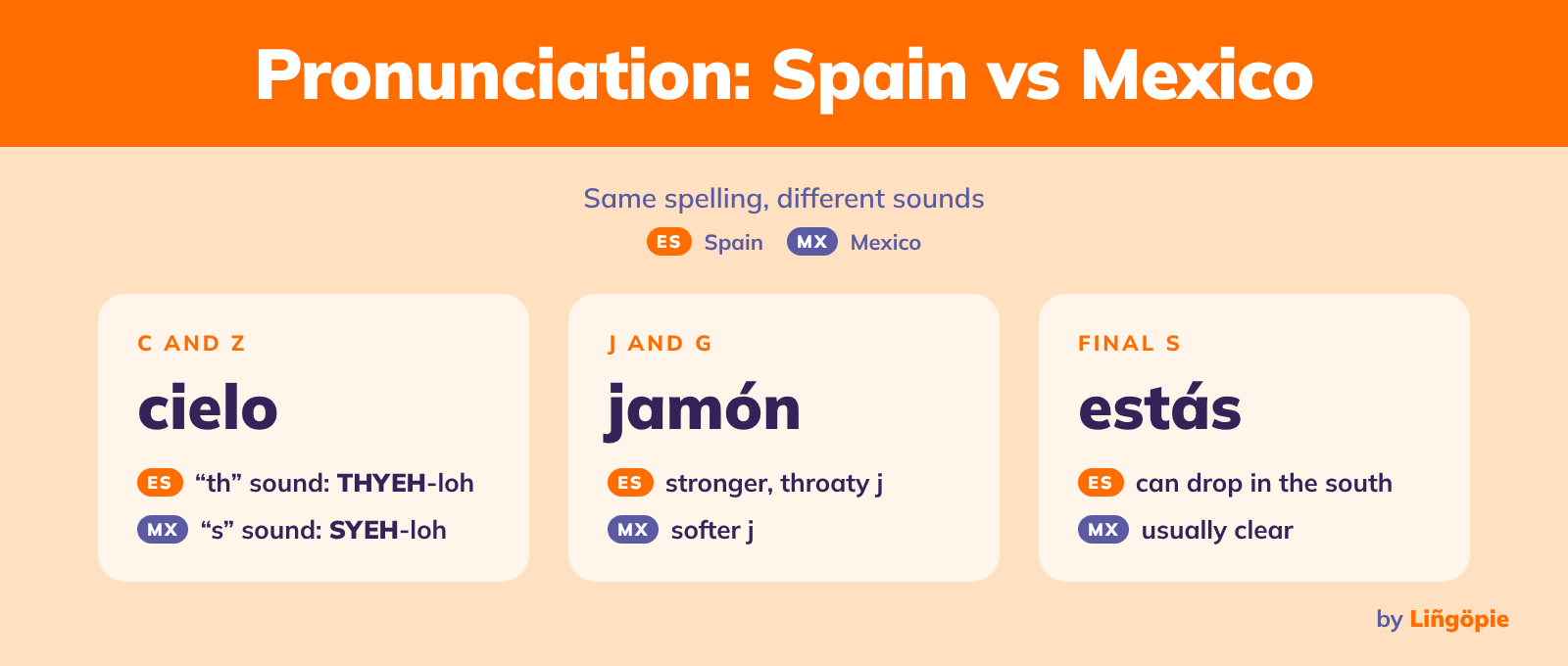
One of the most noticeable differences between Spanish from Spain and Mexico is how certain letters sound. While both countries share the same spelling and grammar foundations, their regional accents can make familiar words sound quite different. Here are four pronunciation differences worth knowing when learning Spanish.
1. The "Th" Sound vs the "S" Sound
In much of central Spain, the letters z and c (before e or i) are pronounced like the "th" in think. This pronunciation pattern is called distinción. In Mexico, these letters are pronounced with an "s" sound, a pattern known as seseo.
Spain | Mexico | English |
|---|---|---|
Cielo (with "th") | Cielo (with "s") | Sky |
Zapato (with "th") | Zapato (with "s") | Shoe |
For example, both countries use El cielo es azul (The sky is blue), but the word cielo sounds different. However, not all Spanish people use distinción. Speakers in the Canary Islands and much of southern Spain also use seseo, just like speakers in Mexico.
2. The J Sound
The Spanish letter j, as well as g before e or i, often has a stronger, throaty sound in much of Spain. In Mexico, the same sound is frequently produced with less friction, making it sound softer to English speakers.
Spain | Mexico | English |
|---|---|---|
Jamón (stronger j) | Jamón (softer j) | Ham |
Gente (stronger g) | Gente (softer g) | People |
For example, Me gusta el jamón (I like ham) is grammatically correct in both countries, but the initial sound of jamón may be pronounced differently. The exact pronunciation also varies by region and speaker.
3. How the S Sound Changes
In central and northern Spain, speakers generally pronounce the "s" sound clearly. However, in parts of southern Spain and the Canary Islands, an s at the end of a syllable may be softened or dropped. In central Mexico, speakers typically retain this sound.
Spain | Mexico | English |
|---|---|---|
Estás (final s may weaken in southern regions) | Estás (s usually retained) | You are |
Los amigos (s may weaken in some regions) | Los amigos (s usually retained) | The friends |
For example, ¿Cómo estás? (How are you?) may sound different depending on whether you're speaking with someone in Andalusia or Mexico City. This is one reason regional accents can vary even within the same country.
4. Rhythm and Intonation
Beyond individual letters, Spanish dialects also differ in their rhythm and intonation. Some Mexican accents, particularly those associated with central Mexico, may sound more flowing to learners, while certain accents in Spain may sound sharper because of their consonant pronunciation.
Spain | Mexico | English |
|---|---|---|
¿Qué quieres hacer? | ¿Qué quieres hacer? | What do you want to do? |
¿Vienes mañana? | ¿Vienes mañana? | Are you coming tomorrow? |
The sentences are identical, but their pitch, stress, and pacing may differ depending on the speaker. Neither country has a single accent, so listening to native speakers from different regions is the best way to become familiar with these variations.
Grammar Differences Between Spain Spanish and Mexican Spanish
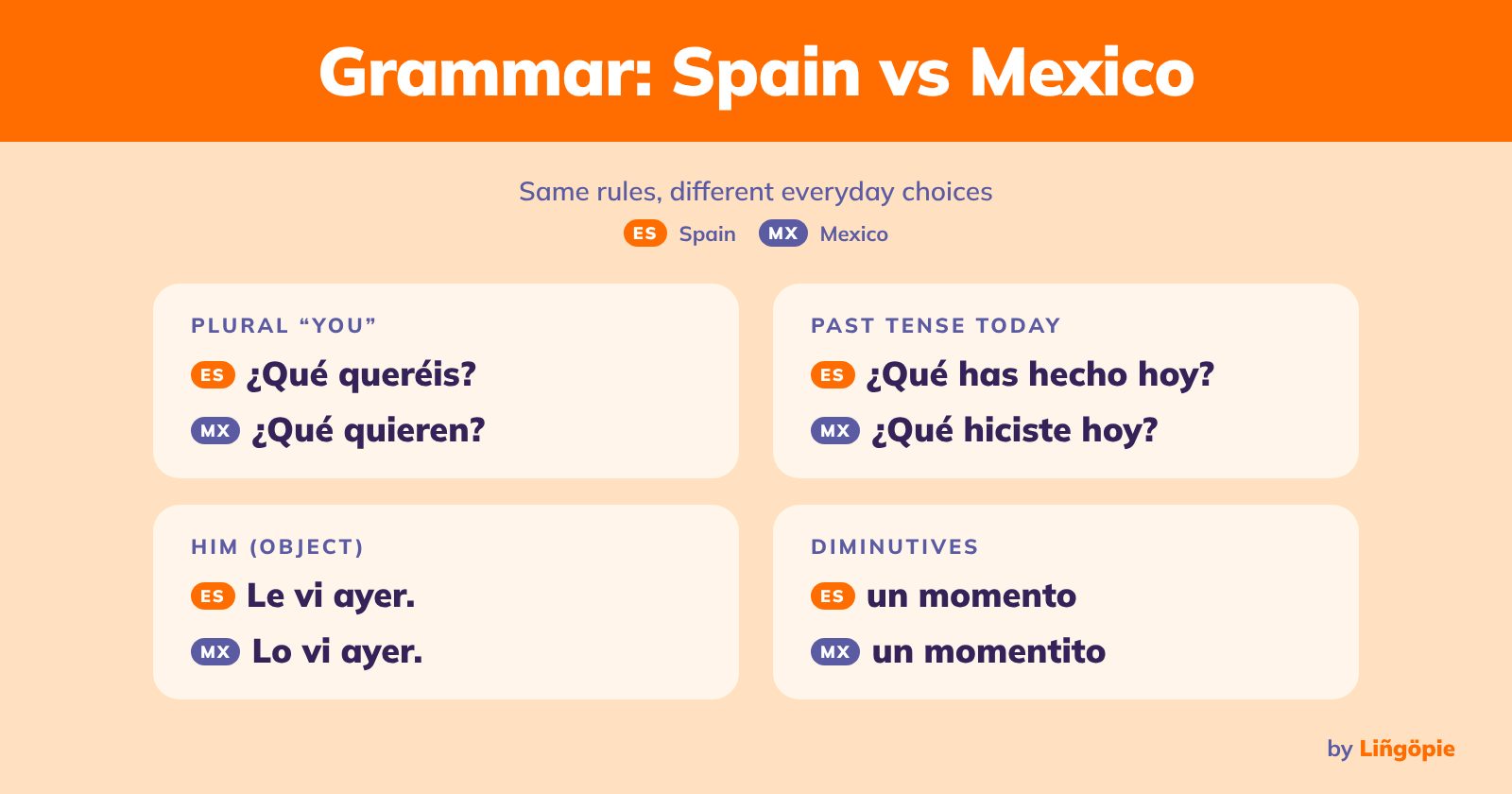
Spain Spanish and Mexican Spanish follow the same core grammar rules, but native speakers don't always use them in the same way. Some of the most noticeable grammatical differences involve how people address others, talk about past events, and express politeness.
5. Vosotros vs Ustedes
In most of Spain, vosotros is the informal plural form of "you," while ustedes is used in formal situations. In Mexico, ustedes is used for everyone, regardless of formality.
Spain | Mexico | English |
|---|---|---|
¿Cómo estáis? | ¿Cómo están? | How are you all? |
¿Qué queréis comer? | ¿Qué quieren comer? | What do you all want to eat? |
For example, a Spaniard might ask friends, ¿Qué hacéis hoy?, while a Mexican would say ¿Qué hacen hoy? (What are you all doing today?). However, ustedes is also common in the Canary Islands and parts of western Andalusia, so vosotros isn't universal across Spain.
6. Present Perfect vs Preterite
Spanish speakers in much of Spain often use the present perfect (he comido) for actions completed within an ongoing period, such as today. Mexican Spanish generally favors the simple past or preterite (comí) in these situations.
Spain | Mexico | English |
|---|---|---|
¿Qué has hecho hoy? | ¿Qué hiciste hoy? | What did you do today? |
Esta mañana he desayunado. | Esta mañana desayuné. | I had breakfast this morning. |
Both forms are grammatically correct. The difference is mainly when speakers prefer one tense over the other. The Real Academia Española's grammar explains how the use of these past tenses varies across Spanish-speaking regions.
7. Tú vs Usted
Mexicans often use usted more frequently than Spaniards to show respect, particularly when speaking to older people, strangers, or someone in authority. However, tú remains common among friends, family members, and people of similar ages in both countries.
Spain | Mexico | English |
|---|---|---|
¿Cómo estás? | ¿Cómo está usted? | How are you? |
¿Puedes ayudarme? | ¿Puede ayudarme? | Can you help me? |
For example, someone in Mexico might use ¿Cómo está usted? when greeting an older stranger, while someone in Spain may be more comfortable using ¿Cómo estás?. The choice still depends on the relationship, setting, and individual preferences.
8. Leísmo: Le vs Lo
In parts of central Spain, speakers commonly use le instead of lo when referring to a male person as a direct object. This grammatical feature is called leísmo and is much less common in Mexico.
Spain | Mexico | English |
|---|---|---|
Le vi ayer. | Lo vi ayer. | I saw him yesterday. |
Le conozco bien. | Lo conozco bien. | I know him well. |
For example, Le vi en el parque and Lo vi en el parque both mean "I saw him in the park." The Real Academia Española accepts this type of leísmo when referring to a singular male person, although lo is also correct.
9. Diminutives and Ahorita
Mexican Spanish uses diminutives like -ito and -ita particularly often, sometimes to express affection, politeness, or soften a request. While diminutives also exist in Spain Spanish, certain expressions are especially common in Mexico.
Spain | Mexico | English |
|---|---|---|
Un café | Un cafecito | A coffee / a little coffee |
Un momento | Un momentito | A moment / just a moment |
Ahora | Ahorita | Now / in a little while |
For example, a Mexican speaker might say Dame un momentito, por favor (Give me just a moment, please) instead of Dame un momento, por favor. Similarly, ahorita can mean right now or sometime later, depending on the context.
These differences don't change the basic structure of Spanish, but they can make everyday conversations sound more natural depending on which country you're in.
Vocabulary Differences Between Spain Spanish and Mexican Spanish
Ever asked for a coche in Mexico or a carro in Spain? People will probably understand you, but they might use a different word themselves. Although both varieties share much of the same vocabulary, everyday objects, food, and activities often have different names.
10. Everyday Words: 20 Common Differences
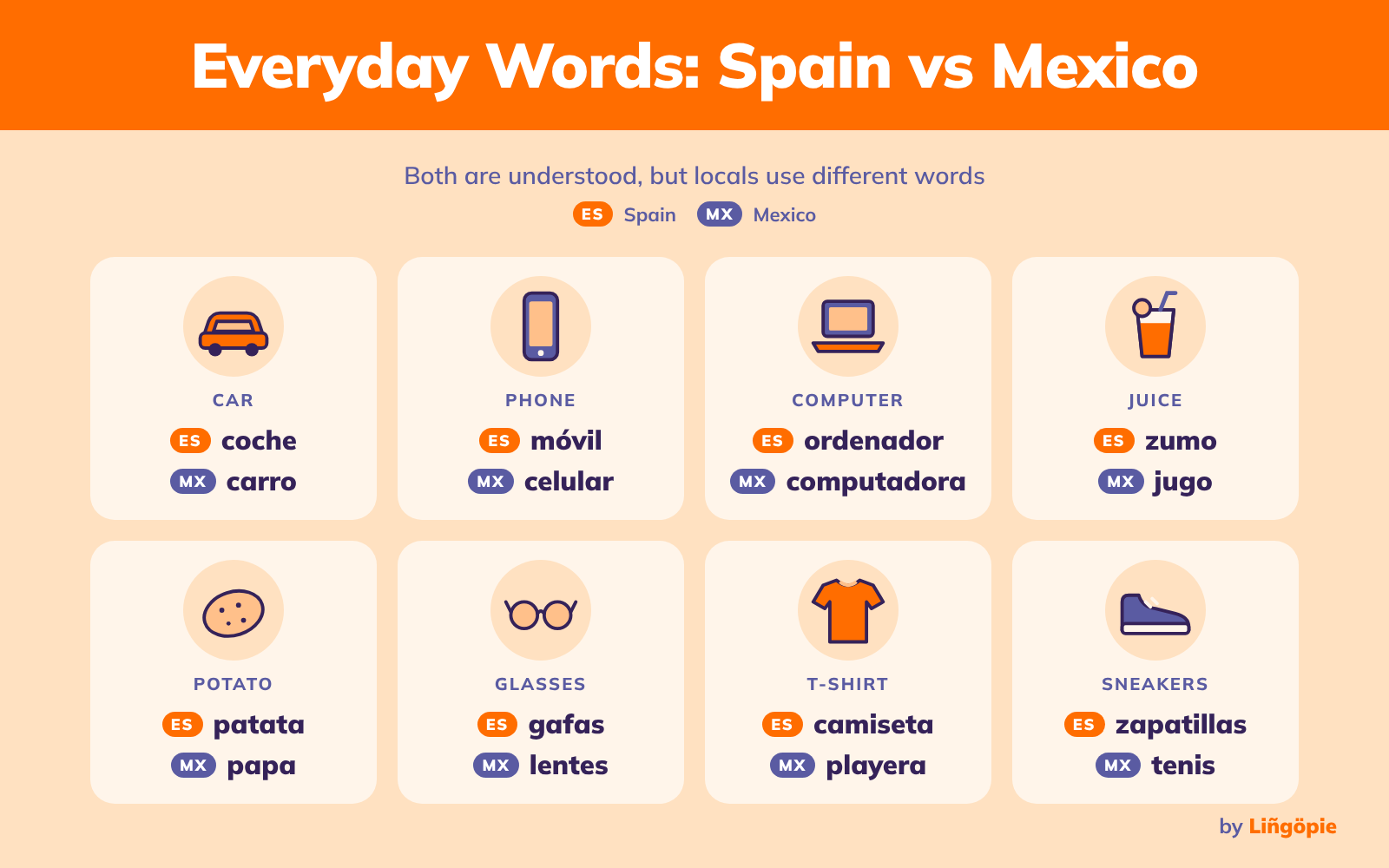
Some of the most noticeable vocabulary differences involve things you use or talk about every day. Here are 20 common examples of how Spanish from Spain and Mexico can differ.
Spain | Mexico | English |
|---|---|---|
Coche | Carro | Car |
Móvil | Celular | Mobile phone |
Ordenador | Computadora | Computer |
Piso | Departamento | Apartment |
Patata | Papa | Potato |
Zumo | Jugo | Juice |
Gafas | Lentes | Glasses |
Conducir | Manejar | To drive |
Aparcar | Estacionar | To park |
Coger | Tomar | To take |
Bocadillo | Torta | Sandwich |
Nevera | Refrigerador | Refrigerator |
Bolígrafo | Pluma | Pen |
Melocotón | Durazno | Peach |
Judías verdes | Ejotes | Green beans |
Guisantes | Chícharos | Peas |
Alubias | Frijoles | Beans |
Camiseta | Playera | T-shirt |
Zapatillas deportivas | Tenis | Sneakers |
Billete de avión | Boleto de avión | Plane ticket |
For example, someone in Spain might say Voy a coger el coche (I'm going to take the car), while a Mexican speaker would more naturally say Voy a tomar el carro. Another interesting example is bocadillo and torta. Both can refer to sandwiches, but a Mexican torta is typically made with a bread roll, while torta in Spain usually refers to a type of flat cake.
These are common regional preferences, not strict rules. Many words are understood in both countries, even when native speakers don't regularly use them.
11. Words Borrowed From Nahuatl
Mexican Spanish also includes many words borrowed from Nahuatl, an indigenous language spoken in Mexico long before the arrival of the Spanish. Some became so widely used that they're now part of everyday Spanish in other countries, too.
Word | English | Notes |
|---|---|---|
Aguacate | Avocado | Derived from Nahuatl ahuacatl |
Chocolate | Chocolate | Derived from a Nahuatl-related term |
Tomate | Tomato | Derived from Nahuatl tomatl |
Chile | Chilli pepper | Derived from Nahuatl chilli |
Cacahuate | Peanut | Common in Mexico; cacahuete in Spain |
For example, Me gusta el chocolate (I like chocolate) sounds perfectly natural in both countries. However, someone in Mexico might say Compré cacahuates (I bought peanuts), while a Spaniard would more commonly say Compré cacahuetes.
These examples show how indigenous languages helped shape Mexican vocabulary while also influencing Spanish spoken elsewhere.
12. English Loanwords in Mexican Spanish
English has also influenced certain words used in Mexico, partly because of its geographical and cultural connections with the United States. Some borrowed expressions are especially common in casual conversations.
Spain | Mexico | English |
|---|---|---|
Alquilar | Rentar | To rent |
Comprobar | Checar | To check |
For example, a Spaniard might say Voy a alquilar un coche (I'm going to rent a car), while a Mexican speaker may say Voy a rentar un carro. Similarly, checar is commonly used in Mexico when checking information, although comprobar can imply verifying that something is correct.
These regional variants are part of what makes Spanish interesting to learn. You don't need to memorize every different word immediately, but recognizing common alternatives can make conversations easier to follow.
Spain Slang vs Mexican Slang
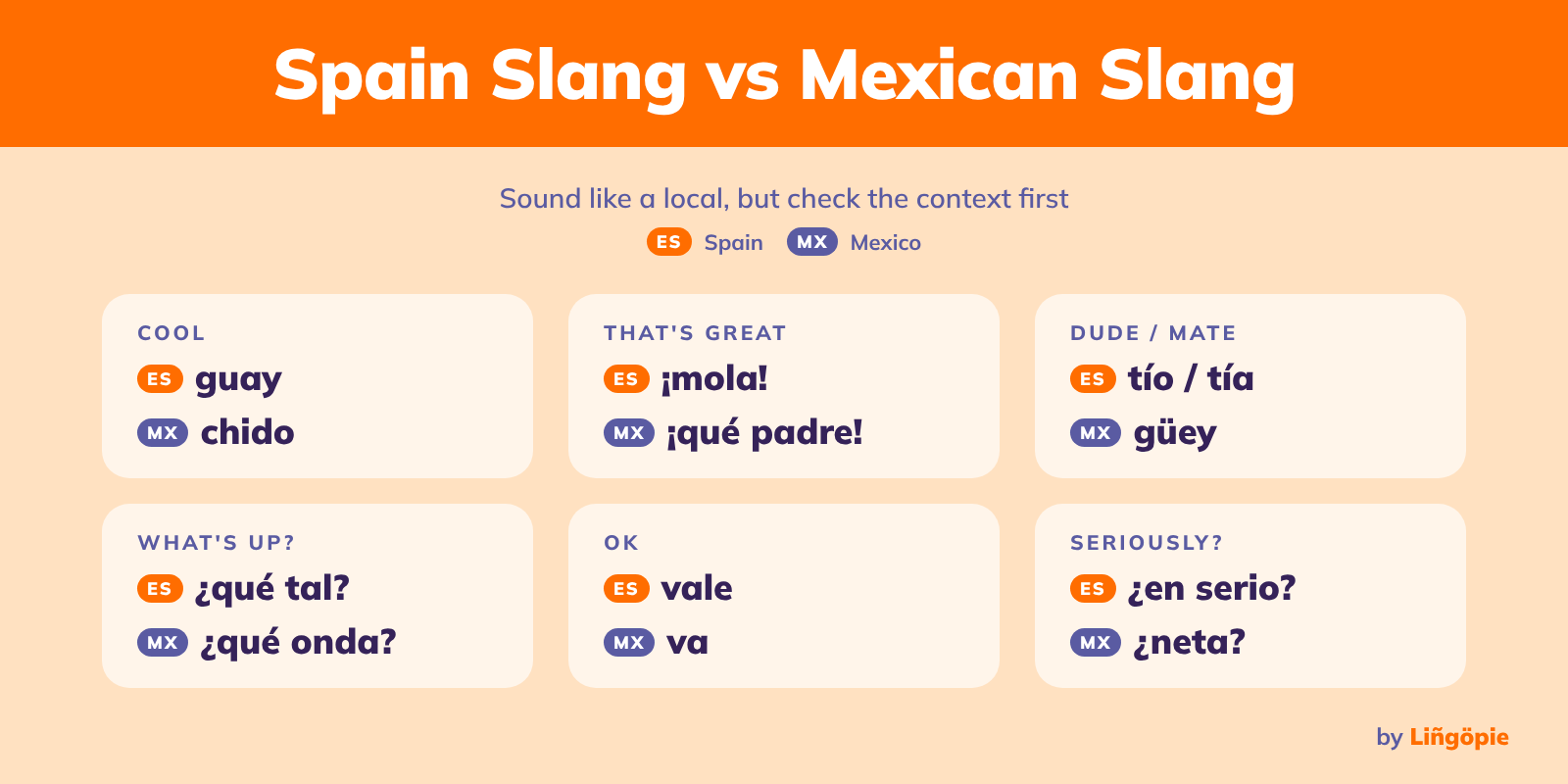
Want to sound more like a local? Learning a few slang expressions can help. While Spanish speakers in both countries understand much of the same vocabulary, casual conversations can sound quite different. Someone in Spain might say ¡Qué guay! when something is cool, while a Mexican speaker might say ¡Qué chido! instead.
Here are some common slang expressions you'll hear in Spain and Mexico.
Spain Spanish | Mexican Spanish | English meaning |
|---|---|---|
Guay | Chido | Cool / awesome |
Mola | ¡Qué padre! | That's great / cool |
Tío / tía | Güey | Dude / mate |
¿Qué tal? | ¿Qué onda? | What's up? |
Vale | Va | OK / agreed |
¿En serio? | ¿Neta? | Really? / Seriously? |
For example, someone in Spain might say ¡Esta película mola! (This movie is awesome!), while someone in Mexico might say ¡Esta película está bien chida! (This movie is really cool!).
These expressions aren't always interchangeable. Güey, for instance, can be friendly among close friends but insulting in other situations. Mexican slang also varies by region and generation, so pay attention to who's speaking and the context before using unfamiliar expressions yourself.
Spanish Words That Can Get You in Trouble
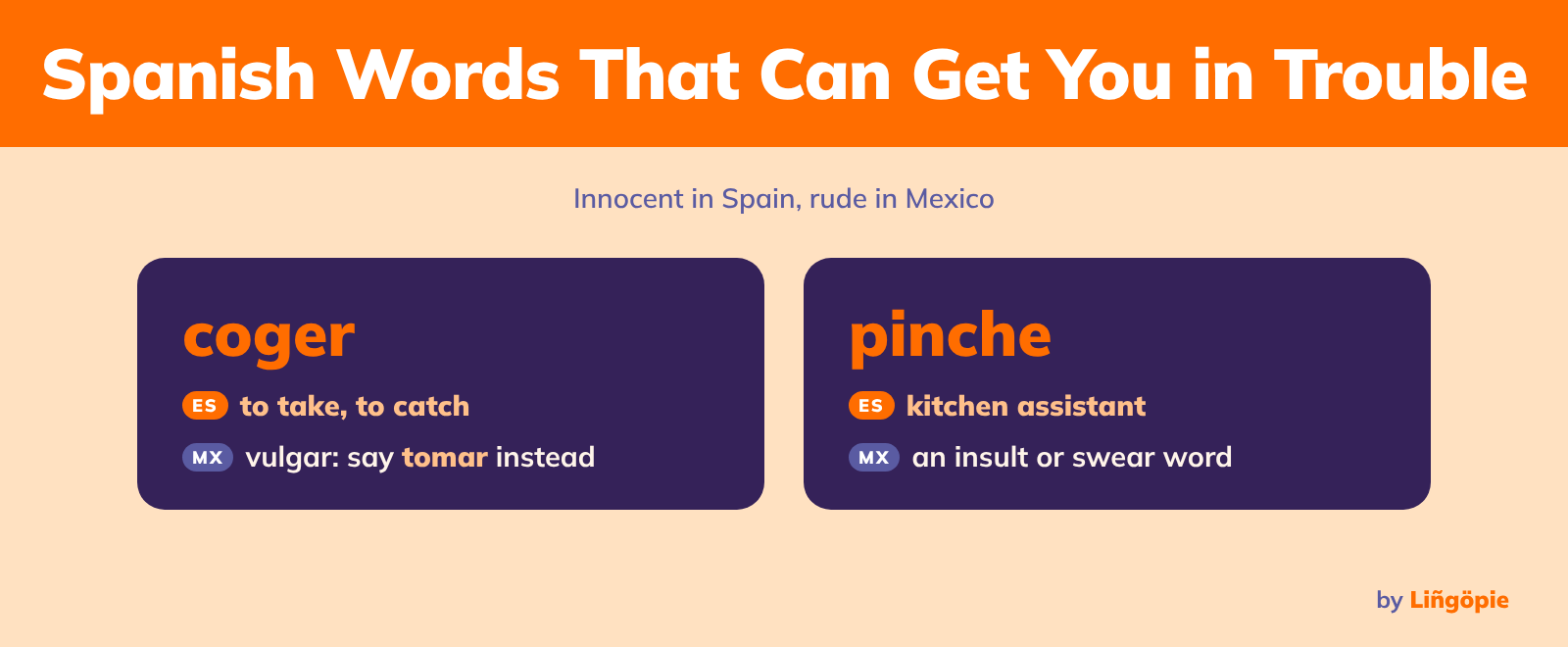
Some Spanish words can mean completely different things depending on where you use them. Take coger, for example. It's an everyday verb in Spain, but using it in Mexico could lead to an awkward misunderstanding.
Word | Meaning in Spain | Meaning in Mexico |
|---|---|---|
Coger | To take, grab, or catch | A vulgar term for having sex |
Pinche | A kitchen assistant | Often an insult or offensive intensifier |
For example, Voy a coger el autobús (I'm going to catch the bus) sounds perfectly normal in Spain. In Mexico, however, people would typically say Voy a tomar el autobús to avoid the sexual connotation.
Similarly, pinche can refer to a kitchen assistant in Spain, but in Mexico, expressions like ¡Pinche tráfico! convey frustration, roughly meaning "Damn traffic!" The Dictionary of Americanisms confirms its various negative and insulting uses in Mexico.
The takeaway? Before using unfamiliar regional expressions, check their meaning and context. A perfectly innocent word in one country might raise eyebrows in another.
Which Spanish Should You Learn: Spain or Mexican Spanish?
Not sure which variety to choose? It depends on where you plan to use Spanish and who you'll be speaking with. If you're travelling to Spain, learning Spanish from Spain makes sense. But if you're planning to visit Mexico or communicate with Mexican communities in the United States, Mexican Spanish may be more practical.
Here's a quick guide to help you decide:
Your learning goal | Recommended variety |
|---|---|
Travelling, studying, or living in Spain | Spain Spanish |
Visiting or moving to Mexico | Mexican Spanish |
Communicating with Mexican communities in the US | Mexican Spanish |
Working with clients in Spain | Spain Spanish |
Creating content or providing translation services | Match the Spanish to your target audience |
Learning Spanish for general communication | Either variety |
The good news is that you don't have to learn both varieties separately. Since they share the same core grammar and much of the same vocabulary, becoming comfortable with one will help you understand the other. You'll also become familiar with regional differences as your learning process progresses.
One way to hear these differences in action is through Spanish-language TV shows. With Lingopie, you can watch shows featuring native speakers from Spain and Mexico, helping you recognise different accents, vocabulary, and everyday expressions in context.
Frequently Asked Questions
Can Mexicans and Spaniards understand each other?
Yes, Mexicans and Spaniards can understand each other because they speak the same language. Differences in pronunciation, vocabulary, and slang may occasionally cause confusion, but they rarely prevent communication.
What is the biggest difference between Spain Spanish and Mexican Spanish?
The biggest differences are pronunciation, grammar, and vocabulary. For example, many Spaniards pronounce z with a “th” sound and use vosotros, while Mexicans use an “s” sound and ustedes.
Should I learn Spain Spanish or Mexican Spanish?
Choose Spain Spanish if you plan to visit or live in Spain, and Mexican Spanish if you'll spend more time in Mexico or communicate with Mexican communities. Both are equally valid, and learning either will help you understand Spanish speakers elsewhere.
Is Castilian Spanish the same as Spain Spanish?
Castilian Spanish generally refers to the Spanish language, although the term is also used for varieties spoken in Spain, particularly central and northern regions. Spain has several regional accents, so Castilian Spanish doesn't describe every way people speak Spanish there.
Why do Spaniards pronounce C and Z like TH?
Many speakers in central and northern Spain use a pronunciation pattern called distinción, where z and c before e or i sound like the English “th” in “think.” This pronunciation isn't universal across Spain, as speakers in the Canary Islands and much of southern Spain typically use an “s” sound instead.
Do Mexicans use vosotros?
No, vosotros isn't part of everyday Mexican Spanish, where ustedes is used to address multiple people in both formal and informal situations. However, Mexican speakers may encounter vosotros in Spanish literature, older texts, or media produced in Spain.