

According to Ethnologue (29th edition, 2026), there are 7,170 living languages in use today. With that much linguistic variety, you’d think two of the easiest words to learn would be yes and no. And often, they are: Spanish uses sí and no, French oui and non, Japanese hai and iie. But yes and no don’t always map neatly to two simple words. Some languages have a special “yes” for contradicting a negative question, and others answer by repeating the verb instead of saying “yes” or “no” outright.
So, how do you say "yes" and "no" in other languages without accidentally sending the wrong message? If you're a language learner, a traveler, or genuinely curious about how languages work, this guide covers the basic words and pronunciations in major languages, along with grammar quirks, courtesy and formality, contradiction forms, verb-echo answers, gestures, and practical ways to remember what to use.
At the end of the day, getting these small words right helps you avoid misunderstandings, communicate more naturally, and show respect for cultural differences…because sometimes a simple yes isn't quite as simple as... well, yes!

Key Takeaways
- Some languages repeat the verb or answer according to the question instead of using exact equivalents of “yes” and “no.”
- French si and German doch can mean “yes” specifically to contradict a negative question or statement.
- Japanese and Korean responses can change depending on politeness, formality, and context, and “yes” to a negative question confirms the negative.
- Irish and Welsh use question-dependent responses, while Finnish has standalone words but can also echo the verb.
- Yes/no gestures aren't universal; head movements carry different meanings throughout cultures such as Bulgaria, Greece, and India.
Why “Yes” and “No” Don’t Work the Same in Every Language
English is widely spoken, but a simple yes or no doesn’t always work the same way when you travel. Linguists have long noted that many languages answer this way: instead of translating yes or no directly, some languages repeat the verb from the question, while others use special words depending on how the question is phrased.
Here are a few examples:
- Irish: Speakers commonly answer by repeating the appropriate verb in a positive or negative form rather than relying on all-purpose equivalents of yes and no.
- Finnish: Kyllä and joo can express agreement, but speakers can also answer by echoing the verb from the question. These echo responses in Finnish and Irish show that agreement doesn't always need a standalone “yes.”
- Mandarin Chinese: Verb repetition instead of yes/no is possible for certain questions. For example, a speaker may repeat a verb to confirm it or add bù (不) to negate it.
- French: Oui handles a straightforward “yes,” but si can contradict a negative question or statement, a distinction English doesn't make with a separate word.
These different ways to say yes and no show why direct translation only gets you so far. Sometimes the right answer depends on the verb, the question, or even what you're disagreeing with. Two tiny words, one surprisingly complicated job.
Basic Yes and No Words in 20 Major Languages
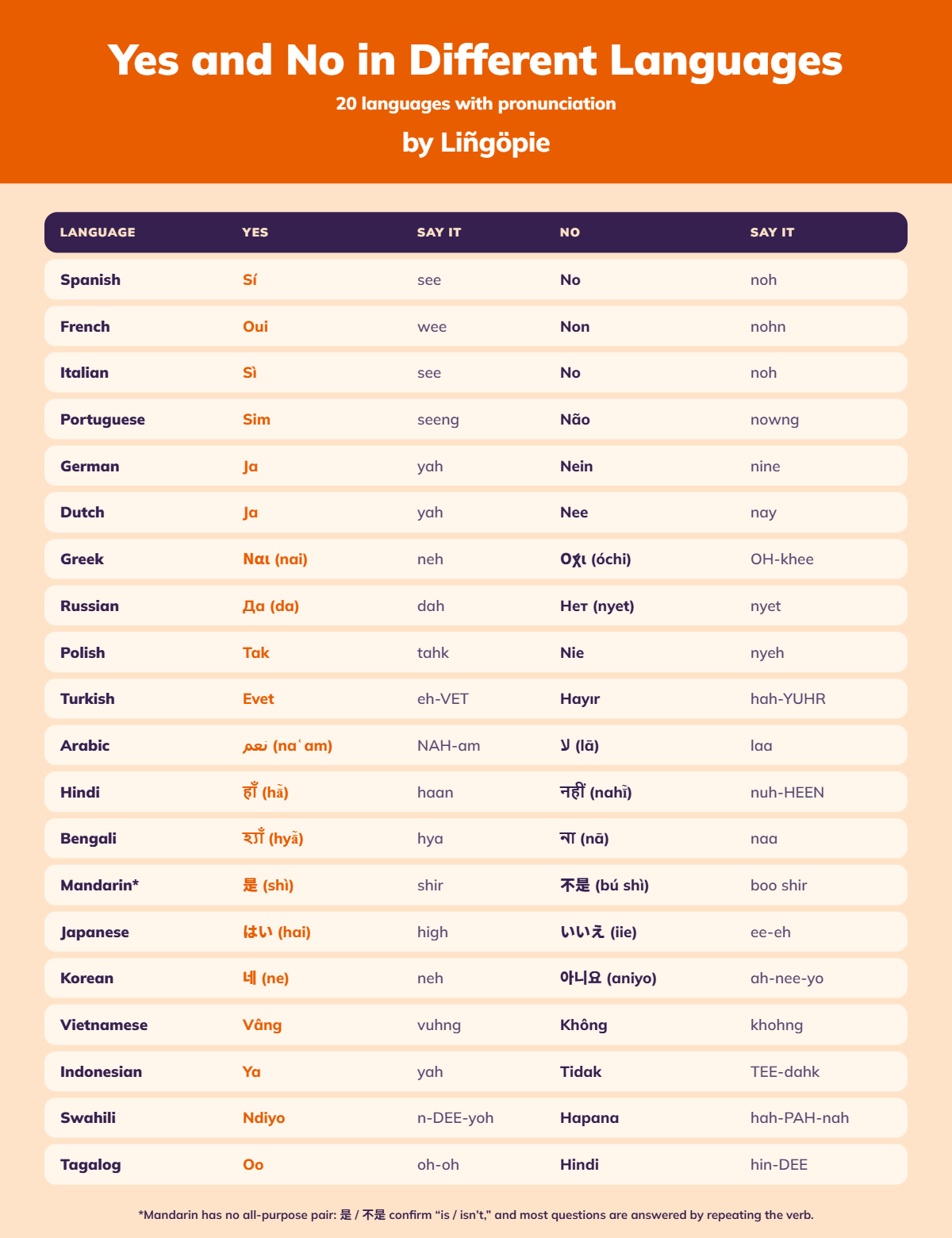
You don't necessarily have 40 completely different words to memorize. Languages from the same family often share recognizable patterns. Spanish sí, Italian sì, and Portuguese sim, for example, all developed from Latin and still look reassuringly similar. Germanic languages offer a few shortcuts too: German and Dutch both use ja for “yes,” while German nein and Dutch nee make “no” fairly easy to remember.
Use this table as a quick reference. Just keep in mind that these are the most common basic forms, not one-size-fits-all translations. Tone, grammar, and context can change which response sounds most natural.
Language | Yes | Pronunciation | No | Pronunciation |
|---|---|---|---|---|
Spanish | Sí | see | No | noh |
French | Oui | wee | Non | nohn |
Italian | Sì | see | No | noh |
Portuguese | Sim | seeng | Não | nowng |
German | Ja | yah | Nein | nine |
Dutch | Ja | yah | Nee | nay |
Greek | Ναι (nai) | neh | Όχι (óchi) | OH-khee |
Russian | Да (da) | dah | Нет (nyet) | nyet |
Polish | Tak | tahk | Nie | nyeh |
Turkish | Evet | eh-VET | Hayır | hah-YUHR |
Arabic | نعم (naʿam) | NAH-am | لا (lā) | laa |
Hindi | हाँ (hā̃) | haan | नहीं (nahī̃) | nuh-HEEN |
Bengali | হ্যাঁ (hyā̃) | hya | না (nā) | naa |
Mandarin Chinese | 是 (shì)* | shir | 不是 (bú shì)* | boo shir |
Japanese | はい (hai) | high | いいえ (iie) | ee-eh |
Korean | 네 (ne) | neh | 아니요 (aniyo) | ah-nee-yo |
Vietnamese | Vâng | vuhng | Không | khohng |
Indonesian | Ya | yah | Tidak | TEE-dahk |
Swahili | Ndiyo | n-DEE-yoh | Hapana | hah-PAH-nah |
Filipino/Tagalog | Oo | oh-oh | Hindi | hin-DEE |
*Mandarin has no single all-purpose pair. 是/不是 confirm or deny “is/isn’t”; for most other questions, speakers repeat the verb (see the East Asian section below).
A few entries need a note. In Vietnamese, vâng is the northern form, while dạ is the usual polite “yes” in the south. Indonesian tidak negates verbs and adjectives, but bukan negates nouns. In Tagalog, opo and hindi po are the polite forms to use with elders.
As you can see on the table, some entries are much easier to remember than others, but a few can trip up English speakers. The Greek nai (ναι), for example, means “yes” even though it sounds a little like the English nay, meaning “no.” The Japanese hai can also communicate acknowledgment rather than an enthusiastic “yes,” while Mandarin doesn't have a single pair of words that maps perfectly onto English yes and no. These little differences are worth remembering early on.
Romance Languages: Shared Roots and Unique Twists
Romance languages aren't called “romance” because they sound particularly romantic. The name comes from Roman: Spanish, Portuguese, French, Italian, Romanian, and others developed from forms of Latin spoken across the Roman Empire. That shared ancestry is why you'll often spot similar-looking words across them.
When it comes to yes and no in Romance languages, though, the family resemblance is stronger in some places than others. Take the basic affirmative words. Spanish sí, Portuguese sim, and Italian sì are easy to connect, while French oui decided to do its own thing. Romanian da also breaks the pattern: it was borrowed from neighbouring Slavic languages. Their common negative is even easier: no or a close relative appears across several major Romance languages.
Language | Yes | No |
|---|---|---|
Spanish | Sí | No |
Portuguese | Sim | Não |
Italian | Sì | No |
French | Oui | Non |
Romanian | Da | Nu |
Catalan | Sí | No |
Galician | Si | Non |
Sardinian | Eja / Emmo (varies by variety) | No |
One of the most useful words to remember is French si. If someone asks Tu ne viens pas ? (“You're not coming?”), si can contradict the negative premise: essentially, “Yes, I am.” German doch does the same job, even though German belongs to a different branch of the Indo-European family.
Politeness matters too. A bare sí, oui, or sì may be perfectly correct, but tone, word order, and even slight emphasis can make an answer sound warmer, firmer, or more courteous in polite conversation. Adding expressions such as “please,” “thank you,” or a respectful form of address can matter just as much as knowing the basic word itself.
East Asian Languages: Politeness and Verb Echoing
When learning yes and no in Asian languages, the word itself is only part of the answer. East Asia includes several language families and varieties, so there isn't one shared yes/no system. Some languages have recognizable standalone responses, while others rely heavily on the wording of the question.
Language | Yes | No |
|---|---|---|
Mandarin Chinese | 是 (shì) / 对 (duì)* | 不是 (bú shì) / 不对 (bú duì)* |
Cantonese | 係 (hai6) | 唔係 (m4 hai6) |
Japanese | はい (hai) | いいえ (iie) |
Korean | 네 (ne) | 아니요 (aniyo) |
Mongolian | Тийм (tiim) | Үгүй (ügüi) |
Tibetan | རེད (red)* | མ་རེད (ma red)* |
*These are common responses rather than universal equivalents of English “yes” and “no.” The appropriate response can depend on how the question is phrased.
In Japanese and Korean especially, politeness shapes the rest of your response. Japanese uses honorific and polite language, including keigo, while Korean has different speech levels and honorific forms.
- Japanese: Hai (はい) is the standard “yes,” but a more complete polite response might be hai, wakarimashita (はい、わかりました), or “Yes, I understand.” With close friends, the casual un (うん) can work more like “yeah.”
- Korean: Ne (네) is a common polite “yes,” while ye (예) can sound more formal or respectful. Among close friends, you may hear the casual eung (응), similar to “yeah.”
Another thing to note is that Mandarin Chinese often works differently from English because there isn't one universal word for “yes” that fits every question. Instead, speakers can repeat the verb from the question to confirm it or negate that verb to disagree.
- “Are you going?” (Nǐ qù ma?) → Qù (“Going/Yes”) or Bù qù (“Not going/No”).
- “Do you like it?” (Nǐ xǐhuan ma?) → Xǐhuan (“Like it/Yes”) or Bù xǐhuan (“Don't like it/No”).
- “Is he a teacher?” (Tā shì lǎoshī ma?) → Shì (“Is/Yes”) or Bú shì (“Isn't/No”).
This approach ties the response directly to what was asked. So rather than memorizing shì as the Chinese word for “yes,” it's more useful to learn how to recognize the verb in the question and respond to it.
Languages with Special Contradiction Forms
English can make negative questions surprisingly slippery. If someone asks, “Aren't you coming?” a simple “yes” can leave you wondering: Yes, I'm coming? Or yes, you're right, I'm not? Some languages avoid that ambiguity by having a separate affirmative response specifically for contradicting a negative statement or question.
Language | Regular “yes” | Contradicting a negative | “No” |
|---|---|---|---|
German | ja | doch | nein |
French | oui | si | non |
Swedish | ja | jo | nej |
Danish | ja | jo | nej |
Norwegian | ja | jo / jau | nei |
Icelandic | já | jú | nei |
Faroese | ja | jú | nei |
Dutch | ja | jawel | nee |
Hungarian | igen | de | nem |
Romanian | da | ba da | nu |
Arabic (Modern Standard) | naʿam | balā | lā |
These extra forms make the speaker's intention clearer. In German, for example, if someone asks Kommst du nicht? (“Aren't you coming?”), doch means, essentially, “Actually, yes, I am.” Swedish jo and French si can serve a similar purpose. These forms explicitly push back against the negative premise instead of leaving the listener to interpret a generic “yes.” Modern Standard Arabic does the same with balā (بلى).
Romanian goes a step further. Da and nu handle ordinary yes and no, while ba da can contradict a negative premise. Romanian can also use ba nu in a contrasting negative response, making its system somewhat richer than the three-form pattern found in languages such as German and French.
The opposite trap: Japanese and Korean
Japanese and Korean go the other way: “yes” confirms the statement exactly as it was asked. If someone asks “Aren't you coming?”, answering hai (Japanese) or ne (Korean) means “Right, I'm not coming.” To say you are coming, you'd answer iie or aniyo and then confirm. English speakers get this backwards all the time, so it's worth practicing before a trip.
Japanese vs Chinese: Which Language Should You Actually Learn?
Japanese vs Korean: Which Language Should You Be Learning? [2026]
Languages That Answer With the Verb
Not every language packages an answer into a neat equivalent of English yes or no. In some languages, the natural response is tied to the verb or structure of the question itself. That means asking for a direct translation can sometimes be the wrong question entirely. Latin and Celtic languages such as Irish and Welsh are well-known examples of this pattern. Finnish leans on it too, though it also has standalone words.
Language | How yes/no questions are commonly answered | Simple example |
|---|---|---|
Irish | Repeat the relevant verb positively or negatively | Ar tháinig sé? (“Did he come?”) → Tháinig. (“He came.”) / Níor tháinig. (“He didn't.”) |
Welsh | Respond with an appropriate verb form or other form determined by the question | Similar to “Are you?” → “I am.” / “I'm not.” |
Scottish Gaelic | Often responds using the verb from the question rather than universal yes/no words | Essentially “Is?” → “Is.” / “Isn't.” |
Manx | Traditionally uses question-dependent responses rather than one universal yes/no pair | Response follows the verb or construction used |
Latin | Uses words or phrases such as ita, sic, non, or repeats the relevant part of the statement | Essentially “It is so” / “It is not” |
Finnish | Has kyllä and joo for “yes”; “no” uses the negative verb ei, which conjugates (en = “I don't”). Echo answers are also common | “Tuletko?” (“Are you coming?”) → “Tulen.” (“I'm coming.”) / “En.” (“I'm not.”) |
Based on the table, you can clearly see the echo response structure. An echo response simply answers by reusing information from the question instead of reaching for a separate “yes” or “no.” Irish makes the idea particularly clear. Ó Dónaill's Irish–English dictionary (available free at teanglann.ie) gives examples where “Will you come?” is answered with the equivalent of “I will,” and “Did he come?” with “He came.”
This is also why echo responses in Finnish and Irish deserve a little nuance. Irish relies much more fundamentally on question-dependent responses, while Finnish also has standalone response particles: kyllä and joo (and the agreement particle niin). They shouldn't be presented as having identical systems.
These patterns show how yes and no can be built into grammar rather than represented by two fixed vocabulary words. For learners, the trick is to stop searching for a one-to-one translation and instead listen for the verb or construction being used. Once you understand the question, the answer often becomes much easier.
Non-Verbal Communication: Gestures and Cultural Variations
Sometimes you don't need to say anything at all. A nod or shake of the head can answer a question instantly, but head gestures for yes and no aren't universal. The same movement can communicate agreement in one country and leave someone confused in another, because gestures are part of culture and can change meaning even when no one is speaking.
Here's a quick look at how these gestures vary:
Place | Gesture | Common meaning |
|---|---|---|
Many countries | Nodding the head up and down | Yes, agreement, or acknowledgment |
Many countries | Shaking the head side to side | No or disagreement |
Bulgaria | Traditionally, a nod can mean “no” and a side-to-side shake “yes” | Younger people and those used to visitors often use the international pattern |
Greece | Upward/backward head movement, sometimes with raised eyebrows | No |
India | Side-to-side head bobble or wobble | Can signal acknowledgment, understanding, agreement, or friendliness depending on context |
The regional exceptions are where things get interesting. Bulgaria is famous for head gestures that can appear reversed to visitors, although modern usage isn't as simple as “nod means no, shake means yes” in every situation. In Greece, a quick upward tilt of the head can communicate “no,” which may look more like a casual head movement to an unfamiliar visitor.
The Indian head bobble is even harder to translate into one English word. Depending on the movement and situation, it can communicate anything from “yes” and “I understand” to simple acknowledgment, much like the small signals people use while talking to show they are following along. In other words, gestures depend on context just as words do.
That's why gestures deserve a place in any guide to saying yes and no around the world. Assuming your own gestures are universal is an easy recipe for misunderstandings. When you're unsure, pay attention to how locals respond and pair unfamiliar gestures with clear words rather than relying on body language alone.
Ways to Say Yes and No Beyond the Basic Words
Knowing “yes” and “no” is useful, but they're rarely your only choices. Depending on the language and situation, you can sound more natural by saying the equivalent of “of course,” “certainly,” or “no, thank you.” These fuller replies are especially helpful in conversation when a bare yes or no sounds too blunt, and they let you do more than simply accept or reject something.
Language | Instead of a basic “yes” | Polite way to say no |
|---|---|---|
Thai | ได้ (dâi, “okay/can do”); add khráp/khâ for politeness | ไม่เอา ขอบคุณครับ/ค่ะ (mâi ao, khòp khun khráp/khâ, “no, thank you”) |
Hebrew | בטח (betach, “sure/of course”) | לא, תודה (lo, toda, “no, thank you”) |
Persian (Farsi) | حتماً (hatman, “certainly/definitely”) | نه، ممنون (na, mamnun, “no, thank you”) |
Georgian | რა თქმა უნდა (ra tkma unda, “of course”) | არა, გმადლობთ (ara, gmadlobt, “no, thank you”) |
Māori | tino pai (“very good/great”) | kāo, tēnā koe (“no, thank you”) |
Ukrainian | звичайно (zvychaino, “of course”) | ні, дякую (ni, diakuiu, “no, thank you”) |
Swahili | bila shaka (“certainly/of course”) | hapana, asante (“no, thank you”) |
As you can see above, saying a direct “no” isn't always the best choice. This is where culture shapes how people say no. A grammatically correct refusal can still sound more direct than intended. Japanese is a classic example: instead of immediately responding with iie (“no”), a speaker might hesitate or use chotto... (“a little...”) to suggest that a request would be difficult. Other languages have their own ways of softening refusals through polite expressions, hesitation, explanations, or tone.
The practical takeaway is simple: don't stop at yes and no. For any language you're learning, memorize three things: the basic yes/no pair, one enthusiastic affirmative such as “of course,” and one polite way to decline. That's a much more useful conversational toolkit than knowing ten different ways to say the same basic “yes.”
Tips for Learning Yes and No in Other Languages Quickly
Don't try to memorize a giant list in one sitting. You'll remember these words faster if you group similar ones, practice them inside actual questions, and focus on the language you're most likely to use.
Learn Related Languages Together
Turn similarities into shortcuts. Spanish sí, Italian sì, and Portuguese sim, for example, are easier to remember as a group than as three unrelated words.
Then make flashcards that test more than translation. Instead of:
- German ja = yes
Try:
- “Aren't you coming?” → Doch! (“Actually, yes!”)
That way, you're learning when to use the word, not just what it means.
Practice for Where You're Going
Make your study list destination-specific. Going to Paris? Practice French oui, non, and si. Heading to Tokyo? Learn polite Japanese responses before worrying about slang. If the people you meet don't speak English, having their yes and no ready can make basic travel questions much easier. For multilingual Mumbai, Marathi is the state's official language, and Hindi is widely used too.
The same goes for pronunciation. If you're visiting Brazil, listen to Brazilian Portuguese rather than relying only on European Portuguese recordings. For Spanish, choose audio from the region you're visiting when possible.
Use Apps for Short, Daily Practice
Language-learning apps can turn this into a daily habit. Flashcard apps are useful for quick recall, while speaking and pronunciation apps let you practice your responses out loud.
For more context, Lingopie has 5,000+ shows, podcasts and books in 17 languages, including most of the languages in the tables above, so you can hear how native speakers actually agree, disagree, hesitate, or soften a “no.” Try watching a short scene, pausing before a character responds, and guessing what they'll say. Then replay the line with subtitles to check yourself.
Listen, Repeat, Then Respond
Use native-speaker videos, audio, or language-learning apps to hear how the words sound in real conversations. Pick a short yes/no question, pause before the speaker answers, imagine how you would respond, and say your response out loud. Then replay the clip and compare.
Finally, practice the gesture along with the word when relevant. India's head bobble and Bulgaria's less familiar head movements are good reminders that communication isn't only verbal, and pairing the spoken reply with the gesture helps in real conversation.
The Power of Two Tiny Words Across Cultures
“Yes” and “no” may be tiny words, but they can tell you a lot about how a language works. Depending on where you are, the right response can change with the question, the person you're speaking to, or even the gesture you use. That's why learning yes and no in different languages goes beyond memorizing two translations.
The next step is hearing those words in real conversations. With Lingopie, you can watch TV shows and movies in your target language and see how native speakers agree, refuse, hesitate, and respond naturally. You get the words, tone, gestures, and context all at once.
So start small. Learn yes. Learn no. Then press play and see how much more you understand.
FAQ
Which countries reverse the usual head nod for yes and no?
Bulgaria and parts of Albania are known for traditionally reversing the familiar pattern, with a head shake signaling “yes” and a nod or upward movement signaling “no,” though many people there also use the international gestures, especially with visitors. Greece, Turkey, Cyprus, and parts of southern Italy also use an upward or backward head movement for “no,” although this isn't a complete reversal of the usual gestures.
Why do some languages not have a single word for yes or no?
Some languages answer the idea in the question rather than using universal yes/no words. Irish and Welsh, for example, commonly use verb-based responses, making yes and no translations dependent on how the question is phrased.
How do languages handle negative questions differently?
Some languages have special words that remove ambiguity: French si and German doch, for example, contradict a negative question or statement. Japanese and Korean work the opposite way, where “yes” agrees with the negative. Others rely on grammar, context, or repeating part of the question.
What are polite ways to say no in different cultures?
People often soften a refusal with hesitation, an explanation, or phrases equivalent to “maybe another time” or “that's difficult.” In Japanese, for example, chotto... (“a little...”) can indirectly signal reluctance or refusal.
How can I practice yes and no words daily in multiple languages?
Group related languages, make quick flashcards, and practice answering questions aloud for five minutes a day. For more natural practice, use native-speaker videos or apps like Lingopie to hear these words in real conversations.





![Japanese Honorifics: 10+ Titles You’ll Actually Use [GUIDE]](/blog/content/images/size/w300/2026/03/Japanese-honorifics.jpg)
