
Learning Swedish vocabulary is easier than most English speakers expect. Swedish and English share Germanic roots, so words like fisk (fish) and äpple (apple) feel familiar from day one. This guide covers the essential Swedish words beginners need first, from greetings and numbers to food and travel phrases, with example sentences and pronunciation tips along the way.
Key Takeaways
- Around 500 high-frequency Swedish words are enough to handle simple everyday conversations at a beginner (A1) level.
- Swedish uses two grammatical genders (en and ett), three extra vowels (å, ä, ö), and a melodic pitch accent that changes meaning.
- Greetings, numbers, food words, and travel phrases give beginners the fastest return on study time.
- Many English speakers recognize Swedish loanwords and compounds faster than they expect, since Swedish and English share a Germanic root.
- Spaced repetition combined with native audio, such as Swedish TV and podcasts, helps new words stick in context, not just in isolation.

Introduction to Swedish Vocabulary
Swedish vocabulary is one of the most approachable starting points for English speakers who want to learn a new language. Swedish is a North Germanic language alongside Norwegian and Danish, and it shares a distant root with English. According to the U.S. Foreign Service Institute's language difficulty ranking, Swedish sits in Category I, the same group as Spanish and French, meaning it typically requires fewer classroom hours for English speakers to reach professional working proficiency than languages like Russian or Mandarin.
That head start shows up directly in vocabulary. Words like hus (house), bok (book), and hand (hand) look and sound close enough to their English equivalents to skip straight to memory. Swedish is spoken by over 10 million people, mainly in Sweden and parts of Finland, and the Swedish Academy's official word list, SAOL, includes around 126,000 words.
This guide breaks down Swedish vocabulary by everyday theme: greetings, travel, numbers, food, and the compound words that make Swedish look intimidating on paper but often easier in practice. Each section includes example sentences, so every new word appears in context rather than as an isolated flashcard entry.
Swedish Language Basics: Alphabet, Genders, and Grammar
The Swedish alphabet uses the same 26 letters as English, plus three additional vowels: å, ä, and ö. These sit at the end of the alphabet and represent distinct sounds, not accented variants of a and o. Mixing them up changes word meaning, so treat them as separate letters from the start.
Swedish nouns fall into two grammatical genders: en-words and ett-words. Most Swedish nouns take en, including en bok (a book) and en dag (a day), while the rest take ett, such as ett hus (a house) and ett barn (a child). The gender determines the indefinite article, the definite ending, and adjective agreement, so it is worth learning alongside each new noun rather than as an afterthought.
Swedish word order follows a strict verb-second (V2) rule in main clauses: the finite verb always occupies the second position, even when the sentence starts with something other than the subject. For example, Idag jobbar jag (Today I work) moves the verb jobbar ahead of the subject jag because Idag takes the first slot. Verb conjugation is simpler than in many European languages. Swedish verbs do not change based on the subject's person or number, so jag pratar (I speak), du pratar (you speak), and de pratar (they speak) all use the identical verb form, with att marking the infinitive in forms like att prata (to speak). Most Swedish words stress the first syllable, and stressed vowels are often lengthened.
Core Swedish Vocabulary for Everyday Use
Greetings and Introductions
Greetings are the first Swedish vocabulary most learners need, and Swedish keeps them short.
Swedish | English | Example sentence |
|---|---|---|
Hej | Hi | Hej, jag heter Anna. (Hi, my name is Anna.) |
Hej då | Bye | Hej då, vi ses imorgon! (Bye, see you tomorrow!) |
God morgon | Good morning | God morgon! Har du sovit gott? (Good morning! Did you sleep well?) |
Tack | Thank you | Tack för hjälpen. (Thank you for the help.) |
Varsågod | You're welcome / here you go | Varsågod, ditt kaffe. (Here you go, your coffee.) |
Ursäkta | Excuse me / sorry | Ursäkta, var är toaletten? (Excuse me, where is the bathroom?) |
Hur mår du? | How are you? | Hej, hur mår du idag? (Hi, how are you today?) |
Jag mår bra | I'm doing well | Tack, jag mår bra. (Thanks, I'm doing well.) |
Trevligt att träffas | Pleased to meet you | Trevligt att träffas, Erik. (Pleased to meet you, Erik.) |
Svenska is what the Swedish language is called in Swedish.
Pronouns and Basic Verbs
Swedish pronouns map closely onto English: jag (I), du (you, singular), han (he), hon (she), den/det (it), vi (we), ni (you, plural), de (they). Since verbs don't conjugate by person, learning ten common verbs lets you build far more sentences than the same effort in French or German would.
Swedish verb | English | Example sentence |
|---|---|---|
vara | to be | Jag är trött. (I am tired.) |
ha | to have | Vi har tid. (We have time.) |
vilja | to want | Jag vill ha en kaffe. (I want a coffee.) |
kunna | to be able to / can | Kan du tala engelska? (Do you speak English?) |
behöva | to need | Jag behöver hjälp. (I need help.) |
gilla | to like | Jag gillar Sverige. (I like Sweden.) |
förstå | to understand | Jag förstår inte. (I don't understand.) |
heta | to be called / named | Jag heter Camille. (My name is Camille.) |
Feelings and Polite Expressions
Beginner conversations lean heavily on a small set of polite expressions and feeling words, with examples learners can reuse such as snäll (kind), glad (happy), ledsen (sad), trött (tired), hungrig (hungry), ursäkta mig (excuse me, formal), and ingen fara (no worries), along with nej for a basic everyday “no.” A short exchange like Hur mår du? Jag mår bra, tack, och du? (How are you? I'm well, thanks, and you?) is worth memorizing as a full script rather than word by words and phrases.
Polite phrases cover most beginner conversations, but they're not the whole picture. For the words you'll hear in Nordic crime dramas and from frustrated locals, check out our guide to Swedish swear words and insults
Swedish Vocabulary for Travel and Daily Life
Food and Drink
Swedish food vocabulary comes up constantly for travelers and learners who watch Swedish cooking or lifestyle content. Core words include mat (food), frukost (breakfast), lunch (lunch), middag (dinner), bröd (bread), kaffe (coffee), vatten (water), and köttbullar (meatballs).
No food-vocabulary list is complete without fika, the Swedish tradition of pausing for coffee and a pastry, usually a kanelbulle (cinnamon bun). A useful travel sentence: Jag skulle vilja beställa en kaffe och en kanelbulle, tack (I would like to order a coffee and a cinnamon bun, please).
Places and Directions
Getting around Sweden requires a compact set of location words: centralstationen (the central station), flygplatsen (the airport), sjukhus (hospital), apotek (pharmacy), till höger (to the right), till vänster (to the left), and rakt fram (straight ahead).
These terms apply directly in cities like Stockholm, Göteborg, and Malmö, where signage and public transport announcements use them consistently. A traveler asking for help might say: Ursäkta, var ligger centralstationen? (Excuse me, where is the central station?)
Money and Shopping
SSweden uses the Swedish krona (SEK), and according to Sveriges Riksbank, only a small share of purchases are now paid in cash, so shopping vocabulary focuses more on cards and receipts than coins. Key words: pengar (money), kvitto (receipt), kort (card), billig (cheap), dyr (expensive), and rea (sale).
A common phrase at checkout is Kan jag betala med kort? (Can I pay by card?), which is almost always answered yes in Sweden's near-cashless economy.
Numbers, Time, and Days in Swedish
Swedish numbers follow a regular pattern after the first ten, which makes them fast to learn.
Number | Swedish | Number | Swedish |
|---|---|---|---|
0 | noll | 10 | tio |
1 | ett | 11 | elva |
2 | två | 12 | tolv |
3 | tre | 13 | tretton |
4 | fyra | 14 | fjorton |
5 | fem | 15 | femton |
6 | sex | 16 | sexton |
7 | sju | 17 | sjutton |
8 | åtta | 18 | arton |
9 | nio | 19 | nitton |
20 | tjugo |
For time, klockan means "the clock" or "o'clock," so Vad är klockan? (What time is it?) is the standard question, answered with Klockan är tre (It's three o'clock).
The days of the week follow Norse mythology roots, similar to English:
Swedish | English |
|---|---|
måndag | Monday |
tisdag | Tuesday |
onsdag | Wednesday |
torsdag | Thursday |
fredag | Friday |
lördag | Saturday |
söndag | Sunday |
Seasons round out the set: vår (spring), sommar (summer), höst (autumn), and vinter (winter).
How Swedish Words Are Built: Compounds and Loanwords
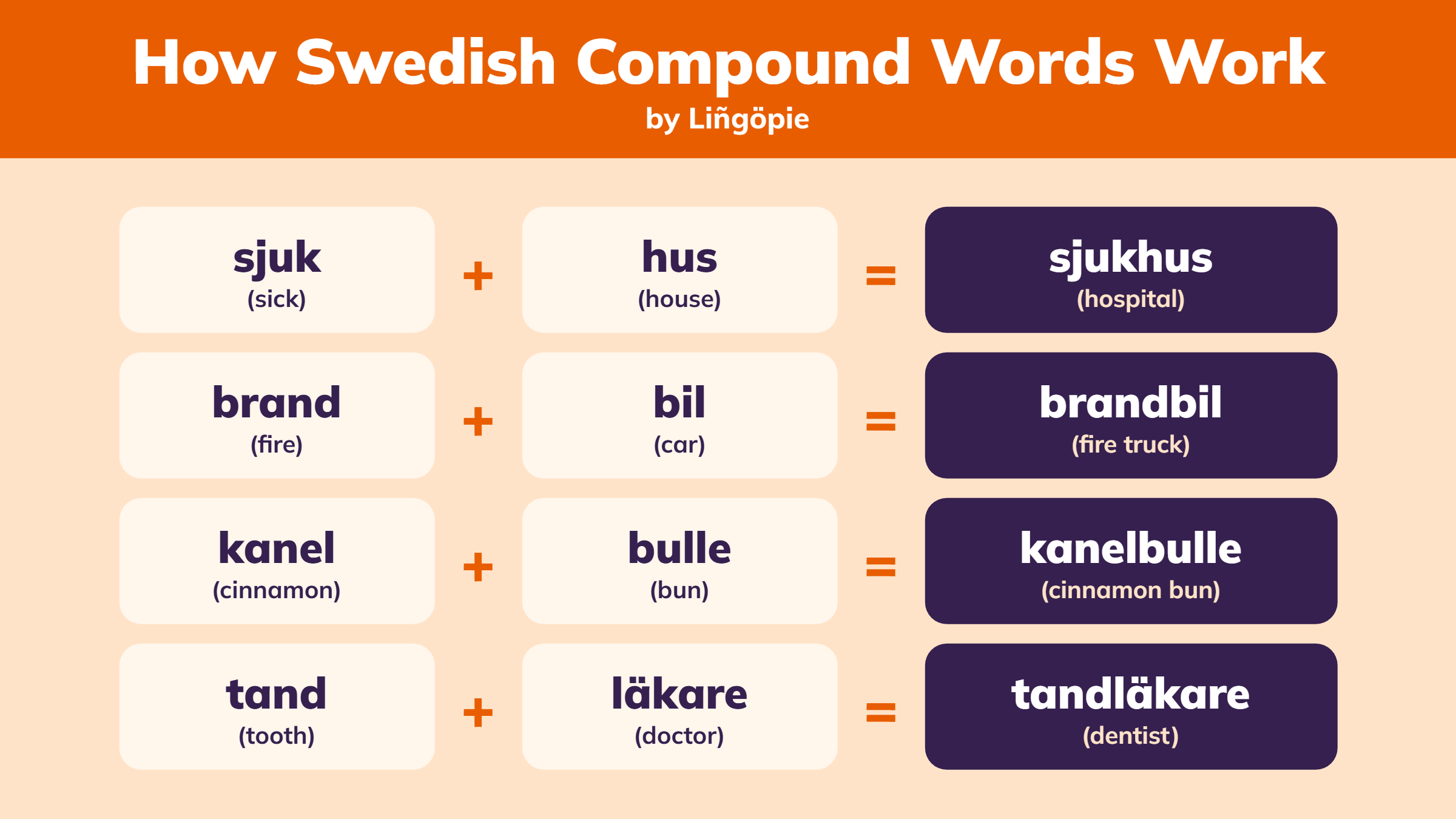
Swedish builds long words by stringing shorter ones together without spaces or hyphens, a feature that intimidates new learners more than it should. Sjukhus (hospital) is literally sjuk (sick) plus hus (house). Brandbil (fire truck) combines brand (fire) and bil (car). Once learners recognize the pattern, long compounds become easier to decode than to memorize, since the meaning of the whole word is usually visible in its parts. One of the longest words in the Swedish Academy's word list is realisationsvinstbeskattning (capital gains taxation), at 28 letters.
Swedish has also absorbed loanwords over several centuries, including French words that entered elite usage in the 18th century and later borrowings shaped by the English language. Words like restaurang (restaurant), garage, and choklad (chocolate) come from French, while modern Swedish freely borrows English words such as jobb (job), keps (cap), and mejl (email).
Two Swedish cultural terms are worth learning on their own because they appear constantly in Swedish media and conversation: fika (a coffee-and-pastry break, treated as a social ritual) and lagom (roughly "just the right amount," neither too much nor too little). Neither has a single-word English equivalent, and both say something about everyday Swedish social norms.
Pronunciation Tips for Swedish Vocabulary
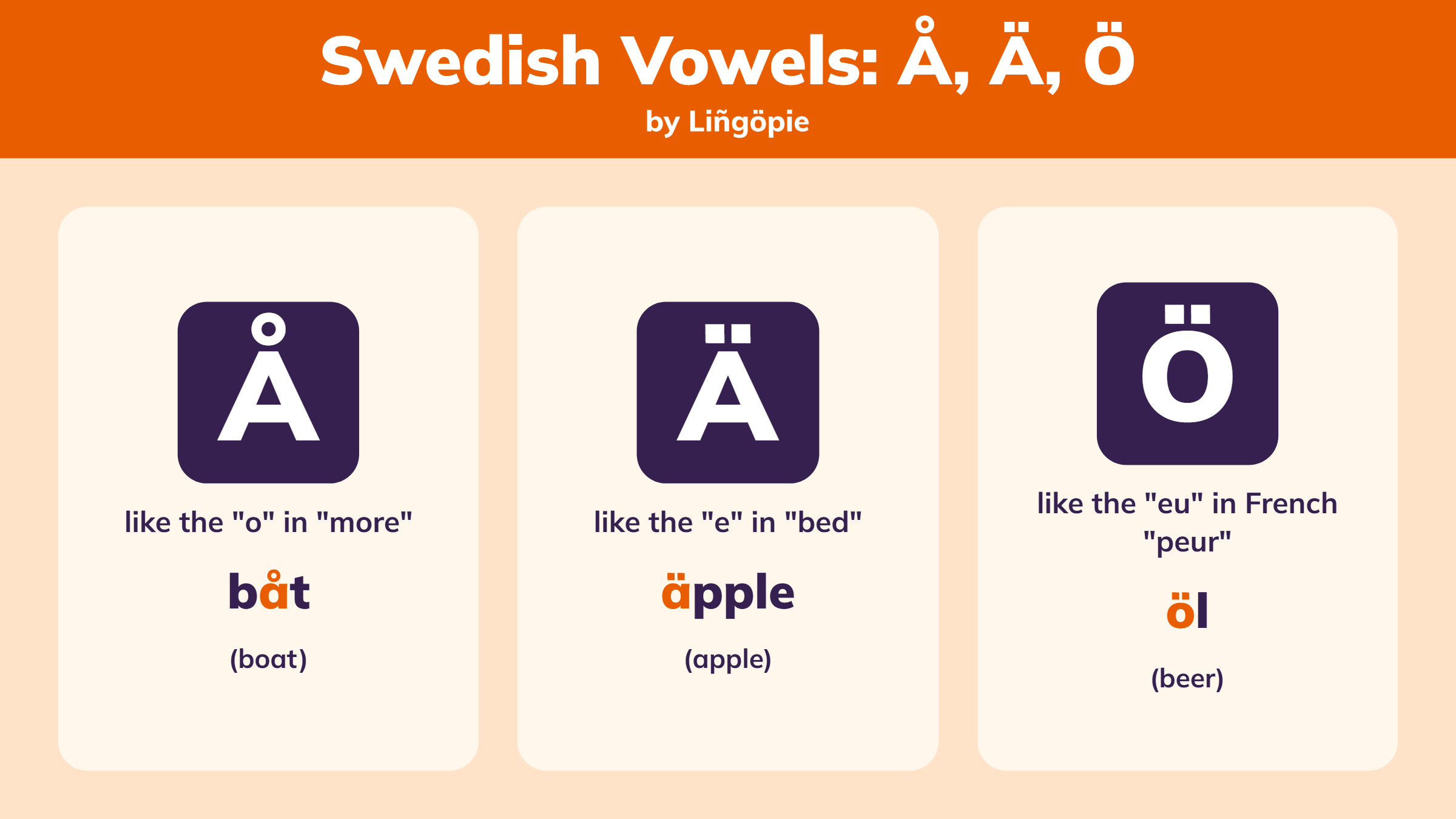
The three extra vowels, å, ä, and ö, are the first pronunciation hurdle. Å sounds close to the "o" in "more." Ä sounds like the "e" in "bed" (or closer to "a" in "cat" in some regional accents). Ö resembles the "eu" in the French word "peur" or the German ö, with rounded lips and no direct English equivalent.
Swedish is a pitch-accent language, meaning stress and tone can change a word's meaning. The classic example is anden, which means "the duck" with one pitch pattern and "the spirit" with another. Beginners don't need to master this distinction immediately, but recognizing that Swedish has a melodic, sing-song quality helps with both listening comprehension and natural-sounding speech.
Consonant clusters cause the most trouble for English speakers. The letter combinations sj, stj, and skj typically produce a breathy "sh"-like or "wh"-like sound, as in sju (seven) or stjärna (star). The letter j, and g before soft vowels (e, i, y, ä, ö), are pronounced like an English "y," so ja sounds like "ya" and göra (to do) starts with a "y" sound. K before soft vowels becomes a soft "sh"-like sound, so kyla (cold) and kök (kitchen) don't start with a hard "k." Listening to native Swedish audio, rather than relying on written rules alone, is the fastest way to internalize these patterns.
Effective Strategies for Learning Swedish Words and Phrases
Spaced repetition, the practice of reviewing new words at increasing intervals right before you would otherwise forget them, is one of the best-researched memory techniques. According to a 2006 meta-analysis by Cepeda and colleagues in Psychological Bulletin, spreading out review sessions leads to better long-term retention than cramming. Pairing spaced repetition with immersion, meaning regular exposure to native Swedish audio and video, reinforces both the word itself and its natural pronunciation and context.
Active practice matters as much as passive review. Writing short sentences with new words,speaking them aloud, listening closely to native use, and using them in real exchanges (even with a language partner, tutor, or other students) moves vocabulary from short-term recognition to long-term recall. Simple exercises like labeling items in your environment in Swedish can increase daily exposure. Watching Swedish shows with dual subtitles, Swedish and English side by side, is one practical way to combine listening, reading, and context in a single session; Lingopie's catalog includes Swedish-language content alongside its 17 supported languages, 5,000+ shows, podcasts, and books, and its subtitle tools are built specifically for this kind of vocabulary-in-context learning. Treat each session as one manageable lesson, then continue to the next lesson.
FAQ
How many basic Swedish words do I need to know to have simple conversations?
Around 500 high-frequency words, covering greetings, common verbs, numbers, and everyday nouns, is enough to handle simple conversations at a beginner (A1) level. At this stage, knowing the most common words well matters more than knowing a lot of words.
Is it better to learn Swedish grammar or vocabulary first?
Most learners progress faster by building a core vocabulary first and layering grammar rules on top of words they already recognize. Swedish grammar, especially verb conjugation, is simpler than in many European languages, so a vocabulary-first approach lets learners form basic sentences quickly and pick up grammar patterns through repeated exposure.
Can I travel in Sweden using only English, or do I really need common Swedish words?
English proficiency is high in Sweden, particularly in cities like Stockholm, Göteborg, and Malmö, so travelers can get by with English alone. That said, using common Swedish vocabulary such as greetings, please and thank you, and food terms is generally well received and makes everyday interactions, from ordering fika to asking directions, noticeably smoother.
What is the difference between Swedish, Norwegian, and Danish vocabulary?
Swedish, Norwegian, and Danish share a large amount of core vocabulary because they all descend from Old Norse, so speakers of one can often read the others with some effort. The differences show up mainly in pronunciation and spelling rather than in the underlying words. Danish pronunciation differs the most, which is why Swedes and Norwegians often find spoken Danish harder to follow than written Danish.
How can I remember similar-looking Swedish words without mixing them up?
Grouping similar words by theme, such as all the weather words or all the food words, rather than studying them in a random list reduces confusion. Attaching each word to an example sentence, rather than memorizing it in isolation, also helps, since the surrounding context makes near-identical words like bra (good) and bro (bridge) easier to tell apart in memory.
Conclusion and Next Steps
Swedish vocabulary rewards steady, thematic study more than memorization marathons. Start with greetings and core verbs, add travel and food words once the basics feel automatic, and layer in compound words and pronunciation once full sentences start coming naturally. Regular exposure to native audio, paired with spaced repetition, does more for retention than any single method on its own. For learners who want vocabulary embedded in real dialogue rather than word lists, dual-subtitle shows and short daily sessions, around 10 minutes a day, are a practical way to keep building without burning out.