
The best books to learn German depend on your level and learning goals. Menschen is a solid choice for structured lessons, while Complete German by Teach Yourself works well for self-study. For grammar practice, try Practice Makes Perfect: Complete German Grammar. If you're ready to start reading German stories, Café in Berlin is a good place to begin.
A good German book should challenge you without leaving you constantly reaching for a dictionary. To help you find one, we've picked 14 textbooks, grammar guides, graded readers, and novels for learners at different stages, with recommendations based on what each book does best.
Key Takeaways
- Start with a book that matches your German level, focusing on basic vocabulary and grammar at A1 before moving to more challenging material at higher levels.
- Consider how you prefer to study: independent learners benefit from clear explanations and answer keys, while classroom textbooks often require teacher guidance.
- Use more than one learning resource to practice grammar, build vocabulary, and improve reading comprehension.
- Choose books you can comfortably understand, aiming to recognize around 98% of the words when reading independently.
- Work your way up to authentic German novels by starting with graded readers that introduce manageable vocabulary and sentence structures.

The Best Books to Learn German at a Glance
Not sure which book to start with? The table below compares all 14 recommendations by type, German proficiency level, learning goal, and audio availability, so you can quickly narrow down your options.
Book | Type | CEFR Level | Best For | Audio |
|---|---|---|---|---|
Menschen | Coursebook | A1–B1 | Structured classroom lessons | Yes |
Netzwerk neu | Coursebook | A1–B1 | Exam preparation | Yes |
German All-in-One for Dummies | Self-study guide | Beginner–intermediate* | Learning with English explanations | Edition-dependent |
Complete German by Teach Yourself | Self-study course | A1–B1 | Independent learning | Yes |
Practice Makes Perfect: Complete German Grammar | Grammar workbook | Beginner–intermediate* | Grammar exercises | No dedicated course audio |
Lehr- und Übungsbuch der deutschen Grammatik | Grammar workbook | A2–C1 | Systematic grammar practice | Edition-dependent |
Hammer's German Grammar and Usage | Grammar reference | Intermediate–advanced* | Advanced grammar explanations | No |
Der, Die, Das: The Secrets of German Gender | Grammar guide | Beginner–intermediate* | Understanding noun genders | No |
Café in Berlin | Graded reader | A1–A2* | First German stories | Edition-dependent |
Short Stories in German for Beginners | Graded reader | A1–A2* | Reading comprehension | Edition-dependent |
Der kleine Prinz | Novel | A2–B1* | Short literary fiction | Edition-dependent |
Emil und die Detektive | Novel | B1* | Accessible mystery stories | Edition-dependent |
Tschick | Novel | B1–B2* | Contemporary German dialogue | Edition-dependent |
Momo | Novel | B2* | Longer literary reading | Edition-dependent |
CEFR levels marked with an asterisk are approximate recommendations rather than official publisher classifications. Audio availability may vary by edition or format.
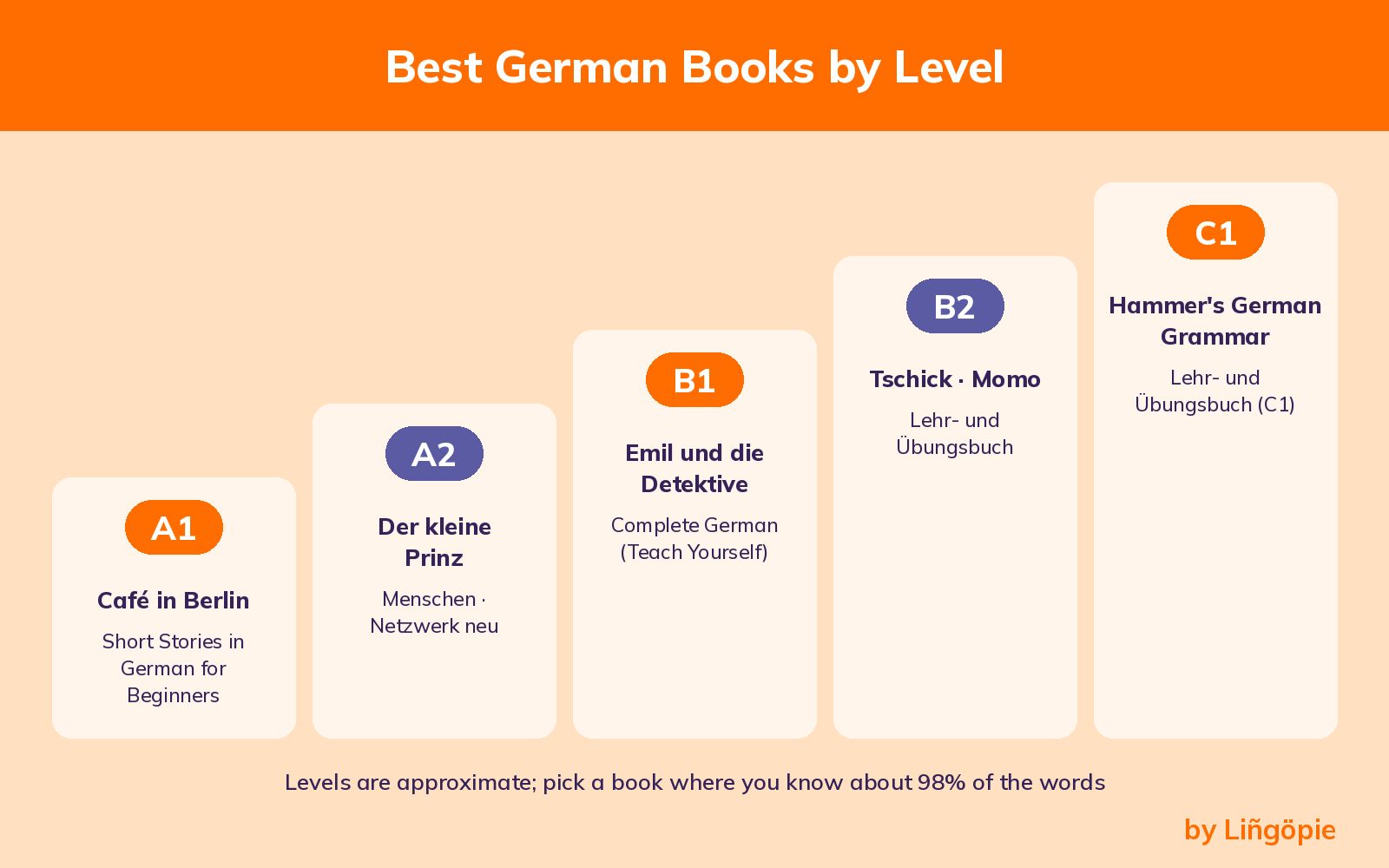
How to Choose the Right German Book
The right German book should match your skill level, learning goals, and study habits. Here are three things to consider before choosing one:
- Check your German level. Beginners should look for A1 books covering basic vocabulary and grammar, while intermediate and advanced learners can explore more complex material. You can check your level using the Council of Europe's CEFR self-assessment grid.
- Know what you want to improve. Choose a coursebook for structured lessons, a grammar workbook for extra exercises, or a graded reader to build reading comprehension.
- Consider how you'll study. If you're learning independently, look for clear explanations, answer keys, and audio recordings. Classroom textbooks may require additional guidance from a teacher.
For reading practice, aim for books where you recognize around 98% of the words. A study by Hu and Nation (2000) suggests this level of vocabulary knowledge helps learners understand texts without constantly checking a dictionary.
Which German Book Should You Choose for Your Goal?
Your Goal | Recommended Book |
|---|---|
Starting German with a teacher | Menschen |
Preparing for A1–B1 exams | Netzwerk neu |
Learning independently | Complete German by Teach Yourself |
Practicing German grammar | Practice Makes Perfect: Complete German Grammar |
Understanding noun genders | Der, Die, Das: The Secrets of German Gender |
Reading your first German stories | Café in Berlin |
Reading contemporary German fiction | Tschick |
Studying advanced grammar | Hammer's German Grammar and Usage |
Best German Course Books
German course books are a great starting point because they introduce new concepts gradually, giving you time to practice before moving on to harder lessons. They also follow a clear learning path, so you don't have to figure out what to study next. This makes them especially useful for beginners who want to build a strong foundation in German.
Menschen — Best for Structured German Classes (A1–B1)
Level: A1–B1 | Best for: Classroom learning
Menschen is designed for classroom learning.Published by Hueber, the series progresses through A1, A2, and B1, using short lessons, everyday situations, and activities that encourage students to practice speaking with classmates.
Each level has a coursebook (Kursbuch) and a separate workbook (Arbeitsbuch) for extra practice. Audio, videos, and digital exercises also help reinforce what you've learned in class. However, since many activities are designed for group participation, the series may be less convenient for independent learners.
Netzwerk neu — Best for German Exam Preparation (A1–B1)
Level: A1–B1 | Best for: Exam preparation and practical communication
If you're preparing for a German proficiency exam, Netzwerk neu by Klettcovers levels A1 to B1 and includes preparation for recognized exams such as the Goethe-Zertifikat and telc assessments.
The lessons emphasize everyday communication, with listening activities, videos, and exercises that introduce spoken German early on. A separate workbook provides additional practice, while digital resources support grammar and pronunciation. Although exam preparation is included throughout the course, you may still need dedicated practice tests to prepare for the exam format.
German All-in-One for Dummies — Best for Accessible Explanations
Level: Beginner–intermediate | Best for: Learning German with English explanations
German All-in-One for Dummies is a practical option if you prefer learning German with straightforward English explanations.The second edition, by Wendy Foster and co-authors,brings together lessons on everyday vocabulary, sentence structure, pronunciation, and conversation in one book.
It also covers situations you might encounter while traveling, working, or speaking with German speakers. You'll find practice exercises and online audio for listening to common conversations. At over 600 pages, though, it may feel overwhelming if you prefer shorter, more focused lessons.
Complete German by Teach Yourself — Best for Self-Study
Level: A1–B1 | Best for: Independent learners
Complete German by Teach Yourself is designed for learners who want to make progress without attending classes.Co-written by Heiner Schenke, it takes you from A1 to B1with connected lessons, clear explanations, and exercises covering reading, writing, listening, and speaking.
One standout feature is its hours of German conversations, available online or through the Teach Yourself Library app. The book also includes cultural notes, progress checklists, and activities that help you recognize language patterns. Still, you'll need real conversations to practice responding naturally without relying on prepared dialogues.
Best German Grammar Books
German grammar can be tricky, especially when you're learning noun genders, cases, and verb conjugations. A good grammar book helps you understand these rules and practice using them correctly. It's particularly useful when you need extra practice alongside your coursebook or want to clear up grammar points you keep getting wrong.
Practice Makes Perfect: Complete German Grammar — Best for Grammar Exercises
Level: Beginner–intermediate | Best for: Grammar practice
Practice Makes Perfect: Complete German Grammar by Ed Swick is a good choice if you understand basic German but need more practice putting sentences together. It covers essential grammar topics, including verb conjugations, noun genders, articles, the four German cases, and word order.
The book explains each rule in English before giving you exercises to apply what you've learned. You'll work through fill-in-the-blank questions, sentence rewrites, and translation activities, with an answer key to check your progress. It's particularly useful alongside a regular German course, although it doesn't provide the listening and speaking practice you'd get from a complete textbook.
Lehr- und Übungsbuch der deutschen Grammatik — Best for Intermediate Grammar (A2–C1)
Level: A2–C1 | Best for: Systematic grammar practice
Lehr- und Übungsbuch der deutschen Grammatik by Hilke Dreyer and Richard Schmitt is designed for learners who want to strengthen their understanding of German grammar. Published by Hueber, it covers A2 to C1, with detailed explanations and exercises on topics such as adjective endings, passive voice, subordinate clauses, and verb forms.
The book uses German for its explanations and exercises, giving you extra reading practice as you work through the rules. An edition with English explanations is also available if you need more support. Keep in mind that the answer key is sold separately for certain editions, so check what's included before buying.
Hammer's German Grammar and Usage — Best for Advanced Grammar Reference
Level: Intermediate–advanced | Best for: Detailed grammar explanations
Hammer's German Grammar and Usage by Martin Durrell is a comprehensive reference for learners who want to understand how German grammar works in greater detail. The seventh edition covers sentence structure, word order, verb forms, cases, and the differences between formal and informal German.
Rather than taking you through beginner lessons, the book explains grammatical rules with examples of how they're used in contemporary German. You can turn to it whenever you encounter unfamiliar grammar while reading or writing, although its detailed explanations may overwhelm beginners. You'll also need a separate workbook for extensive practice exercises.
Best Book for German Noun Genders
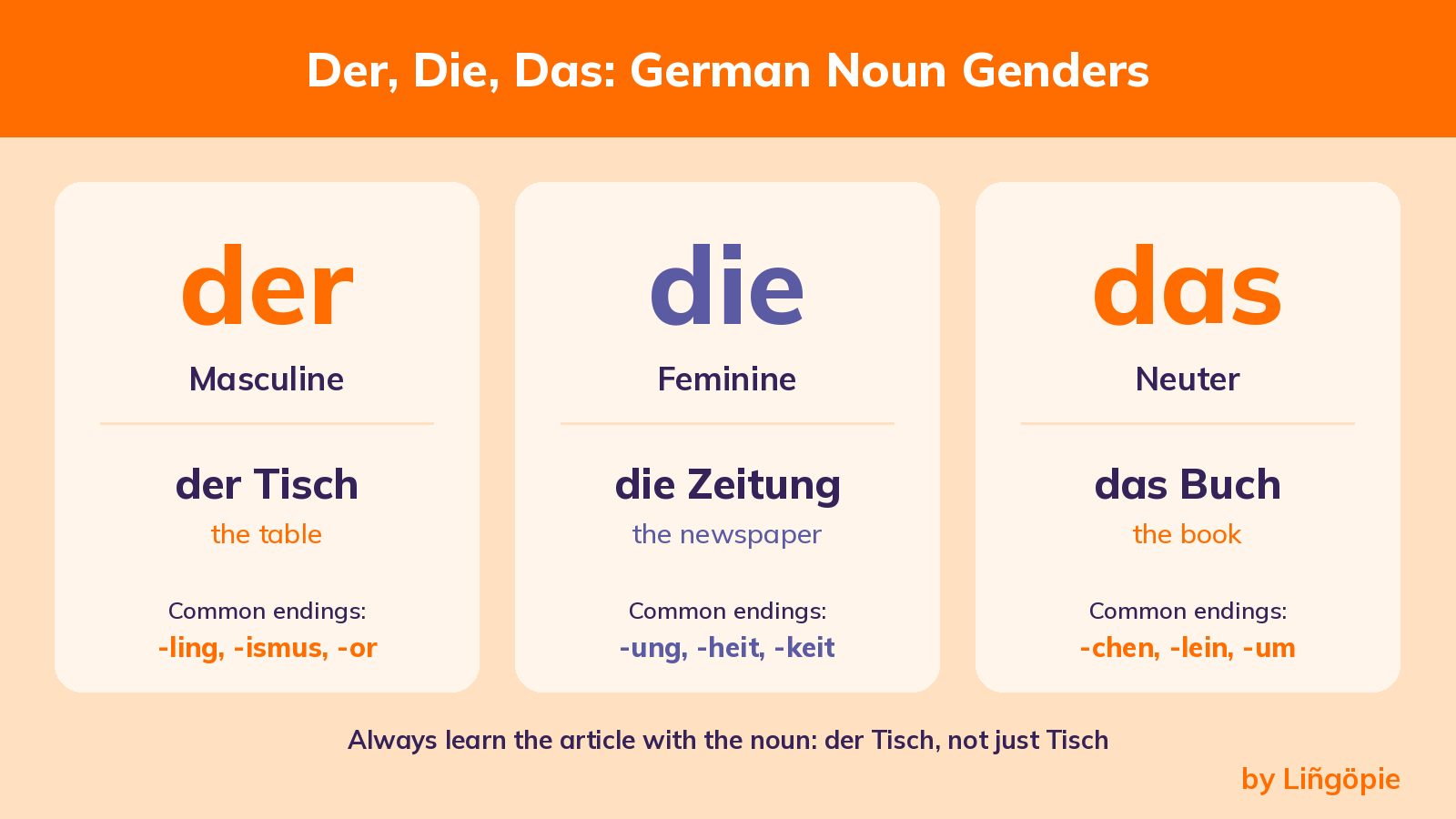
Every German noun has a gender: masculine (der), feminine (die), or neuter (das). Getting these right can be challenging for English speakers, especially since a noun's gender also affects its articles and adjective endings. A book dedicated to noun genders can help you recognize common patterns instead of memorizing every word through guesswork.
Der, Die, Das: The Secrets of German Gender — Best for Learning Articles
Level: Beginner–intermediate | Best for: Understanding German noun genders
Der, Die, Das: The Secrets of German Genderby Constantin Vayenasis a useful companion for learners who struggle to remember which article belongs to a German noun. Instead of relying entirely on memorization, the book explores common gender patterns, word endings, and exceptions to help you make more informed guesses.
For example, learning der Tisch (the table) instead of just Tisch helps you remember that the noun is masculine. This matters because German articles change depending on grammatical case, such as der Tisch becoming den Tisch in the accusative. The book is helpful for understanding these patterns, although you'll still need regular vocabulary practice to remember the exceptions.
Best Graded German Readers for Beginners
Ready to start reading in German but find regular novels too difficult? Graded readers are a good next step. They use simpler vocabulary, shorter sentences, and stories suited to your learning level, so you can practice reading without stopping to look up every unfamiliar word.
Café in Berlin by André Klein — Best for A1–A2 Reading Practice
Level: A1–A2 (approximate) | Best for: Everyday German vocabulary
Café in Berlin by André Klein is a good first reader if you're ready to practice German through short stories. It follows Dino, a young Italian newcomer adjusting to life in Berlin, through a series of connected episodes about everyday experiences, conversations, and cultural misunderstandings.
The stories use accessible German, with vocabulary explanations to help you understand unfamiliar expressions without constantly reaching for a dictionary. Since the episodes follow the same character, you can gradually become familiar with recurring words and situations. The main limitation is that the language is deliberately simplified, so you'll eventually need more challenging reading material.
Short Stories in German for Beginners by Olly Richards — Best for Building Reading Confidence
Level: A1–A2 (approximate) | Best for: Developing reading comprehension
Short Stories in German for Beginners by Olly Richards is worth trying once you know some basic German vocabulary and sentence structures. It features eight stories across different genres, including science fiction, crime, and adventure, giving you a change of pace if traditional textbook passages feel repetitive.
Each story includes vocabulary support, comprehension questions, and summaries to help you follow the plot and check your understanding. The book also encourages you to work out unfamiliar words through context rather than translating every sentence. Complete beginners may find some passages challenging, so it's better suited to learners who already have a foundation in German.
Best German Novels by Level (A2–B2)
Once you're comfortable reading graded stories, German novels can help you get used to how the language is naturally written. You'll encounter richer vocabulary, longer sentences, and expressions that don't always appear in textbooks. Start with a shorter novel or a story you already know, then choose more challenging books as your reading improves.
Note: The levels below are approximate, since these novels weren't written specifically for language learners.
Der kleine Prinz — Best for a First Short Novel (Approx. A2–B1)
Level: A2–B1 (approximate) | Best for: First-time novel readers
Der kleine Prinz (The Little Prince) by Antoine de Saint-Exupéry follows a young prince who travels between planets and meets unusual characters. Its short chapters, relatively simple sentences, and familiar storyline make it a good first German novel, especially if you've already read the English version. However, the philosophical conversations introduce abstract vocabulary that may be challenging for A2 learners.
Emil und die Detektive — Best for an Accessible Mystery (Approx. B1)
Level: B1 (approximate) | Best for: Reading dialogue and following a clear plot
Emil und die Detektive by Erich Kästner follows a boy who teams up with other children to catch a thief in Berlin. Its straightforward mystery and frequent dialogue make it easier to follow than novels with lengthy descriptions. First published in 1929, the book contains some older vocabulary and expressions, so you may occasionally need a dictionary.
Tschick — Best for Contemporary German (Approx. B1–B2)
Level: B1–B2 (approximate) | Best for: Informal German and everyday dialogue
Tschick by Wolfgang Herrndorf follows two teenage boys on an unexpected road trip across Germany. Told through a teenager's perspective, the novel introduces slang, colloquial expressions, and natural-sounding dialogue that can help you understand informal German. The conversational language is also its biggest challenge, particularly for B1 learners who are more familiar with standard textbook German.
Momo — Best for More Advanced Reading (Approx. B2)
Level: B2 (approximate) | Best for: Developing advanced reading comprehension
Momo by Michael Ende follows a young girl who discovers that mysterious men are stealing people's time. Although written as a fantasy novel for younger readers, it explores abstract themes such as friendship, modern life, and the value of time. Its longer chapters, descriptive passages, and complex sentences make it a worthwhile challenge for B2 learners, but potentially frustrating for those still building their reading confidence.
How to Study German Effectively With a Book
You don't need to finish a chapter every day to make progress. A focused 30-minute study session gives you enough time to learn something new, practice it, and review what you've already covered. Here's a routine you can follow:
- Complete one lesson or reading section. Spend 10 minutes studying grammar or reading a few pages, checking unfamiliar words when needed.
- Check your understanding. Complete the exercises and review your mistakes, or summarize what you've read in two German sentences.
- Practice speaking aloud. Listen to three to five sentences and repeat them, paying attention to pronunciation and word stress.
- Build your vocabulary. Record five new words with example sentences, including articles and plural forms for nouns like der Tisch, die Tische.
- Listen to German in context. Watch German-language shows on Lingopie or practice conversations to hear familiar vocabulary and grammar in use.
Most importantly, choose a German book that suits your level and learning goals. You'll get more out of a book you can practice with consistently than one that's too difficult to finish.
Pair Your Books With German TV on Lingopie
Books build grammar and reading; listening to real German fills the gap they leave.With Lingopie, you can learn German through TV showsand movies with interactive German-English subtitles, click any word for a translation, and save it as a flashcard.Captions make a measurable difference: in one study, learners who watched a TV episode with captions improved their listening scores by 16.9 percentage points, versus 7.1 without captions (Birulés-Muntané & Soto-Faraco, 2016). Lingopie is used by more than 2 million learners andrated 4.6/5 on Trustpilot from 3,878 reviews (November 2026). Try Lingopie free.
Frequently Asked Questions
What is the best book to learn German for beginners?
Menschen A1 is ideal for structured classroom lessons, while Complete German by Teach Yourself is better for beginners who prefer studying independently. Both take you from A1 toward B1 with audio included.
Can I learn German just by reading books?
Books can help you build vocabulary, understand grammar, and improve reading comprehension, but you'll also need listening and speaking practice to develop conversational skills.
What is the best German grammar book?
Practice Makes Perfect: Complete German Grammar is best for hands-on exercises, while Hammer's German Grammar and Usage is better for detailed explanations and advanced reference.
What German books are easy to read for beginners?
Graded readers like Café in Berlin by André Klein are a good starting point because they use simpler vocabulary and shorter stories than authentic German novels.
How long does it take to learn German?
The U.S. Foreign Service Institute estimates around 900 classroom hours over 36 weeks to reach professional working proficiency in German, although basic conversational skills develop much sooner.
Should I use a textbook or an app to learn German?
Using both can be effective, as textbooks provide structured grammar and vocabulary lessons while language-learning apps offer interactive listening, pronunciation, and speaking practice.