
According to Italy's National Institute of Statistics (ISTAT), Leonardo and Sofia were the most popular baby names in Italy in 2025. But beyond these classic names, Italians also have a sweet way of addressing their loved ones. Think amore mio (my love), tesoro (treasure), or cuore mio (my heart). If you're looking for Italian nicknames to call someone special, there's plenty to choose from!
In this guide, you’ll discover 75+ Italian terms of endearment for romantic partners, family members, and friends. We’ll cover their meanings, pronunciations, and when to use them, along with cute food-inspired and animal-inspired nicknames. You’ll also learn how Italians create their own affectionate names, so you can use them naturally in everyday conversations.

Key Takeaways
- Amore mio (my love), tesoro (treasure), and cuore mio (my heart) are popular Italian terms of endearment. Italian speakers also use suffixes like -ino/-ina and -etto/-etta to make words sound smaller or more affectionate.
- Italians use affectionate expressions like vita mia (my life) and anima gemella (soulmate) for their romantic partners. They may also use food and animal names like patatino (little potato) and topolino (little mouse) to address loved ones.
- Some nicknames, such as ciccio (chubby) and nano (shorty), are best reserved for close relationships where teasing is welcome.
- Consider your relationship and the situation before using an Italian nickname, as some expressions may sound too familiar, teasing, or even offensive.
Italian Nicknames at a Glance
In the Italian language, a nickname (soprannome) is an informal name given to someone, often based on their personality, appearance, or actual name. Meanwhile, Italian terms of endearment are affectionate expressions used to show love or closeness. Some of the most common Italian nicknames include amore (love), tesoro (treasure), and cuore mio (my heart).
Note that these Italian pet names can also be used for children, family members, and close friends. However, the meaning and tone can change depending on your relationship. For example, tesoro can sound sweet when said to a loved one but slightly condescending when used by a stranger.
How Italians Build Nicknames
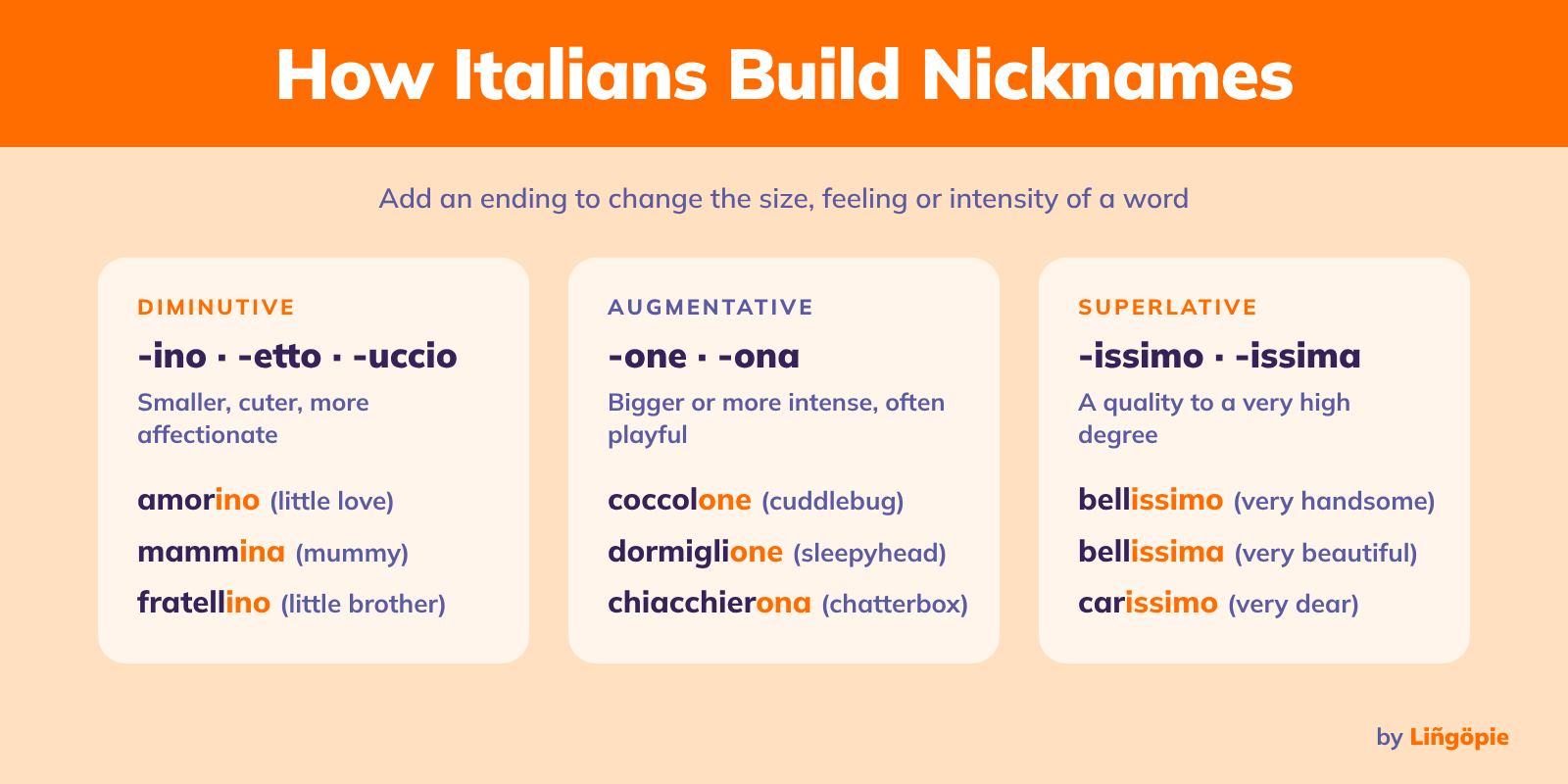
Italians often create affectionate nicknames by adding special endings to existing words. These endings can make a word sound smaller and cuter, suggest something bigger or more intense, or express a stronger feeling. For example, amore (love) becomes amorino (little love), while nonna (grandma) can become nonnina (granny).
Two common ways to form Italian nicknames are through diminutive and augmentative endings, which can express affection, size, or intensity. Italians also use superlative endings like -issimo/-issima to make affectionate descriptions stronger, although these work differently from nickname-forming suffixes.
Diminutive Endings
Diminutive suffixes make Italian words sound smaller, cuter, or more affectionate. Common endings include -ino/-ina, -etto/-etta, -ello/-ella, and -uccio/-uccia. For example, mamma (mum) becomes mammina (mummy), while fratello (brother) becomes fratellino (little brother).
These endings also change depending on gender. Masculine forms typically end in -o, while feminine versions end in -a, as in tesorino (little treasure) and tesorina.
Augmentative Endings
Augmentative endings suggest something bigger, stronger, or more intense. In Italian, -one/-ona can also express affection or playful teasing, depending on the word and context.
For example, coccolone describes someone who loves cuddles, while furbacchione refers to a sly or crafty person, often in a teasing way. The latter uses the expressive ending -acchione, which can add a playful or mildly critical tone.
Superlative Endings
Superlative endings express a quality to a very high degree rather than making something bigger or smaller. Italians use -issimo/-issima to intensify adjectives, such as bellissima (very beautiful) and carissimo (very dear).
The ending changes to match the person's gender: bellissimo is masculine, while bellissima is feminine. Unlike a soprannome (nickname), a vezzeggiativo is an affectionate word form, often created using diminutive endings.
Romantic Italian Nicknames for Your Partner
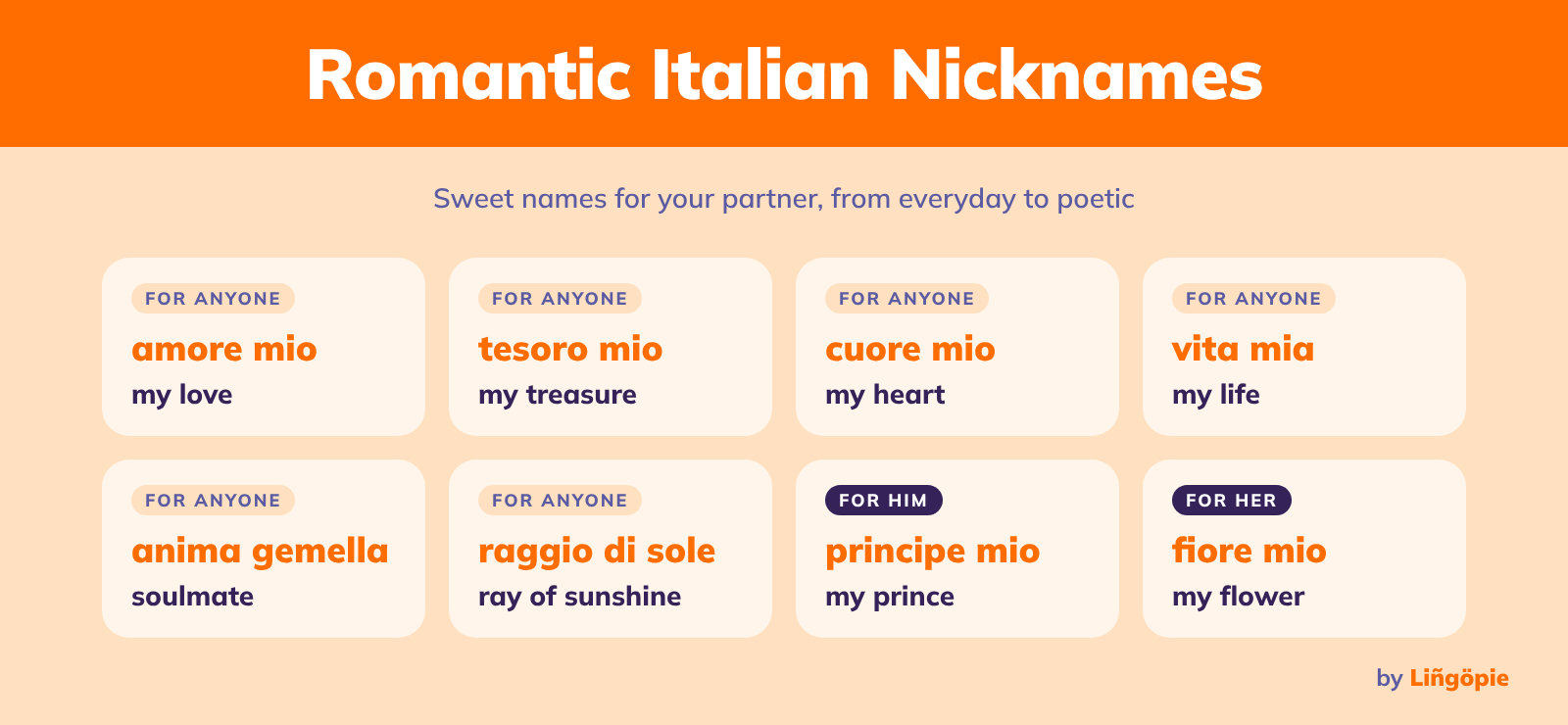
Want to make your partner feel extra special? Italian has plenty of romantic nicknames that express love and affection. Some, like amore mio (my love), are common in everyday conversations, while others, like anima gemella (soulmate), express a deeper romantic connection.
Whether you're looking for a sweet name for your boyfriend, girlfriend, or better half, here are some romantic Italian nicknames you can use.
Romantic Nicknames for Anyone
Some Italian terms of endearment work for both men and women, regardless of your partner's gender. These include everyday expressions like amore mio (my love), along with more poetic phrases like luce dei miei occhi (light of my eyes) and descriptions like anima gemella (soulmate).
Italian | Pronunciation | English | Used for / Tone |
|---|---|---|---|
Amore mio | ah-MOH-reh MEE-oh | My love | Romantic, very common |
Tesoro mio | teh-ZOH-roh MEE-oh | My treasure | Sweet, affectionate |
Cuore mio | KWOH-reh MEE-oh | My heart | Deeply romantic |
Vita mia | VEE-tah MEE-ah | My life | Intimate, emotional |
La mia dolce metà | lah MEE-ah DOHL-cheh meh-TAH | My better half | Loving; describes a partner rather than directly addressing them |
Anima gemella | AH-nee-mah jeh-MEHL-lah | Soulmate / twin soul | Deeply romantic; describes a soulmate |
Raggio di sole | RAHD-joh dee SOH-leh | Ray of sunshine | Warm, poetic |
Luce dei miei occhi | LOO-cheh day MYAY OHK-kee | Light of my eyes | Poetic, intimate; less common in everyday conversation |
Amorino | ah-moh-REE-noh | Little love | Cute, playful |
Tesorino | teh-zoh-REE-noh | Little treasure | Sweet, affectionate |
Example: Buongiorno, amore mio! Come hai dormito? (Good morning, my love! How did you sleep?)
Italian Nicknames for Him
Looking for a sweet name to call your boyfriend or husband? These romantic Italian nicknames range from everyday compliments like bello (handsome) to more affectionate expressions like principe mio (my prince).
Italian | Pronunciation | English | Used for / Tone |
|---|---|---|---|
Bello | BEHL-loh | Handsome | Casual, affectionate |
Caro | KAH-roh | Dear | Warm, familiar |
Principe | PREEN-chee-peh | Prince | Romantic, playful |
Amato | ah-MAH-toh | Beloved | Poetic, intimate |
Bellissimo | behl-LEES-see-moh | Very handsome | Flattering, affectionate |
Example: Buonanotte, bello mio! (Good night, my handsome one!)
Italian Nicknames for Her
Italian also has plenty of terms of endearment for a girlfriend or wife. Some, like bella (beautiful), are common in casual conversations, while others, like fiore mio (my flower), sound more poetic and intimate.
Italian | Pronunciation | English | Used for / Tone |
|---|---|---|---|
Bella | BEHL-lah | Beautiful | Casual, affectionate |
Stella | STEHL-lah | Star | Sweet, affectionate |
Stellina | stehl-LEE-nah | Little star | Cute, tender |
Fiore mio | FYOH-reh MEE-oh | My flower | Poetic, romantic |
Principessa | preen-cheh-PEHS-sah | Princess | Romantic, playful |
Cara | KAH-rah | Dear | Warm, familiar |
Bellissima | behl-LEES-see-mah | Very beautiful | Flattering, affectionate |
Example: Sei bellissima, amore mio! (You're very beautiful, my love!)
Italian Nicknames for Family Members
In Italian families, affectionate nicknames are often used to show love and closeness. Parents might call their children tesorino (little treasure), while children may use mammina (mummy) or nonnina (granny) for their mother or grandmother. Some are ordinary family titles, while others use diminutive endings to sound more affectionate.
Nicknames for Babies and Children
Italian parents often use sweet, playful names when talking to their little ones. These include familiar words for children and affectionate expressions inspired by animals, angels, and love.
Italian | Pronunciation | English | Used for / Tone |
|---|---|---|---|
Bambino/a | bahm-BEE-noh/nah | Child | Ordinary word for a boy or girl |
Piccolo/a | PEEK-koh-loh/lah | Little one | Warm, affectionate |
Cucciolo/a | KOO-choh-loh/lah | Puppy / little one | Sweet, nurturing |
Angioletto | ahn-joh-LEHT-toh | Little angel | Tender, affectionate |
Tesorino/a | teh-zoh-REE-noh/nah | Little treasure | Loving, gentle |
Amorino | ah-moh-REE-noh | Little love | Sweet, playful |
Example: Buonanotte, tesorino mio! (Good night, my little treasure!)
Nicknames for Parents and Grandparents
Many Italian families use familiar titles like mamma (mum) and papà (dad). Adding affectionate endings creates sweeter variations, such as mammina or nonnino. According to Treccani, these family titles are also commonly used when directly addressing relatives.
Italian | Pronunciation | English | Used for / Tone |
|---|---|---|---|
Mamma | MAHM-mah | Mum | Familiar, affectionate family title |
Mammina | mahm-MEE-nah | Mummy | Extra affectionate |
Papà | pah-PAH | Dad | Familiar family title |
Nonna | NOHN-nah | Grandma | Warm, familiar family title |
Nonnino | nohn-NEE-noh | Dear grandpa | Sweet, affectionate |
Nonnina | nohn-NEE-nah | Dear grandma | Sweet, affectionate |
Example: Ti voglio bene, nonnina! (I love you, Grandma!)
Nicknames for Siblings and Cousins
Italians can also add diminutive endings to family words to make them sound more affectionate. For example, fratello (brother) becomes fratellino (little brother), while sorella (sister) becomes sorellina (little sister).
Italian | Pronunciation | English | Used for / Tone |
|---|---|---|---|
Fratellino | frah-tehl-LEE-noh | Little brother | Affectionate, familiar |
Sorellina | soh-rehl-LEE-nah | Little sister | Sweet, affectionate |
Cuginetto | koo-jee-NEHT-toh | Little cousin (male) | Playful, familiar |
Cuginetta | koo-jee-NEHT-tah | Little cousin (female) | Playful, familiar |
Example: Come stai, sorellina? (How are you, little sister?)
Italian Nicknames and Slang for Friends
Italian nicknames aren't just for family members or romantic partners. Close friends also use casual expressions like bella (beautiful), vecchio (old man), and fratello (brother) to show familiarity. Some belong to everyday Italian slang, so they're best used with people you know well.
Italian | Pronunciation | English | Used for / Tone |
|---|---|---|---|
Bella | BEHL-lah | Beautiful | Friendly, casual; often used with women |
Caro/cara | KAH-roh/rah | Dear | Warm, familiar; can sound condescending with strangers |
Amico/amica | ah-MEE-koh/kah | Friend | Friendly, neutral |
Vecchio | VEHK-kyoh | Old man / old friend | Teasing, very familiar |
Fratello/sorella | frah-TEHL-loh / soh-REHL-lah | Brother / sister | Close, affectionate; informal when used for friends |
Raga' | RAH-gah | Guys | Informal group address, shortened from ragazzi |
Zio/zia | TSEE-oh / TSEE-ah | Uncle / aunt | Familiar; zio can be slang for dude in some social groups |
Fra | FRAH | Bro | Very informal, shortened from fratello |
Bro | BROH | Bro | Youth slang borrowed from English |
Example: Ehi, fra! Come va? (Hey, bro! How's it going?)
These expressions depend heavily on your relationship and the situation. Calling a good friend vecchio might be funny, but using it with a stranger could sound rude. Likewise, caro or cara can feel slightly condescending when said by someone you don't know well.
Cute Italian Nicknames Inspired by Food
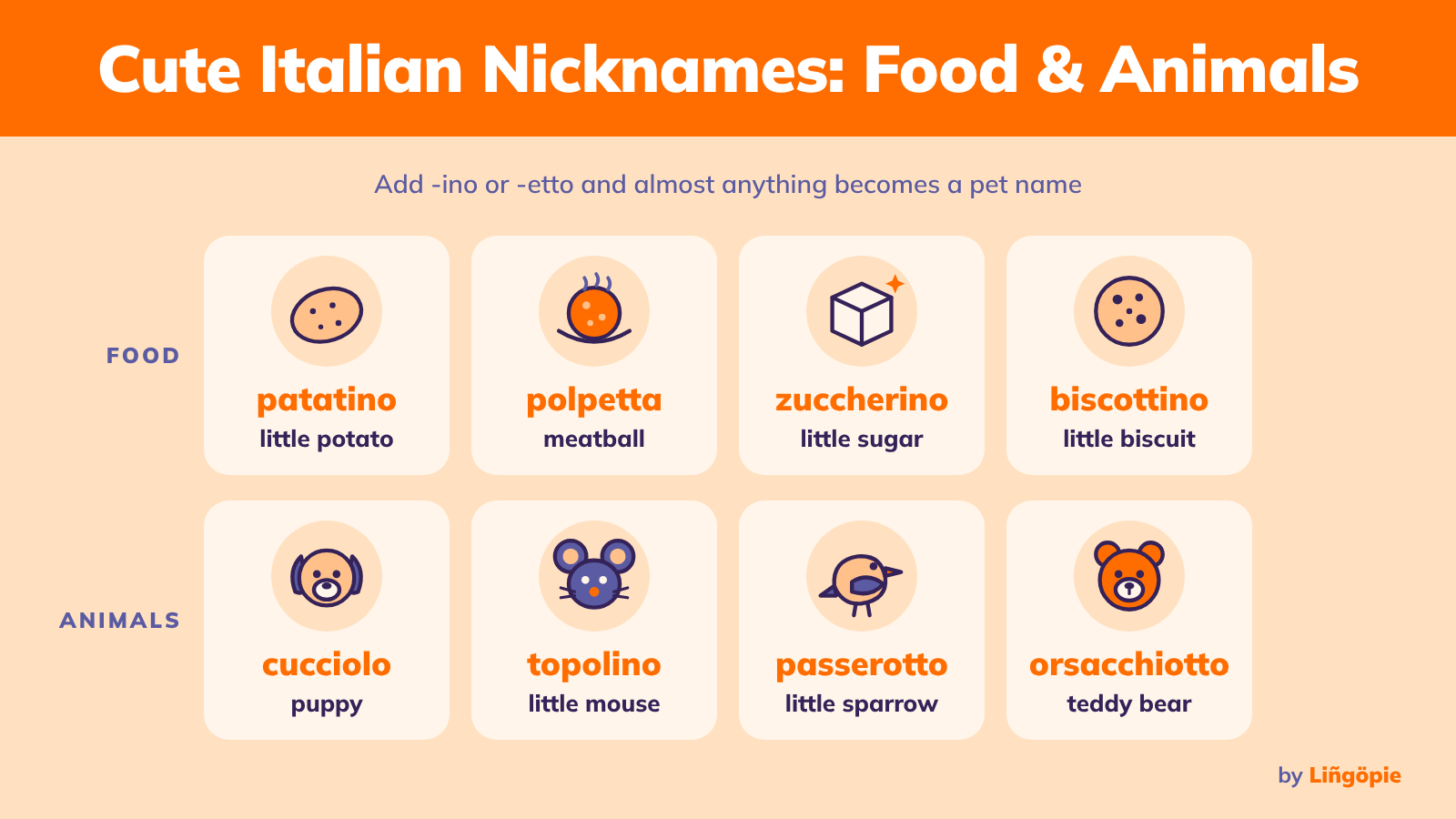
Who knew a potato or meatball could become a sweet nickname? Italians sometimes turn food words into playful expressions of affection, especially by adding diminutive endings like -ino or -ina. Some of these cute Italian nicknames are familiar terms of endearment, while others are creative names you might use with someone close to you.
Italian | Pronunciation | English | Used for / Tone |
|---|---|---|---|
Polpetta | pohl-PEHT-tah | Meatball | Playful, teasing |
Patatino/a | pah-tah-TEE-noh/nah | Little potato | Cute, affectionate |
Fagiolino | fah-joh-LEE-noh | Little bean / green bean | Sweet, playful |
Pasticcino | pah-stee-CHEE-noh | Little pastry | Sweet, affectionate |
Zuccherino | dzook-keh-REE-noh | Little sugar / sweetie | Tender, affectionate |
Biscottino | bees-koht-TEE-noh | Little biscuit | Cute, playful |
Ciliegina | chee-lyeh-JEE-nah | Little cherry | Sweet, playful |
Cioccolatino | chohk-koh-lah-TEE-noh | Little chocolate | Sweet, affectionate |
Example: Buongiorno, patatina mia! (Good morning, my little potato!)
Cute Italian Nicknames Inspired by Animals
Animal-inspired Italian nicknames can sound surprisingly affectionate. Words like topolino (little mouse), cucciolo (puppy), and passerotto (little sparrow) are often used playfully with children or loved ones. Others, like tartaruga (turtle), can be teasing, so context matters.
Here are 11 cute Italian nicknames inspired by animals, ranging from sweet and cuddly to playful and teasing.
Italian | Pronunciation | English | Used for / Tone |
|---|---|---|---|
Cucciolo/a | KOO-choh-loh/lah | Puppy / little one | Sweet, nurturing |
Gattino/a | gaht-TEE-noh/nah | Kitten | Cute, affectionate |
Micio/a | MEE-choh/chah | Kitty | Playful, affectionate |
Topolino/a | toh-poh-LEE-noh/nah | Little mouse | Sweet, playful |
Passerotto/a | pahs-seh-ROHT-toh/tah | Little sparrow | Tender, often for children |
Orsacchiotto | or-sahk-KYOHT-toh | Teddy bear | Cuddly, affectionate |
Scimmietta | sheem-MYEHT-tah | Little monkey | Playful, teasing |
Pulcino | pool-CHEE-noh | Chick | Sweet, nurturing |
Pulce | POOL-cheh | Flea | Playful, teasing |
Tartaruga | tar-tar-OO-gah | Turtle / slowpoke | Teasing, for someone slow |
Coniglietto/a | koh-nee-LYEHT-toh/tah | Little bunny | Cute, affectionate |
Example: Vieni qui, passerotto mio! (Come here, my little sparrow!)
However, not all animal-inspired nicknames are compliments. While orsacchiotto can suggest someone cuddly, calling someone tartaruga may poke fun at how slowly they move. It's best to save teasing nicknames for people who'll appreciate the joke.
Funny and Teasing Italian Nicknames
Not all Italian nicknames are sweet and romantic. Some poke fun at someone's personality, habits, or appearance. For example, dormiglione (sleepyhead) is a playful name for someone who loves sleeping, while furbacchione (sly fox) describes someone who's clever or a little mischievous.
Italian | Pronunciation | English | Used for / Tone |
|---|---|---|---|
Ciccio | CHEECH-choh | Chubby / chubster | Familiar, potentially offensive |
Nano/a | NAH-noh/nah | Shorty | Teasing, potentially offensive |
Furbacchione/a | foor-bahk-KYOH-noh/nah | Sly fox / crafty one | Playful, sometimes critical |
Coccolone/a | kohk-koh-LOH-noh/nah | Cuddlebug | Affectionate, playful |
Dormiglione/a | dor-mee-LYOH-noh/nah | Sleepyhead | Lighthearted, teasing |
Mostriciattolo | moh-stree-CHAHT-toh-loh | Little monster | Playful, often for mischievous children |
Monello/a | moh-NEHL-loh/lah | Little rascal | Playful, mildly scolding |
Pigrone/a | pee-GROH-noh/nah | Lazybones | Teasing, sometimes critical |
Chiacchierone/a | kyahk-kyeh-ROH-noh/nah | Chatterbox | Playful, for someone talkative |
Birbante | beer-BAHN-teh | Little rascal / rogue | Mischievous, teasing |
Example: Dai, dormiglione! È ora di alzarsi! (Come on, sleepyhead! It's time to get up!)
Be careful when using teasing nicknames, especially those referring to someone's appearance. Words like ciccio and nano can sound insulting, even if you mean them affectionately. Save them for close friends or family members who are comfortable with that kind of humour.
When (and When Not) to Use Italian Nicknames
Italian nicknames are common among romantic partners, family members, and close friends, but not every expression suits every relationship. For example, tesoro (treasure) can sound affectionate when used with someone you love, while caro/cara (dear) may come across as slightly condescending when said by a stranger.
And most importantly, remember that context also matters in Italian culture. Some expressions, like cocco/cocca (darling), can sound a bit old-fashioned, while slang terms like zio (dude) are more common among certain younger social groups and vary by region. As a general rule, avoid overly familiar nicknames in professional settings unless you already have that kind of relationship.
Want to get a better feel for when these expressions sound natural? Watching Italian TV shows and movies on Lingopie can help you recognise how native speakers use them, including their pronunciation, tone, and context in everyday conversations.
Frequently Asked Questions About Italian Nicknames
What is the most common Italian term of endearment?
Amore (love) is one of the most common Italian terms of endearment, especially between romantic partners. Adding mio (my) makes it amore mio, a more personal way to address someone you love.
What do Italians call their girlfriend or boyfriend?
Italians commonly call their girlfriend or boyfriend amore (love), tesoro (treasure), or amore mio (my love). More poetic expressions like vita mia (my life) are often used to express deeper affection.
What does "tesoro" mean in Italian?
Tesoro literally means "treasure" in Italian, but it's also an affectionate way to address someone you cherish. Unlike exclusively romantic expressions, it can be used for partners, children, and other loved ones.
How do you make a nickname in Italian?
You can create affectionate Italian nicknames by adding suffixes like -ino/-ina or -etto/-etta, such as tesoro becoming tesorino (little treasure). Italians also shorten first names, such as Alessandro to Ale.
Can you call a friend "bella" in Italian?
Yes, bella can be an informal greeting among friends, similar to saying "hey" in English. Expressions like bella, zio! are associated with youth slang, so they may sound unnatural in formal situations.
Are Italian nicknames different in different regions?
Yes, Italian nicknames vary across regions because local dialects and slang influence how people address each other. For example, zio (dude) is documented in Milanese youth slang, while affectionate suffixes like -uzzo have southern Italian associations.