
Remember when flip phones were cool, everyone had an AIM away message, and Paris Hilton made “that’s hot” a thing? The 2000s gave us plenty of unforgettable trends, but 2000s slang was just as iconic. Popular expressions like “bling,” “fo shizzle,” “so fetch,” and “epic fail” spread through hip-hop, early internet chats, and teen movies. Some, like “LOL” and “my bad,” are still part of everyday conversations.
Feeling nostalgic? We've rounded up over 60 popular 2000s slang words and phrases, complete with their meanings, origins, and example sentences. You'll also discover which expressions are still used today and which ones are best left in the 2000s.

Key Takeaways
- Many 2000s slang expressions developed through wordplay, shortened phrases, and creative spellings. Hip-hop, online gaming, texting, and pop culture also helped spread these expressions among young people.
- Some words gained new slang meanings, such as “sick” and “sweet,” which became ways to describe something cool or impressive.
- Popular 2000s expressions like “crunk,” “holla,” and “shawty” became widely recognized through hip-hop music.
- Abbreviations like “BRB,” “TTYL,” and “G2G” became popular through instant messaging and flip-phone texting. Some expressions, including “IDK,” “BFF,” and “hater,” are still commonly used today.
2000s Slang at a Glance
Long before the 2000s, people have naturally shortened words, played with spellings, and gave familiar expressions new meanings. In fact, a study published in Language in Society found that young people adapted their language across emails, instant messages, and texts, showing how comfortably they switched between different ways of communicating.
Here are 10 iconic 2000s slang words and phrases worth remembering:
Slang | Meaning | Where it came from | Example sentence | Still used? |
|---|---|---|---|---|
Bling | Flashy, expensive jewellery | Popularised by B.G.'s 1999 song Bling Bling | "Check out her new bling!" | Yes |
Crunk | Extremely excited or energetic | Southern hip-hop; popularised by Lil Jon | "This party is about to get crunk!" | Ironically |
Fo shizzle | For sure; definitely | Popularised by Snoop Dogg | "You coming tonight?" "Fo shizzle!" | Ironically |
So fetch | Really cool or fashionable | Mean Girls (2004) | "Your new bag is so fetch!" | Ironically |
LOL | Laughing out loud | Early online chats and texting | "LOL, that's hilarious!" | Yes |
Noob | Someone inexperienced at something | Online gaming communities | "I'm such a noob at this game." | Yes |
Epic fail | A major or embarrassing failure | Internet memes and gaming culture | "I sent the message to the wrong person. Epic fail!" | Ironically |
That's hot | Something attractive, fashionable, or impressive | Paris Hilton's catchphrase on The Simple Life | "Those sunglasses? That's hot!" | Ironically |
My bad | My mistake; an informal apology | AAVE; popular before the 2000s | "Oops, my bad! I forgot to call." | Yes |
BFF | Best friends forever | Friendship slang popularised through teen culture and messaging | "We've been BFFs since middle school." | Yes |
Where 2000s Slang Came From
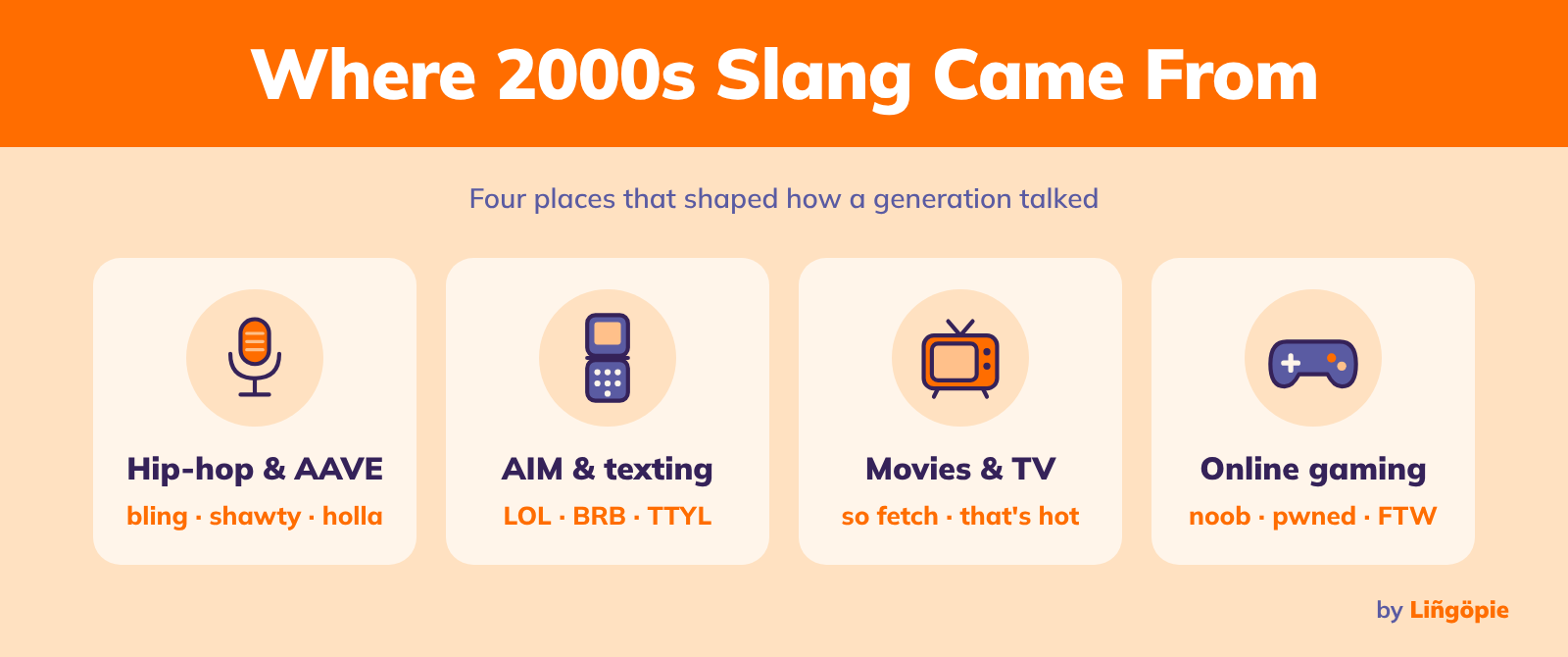
Before anything else, let us be clear about one thing: 2000s slang didn't come from just one place! Many expressions developed within Black American culture, online communities, and everyday conversations before reaching a wider audience through music, television, and the internet. Here are four major influences that shaped the way people spoke during the decade.
Hip-hop and African American Vernacular English (AAVE)
Many popular expressions, including “bling,” “shawty,” and “holla,” have roots in Black American language and hip-hop culture. In fact, a study published in PLOS ONE found that listening to hip-hop was associated with greater knowledge of African American English vocabulary among non-Black listeners. Artists such as Snoop Dogg and Lil Jon also helped bring these expressions into mainstream culture.
Early internet and flip-phone texting
Before smartphones, people relied on AOL Instant Messenger (AIM), chat rooms, and flip phones to stay connected. According to Smithsonian Magazine, AIM helped popularize short-form expressions like “LOL” and “BRB,” allowing users to communicate quickly with fewer keystrokes.
Teen movies, reality TV, and celebrity catchphrases
Pop culture also played a major role in popularizing expressions. The 2004 movie Mean Girls gave audiences “so fetch,” while Paris Hilton made “that's hot” her signature catchphrase on the reality TV show The Simple Life. Fans repeated these lines in school, with friends, and in everyday conversations.
Online gaming communities
Multiplayer games and gaming forums developed their own vocabulary. Players used terms like “noob” for inexperienced gamers and “pwned” to describe someone being completely defeated. Oxford University Press documents how gaming terminology such as “pwn” became established enough to enter English dictionaries.
Hip Hop Slang That Went Mainstream
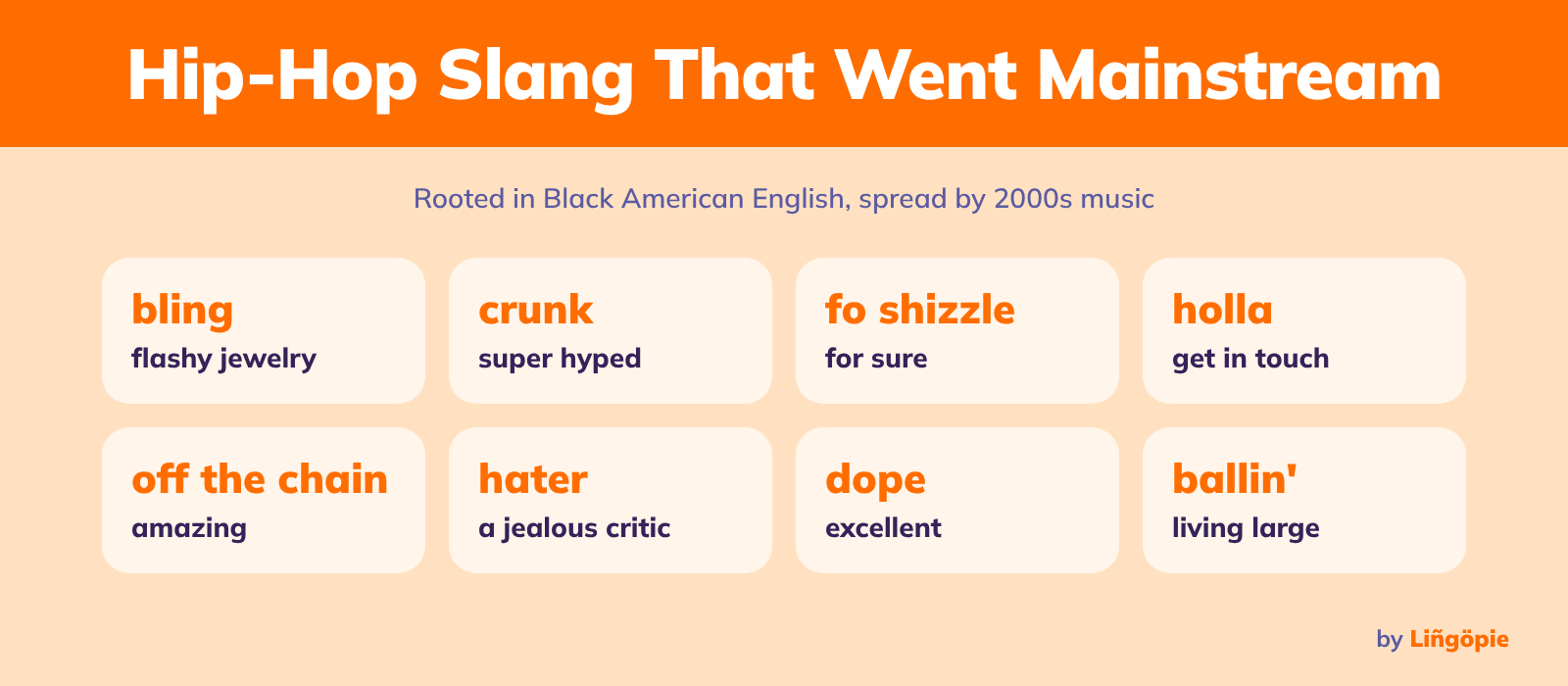
Hip-hop and R&B music helped bring expressions rooted in Black American culture and African American Vernacular English (AAVE) to a wider audience during the 2000s. As hip hop artists gained mainstream popularity, words like “bling” and “crunk” became familiar even to people who didn't regularly listen to rap.
Here are 14 hip-hop slang words and phrases that became popular during the 2000s:
Slang | Meaning | Where it came from | Example sentence | Still used? |
|---|---|---|---|---|
Bling | Flashy and expensive jewelry | Popularized by B.G.'s 1999 song Bling Bling | “Check out all that bling!” | Yes |
Crunk | Extremely excited or energetic, especially at parties | Southern hip-hop; popularized by Lil Jon | “The party tonight is gonna be crunk!” | Ironically |
Fo shizzle | For sure; definitely | Popularized by Snoop Dogg; the “-izzle” style predates him | “You coming tomorrow?” “Fo shizzle!” | Ironically |
Holla | To contact, greet, or call out to someone | AAVE; widely used in hip-hop | “Holla at me when you get home!” | Yes |
Shawty | An affectionate or flirtatious term of address | Southern hip-hop and AAVE | “Hey, shawty, what's up?” | Yes |
Lil mama | A playful or flirtatious way to address a girl or woman | AAVE and hip-hop; associated with the artist Lil Mama | “Hey, lil mama, looking good!” | Ironically |
Off the chain | Extremely good, exciting, or impressive | AAVE; popular in hip-hop | “That concert was off the chain!” | Ironically |
Hater | Someone who criticizes or resents another person's success | AAVE and hip-hop culture | “Don't listen to the haters.” | Yes |
Playa | Someone who dates or flirts with multiple people | AAVE and hip-hop pronunciation of player | “He's such a playa!” | Ironically |
Dope | Excellent, impressive, or cool | Older slang popular in hip-hop | “Those sneakers are dope!” | Yes |
Ballin' | Living lavishly or showing off wealth | Basketball slang and hip-hop | “New car, new house? You're ballin'!” | Yes |
Drop it like it's hot | Dance by lowering your body toward the floor | Popularized by Snoop Dogg's 2004 hit | “Drop it like it's hot when the beat starts!” | Ironically |
Get low | Dance by lowering your body close to the floor | Popularized by Lil Jon & the East Side Boyz's 2003 hit | “Everybody, get low!” | Yes |
Represent | Show pride in or support for your community | Older expression widely used in hip-hop | “Represent your hometown!” | Yes |
Many of these expressions existed long before the 2000s, particularly within Black American communities. Hip-hop helped spread them into mainstream culture, where some became lasting parts of everyday English.
Did you know? Snoop Dogg popularized “fo shizzle,” Lil Jon helped make “crunk” synonymous with energetic parties, and Lil Mama's 2007 hit “Lip Gloss” became another memorable part of the decade's music culture.
Internet and Texting Slang
Remember typing messages on your Nokia or Motorola flip phone, updating your AIM away message, or spending hours in Yahoo! Messenger chat rooms? The early internet changed how an entire generation communicated. With limited characters and tiny phone keypads, people relied on short-form slang like “BRB” and “TTYL” to save time.
Meanwhile, online gaming communities in popular games like World of Warcraft, RuneScape, and Counter-Strike developed their own expressions, many of which spread through forums, posts, and comments sections.
Let's look at the abbreviations and gaming terms that defined the era, including a few you'll still see in messages today.
AIM and Texting Slang
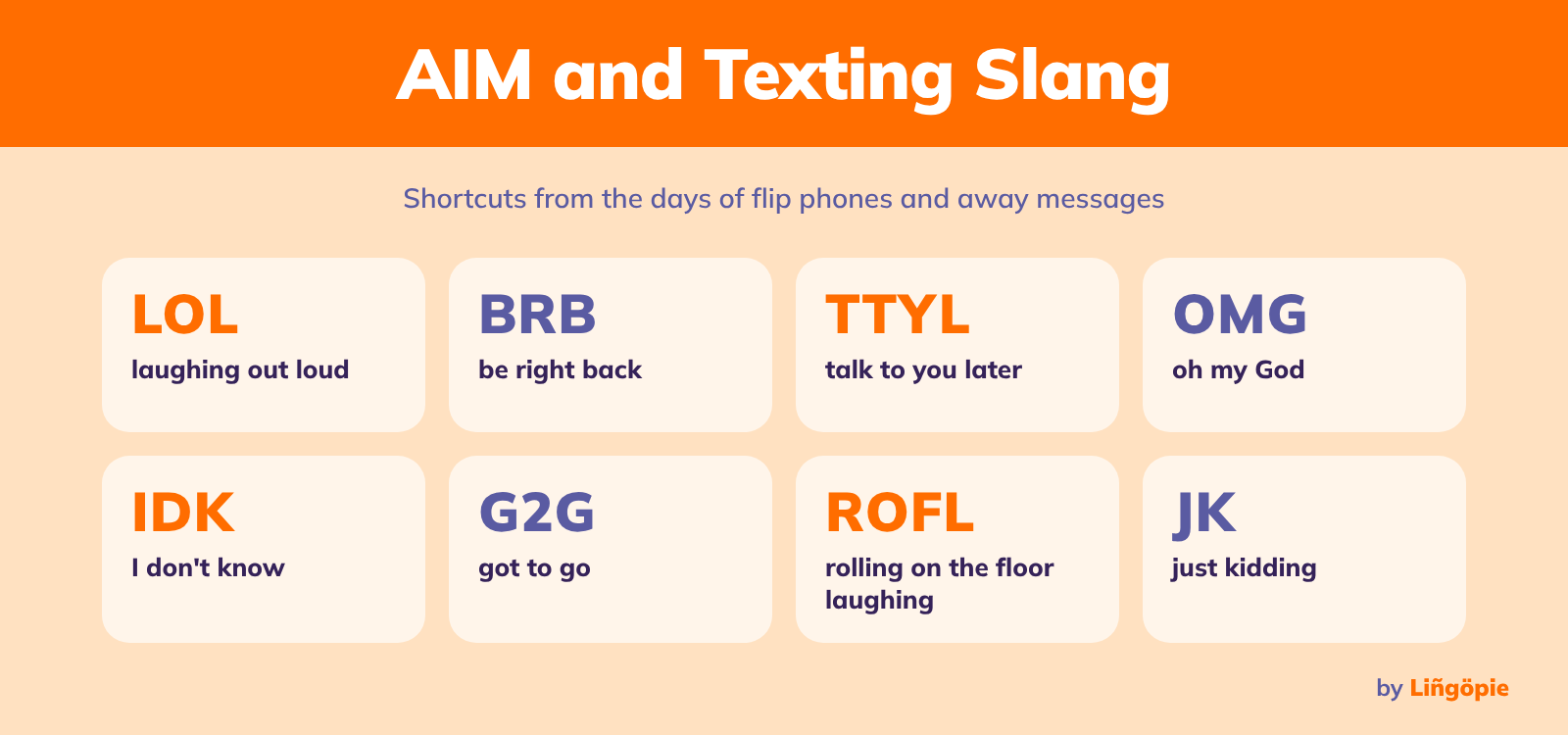
Before autocorrect and predictive texting became widespread, typing messages meant pressing the same number key multiple times to get the right letter. Abbreviations made conversations quicker, especially when chatting on AIM or sending SMS messages with character limits. Here are 12 popular shortcuts you might remember using.
Slang | Meaning | Where it came from | Example sentence | Still used? |
|---|---|---|---|---|
LOL | Laughing out loud | Early online chats and messaging | “LOL, that's so funny!” | Yes |
BRB | Be right back | Online chat rooms and instant messaging | “BRB, gotta eat dinner.” | Yes |
TTYL | Talk to you later | Early internet chats and SMS texting | “Gotta go, TTYL!” | Ironically |
OMG | Oh my God | Older abbreviation popularised through online chats and texting | “OMG, did you hear the news?” | Yes |
IDK | I don't know | Online messaging and SMS texting | “IDK what time the movie starts.” | Yes |
G2G | Got to go | Instant messaging and early texting | “Mom's calling, G2G!” | Ironically |
C U | See you | Text messaging and internet chat shorthand | “C U tomorrow!” | Ironically |
ROFL | Rolling on the floor laughing | Early internet chat rooms and forums | “ROFL, that was hilarious!” | Ironically |
LMAO | Laughing my ass off | Online chat rooms and instant messaging | “LMAO, I can't stop laughing!” | Yes |
JK | Just kidding | Internet chats and SMS texting | “You're the worst! JK!” | Yes |
BTW | By the way | Older abbreviation widely used in online messaging | “BTW, are you coming tonight?” | Yes |
B4 | Before | SMS shorthand using the number 4 for “four” | “Call me B4 you leave.” | Ironically |
Today, texting slang continues to evolve, with newer abbreviations like “NGL” (not gonna lie), “IYKYK” (if you know, you know), and “SMH” (shaking my head) appearing in messages and social media posts. While some of these expressions have been around for years, platforms like TikTok and Instagram have helped introduce them to new audiences.
Gaming Slang
Online gaming took off in the 2000s as faster internet connections made multiplayer games more accessible. Instead of playing alone, gamers could compete against people around the world, join virtual communities, and chat in real time. This growing gaming culture also developed its own slang, with expressions used to celebrate wins, mock opponents, and communicate quickly during matches.
Slang | Meaning | Where it came from | Example sentence | Still used? |
|---|---|---|---|---|
Pwned | Completely defeated or humiliated | Online gaming; often linked to a typo of “owned” | “You just got pwned!” | Ironically |
Noob | An inexperienced or unskilled player | Earlier internet slang adopted by gaming communities | “I'm a noob at this game.” | Yes |
Epic fail | A spectacular or embarrassing failure | Internet memes and gaming culture | “I fell off the map again. Epic fail!” | Ironically |
FTW | For the win; used to celebrate or praise something | Online gaming and internet forums | “We finally beat the boss! FTW!” | Yes |
AFK | Away from keyboard | Online multiplayer games and chat rooms | “AFK for five minutes. Don't start without me!” | Yes |
Owned | Thoroughly beaten or outplayed | Older slang popularised in competitive gaming | “We totally owned that team!” | Yes |
w00t | An expression of excitement or celebration | Early online gaming and hacker communities | “We got the rare item! w00t!” | Ironically |
One interesting example is “pwned,” which is commonly believed to have come from someone accidentally typing “p” instead of “o” in “owned.” However, its exact origin remains uncertain. Both expressions became popular ways for gamers to brag about victories or jokingly mock their opponents.
Slang From Movies and TV
The 2000s were a golden era for feel-good teen movies and romantic comedies. Films like Legally Blonde (2001), The Princess Diaries (2001), Freaky Friday (2003), Mean Girls (2004), and 13 Going on 30 (2004) gave young audiences memorable characters, fashion trends, and quotable lines. Reality TV was also booming, with shows like The Simple Life and The Hills turning celebrities and their catchphrases into pop culture sensations.
It wasn't long before young people started repeating their favourite lines at school or using them as inside jokes with close friends. Some phrases became so closely associated with a particular movie, TV show, or celebrity that they're still instantly recognisable today.
Slang | Meaning | Where it came from | Example sentence | Still used? |
|---|---|---|---|---|
So fetch | Really cool or fashionable | Coined for Mean Girls (2004) | “Your new shoes are so fetch!” | Ironically |
Get in, loser | A playful invitation to join someone | Popularised by Mean Girls (2004) | “Get in, loser! We're going shopping.” | Ironically |
That's hot | Something attractive, fashionable, or impressive | Paris Hilton's catchphrase on The Simple Life (2003) | “That new outfit? That's hot!” | Ironically |
BFF | Best friends forever | Older friendship abbreviation popular in teen culture and texting | “We've been BFFs since middle school.” | Yes |
Yo mama | An opening for a joke about someone's mother | Older joke tradition; featured on MTV's Yo Momma (2006) | “Are we seriously doing yo mama jokes again?” | Ironically |
Bromance | A close, affectionate friendship between men | Older term that gained popularity through 2000s entertainment | “Those two have a serious bromance.” | Yes |
Chillax | To relax or calm down | Blend of “chill” and “relax,” popular in 2000s speech and media | “It's Friday, just chillax!” | Ironically |
You got served | You were decisively beaten or outperformed | Older expression associated with You Got Served (2004) | “That dance battle was brutal. You got served!” | Ironically |
That's what she said | A joke that gives an innocent remark a sexual double meaning | Older joke popularised by The Office (2005–2013) | “This is harder than I thought.” “That's what she said!” | Yes |
Fierce | Bold, stylish, or impressively confident | Older expression associated with ballroom culture and popularised in fashion media | “That runway look is fierce!” | Yes |
These expressions also show how a memorable catchphrase could become part of a celebrity's personal brand. Paris Hilton, for example, became so closely associated with “that's hot” that she registered it as a trademark in 2007.
Related: Learn English with Sitcoms
School Hallway Slang
Middle school and high school in the 2000s had their own vocabulary, especially when it came to gossip, friendships, and teenage drama. Young people used sarcasm, exaggerated reactions, and playful insults to express themselves, often with a dramatic eye roll or hand gesture. Some expressions were so common among close friends that parents had a hard time keeping up with what everyone was saying.
Here are 18 expressions you might remember hearing in school hallways, cafeterias, and conversations with friends.
Slang | Meaning | Where it came from | Example sentence | Still used? |
|---|---|---|---|---|
Whatever | An expression of indifference or dismissal | Older slang popularized in 1990s teen culture | “Whatever, I don't even care!” | Yes |
Talk to the hand | Stop talking; I'm not listening | Popularized in 1990s youth culture | “Talk to the hand, because I'm done listening!” | Ironically |
My bad | My mistake; an informal apology | AAVE; popular before the 2000s | “Oops, my bad! I forgot your notebook.” | Yes |
Totes | Totally; completely | Playful shortening of “totally” | “I'm totes going to the party!” | Ironically |
Whatevs | Whatever; I don't care | Shortened, sarcastic form of “whatever” | “Whatevs, do what you want.” | Ironically |
Frenemy | Someone who acts like a friend but is also a rival | Blend of “friend” and “enemy”; older term popular in teen culture | “She's nice to my face, but she's such a frenemy.” | Yes |
Emo | Associated with emotional music, fashion, or subculture | Short for “emotional hardcore”; popularized through 2000s music culture | “He's going through his emo phase.” | Yes |
Sick | Extremely cool or impressive | Older slang popular in youth and skate culture | “Your new skateboard is sick!” | Yes |
Sweet | Great, awesome, or exciting | Older slang widely used among young people | “You got concert tickets? Sweet!” | Yes |
Le tired | A humorous way of saying very tired | Early internet humor using “le” for comic effect | “I studied all night. I'm le tired.” | Ironically |
Cool beans | Great; sounds good | Older American slang popular before the 2000s | “We're getting pizza? Cool beans!” | Ironically |
Chill pill | A joking way to tell someone to calm down | Older expression popular before the 2000s | “Take a chill pill, it's just a game!” | Yes |
Da bomb | Extremely good or impressive | Older slang popular in 1990s youth culture | “That new CD is da bomb!” | Ironically |
Duh | Used when something seems obvious | Older sarcastic expression | “Duh, of course I know that!” | Yes |
Awkward turtle | A gesture or phrase acknowledging an awkward moment | Associated with 2000s school and college humor | “Nobody laughed at his joke. Awkward turtle!” | Ironically |
Random | Unexpected, strange, or unrelated | Older word used playfully in 2000s teen speech | “That was such a random question!” | Yes |
Major | Very important, intense, or impressive | Older word used for emphasis in teen speech | “She's having major drama with her friends.” | Yes |
Sketchy | Suspicious, questionable, or unreliable | Older slang popular in casual speech | “That guy seems kind of sketchy.” | Yes |
Some expressions came with gestures, too. Saying “whatever” while forming a W with your fingers became a recognizable way to dismiss someone, although the gesture was already featured in Clueless (1995). Others, like “cool beans,” “chill pill,” and “da bomb,” were around long before the 2000s but remained familiar during the decade.
2000s Slang People Still Use Today
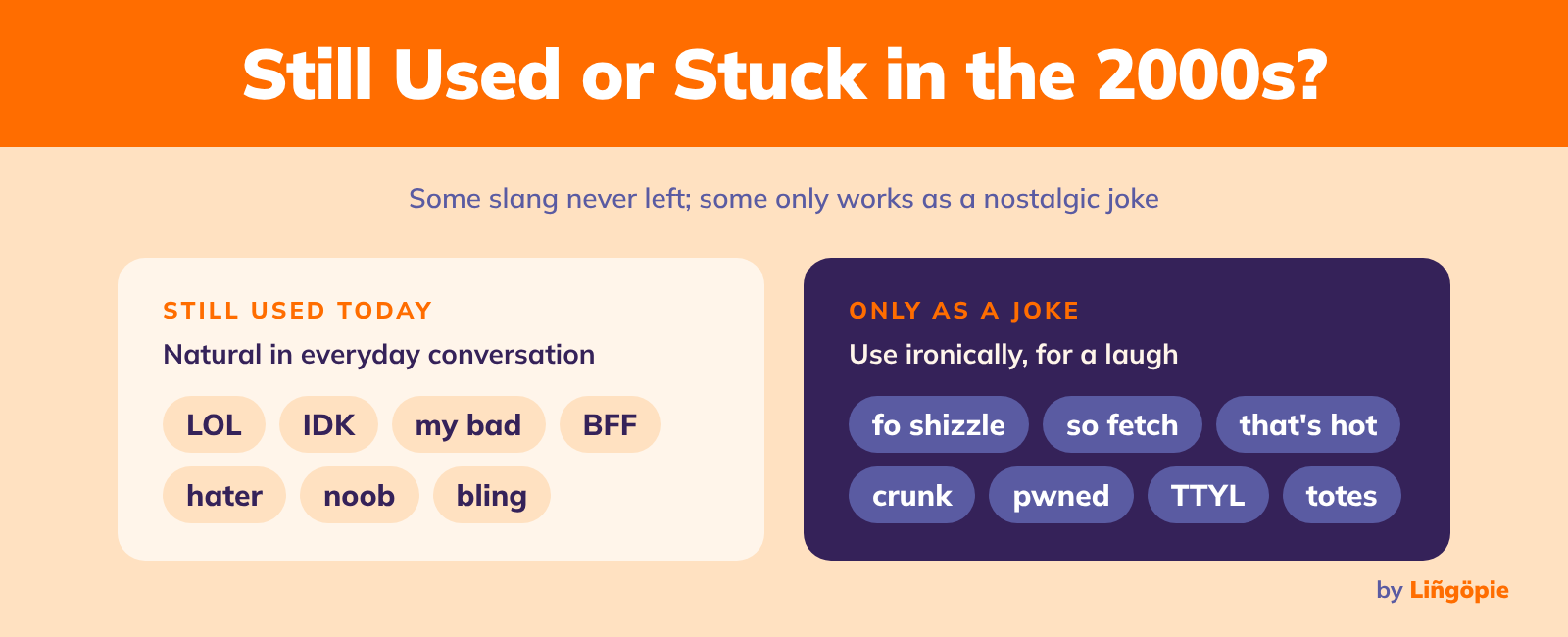
Some 2000s slang has become so common that people barely think of it as slang anymore. “LOL” and “IDK” are still useful shortcuts in text messages, while “my bad” remains a casual way to acknowledge a mistake. You might also hear someone call a constant critic a “hater” or refer to their closest friend as their “BFF.” These expressions still sound natural because people use them for the same reasons they did years ago.
Others have stuck around in more specific contexts. “Bling” still describes flashy jewellery, especially in fashion and hip-hop, while “emo” is used to describe a music style, fashion aesthetic, or emotional mood. Younger generations have also revisited 2000s fashion and music on TikTok, bringing these words back into conversations. Unlike phrases such as “fo shizzle” or “that's hot,” which are often used as nostalgic jokes, these seven expressions generally don't need an ironic tone to make sense today.
2000s Slang That Aged Badly
Not every slang word popular in the 2000s has aged well. During the decade, young people sometimes used expressions that mocked someone's appearance, intelligence, or identity, often without thinking much about their meaning or impact.
Language changes as society becomes more aware of stereotypes and how words affect others. What passed as a joke during that era might not be appropriate today, especially in workplaces or conversations with people you don't know well. When revisiting older slang, consider the context, your audience, and whether the expression still fits how people communicate today.
How English Learners Can Use 2000s Slang
Understanding 2000s slang can help English learners follow conversations in older movies, TV shows, and songs. For example, knowing that “sick” can describe something impressive or that “my bad” is a casual way to acknowledge a mistake makes it easier to understand what characters really mean.
However, recognising an expression is different from knowing when to use it. Before adding slang to your vocabulary, check its meaning, whether people still say it, and who typically uses it. Expressions like “LOL” and “IDK” work well in casual messages, while phrases like “fo shizzle” are better saved for a joke with close friends.
If you enjoy talking about movies and TV, Lingopie lets you learn English through shows and films with interactive subtitles that help you recognise unfamiliar expressions in real dialogue. This way, you can understand older slang without accidentally sounding like a character from 2004.
Give Lingopie a try now!
Frequently Asked Questions About 2000s Slang
What are the most popular 2000s slang words?
Some of the most popular 2000s slang words include “bling,” “crunk,” “fo shizzle,” “LOL,” “BFF,” “noob,” and “my bad.” Catchphrases like “so fetch” and “that's hot” also became widely recognised through teen movies and reality TV.
Where did 2000s slang come from?
2000s slang came largely from hip-hop and African American Vernacular English (AAVE), online chat rooms, texting, gaming communities, and pop culture. Music artists, celebrities, and popular TV shows helped spread these expressions, although many existed before the decade.
What does "crunk" mean?
“Crunk” describes a state of high energy, excitement, or enthusiasm, particularly at parties or concerts. The term became closely associated with Southern hip-hop in the early 2000s, especially through rapper and producer Lil Jon.
What does "fo shizzle" mean?
“Fo shizzle” means “for sure” and is used to express agreement or certainty. The phrase comes from African American Vernacular English (AAVE) wordplay and became widely recognised through rapper Snoop Dogg. Today, it's more commonly used as a nostalgic or humorous expression.
Is 2000s slang still used today?
Yes, many 2000s slang expressions are still used today, including “LOL,” “IDK,” “my bad,” “hater,” and “BFF.” Others, such as “so fetch” and “fo shizzle,” are more likely to appear in nostalgic jokes or references to 2000s pop culture.
Should English learners use 2000s slang?
Yes, English learners can use 2000s slang, but it's important to understand the meaning and context first. Common expressions like “my bad” and “IDK” sound natural in casual conversations, while outdated catchphrases are better recognised than regularly used.