

If you’ve ever promised yourself that this will be the year you finally learn Korean, only to end up watching Crash Landing on You for the third time, you’re not alone. The truth is, Korean dramas can be your secret language teacher. Every “ya” or “gomawo” you catch is more than entertainment; it’s a real piece of the language and culture sinking in naturally. The key is learning how to turn that fun screen time into something that actually builds your fluency.
In this post, I’ll show you exactly how to create Korean language immersion right from home. You’ll discover the best apps made for learning through K-dramas, and why Lingopie is a must if you want to turn every episode into a powerful and enjoyable language lesson.
- 12 Korean Myths And Legends Everyone Learning Korean Should Know
- Best Way To Learn Korean: A Guide For Beginners
- 15+ Korean Insults That Won’t Get You Slapped (Probably)

How To Do Korean Language Immersion At Home?
Immersion starts with one simple idea: replace your background noise with Korean. Watch, listen, and read as much authentic Korean media as you can. That means K-dramas, YouTube creators, podcasts, and music. No translations, no study drills—just real Korean in real contexts. The more you expose yourself, the faster your brain adapts to the sounds and patterns of the language.
K-dramas are the easiest entry point because they’re addictive and packed with natural dialogue. Focus on shows that use everyday speech, turn on Korean subtitles, and pause to repeat lines that stick. This way, you’re training your ear, your memory, and your speaking rhythm all at once—without feeling like you’re studying.
Best Korean Drama Apps For Language Immersion
Lingopie - Best For Language Learners
Lingopie is made specifically for language immersion through TV shows. It features interactive Korean subtitles, one-click translations, and personalized flashcards that let you review words and phrases directly from what you’ve just watched. You can adjust playback speed, repeat sentences, and track progress. Everything you see is designed to help you actually learn while enjoying the story.
Unlike other platforms, Lingopie doesn’t just play dramas—it turns them into an active learning experience. It’s built for language growth, which makes it the strongest option for learners who want fluency through consistent, contextual exposure.
| Pros | Cons |
|---|---|
| Interactive subtitles with instant translation | Requires subscription |
| Built-in flashcards for every word you click | Limited to supported content |
| Slowed playback and sentence repetition | — |
| Designed specifically for language learning | — |
Viki - Best For Quality Subtitles and Variety
Viki has one of the most extensive K-drama libraries online. It’s known for community-translated subtitles, often available in multiple languages, and dual subtitles that show English and Korean together. You’ll find every genre imaginable and exposure to a range of speech levels and accents.
However, Viki is mainly a streaming service, not a learning platform. You can’t save words, slow down dialogue, or create flashcards like you can with Lingopie. While it’s great for immersion and casual watching, it lacks the interactive tools that turn passive viewing into structured learning.
| Pros | Cons |
|---|---|
| Large library of K-dramas across genres | Mostly entertainment-focused |
| Dual subtitles (Korean + English) | No built-in flashcards |
| Great for hearing natural Korean | Less structured for learning |
| Community-translated subs add variety | No progress tracking |
iFlix - Best for Beginners and Regional Access
iFlix is a budget-friendly app that offers a solid range of Korean dramas, often with free access in certain regions. The platform is easy to navigate and works well for beginners who want to get used to listening to Korean sounds, sentence rhythm, and tone without committing to paid apps right away.
That said, iFlix doesn’t provide dual subtitles or any language-focused tools. It’s purely for watching. Compared to Lingopie, it feels limited—you’ll need to do all your own vocabulary tracking and note-taking. For serious learners, Lingopie’s built-in study tools make progress much easier to sustain.
| Pros | Cons |
|---|---|
| Free or low-cost access | Limited Korean catalog |
| Easy to use for beginners | No bilingual subtitles |
| Supports casual exposure | No interactive tools |
| Good regional availability | Not optimized for learners |
KOCOWA - Best For Authentic Korean Broadcast
KOCOWA specializes in authentic Korean content straight from major TV networks like SBS, KBS, and MBC. You’ll get dramas, talk shows, and reality programs that use real, unfiltered Korean as spoken on national television. It’s excellent for hearing formal and casual speech in natural contexts.
The downside is that KOCOWA focuses on entertainment, not education. Subtitles are often available only in English, and there are no interactive features for vocabulary review or repetition. Lingopie covers that gap by letting you study directly within the show, keeping immersion and learning tightly connected.
| Pros | Cons |
|---|---|
| Authentic Korean content from major networks | English-only subtitles |
| Frequent new releases | No playback or learning tools |
| Great for real speech and pronunciation | No vocabulary tracking |
| Reliable, official sources | Less control for learners |
Viu - Best for Fast Updates and Offline Viewing

Viu is known for speed. New Korean dramas appear on the platform shortly after they air in Korea, often with English subtitles. It also allows offline downloads, making it a convenient option for learners who want to watch anywhere and anytime.
Still, Viu is not optimized for learning. You can’t toggle subtitles, slow down dialogue, or highlight vocabulary. It’s great for staying current with new shows, but Lingopie’s interactive subtitles and built-in flashcards make it far more effective for anyone serious about comprehension and retention.
| Pros | Cons |
|---|---|
| Fast uploads of new dramas | Limited subtitle options |
| Offline downloads available | No flashcards or review features |
| Great for staying current | Not tailored for language learning |
| Clean mobile experience | Lacks interactivity |
Netflix - Best For High-Quality Originals
Netflix has invested heavily in Korean originals, offering sleek, high-production dramas like The Glory and Crash Landing on You. It’s a great source for hearing modern Korean, and its subtitle and playback speed options can help with listening practice.
Just note that Netflix wasn’t made for language learning. You can’t interact with subtitles or save new vocabulary easily. Some learners use browser extensions to add features that Lingopie already includes by default. If you’re watching to actually learn, Lingopie delivers a far smoother and more complete immersion experience.
| Pros | Cons |
|---|---|
| High-quality Korean originals | No built-in learning tools |
| Dual subtitle support | Limited Korean catalog regionally |
| Adjustable playback speed | No flashcard or translation features |
| Great for modern, natural Korean | Requires extensions for study features |
How To Get The Most Out Of Korean Drama Apps
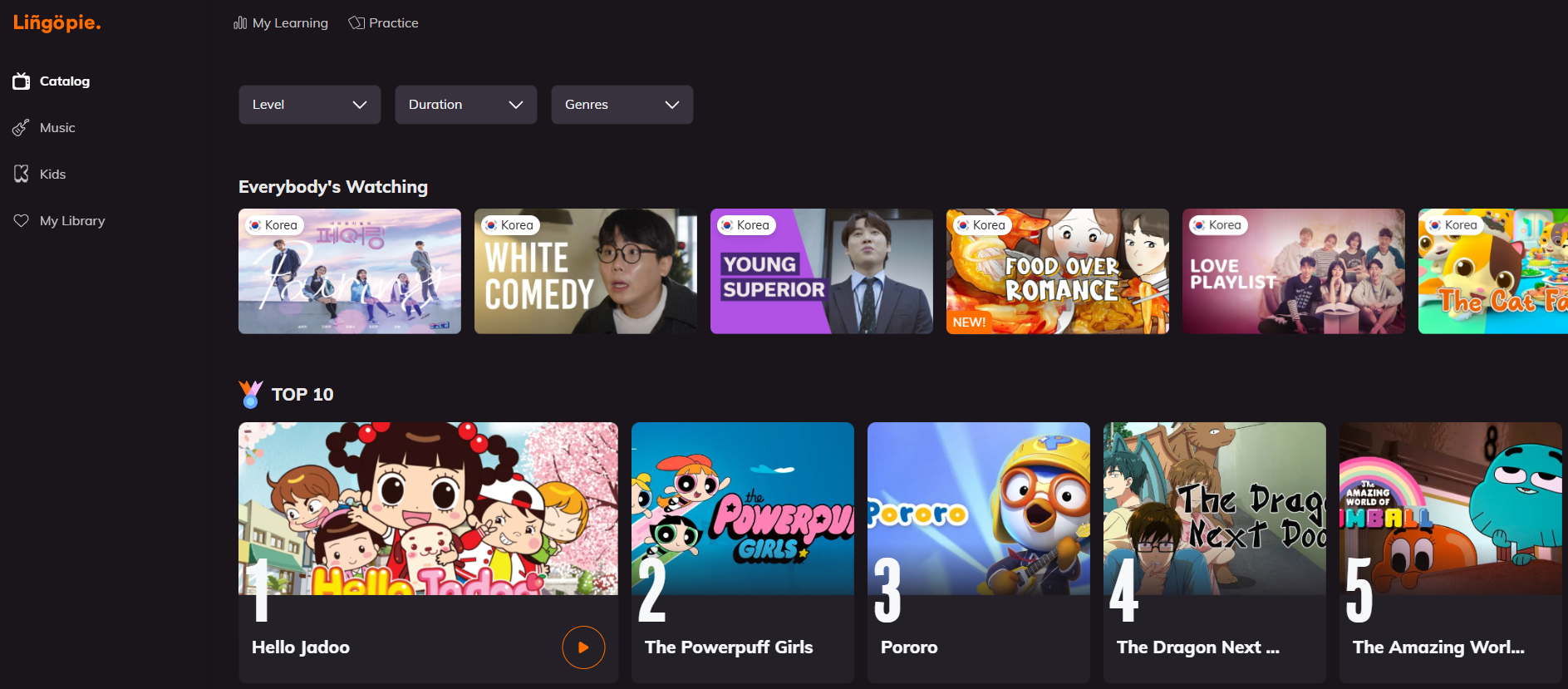
Downloading the right app is only the first step. The real progress comes from how you watch. Start by choosing dramas that match your current level—slice-of-life or romance shows are best for beginners since the language is more conversational. Turn on Korean subtitles so you can read and hear words at the same time. Pause often, repeat lines aloud, and note common phrases you hear across episodes.
If you’re using Lingopie, take advantage of its interactive tools. Click words you don’t know, review your saved flashcards regularly, and replay scenes until the phrases sound natural. Try to shadow (repeat aloud) short lines with the same tone and rhythm as the actors. This builds listening comprehension, pronunciation, and natural flow faster than textbook study ever could.
Tips to Stay Consistent with Immersion
Consistency is what turns casual watchers into real learners. Immersion only works when it’s part of your everyday rhythm, not something you do once in a while. Watch with focus, listen closely, and revisit scenes until the dialogue feels second nature.
Over time, your ear sharpens, your vocabulary grows, and Korean stops sounding foreign—it starts to feel like a language you actually understand. Here’s how to stay consistent:
- Watch a little Korean content every day, even 15 minutes.
- Rewatch favorite scenes to reinforce phrases and pronunciation.
- Use Korean subtitles to train your reading and listening together.
- Repeat lines out loud to build speaking rhythm and confidence.
- Review saved words or flashcards right after each session.
- Keep your goals realistic—consistency beats intensity every time.
Try Lingopie Now
If your goal is to actually understand what you hear in Korean dramas, start with Lingopie. It’s the only app built specifically for language learning through real shows. You can watch, click words for instant meaning, and review them later with built-in flashcards. Every feature exists to help you learn faster while enjoying authentic Korean content.
With Lingopie, you’re not just watching—you’re training your ear, memory, and pronunciation at the same time. It’s the most efficient way to turn everyday screen time into real Korean fluency. Try it now!

![6 Best German Translator Apps For Beginners [TESTED]](/blog/content/images/2026/01/Best-german-translation-apps-for-beginners-.jpeg)




![7 Best Apps To Learn German On Your Own [REVIEWED]](/blog/content/images/size/w300/2026/01/best-apps-to-learn-german-on-your-own.png)
