
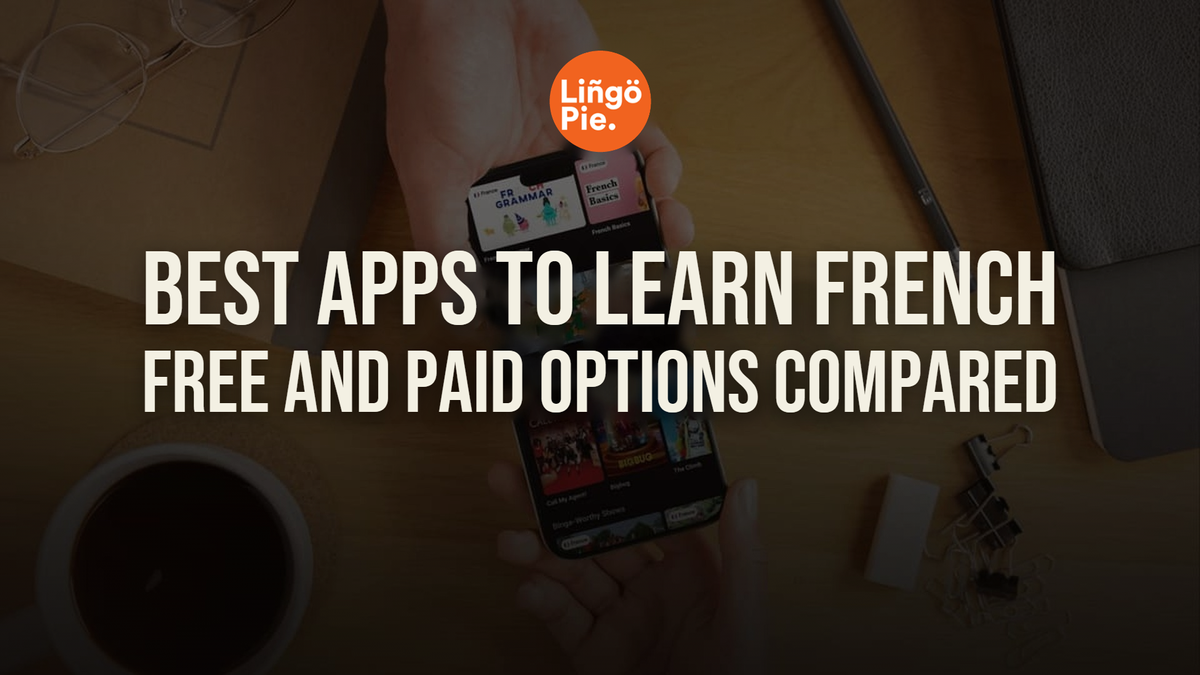
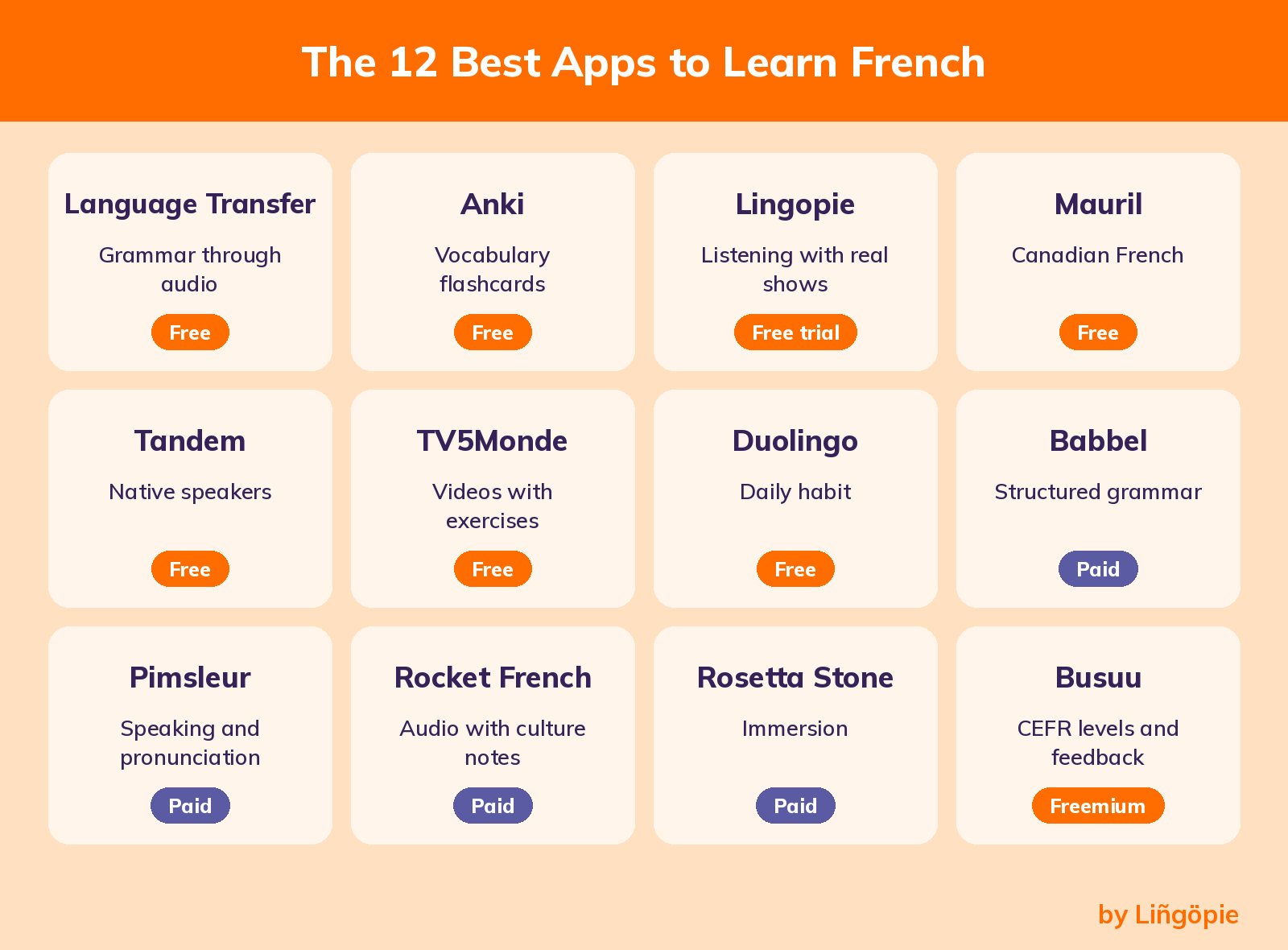
The best apps to learn French are Language Transfer for grammar through audio lessons, Anki for vocabulary, TV5Monde for authentic videos with exercises, Duolingo for a daily habit, and Tandem for practicing with native speakers. If you're open to paying, Babbel, Pimsleur and Busuu offer more structured courses. Most learners get the best results by combining two or three apps.
Learning French doesn't have to drain your wallet. Several strong tools are free, and many paid apps offer a trial so you can test them first. Below, you'll find the 12 best apps to learn French, free and paid, with the strengths and limits of each, so you can find the right fit for your goals.
- 13 Must-Know French Traditions For Your Next Trip
- 11+ Funny French Expressions That’ll Surprise You
- Best Way to Learn French on Your Own [Guide]
Comparison of the Best Apps to Learn French
This table compares the apps on price, speaking practice and offline learning. If you're not sure where to begin, look at the "Best for" column first. Free versions often have limits, and prices vary by country, so check each official site for current details.
App | Price | Best for | Speaking practice | Offline |
|---|---|---|---|---|
Language Transfer | Free | Grammar through audio | Yes (no feedback) | Yes |
Anki | Free (iOS app paid) | Vocabulary | No | Yes |
Lingopie | Free trial, then paid | Listening with real shows | AI pronunciation coach | No |
Mauril | Free | Canadian French listening | No | No |
Tandem | Free, with a paid plan | Conversation with native speakers | Yes | No |
TV5Monde | Free | Authentic videos with exercises (A1–B2) | Limited | Partial |
Duolingo | Free, with paid plans | A daily habit for beginners | Limited | Paid plan only |
Babbel | Paid | Structured lessons and grammar | Yes (speech recognition) | Yes |
Pimsleur | Paid | Speaking and pronunciation | Yes (strong) | Yes |
Rocket French | Paid | Audio lessons with grammar and culture | Yes (voice recognition) | Yes |
Rosetta Stone | Paid | Immersion without translation | Yes (speech recognition) | Yes |
Busuu | Free version, then paid | Lessons by CEFR level | Yes (feedback from native speakers) | Paid plan only |
"Speaking practice" means the app has you speak in some way. Only some apps check or correct what you say, so read that column with care.
How We Chose the Best Apps to Learn French
We looked at the same points for every app:
- Cost, and what the free version includes
- Skills covered: listening, speaking, reading and writing
- Speaking practice and feedback, such as speech recognition or real conversations
- Grammar explanations and a structured learning path
- Authentic French, such as real videos and native speakers
- Offline learning and the levels covered, from complete beginners to advanced learners
Our picks are based on each app's features, checked on its official site, and our team's experience learning French. We did not rank apps by price alone, and we kept the cons honest, because every app has limits. Prices aren't listed because they change often.
We describe what each app does rather than what it promises. Where a feature depends on your plan or country, we say so. A free app can be a better choice than a paid one if it fits your goal.
Why Use Apps to Learn French
Language apps make it easy to fit French into your daily routine. A few minutes on your commute or during a break add up, and apps are great for building vocabulary, practicing pronunciation and staying consistent.
That said, apps work best as a supplement. If you're aiming for fluency or an official test, combine them with classes or tutoring. And use French outside the app too: listen to a French podcast, read a short news story or name objects around your home in French. These small moments help words stay in your memory.
The best results come from a routine. Pick a time each day, keep sessions short and track what you learn. A small habit you keep is worth more than a big plan you drop after a week.
7 Best Free Apps to Learn French
These seven apps are free or have a free version (Lingopie is a free trial, labeled clearly below). Language Transfer and Anki build the base, Mauril and TV5Monde train your ear, Tandem gets you talking, Duolingo keeps you steady and Lingopie gives you real shows. You don't need all seven.
Best Apps To Learn French
Language Transfer

Best for: understanding French grammar through audio lessons.
Language Transfer is a free audio course created by Mihalis Eleftheriou. It teaches French grammar through what he calls "The Thinking Method." Instead of memorizing rules, you work out patterns by reasoning, using what you already know from English. Each lesson is a recording of a real teaching session: the teacher guides a student, and you answer along with them. There is no subscription, no free trial and no paywall. The course is long, so go at your own pace.
Many learners do one or two lessons a day and repeat a lesson when something feels shaky. Because you answer aloud, use it somewhere you can speak freely. It's a strong first step before you move to apps with more written practice.
| Pros | Cons |
|---|---|
| Completely free – No hidden costs, trials, or premium features | Audio-only format – No visual materials, PDFs, or downloadable references to support learning |
| High-quality audio production – Clear, professional recordings that are easy to follow | No speaking or writing practice – Focuses only on listening comprehension and mental processing |
| Efficient, no-filler content – Every minute is dedicated to actual language instruction without gamification fluff | Limited real-world application – Lacks cultural context and authentic conversation examples |
| Logical teaching method – Helps you understand the "why" behind grammar rules rather than just memorizing | Not a complete solution – Works best as a foundation tool rather than standalone language course |
| Offline accessibility – Download lessons to learn without internet connection | Visual learners may struggle – No charts, written examples, or visual reinforcement of concepts |
Anki

Anki is an open-source flashcard app that uses spaced repetition to help you remember French vocabulary and phrases. The idea comes from Hermann Ebbinghaus's 19th-century research on the forgetting curve. Anki decides when you should review each card, so you spend less time studying and keep more words.
Anki is free on desktop, Android and the web; the official iOS app, AnkiMobile, is a one-time purchase. Many learners love Anki, but you need time to build good cards. If you're a complete beginner, start with a shared deck of basic vocabulary, then add your own words. Add five to ten new cards a day, review at the same time each day, and use full phrases instead of single words when you can.
Pros | Cons |
|---|---|
Free on most platforms, and open source | iOS app is paid: AnkiMobile is a one-time purchase |
Spaced repetition: reviews are timed to help you remember | Slow setup: good cards take time to create |
Highly customizable: add audio, images and formatting | Reviews pile up: daily reviews can feel like a chore |
Offline use once your cards are downloaded | No context: single cards don't show how words work in conversation |
Shared decks: thousands of user-made French decks | Steep learning curve: the interface can feel confusing |
Syncs across desktop, mobile and web | Easy to over-build: it's tempting to make cards instead of learning |
Lingopie (Free Trial)
Best for: listening to real French with TV shows and movies.
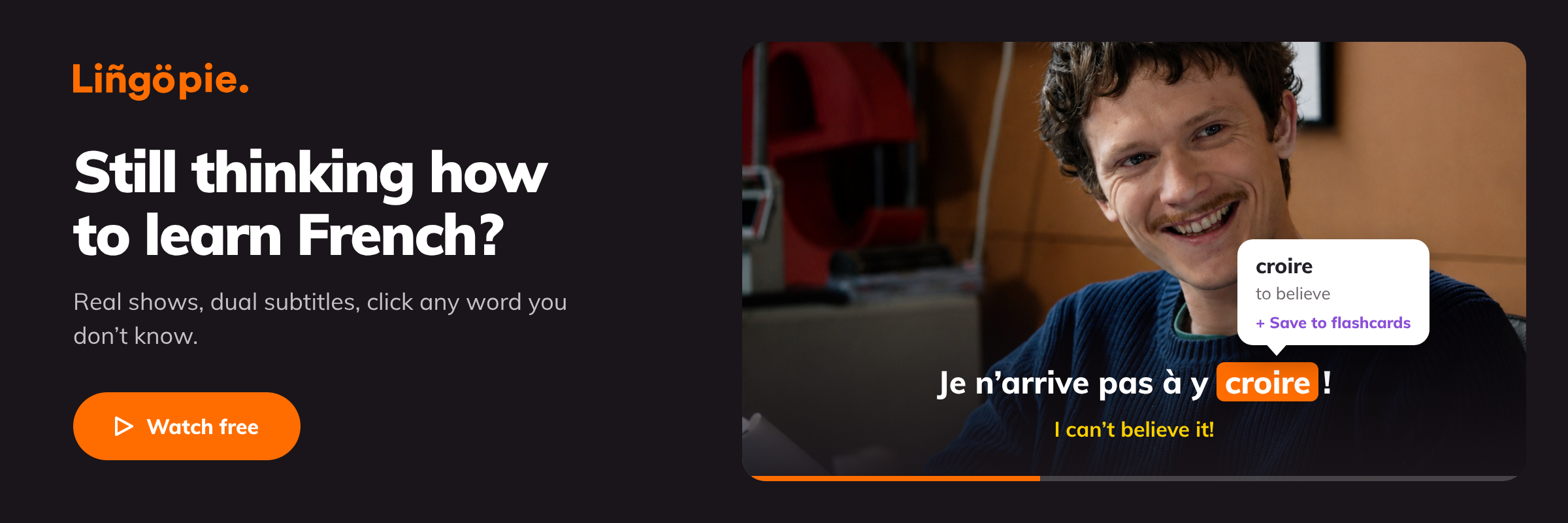
Lingopie teaches French through TV shows, movies and documentaries. Instead of drills, you hear French the way people really speak it. Interactive subtitles let you click any word to see a translation and hear it pronounced, then save it as a flashcard.An AI pronunciation coach lets you record yourself repeating a line and compare it with the native audio.Clicking for translations has research behind it: in a study of 227 learners, captions with word translations more than doubled word-meaning recall compared with standard captions (Montero Perez, Peters & Desmet, 2018).
Lingopie is a free trial, not a free app, and it's our own app, so keep that in mind as you read this review. Start with shows you already like and dual subtitles, watch one episode in short parts, and review saved words the next day. It fits best if you already know a little French.
This is the app to pick if reading about French feels dull and you'd rather hear it in context, with humor, social cues and cultural references you won't find in a textbook.
Pros | Cons |
|---|---|
Authentic content: real French shows, movies and documentaries | Paid after the trial: full access needs a subscription |
Interactive subtitles: click any word for a translation and pronunciation | No structured grammar curriculum: you learn by watching |
Cultural context: pick up humor, social cues and references naturally | Hard for absolute beginners: native speech can feel fast |
Flexible subtitles: switch between French, English and dual subtitles | Needs internet: streaming requires a reliable connection |
Vocabulary saving and an AI pronunciation coach | |
Progress tracking across shows and difficulty levels |
Mauril

Best for: Canadian French and Quebec listening practice.
Mauril is a free app from CBC/Radio-Canada. It teaches French with real video clips from Canadian TV shows and news, with a focus on Canadian French, including the Quebec accent and expressions. That makes it a good pick if you plan to live, work or study in Quebec or elsewhere in Canada. Mauril is made for people in Canada, so check that it's available in your country's app store. If you'll mostly speak with people in France, pair it with an app that covers European French too.
The accent and some words in Canadian French differ from French in France, and Mauril helps you hear those differences early, along with Canadian culture and current events.
Pros | Cons |
|---|---|
Authentic Canadian content: real CBC and Radio-Canada shows and news | Limited availability: check that it's offered in your country |
Quebec French: hear the accent and expressions used in Canada | Not for beginners: it assumes some French |
Comprehension exercises after each video | Narrow scope: listening, not full grammar or vocabulary |
Completely free: no subscription, trial or premium tier | Needs other tools: works best next to other resources |
Cultural insight into Canadian life and current events | |
Listening practice with natural speech |
Tandem

Best for: practicing conversation with native speakers.
Tandem is a language exchange app that connects you with native French speakers around the world: you help someone learn your language, and they help you learn French. You can text, send voice messages or make video calls, and built-in tools let partners correct each other's mistakes in the chat. Be polite but direct about your goals, so both of you get value from each session.
Finding a committed partner can take time. Agree to speak half the time in French and half in English, ask for corrections and note new words. If a partner doesn't fit, move on. As on any social platform, keep personal details private until you know the person.
Pros | Cons |
|---|---|
Real conversations with French speakers | Mixed partner quality: some prefer chatting to structured practice |
Cultural exchange: slang, regional expressions and habits | Inconsistent commitment: some conversations fade quickly |
Correction tools: partners fix your mistakes in the chat | No curriculum: there are no formal lessons |
Several formats: text, voice messages or video calls | Time zones: scheduling with global partners can be hard |
Free basic version: core features need no subscription | Not for beginners: you need some French to start |
Speakers from France, Quebec and other French-speaking places | Uneven teaching skill: partners aren't trained teachers |
TV5Monde

Best for: authentic videos with exercises, from A1 to B2.
TV5Monde offers a free way to learn French with videos from a major francophone TV network: news reports, music videos, film clips and documentaries from French-speaking places around the world. It's designed for learners from beginner (A1) toupper-intermediate (B2). Each video comes with French subtitles and exercises, such as multiple-choice questions, crosswords and fill-in-the-blank activities.
Watch a video at your level once without the exercises, then again with subtitles while you do the activities. Because content comes from many regions, it also trains your ear for different accents.
This two-step routine helps you catch details you missed the first time, and it's a good way to prepare for travel in different French-speaking regions.
Pros | Cons |
|---|---|
Free: no trials or subscriptions | Limited to B2: not suited to advanced learners |
Authentic content from across the French-speaking world | Hard for true beginners: real TV can feel fast at A1 |
Exercise variety: quizzes, crosswords and fill-in-the-blank | Navigation: some users find the layout unclear |
Subtitles and transcripts to follow along | Limited speaking practice: listening and reading focus |
TCF practice: helps you prepare for the official test | Uneven video quality: older clips can look dated |
Many accents: hear French from different regions |
Duolingo

Best for: building a daily habit as a beginner.
Duolingo is probably the best-known language app. It turns learning into a game, with streaks, leaderboards and its famous green owl, and its short lessons follow a clear path from beginner to intermediate. It teaches grammar mostly through practice and short tips, so pair it with a tool that explains grammar in depth, such as Language Transfer.
Treat Duolingo as a warm-up, not the whole course. It's a good way to build a daily habit: ten minutes a day keeps French in your mind, and the streak system helps when motivation drops. When you finish a unit, say new sentences aloud or write your own versions, so you move beyond recognizing answers.
Pros | Cons |
|---|---|
Motivating: streaks, achievements and social features | Limited real-world context: sentences can feel artificial |
Structured path from beginner to intermediate | Repetitive format: exercises can get dull over time |
Free core content, with a paid plan for extras | Translation-heavy: relies on English-to-French translation |
Short lessons: 5 to 15 minutes fit a busy day | Limited speaking practice: pronunciation exercises are basic |
Several skills: reading, writing, listening and some speaking | Sentence-level focus: little practice with longer conversations |
Offline learning on paid plans | Recognition over production: you often pick answers |
Paid Apps Worth Considering
Paid apps often add structure, speech recognition and feedback. Many offer a free trial or a free lesson, so you can test them first. Paying helps most when you want a set path, feedback on your speaking or a reason to stay consistent. If you already have a habit and a clear plan, free apps may be enough, or you can start free and add one paid app later, once you know what's missing. Prices change and vary by country, so check each official site for current plans.
Babbel
Best for: structured lessons with clear grammar explanations.
Babbel is a subscription app built around short, structured lessons. Courses start with practical dialogues, such as ordering food or asking for directions, and build step by step, with grammar explanations, review sessions and speech recognition that checks your pronunciation. It works well if you like clear steps and want to know why a sentence is built the way it is. Check Babbel's site for current trial options.
The lessons are written by language experts, and because each one is short, Babbel is easy to fit into a lunch break or a commute.
Pros | Cons |
|---|---|
Clear grammar explanations inside each lesson | Paid: full access needs a subscription |
Speech recognition checks your pronunciation | Limited authentic content: dialogues are written for learners |
Review sessions help you remember | No live practice with native speakers |
Practical focus on real-life situations | Fixed course path: less room for your own interests |
Pimsleur
Best for: speaking and pronunciation through audio lessons.
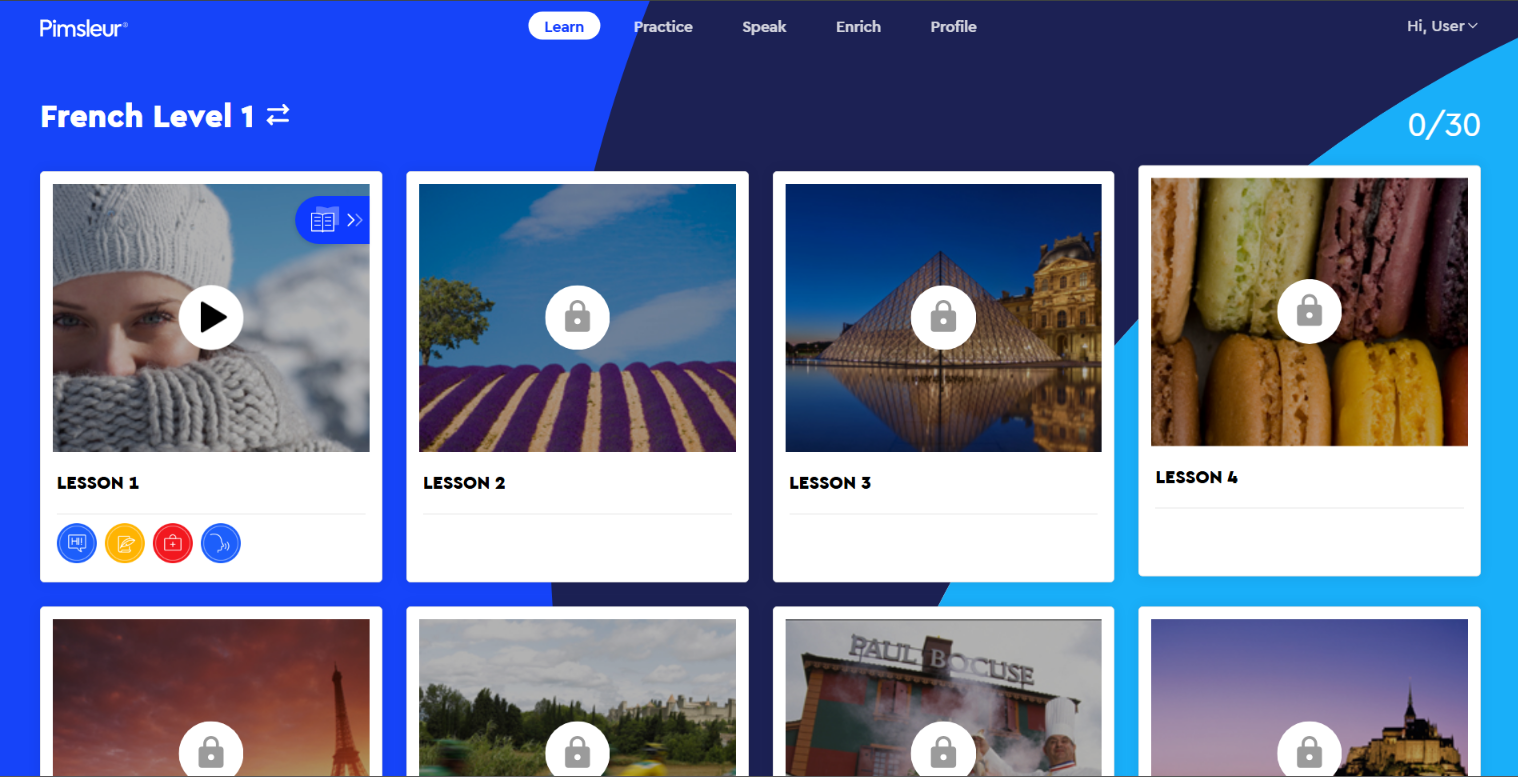
Pimsleur teaches French through audio lessons of about 30 minutes each, built on spaced recall: you hear a phrase, repeat it aloud and are asked to remember it later in the same lesson and in future ones. It's strong for speaking and pronunciation, and easy to use while you walk, drive or cook. Pair it with a reading app if you also want to learn spelling.
It suits people who want to speak early and who learn well by ear. Because there's little on screen, you can use it with your eyes on the road or on your chores. Check the site for current trial options.
Pros | Cons |
|---|---|
Strong speaking practice in every lesson | Paid: full access needs a subscription |
Spaced recall: phrases come back at set intervals | Little reading and writing |
Hands-free learning on a commute or a walk | Limited grammar detail: rules are learned through use |
Good for pronunciation: you copy native speakers closely | Slow vocabulary growth |
Rocket French
Best for: audio lessons with grammar and culture notes.
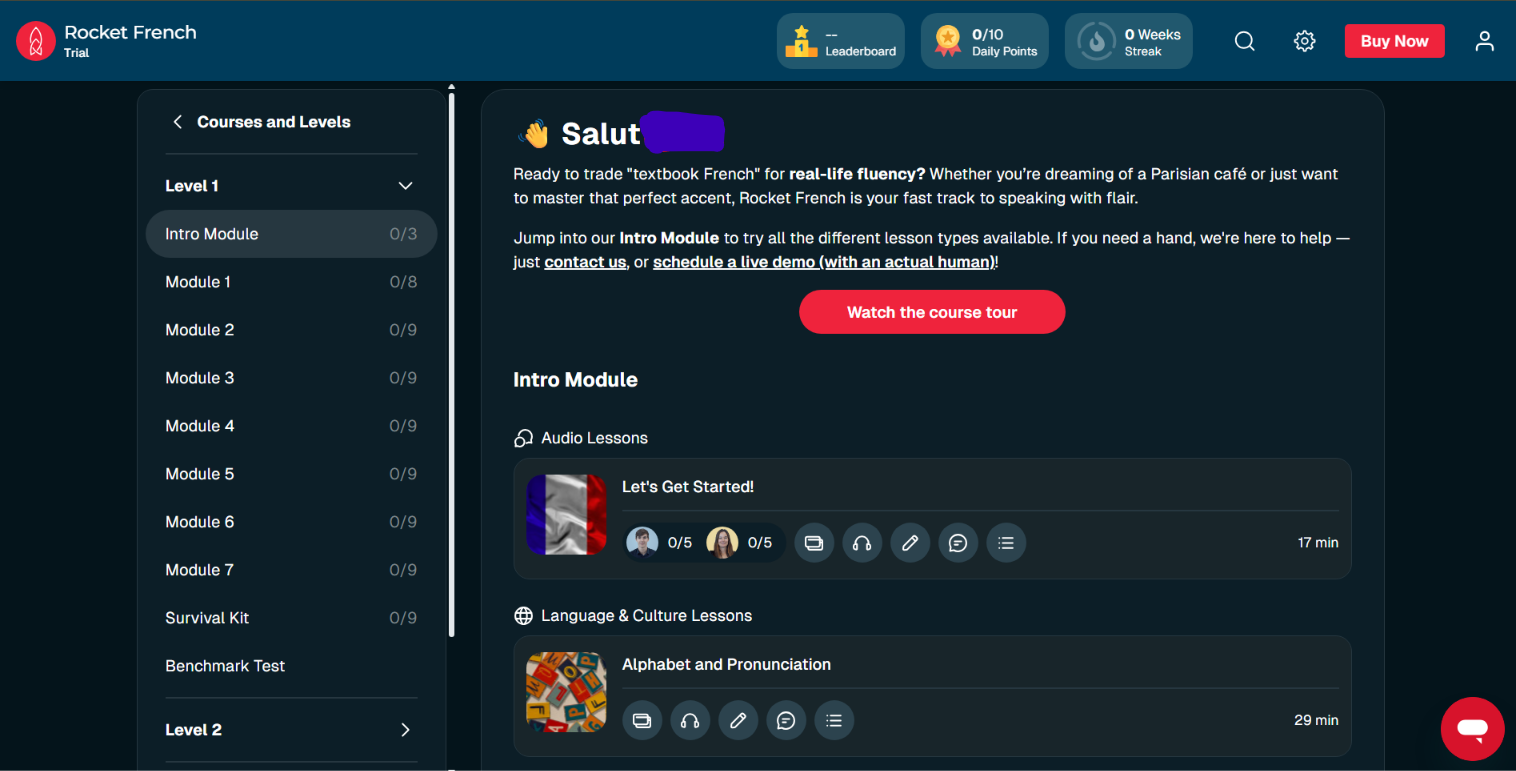
Rocket French combines interactive audio lessons with grammar and culture lessons. Each audio lesson follows a short dialogue and explains the key phrases step by step, followed by review activities, and voice recognition shows how close your speech is to the model. It suits self-study learners who want a clear course rather than a game.
The mix of audio, grammar and culture notes gives you a fuller picture than audio alone, and you work through lessons in order. Check the site for what's included in each plan.
Pros | Cons |
|---|---|
Audio plus grammar and culture notes | Paid: full access needs payment |
Voice recognition helps you practice speaking | Dated design: less polished than newer apps |
Clear steps: dialogues are explained slowly | Less authentic content: dialogues are made for learners |
Review activities for self-study | Fixed structure: little room for your own interests |
Rosetta Stone
Best for: learning through immersion without translation.
Rosetta Stone teaches French through immersion: you see images, hear French and match them, with no English translation. Speech recognition gives instant feedback on your pronunciation. The approach feels natural but explains little grammar, so many learners pair it with a grammar tool such as Language Transfer.
It works best for learners who like to guess meaning from context. If you get stuck, a short grammar guide fills the gaps. Check the current plans on the site, since options change often.
Pros | Cons |
|---|---|
Immersion: you think in French from the first lesson | Few grammar explanations |
Speech recognition with instant feedback | Paid: full access needs a subscription |
No translation: builds direct links between words and meaning | Can feel confusing for beginners |
Mobile-friendly short lessons | No live conversation partners |
Busuu
Best for: courses by CEFR level with feedback from native speakers.
Busuu offers French courses aligned with CEFR levels, so you can track your progress from beginner upward. Its best feature is community feedback: native speakers correct your writing and speaking exercises. It's a good middle ground if you want a course with levels and some human contact without booking a tutor. Busuu has a free version, and a paid plan unlocks more features.
Writing short texts and getting corrections from real speakers is a useful way to practice between lessons, and the CEFR levels make it easy to see what to study next.
Pros | Cons |
|---|---|
CEFR-aligned courses with clear levels and goals | Free version is limited |
Feedback from native speakers | Feedback takes time: replies aren't instant |
Free version available | Less depth at higher levels |
Structured path: easy to follow week by week | Repetitive exercises |
How to Choose the Right French Learning App
The best French learning app depends on your goal. Use this guide to match your needs to the right tools.
- Complete beginners: Start with a structured app such as Duolingo or Babbel for a clear path and practical vocabulary from day one. Add Language Transfer to understand how French grammar works.
- Speaking skills: Tandem gives you real conversations with native speakers. For pronunciation, try Pimsleur or an app with speech recognition, such as Babbel or Rosetta Stone.
- Listening and real-life French: Lingopie, TV5Monde and Mauril use real videos. Mauril is best for Canadian French, TV5Monde covers the whole French-speaking world, and Lingopie lets you watch shows and movies with subtitles and save new words.
- Vocabulary: Anki helps you review words until they stick. Use it to reinforce vocabulary from the shows or lessons you already follow.
- Exams (DELF, TCF): Use TV5Monde's TCF practice, and add a tutor who can give you feedback on speaking and writing.
Be honest about your time. With 15 minutes a day, one app and one habit are enough. With an hour, you can mix an audio lesson, a short video and a few flashcards. A good starting combination uses three types of apps:
- One structured app for a steady path, such as Duolingo or Babbel
- One input app for listening and reading, such as Lingopie or TV5Monde
- One speaking app for real practice, such as Tandem or Pimsleur
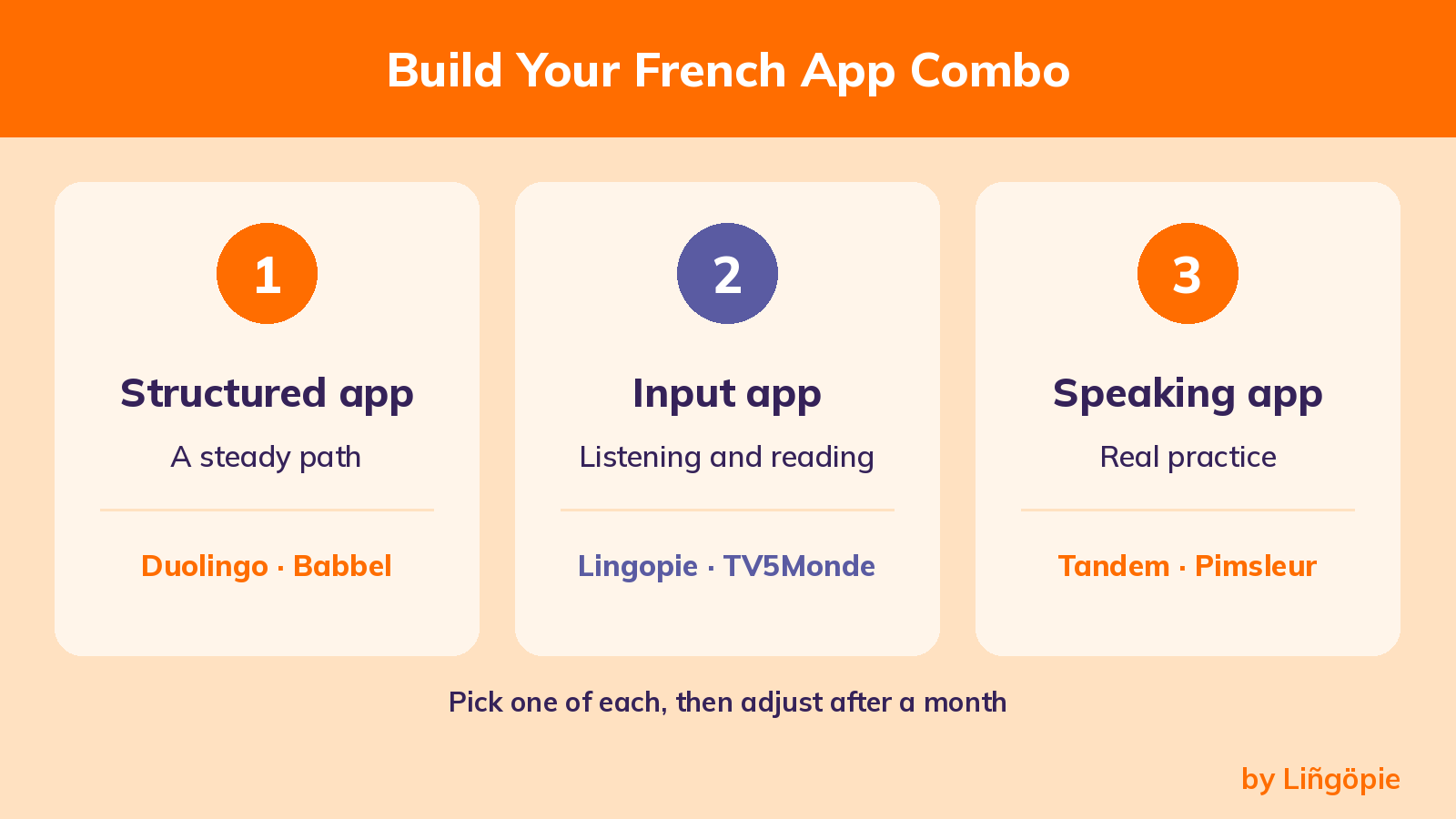
Here's an example week: a Duolingo or Babbel lesson each morning, one episode with subtitles on three evenings and one Tandem chat at the weekend, with five minutes of Anki on busy days. Change the mix after a month if something feels too easy or too hard.
Different learning preferences fit different apps. Some people like to study rules first, while others prefer to listen and pick up patterns. Try one or two apps for a week and keep the ones you enjoy. If you're learning for a trip, focus on speaking and listening first. And remember that app availability and prices vary by country, so check each app's site before you subscribe.
FAQ
What's the best app to learn French for complete beginners?
Duolingo and Babbel are good starting points because they give you a clear path and short lessons. Add Language Transfer to understand how French grammar works. Together, they cover structure, vocabulary and grammar logic without a big upfront cost.
Can you learn French with free apps alone?
You can reach a solid basic level with free apps. Language Transfer, Anki, TV5Monde and Tandem cover grammar, vocabulary, listening and speaking. But apps rarely replace classes or a tutor, so if you want to pass an exam like the DELF or TCF, add a teacher for feedback.
Which app is best for French pronunciation?
Pimsleur is strong for pronunciation because you repeat everything aloud. Babbel and Rosetta Stone use speech recognition to check how you sound. For feedback from a real person, try Tandem, where native speakers can correct you. Language Transfer gets you speaking but doesn't check your accent.
Which app is best for learning French grammar?
Language Transfer explains French grammar through reasoning, and it's free. Babbel gives clear grammar explanations inside structured lessons, while Duolingo teaches grammar through practice and short tips. If grammar is your main goal, start with one of these and add a grammar book later.
Can you learn French offline?
Yes. Language Transfer lets you download lessons, and Anki works offline once your cards are synced. Babbel, Pimsleur and Rosetta Stone also offer downloads, while Duolingo's offline mode needs a paid plan. Check each app's current features before you rely on them.
How long does it take to learn French with apps?
It depends on your goal and study time. The U.S. Foreign Service Institute estimates that English speakers needabout 30 weeks (750 class hours) of full-time studyto reach professional working proficiency in French. Apps can cover part of that time, especially for vocabulary and listening.
Final Thoughts
Many good apps teach French, and no single app does everything. The best one is the one that fits your goal and that you'll open every day. Use the "How to Choose" section above to build a simple mix of a structured app, an input app and a speaking app. Start small, stay consistent and adjust as you go. If one app stops working for you, switch without guilt: your goal is French, not a perfect app.
French rewards regular contact, even in small doses, and the right app is the one that keeps you coming back.
If you want to hear real French while you learn, Lingopie is our option. More than 2 million learners use it, and it'srated 4.6/5 on Trustpilot from 3,878 reviews (November 2026). You can watch French shows with dual subtitles, click any word for a translation and save it as a flashcard. Start your free trial and see how it fits your routine.
Want to keep learning? Read our guides to French greetings: 40+ ways to say hello and goodbye and how to pronounce Paris in French.