

Ever noticed how many Japanese words in English you already know? Sushi, karaoke, anime, and emoji are just a few examples. But the borrowing goes both ways! Japanese people also use plenty of English-inspired words, like konbini (コンビニ, convenience store) and sumaho (スマホ, smartphone). Some even take on completely different meanings, which is where Japanglish gets interesting.
Of course, knowing a few loanwords is just the beginning. If you want to start speaking Japanese, learning basic Japanese words and phrases like ohayō gozaimasu (good morning), arigatō gozaimasu (thank you), and hai (yes) is a great next step. In this article, we'll cover familiar loanwords, surprising Japanglish expressions, and everyday Japanese greetings you can actually use.
Key Takeaways
- Gairaigo (外来語) are words borrowed from foreign languages and adapted to Japanese pronunciation, such as konpyūtā (computer) and terebi (television).
- Wasei-eigo (和製英語) refers to Japanese-made English expressions that have different meanings or aren't commonly used in English, such as konsento (power outlet).
- Japanese words used in English include familiar terms like sushi, karaoke, emoji, and tsunami.
- Basic Japanese words and phrases like konnichiwa (hello), arigatō gozaimasu (thank you), and hai (yes) are useful for everyday conversations.

Why Japanese Uses So Many Loanwords
Did you know that a large part of Japanese vocabulary actually comes from other languages? According to Nippon.com, roughly 33% of Japanese vocabulary is native Japanese (wago), 49% is of Chinese origin (kango), and 18% consists of loanwords from other languages, including mixed-origin words and wasei-eigo.
- 100 Common Japanese Last Names And Their Meanings
- 70+ Japanese Anime Phrases Every Fan Heard At Least Once
- How To Say Yes In Japanese: 5+ Easy Ways For Beginners
A Long History of Borrowing
Japanese has been borrowing words for centuries. Chinese had an early influence on the language, followed by Portuguese in the 1500s, which introduced words like pan (bread) and tabako (tobacco). Dutch later contributed vocabulary related to trade, science, and medicine.
During Japan's modernization in the late 1800s, more words arrived through German, French, and English. English borrowing became especially prominent after World War II as American media, technology, and consumer culture spread.
An Open, Adaptive Mindset
Japanese doesn't always need to invent a completely new word for something unfamiliar. Sometimes, borrowing an existing term is simply more convenient. Take terebi (television) and pasokon (personal computer): both are adapted from English, but they've become ordinary Japanese words.Borrowed words also give products and ads a modern, international feel.
A Writing System Built for It
Katakana gives Japanese a consistent way to write borrowed words, adapted to Japanese sounds instead of the original spelling.That's why an English word might look or sound a little different in Japanese. Japanese uses three main scripts, plus romaji:
- Kanji (漢字): Characters of Chinese origin used for many nouns and the stems of verbs and adjectives.
- Hiragana (ひらがな): Used for grammatical endings and many native Japanese words.
- Katakana (カタカナ): Commonly used for foreign loanwords, such as コーヒー (kōhī, coffee).
- Romaji: Japanese written in Latin letters, making unfamiliar words easier for beginners to read.
Hiragana and katakana are collectively called kana. While most modern loanwords appear in katakana, some older borrowings have kanji spellings, such as 珈琲 for coffee.
Gairaigo (外来語): Traditional Loanwords
Gairaigo (外来語) are foreign words adapted to Japanese pronunciation and writing. The term itself explains the concept: gai (外) means "outside" or "foreign," rai (来) means "to come," and go (語) means "language" or "word." Most modern gairaigo are written in katakana, and their meanings may change slightly in Japanese.
English Word | Japanese Gairaigo | Japanese Writing | Notes on Usage |
|---|---|---|---|
Smartphone | Sumaho | スマホ | Shortened from "smartphone" |
Internet | Intānetto | インターネット | Often shortened to netto |
Game | Gēmu | ゲーム | Video games and games in general |
Computer | Konpyūtā | コンピューター | Pasokon is the everyday word for a PC |
Coffee | Kōhī | コーヒー | Common everyday word |
Chocolate | Chokorēto | チョコレート | Often shortened to choko |
Ice cream | Aisukurīmu | アイスクリーム | Often shortened to aisu |
Cake | Kēki | ケーキ | Common dessert |
T-shirt | Tī-shatsu | Tシャツ | Common clothing term |
Jeans | Jīnzu | ジーンズ | Standard clothing term |
Part-time job | Arubaito | アルバイト | From German Arbeit (work) |
Television | Terebi | テレビ | Shortened from "television" |
Party | Pātī | パーティー | Social gathering |
Ticket | Chiketto | チケット | Admission tickets |
Hotel | Hoteru | ホテル | Accommodation |
Table | Tēburu | テーブル | From English "table" |
Wasei-Eigo (和製英語): Japanese-Made English
While gairaigo broadly refers to foreign-derived vocabulary, wasei-eigo (和製英語) is a more specific term for English-based expressions created or given new meanings in Japan. For example, manshon sounds like "mansion" but refers to an apartment building, while konsento means a power outlet.
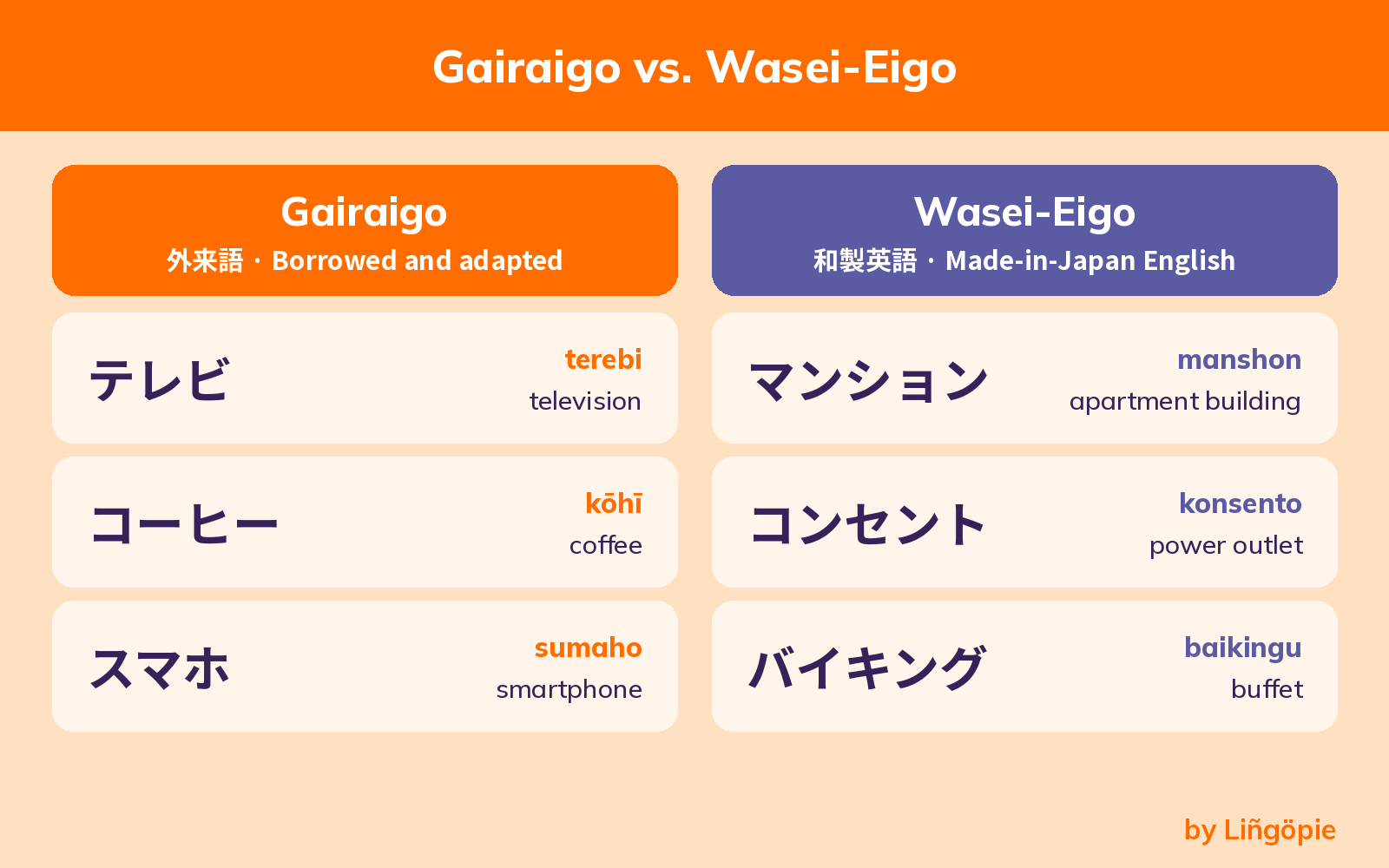
Wasei-Eigo | Japanese Writing | Literal Meaning | Actual Japanese Meaning |
|---|---|---|---|
Viking | バイキング (baikingu) | Norse explorer | Buffet-style meal |
Handle keeper | ハンドルキーパー (handoru kīpā) | One who keeps the handle | Designated driver |
After service | アフターサービス (afutā sābisu) | Service after purchase | After-sales support or warranty service |
One piece | ワンピース (wanpīsu) | A single piece | One-piece dress |
Salaryman | サラリーマン (sararīman) | Man who earns a salary | Salaried male office worker |
Konsento | コンセント (konsento) | Associated with "concentric plug" | Electrical outlet |
Ice candy | アイスキャンディー (aisu kyandī) | Candy made of ice | Ice pop or popsicle |
Image change | イメチェン (imechen) | Shortened from "image change" | Makeover |
Note personal computer | ノートパソコン (nōto pasokon) | Notebook PC | Laptop computer |
Gasoline stand | ガソリンスタンド (gasorin sutando) | Stand for gasoline | Gas station |
Baby car | ベビーカー (bebīkā) | Car for babies | Baby stroller |
Sharp pencil | シャープペンシル (shāpu penshiru) | Sharp pencil | Mechanical pencil |
Fight! | ファイト! (faito!) | Fight or struggle | You can do it! / Keep going! |
Skinship | スキンシップ (sukinshippu) | Skin + relationship | Physical affection or bonding through touch |
Kanningu | カンニング (kanningu) | Cunning | Cheating on a test |
How Japanese Transforms English Words
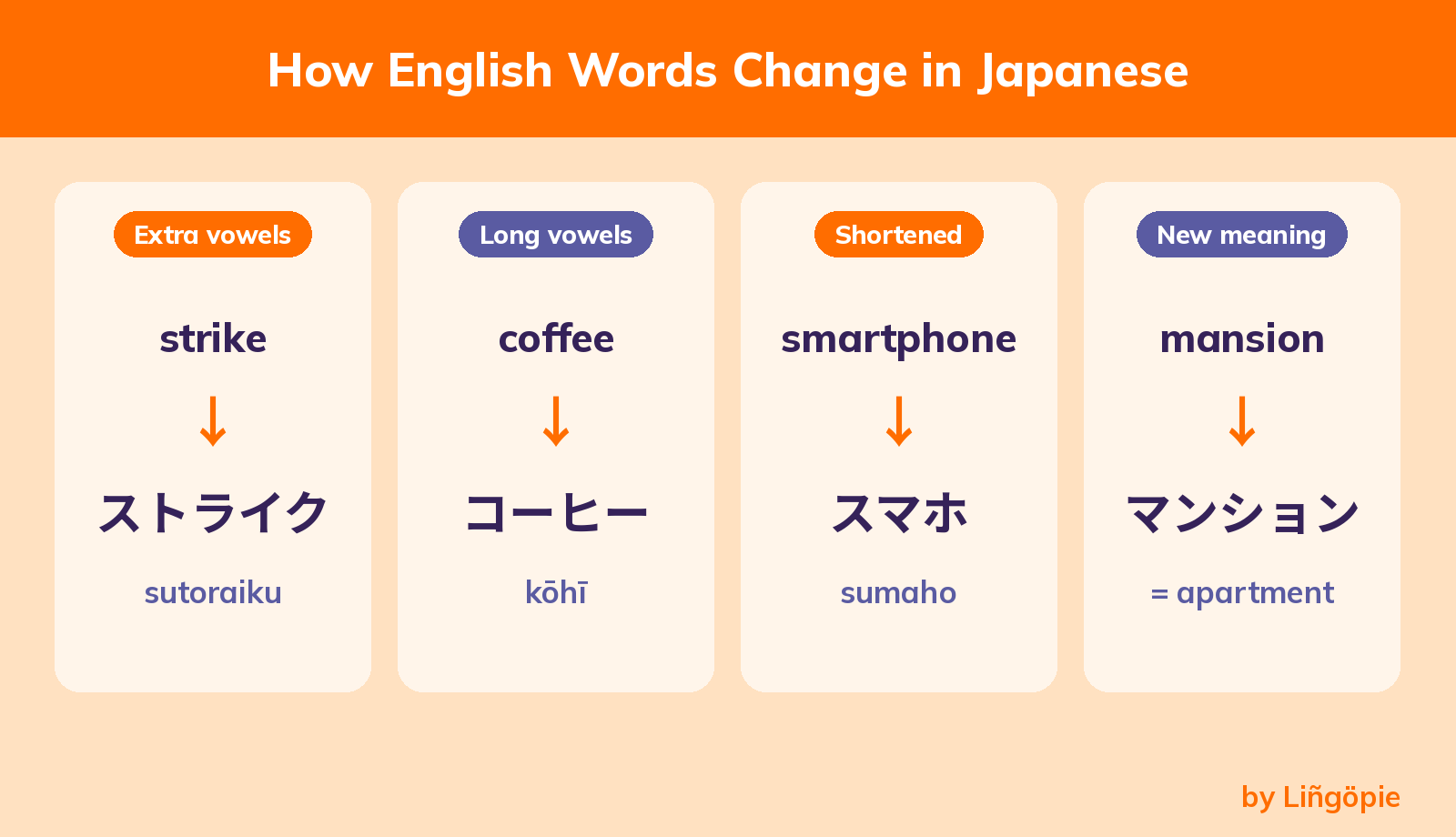
Ever wondered why some English words sound a bit different in Japanese? Japanese adapts borrowed words to fit its pronunciation, writing system, and everyday usage. Here are four common ways this happens.
Phonetic Changes
Japanese generally has a simpler syllable structure than English, so borrowed words often gain extra vowel sounds or change certain consonants:
- Strike → Sutoraiku (ストライク): Extra vowels break up the consonant cluster.
- Bus → Basu (バス): A vowel is added after the final consonant.
- Coffee → Kōhī (コーヒー): The English sounds are adapted to Japanese pronunciation.
Older loanwords often replaced unfamiliar sounds, but modern katakana can represent more of them using special character combinations. For example, ティ (ti) appears in パーティー (pātī, party), while フィ (fi) appears in フィルム (firumu, film).
Katakana Writing
Because most modern loanwords are written in katakana, they're easy to spot on menus, ads, and product names.Katakana also uses the long vowel mark (ー), as in ケーキ (kēki, cake), to show that a vowel is held longer.
Shortened Forms
Japanese speakers often shorten longer English expressions to make them quicker to say:
- Rimokon (リモコン): Remote control
- Pasokon (パソコン): Personal computer
- Sumaho (スマホ): Smartphone
- Eakon (エアコン): Air conditioner
Meaning Shifts
Here's where things get fun. Some English loanwords take on meanings in Japanese that you won't find under the same word in an English dictionary. For example, manshon (マンション) refers to a condominium or apartment building rather than a luxurious house. Similarly, tenshon (テンション), borrowed from "tension," often describes someone's energy level or excitement rather than stress.
Japanese Words in English You Already Know
English has borrowed plenty of Japanese words, especially for food, entertainment, and cultural traditions. Here are some familiar examples, grouped by category, along with what they originally mean in Japanese.
Category | Japanese Word | Meaning in English |
|---|---|---|
Food and Drink | Sushi | Japanese dish made with vinegared rice, often served with seafood or vegetables |
Ramen | Japanese noodle soup with broth and toppings | |
Tofu | Food made from coagulated soy milk | |
Wasabi | Pungent Japanese condiment made from the wasabi plant | |
Sake | Rice alcohol; in Japan, sake can mean alcohol in general, while nihonshu means Japanese rice alcohol | |
Umami | Savory taste, one of the five basic tastes | |
Arts and Culture | Origami | Traditional Japanese art of paper folding |
Bonsai | Art of growing and shaping miniature trees in containers | |
Haiku | Japanese poetic form traditionally built on a 5-7-5 sound-unit pattern | |
Kimono | Traditional Japanese robe-style garment | |
Zen | School of Buddhism associated with meditation | |
Martial Arts | Karate | Martial art emphasizing strikes, kicks, and defensive techniques |
Judo | Martial art and sport involving throws, holds, and grappling | |
Ninja | Historical Japanese covert operative or spy | |
Pop Culture | Anime | Japanese animation |
Manga | Japanese comics and graphic novels | |
Emoji | Digital picture or symbol, from e (picture) + moji (character), not the English word "emotion" | |
Karaoke | Singing along to recorded instrumental music | |
Kawaii | Cute or adorable | |
Senpai | Senior or more experienced person in a school, workplace, or group | |
Isekai | Fiction genre featuring characters transported or reborn into another world | |
Everyday Words | Tsunami | Large sea waves caused by underwater earthquakes; literally "harbor wave" |
Futon | Traditional bedding laid on the floor, unlike the sofa bed often called a futon in English | |
Tycoon | Wealthy or powerful businessperson, from taikun (great lord) | |
Honcho | Boss or person in charge, from hanchō (squad leader) | |
Skosh | A small amount, from sukoshi (a little) |
Some of these words, like honcho and skosh, are more common in American English, while others, like tsunami and emoji, are recognized worldwide. Hawaiian local English also uses Japanese-derived words like bento (boxed meal) and shoyu (soy sauce). And while many keep their original meanings, others shift slightly as English adopts them.
Basic Japanese Words and Phrases (With English Meanings)
Recognizing borrowed words like terebi (television) and kōhī (coffee) can give you a head start in Japanese. But if you want to start speaking Japanese, you'll also need basic greetings, verbs, and everyday expressions.
Japanese | English Meaning |
|---|---|
おはようございます (ohayō gozaimasu) | Good morning (polite) |
こんにちは (konnichiwa) | Hello / Good afternoon |
こんばんは (konbanwa) | Good evening |
ありがとうございます (arigatō gozaimasu) | Thank you (polite) |
すみません (sumimasen) | Excuse me / Sorry |
はい (hai) | Yes |
ちょっと待って (chotto matte) | Wait a moment (casual) |
大丈夫 (daijōbu) | I'm fine / It's okay |
心配しないで (shinpai shinaide) | Don't worry (casual) |
いただきます (itadakimasu) | Said before eating to express gratitude for the meal |
乾杯 (kanpai) | Cheers (before drinking) |
Basic Verbs and Adjectives
Add a few common verbs and adjectives to talk about everyday activities and describe things.
Japanese | English Meaning |
|---|---|
食べる (taberu) | To eat |
飲む (nomu) | To drink |
話す (hanasu) | To talk / Speak |
聞く (kiku) | To listen / Hear |
待つ (matsu) | To wait |
かわいい (kawaii) | Cute |
おいしい (oishii) | Delicious |
すごい (sugoi) | Amazing / Impressive |
Here's one useful sentence to remember: 英語を話せますか? (Eigo o hanasemasu ka?), "Can you speak English?"
Practical Tips for Learning Japanese With Japanglish
Want to turn your knowledge of loanwords and wasei-eigo into practical language gains? Here are some tips.
Start With Katakana
Learning the 46 basic katakana characters helps you read many foreign-derived words.When you learn Japanese with anime, pay special attentionwhenever you see katakana in dual subtitles: there's a good chance it's a word you already know or can guess. Keep a notebook of these words to build your "free" vocabulary.
Be Cautious With Wasei-Eigo
Don't assume a familiar-looking word means what you think it does. When something sounds like English, double-check its Japanese meaning to avoid misunderstandings.
Use Your Existing Knowledge
Start with gairaigo related to your interests. If you're into gaming, tech, or fashion, many Japanese terms will be English loanwords you already understand.
Practice Katakana-izing English Words
Try writing familiar loanwords like terebi and kōhī in katakana, then listen to how native speakers pronounce them. This helps you practice spelling and pronunciation without guessing.
💡 Keep learning: On'yomi vs. Kun'yomi: A Guide to Japanese Kanji Reading · A Guide to Kansai-ben Dialect for Beginners
Take Your Japanese to the Next Level With Lingopie
Ready to put those Japanese words into practice? Lingopie lets you learn Japanese through anime and TV shows with interactive dual subtitles. Click unfamiliar words to see their meanings, save them as flashcards, and review vocabulary as you watch.That click-to-translate approach is backed by research: in a study of 227 learners, captions with word translations more than doubled word-meaning recall compared with standard captions (Montero Perez, Peters & Desmet, 2018).
Start practicing with Lingopie and build your Japanese vocabulary one episode at a time.
Frequently Asked Questions
What are some common Japanese words used in English?
Some common Japanese words in English include sushi, ramen, karaoke, emoji, anime, and tsunami. Other familiar examples include origami (paper folding), judo (a martial art), and umami (savory taste).
What's the difference between gairaigo and wasei-eigo?
Gairaigo is the broad term for foreign-derived Japanese vocabulary, such as terebi (television) and kōhī (coffee). Wasei-eigo refers more specifically to English-based expressions coined or reinterpreted in Japan, such as manshon (apartment building) and baikingu (buffet).
What are basic Japanese greetings I should know?
Start with ohayō gozaimasu (good morning), konnichiwa (hello or good afternoon), and konbanwa (good evening). Other useful phrases include arigatō gozaimasu (thank you) and sumimasen (excuse me or sorry).
What is romaji, and is it helpful for beginners?
Romaji is Japanese written using Latin letters, such as arigatō instead of ありがとう. It helps beginners pronounce basic words, but learning hiragana and katakana early will make reading Japanese easier.
Why does Japanese use so many English loanwords?
Historical contact, technological developments, and American media and popular culture all played a part. Many borrowed words describe modern products or concepts, such as sumaho (smartphone), and katakana makes foreign words easy to write.
What's the difference between kanji, hiragana and katakana?
Kanji uses characters of Chinese origin for meaning and is common in nouns and word stems. Hiragana is used for grammatical endings and many native Japanese words, while katakana is commonly used for foreign loanwords. Together, hiragana and katakana are called kana.