

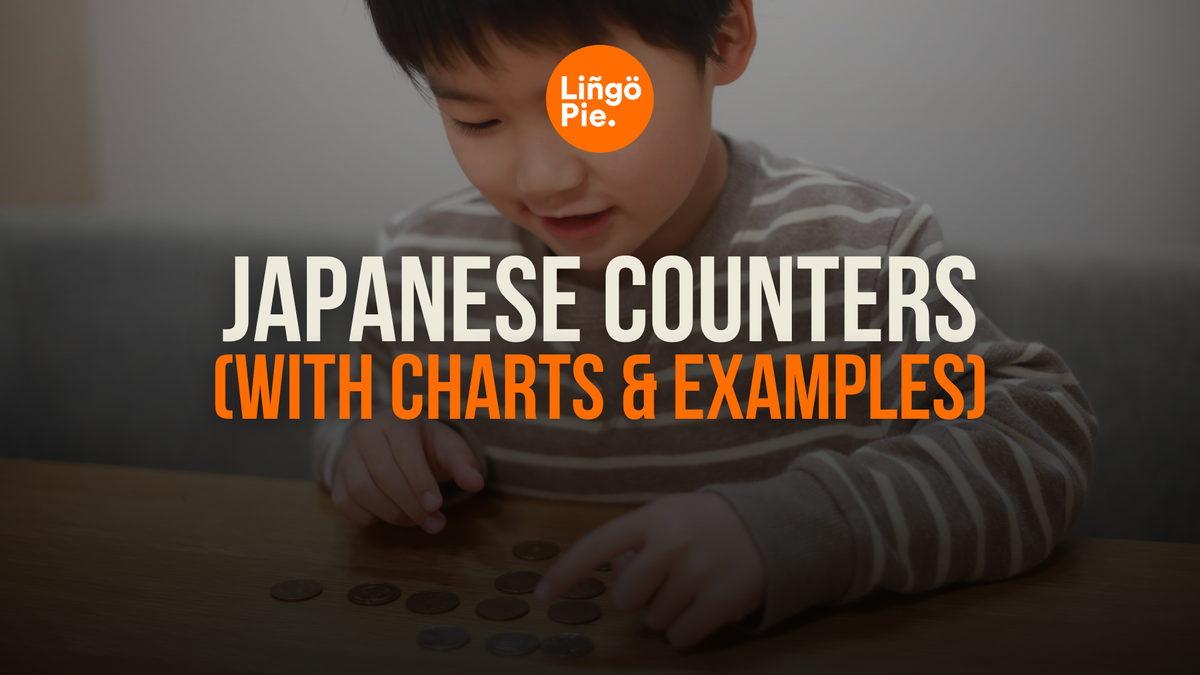
If you've been learning Japanese, you already know basic numbers. But knowing numbers isn't enough! In fact, Japanese requires you to attach a counter word to every number based on what you're counting. Three cats, three books, and three sheets of paper each use a different counter.
This guide covers every major Japanese counter, with full pronunciation tables in romaji, real examples, and a quick-reference chart. Let's begin!
- 12 Best Japanese TV Shows To Learn Japanese [2026]
- How To Write The Japanese Kanji For Love [+ FREE Printable]
- 26+ Crazy Cute Japanese Words You Need To Learn

What Are Japanese Counters?
Japanese counters (助数詞, josūshi) are suffixes that attach to numbers to indicate what kind of object you're counting. English has a few equivalents — "a sheet of paper," "a slice of bread" — but Japanese uses them for almost everything.
Basic structure: Object + Number + Counter → Example: リンゴ三個 (ringo san-ko) = three apples
Just note that sometimes the counter comes before the object, but the number + counter always stay together.
The Two Japanese Number Systems
Japanese has two completely separate ways to say numbers, which coexist in the language. Think of it like how English has "one, two, three" but also "once, twice, thrice" — except in Japanese, both systems are fully active and you need both.
Wago are the original Japanese words for numbers, predating Chinese influence. You've probably heard them without realizing it:
- 1 = ひとつ (hitotsu)
- 2 = ふたつ (futatsu)
- 3 = みっつ (mittsu)
The word 人 (person) gives you a clue — 一人 (hitori) and 二人 (futari) use the Wago roots "hito" and "futa," which are the same roots as hitotsu and futatsu. Wago numbers only go up to 10 naturally. Past that, the native system essentially stops being used for counting.
On the other hand, Kango (漢語) numbers scale infinitely (e.g., 11, 100, 1,000, 10,000), so they became the dominant counting system for most practical purposes.
Japanese Counters Quick Reference Chart
Here are the most common Japanese counters you'll encounter:
The つ Counter
The tsu counter is the general counter from the native Japanese (Wago) system. Use it for everyday physical objects when you don't know or can't remember the specific counter. It only works up to ten.
📌 You can't use つ for people, animals, or time. And once you go past 10, you must switch to a specific counter.
個 (ko) For Small and Round Objects
Ko is the most flexible specific counter. It's meant for small, compact, often round objects, but modern Japanese speakers use it as a default for many everyday items when the exact counter isn't obvious.
Use 個 for: apples, oranges, eggs, onigiri, erasers, stones, boxes, candies, batteries
Example: 卵を六個買いました。(Tamago wo rokko kaimashita.) = I bought six eggs.
枚 (mai) For Flat, Thin Objects
Mai counts anything flat and thin that you could stack. It's one of the more predictable counters — the pronunciation stays consistent across all numbers.
Use 枚 for: paper, photographs, shirts and flat clothing, plates, pizza slices, CDs, playing cards, business cards, posters, towels, stamps
Example: 写真を三枚撮りました。(Shashin wo san-mai torimashita.) = I took three photos.
Note: For structured clothing items like suits or uniforms, use 着 (chaku) instead.
本 (hon) For Long, Cylindrical Objects
Hon is one of the trickier counters because the pronunciation shifts between hon, pon, and bon depending on the number. These changes are called rendaku (sequential voicing).
Use 本 for: bottles, cans, pens, pencils, chopsticks, trees, umbrellas, bananas, train lines, bus routes, phone calls, videos/movies
Pattern: Numbers 1, 6, 8, 10 trigger pon. Number 3 triggers bon. The rest use hon.
Example: ビールを二本ください。(Biiru wo ni-hon kudasai.) = Two bottles of beer, please.
人 (nin) — Counting People in Japanese
This is one of the most important counters to know. The first two numbers are completely irregular; they come from the native Japanese system and must be memorized separately.
Counting people in Japanese at a restaurant:
- "Table for two" → 二人です。(Futari desu.)
- "How many people?" → 何人ですか?(Nan-nin desu ka?)
- "Four people, please" → 四人お願いします。(Yo-nin onegaishimasu.)
Japanese counter for people — formal vs casual:
In formal situations (hotel check-ins, business settings), you may hear 名様 (mei-sama) instead of 人. Example: 三名様 (san-mei-sama) = three guests (formal).
匹 (hiki) and 頭 (tou) For Counting Animals
匹 (hiki/biki/ppiki) For Small Animals
Use 匹 for small and medium animals: cats, dogs, fish, insects, rabbits (sometimes), hamsters, snakes
頭 (tou) For Large Animals
Use 頭 for large animals: horses, cows, elephants, whales, lions, bears
📌 When in doubt between 匹 and 頭, use 匹. It's the safer general animal counter for everyday conversation.
羽 (wa/ha) For Birds and Rabbits
羽 counts birds and, interestingly, rabbits. This is because rabbits were historically classified as birds in Japan to allow Buddhist monks to eat them while following dietary restrictions.
台 (dai)For Machines and Vehicles
Use dai for any mechanical device or vehicle: cars, motorcycles, bicycles, computers, refrigerators, washing machines, TVs, air conditioners, cameras, pianos
Example: 駐車場に車が三台あります。(Chuushajou ni kuruma ga san-dai arimasu.) = There are three cars in the parking lot.
冊 (satsu) For Books and Notebooks
Use satsu for books, magazines, notebooks, manga volumes, and other bound reading materials.
Example: 本を五冊読みました。(Hon wo go-satsu yomimashita.) = I read five books.
Note: 新聞 (shinbun) means newspaper in Japanese, and newspapers are also counted with 冊 or sometimes 部 (bu) for copies. 新聞一部 (shinbun ip-pu) = one newspaper.
杯 (hai/pai/bai) For Cups, Glasses, and Bowls
Use hai for drinks served in cups or glasses, and for bowls of food: coffee, tea, beer, ramen, rice bowls
Example: コーヒーを一杯ください。(Koohii wo ip-pai kudasai.) = One coffee, please.
着 (chaku) For Clothing (Outfits)
Use chaku when counting clothes as complete outfits or garments like suits, uniforms, and dresses. For counting individual flat items like T-shirts or loose garments, 枚 (mai) is also common.
足 (soku) For Pairs of Footwear
Use soku for counting shoes, socks, sandals, and other footwear — always as a pair, not individual pieces.
Example: 靴下を三足買いました。(Kutsushita wo san-soku kaimashita.) = I bought three pairs of socks.
Counting Time in Japanese
Time counters are some of the most practical to learn. Here are all of them in one place.
分 (fun/pun) For Minutes
This counter has sound changes similar to 本. It's used for counting minutes, making it a key counter for everyday schedules and conversations.
Example: 三分待ってください。(San-pun matte kudasai.) = Please wait three minutes.
📌 十分 (juu-pun) = 10 minutes. But 十分 (juubun) = sufficient/enough. Same kanji, different reading!
時間 (jikan) For Hours (Duration)
Use 時間 to count hours as a duration. This is different from 時 (ji), which tells the time of day (e.g., 3時 = 3 o'clock).
日 (nichi/ka) For Counting Days in Japanese
This is one of the most complex counters because the first 10 days use irregular native Japanese readings. These same irregular readings apply both to calendar dates and to counting a number of days.
Duration example: 三日間旅行します。(Mikka-kan ryokou shimasu.) = I'll travel for three days.
📌 Add 間 (kan) after the day counter to emphasize duration. 三日間 = "for three days."
週 (shuu) For Weeks
ヶ月 (kagetsu) For Months (Duration)
Use ヶ月 to count months as a duration. Don't confuse it with 月 (gatsu/tsuki), which names specific months (1月 = January).
年 (nen) For Years
歳 (sai) For Age
Use sai to count age. The exception is 20 years old, which uses the traditional term 二十歳 (hatachi).
Example: 私は二十五歳です。(Watashi wa nijuugo-sai desu.) = I am 25 years old.
階 (kai) For Floors in a Building
Use kai when referring to floor numbers in a building. Note that 階 (kai) meaning floor is different from 回 (kai) meaning times/occurrences — they share the same romaji but different kanji.
Example: レストランは三階にあります。(Resutoran wa san-kai ni arimasu.) = The restaurant is on the third floor.
回 (kai) For Times and Occurrences
Use 回 to say how many times something happens. Very common in everyday conversation.
Example: 日本に二回行ったことがあります。(Nihon ni ni-kai itta koto ga arimasu.) = I've been to Japan twice.
室 (shitsu) For Rooms
Use shitsu when counting rooms in a building or facility context. In residential settings, you'll more often hear 部屋 (heya) for an individual room, but 室 is used for formal or commercial spaces.
Example: 会議室を三室予約しました。(Kaigishitsu wo san-shitsu yoyaku shimashita.) = I reserved three conference rooms.
番 (ban) For Numbers and Rankings
Use ban for numbering items in a sequence — like bus numbers, train lines, platform numbers, or ranked positions.
📌 一番 (ichiban) also means "the most" or "the best" in Japanese. 一番好き (ichiban suki) = my favorite.
Counting from 1 to 10 in Japanese — Quick Reference
Here are the base Japanese numbers 1–10 in kanji, hiragana, and romaji:
📌 4 and 7 each have two readings. yon and nana are preferred in most counter contexts because shi (4) and shichi (7) can sound like 死 (death) and are avoided.
Japanese Counting System: Why So Many Counters?
The Japanese counting system was heavily influenced by Classical Chinese, which also uses classifier words (量词, liàngcí). When Japan adopted Chinese script and vocabulary, it brought this counting system with it.
Japanese then developed its own layer on top — the native Wago system (one, two, three = hitotsu, futatsu, mittsu) for general counting. The result is a two-track system where most counters use Sino-Japanese (Kango) numbers, while the つ counter uses native Japanese numbers.
Over time, the Japanese also created unique counters for very specific categories that don't exist in Chinese, like 枚 for flat objects and 羽 for birds/rabbits. The system has hundreds of counters in total, but the good news: native speakers actively use only around 30 in daily life.
The Best Way to Make Japanese Counters Stick
Reading a guide gets you started, but counters only become automatic when you hear them used naturally. That's exactly what Japanese TV shows and films give you! Every episode is packed with counters in context: characters ordering food (杯, 個), talking about people (人), counting days until something happens (日). You absorb the patterns without drilling a table.
Lingopie lets you watch Japanese TV with interactive dual subtitles, so when a counter pops up mid-scene, you can tap it instantly to see the meaning without pausing your immersion. It's the fastest way to go from knowing counters on paper to actually using them without thinking.
Start your free trial and let Japanese TV do the teaching.
Japanese Counters FAQ
How many Japanese counters are there?
There are hundreds of counters in the Japanese language technically, but native speakers actively use around 30 in everyday life. Specialist counters exist for things like tatami mats (畳/jou) and Buddhist temple visits (ヶ寺/katera), but you won't need those in daily conversation.
What is the most common Japanese counter?
The most common general counters are つ (tsu) for everyday objects and 個 (ko) for small things. For specific categories, 人 (nin) for people, 本 (hon) for cylindrical things, and 枚 (mai) for flat things come up most frequently.
What is the Japanese general counter?
つ (tsu) is the Japanese general counter. It comes from the native Wago number system and works for most physical objects when you don't know the specific counter. It only counts from 1–10.
How do you count to 5 in Japanese?
ichi (1), ni (2), san (3), yon/shi (4), go (5) — or in the native system: hitotsu, futatsu, mittsu, yottsu, itsutsu.
How do you count to 10 in Japanese?
ichi, ni, san, yon, go, roku, nana, hachi, kyuu, juu — or native: hitotsu, futatsu, mittsu, yottsu, itsutsu, muttsu, nanatsu, yattsu, kokonotsu, too.
How do you count to 20 in Japanese?
11 = juuichi, 12 = juuni, 13 = juusan, 14 = juushi/juuyon, 15 = juugo, 16 = juuroku, 17 = juushichi/juunana, 18 = juuhachi, 19 = juukyuu, 20 = nijuu.
How many words/characters are in the Japanese language?
The Japanese language contains approximately 500,000+ words, and the writing system uses 3 scripts: hiragana (46 characters), katakana (46 characters), and kanji (the standard set is 2,136 jōyō kanji, though over 50,000 kanji exist in total). For everyday literacy, knowing around 2,000–3,000 kanji is sufficient.


![Japanese Honorifics: 10+ Titles You’ll Actually Use [GUIDE]](/blog/content/images/size/w300/2026/03/Japanese-honorifics.jpg)

![Japanese vs Korean: Which Language Should You Be Learning? [2026]](/blog/content/images/size/w300/2026/03/Japanese-vs-Korean.jpg)
)