

You've probably tried to learn to speak Italian at least once. Maybe it was Duolingo streaks you eventually broke, or a night class you stopped attending after six weeks, or a phrasebook that got you through one holiday but no further. The standard approach to learning to speak Italian just isn't built for how people actually retain language.
The good news is there’s a better way, and it involves watching great Italian TV instead of conjugating verbs at a desk. This beginner’s roadmap covers everything you need without the stuff that makes language learning feel like homework.
- 6 Best Italian Translation Apps For Learners [TESTED]
- How Long Does It Take To Learn Italian? [2026 Guide]
- How Many Italian-Speaking Countries Are There? [Data]

How long it realistically takes to reach fluency
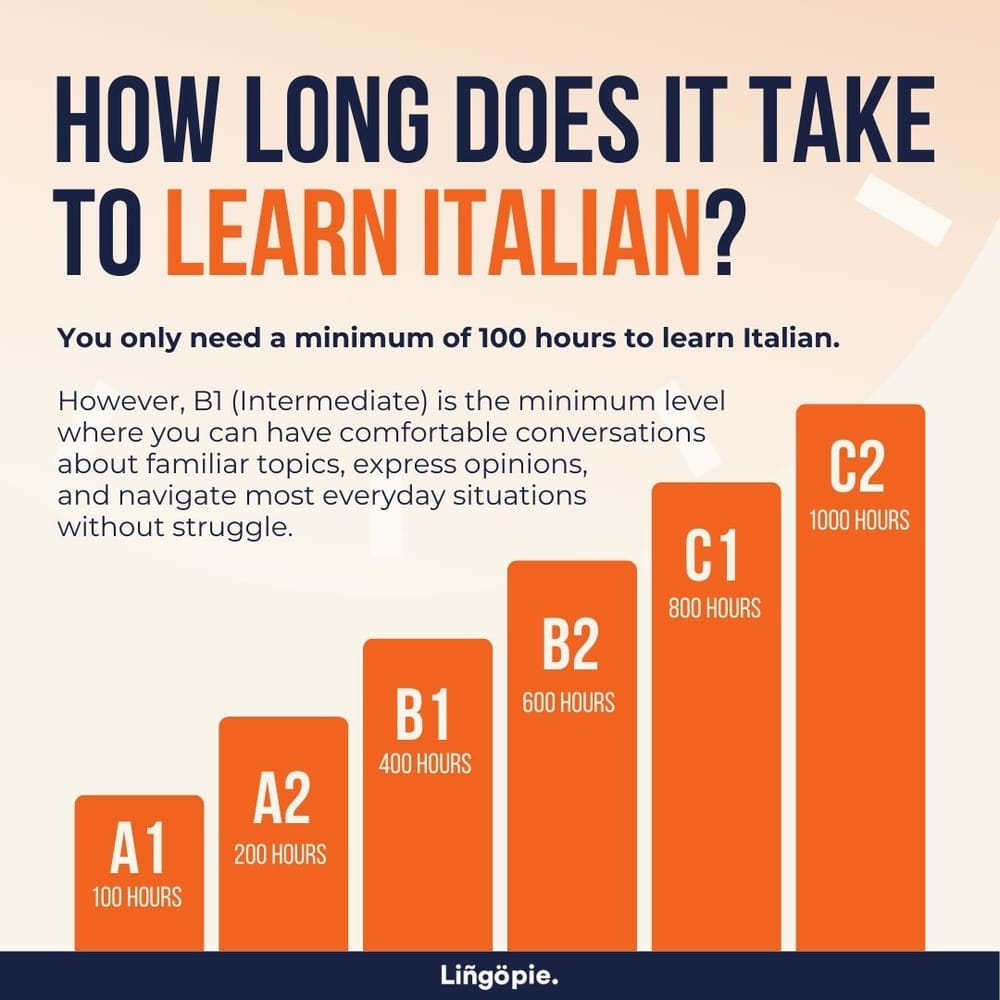
Learning to speak Italian to a conversational level takes most English speakers around 552 to 690 hours of study, according to the Foreign Service Institute. That sounds like a lot. Broken into 30-minute daily sessions, you're looking at roughly 3 to 4 years for fluency (or much faster if you study consistently and immerse yourself properly).
Italian is actually one of the easier languages for English speakers. The pronunciation is consistent (what you see is what you say), the grammar is more predictable than French or German, and there’s a ton of shared vocabulary from Latin roots.
| Italian | English |
|---|---|
| telefono | telephone |
| università | university |
| animale | animal |
| musica | music |
| famiglia | family |
| informazione | information |
| problema | problem |
| ristorante | restaurant |
| ospedale | hospital |
| stazione | station |
Most importantly, remember that the learners who progress fastest aren’t necessarily the ones with the most study hours. They’re the ones who get real Italian into their ears early and often.
The Biggest Mistakes Beginners Make When Learning to Speak Italian

Honestly, the biggest mistake when learning to speak Italian is the idea of waiting to be ready. Spoiler: that feeling never comes. You see, speaking feels uncomfortable early on, but discomfort is literally how your brain learns. Start speaking in week one, even if it's just talking to yourself.
Aside from that, here are three more mistakes you might be making when learning Italian:
Studying vocabulary lists in isolation
Italian words need context to stick. Memorising "felice = happy" gives your brain almost nothing to hold onto. Hearing "Sono così felice di vederti!" in a show you're actually watching — that sticks, because it's tied to an emotion, a face, a moment.
Ignoring listening practice until they're "advanced enough"
Italian listening practice isn't a reward for reaching B2. It's how you get there. Your ear needs exposure to real speech rhythm, connected words, and regional accents from the very beginning. Otherwise, you end up able to read Italian but completely lost when someone speaks at a normal pace.
Over-relying on translation
Mentally translating every sentence from English to Italian and back again is slow and exhausting. Native-level fluency means thinking in Italian, and you get there by practising in Italian, not by becoming a really fast translator.
Your Beginner’s Roadmap to Speak Italian Like a Native
Stage 1: Learning your first 500 Italian words
Italian vocabulary for beginners starts with high-frequency words, the ones that appear in basically every conversation. Numbers, greetings, common verbs (essere, avere, fare, andare), food, family, and everyday objects. These 500 words will get you through a surprising amount of daily interaction.
A few things that actually help at this stage:
- Flashcard apps with spaced repetition (Anki is free and very effective) so you review words right before you'd forget them
- Learning words in chunks, not isolation — "ho fame" (I'm hungry) is more useful than just "fame"
- Labelling things in your environment in Italian — your coffee machine, your front door, your laptop
Aim for 10 to 15 new words a day. That's manageable and sustainable, and at that pace you'll hit 500 in about six weeks.
Stage 2: Training your ear with real Italian content
Once you have a basic vocabulary base, start Italian immersion learning immediately. This is where most courses let you down — they keep you in controlled, slow, simplified audio long past the point where it's useful.
Real Italian sounds nothing like a language app. Italians drop syllables, blend words together, and use regional expressions that never appear in textbooks. You need to start hearing authentic speech early, even if you only catch 30% of it. That 30% trains your ear.
The best approach at this stage is watching Italian shows and movies with dual subtitles — Italian audio with Italian subtitles, or Italian audio with English subtitles as a fallback. The idea here is for you to watch actively: pausing on unfamiliar phrases, rewinding to hear them again, and noting patterns.
Stage 3: Speaking out loud even when it feels uncomfortable
This is the stage most learners avoid, and it's the most important one. Speaking Italian fluently doesn't happen by thinking about speaking Italian — it happens by speaking Italian, repeatedly, until your mouth knows what to do without your brain running the full translation process.
Practical ways to actually do this:
- Shadowing: Play a clip of a native Italian speaker and repeat what they say in real time, matching their rhythm, intonation, and speed. This is one of the most underrated techniques for sounding natural.
- iTalki or Preply: Book sessions with a native speaker tutor, even just once a week. Talking to a real person forces your brain to process and produce Italian under gentle pressure.
- Talking to yourself in Italian: Give yourself a running commentary of your day — "Adesso faccio il caffè. Ho molto sonno." It sounds ridiculous. It works.
Don't wait until your Italian is "good enough" to speak. That's backwards. Speaking is what makes it good enough.
Stage 4: Going from conversational to natural and fluent
Conversational Italian means you can handle most everyday situations. Fluent means you're not thinking about it anymore. The gap between the two is almost entirely a listening gap.
At this stage, you want maximum exposure to how to sound like a native Italian speaker: the filler words Italians actually use ("allora," "cioè," "dai"), the rhythm of casual conversation, the informal register that never appears in formal study materials. TV shows, podcasts, YouTube channels in Italian, conversations with native speakers — all of this accelerates the final stretch.
One practical thing: stop using English subtitles. Push yourself to Italian subtitles, then to no subtitles at all. Your brain will fill in the gaps faster than you think.
How Watching Italian TV Rewires Your Brain for the Language
Learning Italian through TV shows works because your brain processes language differently when it comes with context. In fact, researchers found that meaningful context significantly boosts language retention. Hearing a word while watching a character react to it is far more effective than seeing it printed on a list.
Italian immersion learning through TV also exposes you to how Italians actually speak. Real Italian, with regional accents, dropped syllables, filler words, and casual grammar.
Here's what you're actually training when you learn Italian through TV shows:
- Listening comprehension — following natural speech at real speed
- Vocabulary in context — words tied to emotion and situation, not just definitions
- Pronunciation patterns — hearing the rhythm and melody of Italian repeatedly
- Informal register — the everyday language that textbooks skip entirely
The last reason to use TV as your main immersion tool: you'll actually keep doing it. Most people quit language learning because it feels like homework. A show you're genuinely hooked on doesn't feel like studying. That consistency is everything.
Best Italian TV Shows on Lingopie for Beginners
Lingopie has a library of Italian shows and films with interactive subtitles, vocabulary saving, and playback tools designed specifically for language learning. Here are some good starting points:
For complete beginners:
- Snow Black
- The Boss Hunt
For intermediate learners ready for real Italian:
- The Lady with the Black Veil
- Monterossi
You can also browse the best Italian apps and learning resources alongside your Lingopie watching to build vocabulary faster.
How to Get the Most Out of Every Watching Session
Passive watching is better than nothing. Active watching is where the real gains happen.
Before you press play:
- Set a small goal — "I'm going to notice every time they use 'avere'" or "I'm going to catch five new words today"
While watching:
- Pause on unfamiliar phrases and repeat them out loud
- Use Lingopie's built-in subtitle tools to click on words and save them instantly
- Rewind any scene where you caught the emotion but missed the words
After the session:
- Review the words you saved — even just a two-minute scroll through
- Try to use one new phrase before your next session. Say it out loud, in a sentence, to yourself or anyone nearby who'll tolerate it
Consistency beats intensity here. Three 20-minute focused sessions beat one 90-minute passive binge every time.
Start Learning Italian with Lingopie Today
If you've been wondering how to learn to speak the Italian language but keep putting it off, this is the sign to just start. The best way to learn to speak Italian is consistent exposure to real content... and you can do all of it from home, at your own pace, for free to begin with!
Lingopie is one of the easiest ways to learn Italian online free with a trial, and genuinely one of the most effective ways to learn Italian fast once you're in the habit. You get real Italian TV shows with interactive subtitles, built-in vocabulary tools, and content that suits you whether you're a complete beginner or pushing toward fluency.
FAQs
What is the shadowing technique and does it really work?
Shadowing means listening to a native speaker and repeating what they say simultaneously, matching their pace and intonation exactly. It's particularly effective for training your mouth to produce natural Italian sounds and getting comfortable with the rhythm of the language. Start with short 30 to 60 second clips and do it daily.
Should I learn Italian grammar before I start speaking?
No. Try to get a basic grasp of present tense verbs and sentence structure, then start speaking. Waiting until your grammar is solid is one of the most common reasons people plateau. Native speakers internalise patterns through repetition, not rules, and you will too.
Does Lingopie have enough Italian content for beginners?
Yes. Lingopie's Italian library covers difficulty levels from slower classic films for beginners through to fast-paced modern dramas for advanced learners. The interactive subtitles and vocabulary tools mean you can engage with content slightly above your level without losing the thread.
Is Italian hard to learn for English speakers?
Italian is one of the more accessible European languages for English speakers — the FSI classifies it as Category I, the easiest tier. Pronunciation is phonetic, vocabulary overlaps heavily with English, and the grammar follows predictable rules. Most motivated learners reach conversational level in 12 to 18 months of consistent study.
Is there a free trial so I can try Lingopie before committing?
Yes, Lingopie offers a free trial so you can explore the Italian content library and test the interactive subtitle tools before paying anything. No reason not to try it first.