
You've spent three episodes of your favorite K-drama nodding along to subtitles, picked up "annyeong" from a BTS song, and somehow convinced yourself you're halfway to fluent. Then you open a textbook and realize Korean grammar works nothing like English. Nothing. Like, at all!!
Well, the truth is that the U.S. Foreign Service Institute (FSI) classifies Korean as one of the hardest languages for English speakers to learn. But that number doesn't tell the whole story.
Korean has some genuinely tricky parts, but it also has features that are surprisingly learner-friendly, and millions of people have reached conversational fluency by leaning into the right methods. This guide breaks down exactly what you're getting into.
- How To Use Lingopie: Step-by-Step Guide For Beginners
- Japanese vs Korean: Which Language Should You Be Learning? [2026]
- 6 Best Korean Flashcard Apps You Need To Install Today

Facts About Korean
Before you decide whether Korean is worth your time, here are some quick facts that put the language in context.
- Official language of: South Korea and North Korea
- Total speakers: Over 80 million worldwide
- Language family: Koreanic (a language isolate with no confirmed relatives)
- Writing system: Hangul, a phonetic alphabet created in 1443 by King Sejong
- FSI difficulty rating: Category V ("Super-Hard"), estimated 2,200 hours to professional fluency
- Tonal language? No. Korean is not tonal.
- Grammatical gender? No. Korean nouns have no gender.
- Fun fact: Hangul was deliberately designed to be easy to learn. King Sejong created it specifically so that common people, not just scholars, could read and write.
Is Korean Hard to Learn?
Korean is genuinely challenging for English speakers, but the difficulty is uneven. The writing system is one of the easiest to pick up in the world, and pronunciation is more predictable than English. The real difficulty lies in Korean grammar, sentence structure, and the honorific system.
The short answer: hard, but not as hard as its reputation suggests, and far more learnable than people think if you approach it the right way.
Korean sits in the FSI's Category V alongside Mandarin, Japanese, and Arabic. For English-speaking diplomats-in-training, reaching professional fluency takes about 2,200 hours. But if your goal is conversational Korean, not reading government documents, you can have real conversations much sooner than that.
What Makes Korean Hard to Learn?
Sentence Structure Is Backwards (Compared to English)
Korean follows Subject-Object-Verb (SOV) order. In English, you say "I eat rice." In Korean, you say the equivalent of "I rice eat." This applies to every sentence, and it trips up English speakers constantly because the verb always lands at the end. When you're listening or reading, you have to hold meaning in your head until the last word arrives.
It gets trickier when sentences get longer. A long Korean clause can contain multiple embedded phrases, all stacking before the final verb. If you try to translate word-by-word from English, your brain will short-circuit.
The Honorific System Is Genuinely Complex
Korean has multiple speech levels that change verb endings depending on who you're talking to. Formal polite speech is different from informal polite speech, which is different from casual speech between close friends, which is different again from the highly formal language used in professional settings.
The most important distinction for beginners:
- Formal speech (해요체): Used with strangers, elders, and in professional settings
- Informal speech (해체): Used with close friends and younger people
- High formal speech (합쇼체): Used in official or ceremonial contexts
This isn't just about swapping a few words. Entire verb endings change. Getting this wrong isn't grammatically "wrong" in the academic sense, but it can come across as rude, overly stiff, or strange depending on context.
Vocabulary Has Almost Zero Overlap with English
Unlike French or Spanish, which share thousands of cognates with English, Korean vocabulary is largely unfamiliar. There are English loanwords (called Konglish), and words like "컴퓨터" (keompyuteo, computer) or "커피" (keopi, coffee) are recognizable. But the core vocabulary you need for daily life comes from native Korean or Sino-Korean roots, none of which look or sound like English words.
Particles Add Grammar to Every Noun
Korean uses particles, small grammatical markers attached to nouns that indicate what role a word plays in a sentence. The subject particle, object particle, topic particle, and location particle all behave differently. English speakers who rely on word order to understand grammar have to rewire how they process a sentence entirely.
What Makes Korean Easy to Learn?
Hangul Can Be Learned in a Weekend
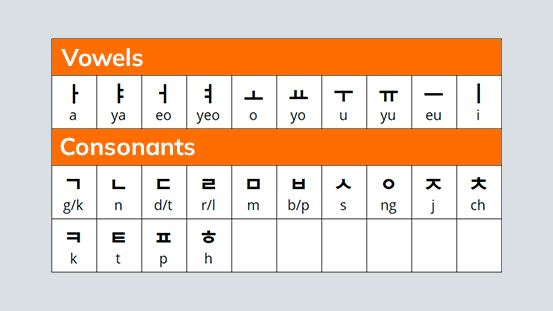
Hangul is legitimately one of the fastest writing systems to learn in the world. It contains 14 consonants and 10 vowels, combined into syllable blocks. Most dedicated learners can read Hangul within 1 to 3 days of practice. You won't understand what you're reading yet, but you'll be able to sound it out accurately. That is a huge confidence boost early in the process.
Compare this to Japanese, where you need to learn two syllabic scripts plus thousands of kanji characters just to read a newspaper. Korean’s writing system is not in the same category of difficulty.
Korean Is Not Tonal
This matters more than people realize. In Mandarin and Cantonese, the pitch you use when pronouncing a syllable changes the word's meaning entirely. Korean has no tones. Pronunciation is consistent and phonetic. Once you learn how Hangul characters sound, you can read and pronounce any Korean word without ambiguity.
No Grammatical Gender
Korean nouns don't have gender. You won't need to memorize whether a table is masculine or feminine (like in French or Spanish). This removes an entire layer of complexity that frustrates learners of Romance languages.
No Verb Conjugation by Person
In English and Spanish, verbs change form depending on who's doing the action ("I go," "he goes," "they go"). Korean verb forms don't change based on person. The same verb form works for "I," "you," "he," and "they." You only change the verb based on tense and speech level.
Rich Media Makes Immersion Accessible
Korean content is everywhere. K-dramas, K-pop, Korean films, Korean variety shows, Korean food vlogs. The depth and quality of Korean media available with subtitles gives you constant, natural exposure to the language at every level. You don't have to travel to Korea to hear real Korean every day.
How Long Does It Take to Learn Korean?
The honest answer is that it depends on your goals, your daily study time, and your exposure to the language outside of study sessions.
Here's a rough breakdown:
- Basic survival phrases (A1): 4 to 8 weeks of consistent daily study
- Hold simple conversations (A2): 3 to 6 months at 1 to 2 hours per day
- Conversational fluency (B1-B2): 12 to 24 months with regular immersion
- Professional proficiency (C1+): The FSI estimates 2,200 hours, roughly 3 to 5 years for most self-studiers
These timelines shrink dramatically if you immerse yourself in Korean media, talk to native speakers regularly, and use active recall techniques rather than passive study. Learners who watch Korean dramas with Korean subtitles, not just English subtitles, often progress significantly faster than those who only use textbooks.
Which Methods Work Best for Learning Korean?
Start with Hangul Before Anything Else
Do not use romanized Korean (English letters substituted for Korean sounds) for more than a week. Romanization creates bad habits and inaccurate pronunciation. Commit to Hangul in the first few days, and everything after that becomes cleaner and more intuitive.
Build a Foundation in Grammar, Then Immerse
Korean grammar is systematic. Unlike memorizing vocabulary, which is mostly brute force, Korean grammar has patterns that repeat across the language. Spending your first 2 to 3 months building grammar foundations, verb endings, particles, and sentence structure, gives you a scaffold to hang vocabulary on.
Use Spaced Repetition for Vocabulary
Apps like Lingopie and Anki work well for Korean vocabulary because the language requires you to memorize a lot of words that have no English equivalent. Spaced repetition makes sure you review words right before you'd otherwise forget them, which is far more efficient than random drilling.
Watch Korean Content with Korean Subtitles
This is where most learners see their listening comprehension leap forward. Watching Korean dramas or variety shows with Korean subtitles (not English) forces you to connect sounds to text in real time. Lingopie does this particularly well, letting you click on words to see definitions without leaving the episode.
Find a Language Exchange Partner or Tutor
Speaking practice is the part most learners delay too long. Korean has speech levels that only become intuitive through actual conversation. Even one or two hours of conversation practice per week makes a measurable difference in your speaking confidence and listening speed.
Is Korean Worth Learning?
Yes, with a specific kind of enthusiasm behind it. Korean is not a language you should learn because it's supposedly useful or because someone told you to. Korean is worth learning when something about the culture genuinely pulls you in. That pull could be K-dramas, K-pop, Korean cuisine, Korean film (see: Parasite, Train to Busan), or Korean business culture. Whatever it is, you need something that makes you want to engage with the language every day.
From a practical standpoint, with over 80 million Korean speakers worldwide, South Korea's economy is one of the largest in Asia, and Korean pop culture has global reach. For careers in entertainment, tech, or international business, Korean is increasingly relevant. For travelers, even basic Korean makes a trip to South Korea a completely different experience.
Ready to Learn and Speak Korean?
Memorizing vocabulary lists and drilling grammar tables will get you somewhere. But it won't get you to the point where Korean feels natural and alive.
What actually moves the needle is hearing real Korean the way Koreans actually speak it, at natural speed, in real contexts, with cultural nuance that no textbook captures. That's where watching Korean TV shows and films in Korean becomes one of the most powerful tools you have.
Lingopie lets you learn Korean through real Korean dramas and variety shows, with interactive subtitles that let you look up words instantly, save vocabulary, and replay clips without losing the flow of the episode. It's not just watching TV. It's building an ear for Korean the way native speakers actually use it.
Try Lingopie free and start watching your way to Korean fluency.
FAQ About Learning Korean
Is Korean harder than Japanese?
Both are Category V languages on the FSI scale, meaning they take a similar estimated time to reach professional fluency. Japanese has a more complex writing system (three scripts plus thousands of kanji), while Korean grammar's honorific system and sentence structure are harder in different ways. For most English speakers, Korean's writing system gives it an early advantage. Which is harder depends on the individual.
Can you learn Korean in a year?
You can reach a solid conversational level in Korean in one year with consistent study of 1 to 2 hours per day and regular immersion in Korean content. Professional fluency within a year is unlikely for most English speakers, but meaningful, functional Korean is absolutely achievable.
Does watching K-dramas actually help you learn Korean?
Yes, if you use them actively. Watching with Korean subtitles, pausing to look up words, and trying to repeat phrases out loud make K-dramas a legitimate learning tool. Passive watching with only English subtitles helps your ear adjust to Korean sounds, but won't build vocabulary or grammar on its own.
Is Korean grammar really that different from English?
Very different. Korean uses SOV sentence structure (Subject-Object-Verb), attaches particles to nouns to show grammatical roles, and changes verb endings based on formality levels. None of this has a direct equivalent in English. Plan for a genuine adjustment period, and expect it to click more slowly than Romance language grammar.
How many Korean words do I need to hold a conversation?
Around 1,000 to 2,000 words cover the majority of everyday Korean conversations. The most common 500 words appear in roughly 75% of everyday speech. Getting to that 1,000-word level in the first 3 to 6 months of study is a realistic and useful milestone.


![Japanese vs Korean: Which Language Should You Be Learning? [2026]](/blog/content/images/size/w300/2026/03/Japanese-vs-Korean.jpg)