
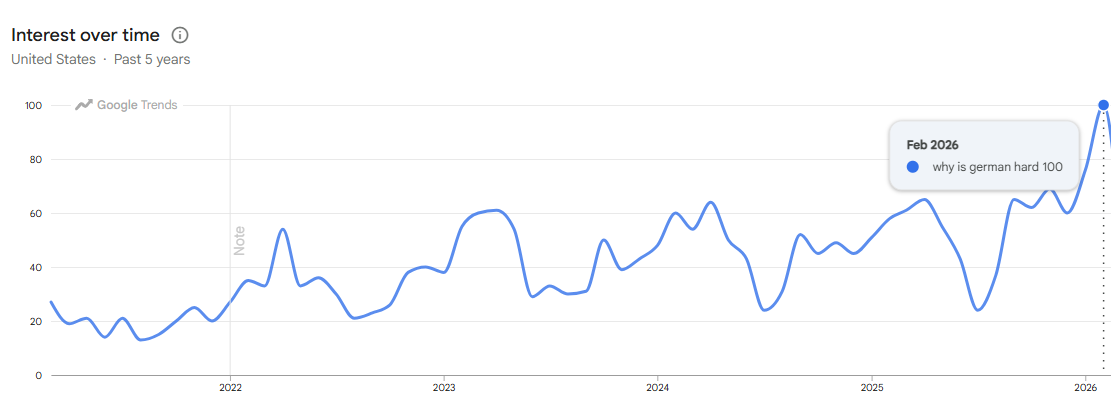
Ask anyone who has tried to learn German, and they’ll probably mention the grammar, the three ways to say “the,” or the words that look like someone fell asleep on the keyboard 😅. And honestly, some of that is deserved. In fact, the consistently rising trend in Google search results for the question "Why is German hard?” shows that many are asking it, and most of them end up walking away.
But if you already speak English, German may not be as hard as you think. In fact, the two languages share the same Germanic roots, which means a surprising amount will feel familiar before you even start.
To help you out, this guide gives you the real picture of what genuinely trips people up when learning German. We’ll talk about which aspects of the language are easier than advertised and how long it actually takes to go from zero to watching German TV without reading every subtitle.
- 7 Best Apps To Learn German On Your Own [REVIEWED]
- 6 Best German Translator Apps For Beginners [TESTED]
- 13 German Traditions You Need To Know Before Your Trip
How Long Does It Take To Learn German?
According to the Foreign Service Institute (FSI), it takes roughly 750 hours of structured study for English speakers to reach professional proficiency in German. However, the honest answer is that it depends on what “learning German” means to you.
If your goal is to hold a basic conversation, you are looking at a very different timeline than someone aiming to work at a company in Berlin. So, instead of relying solely on the recommended number of hours, it helps to know where you are trying to get.
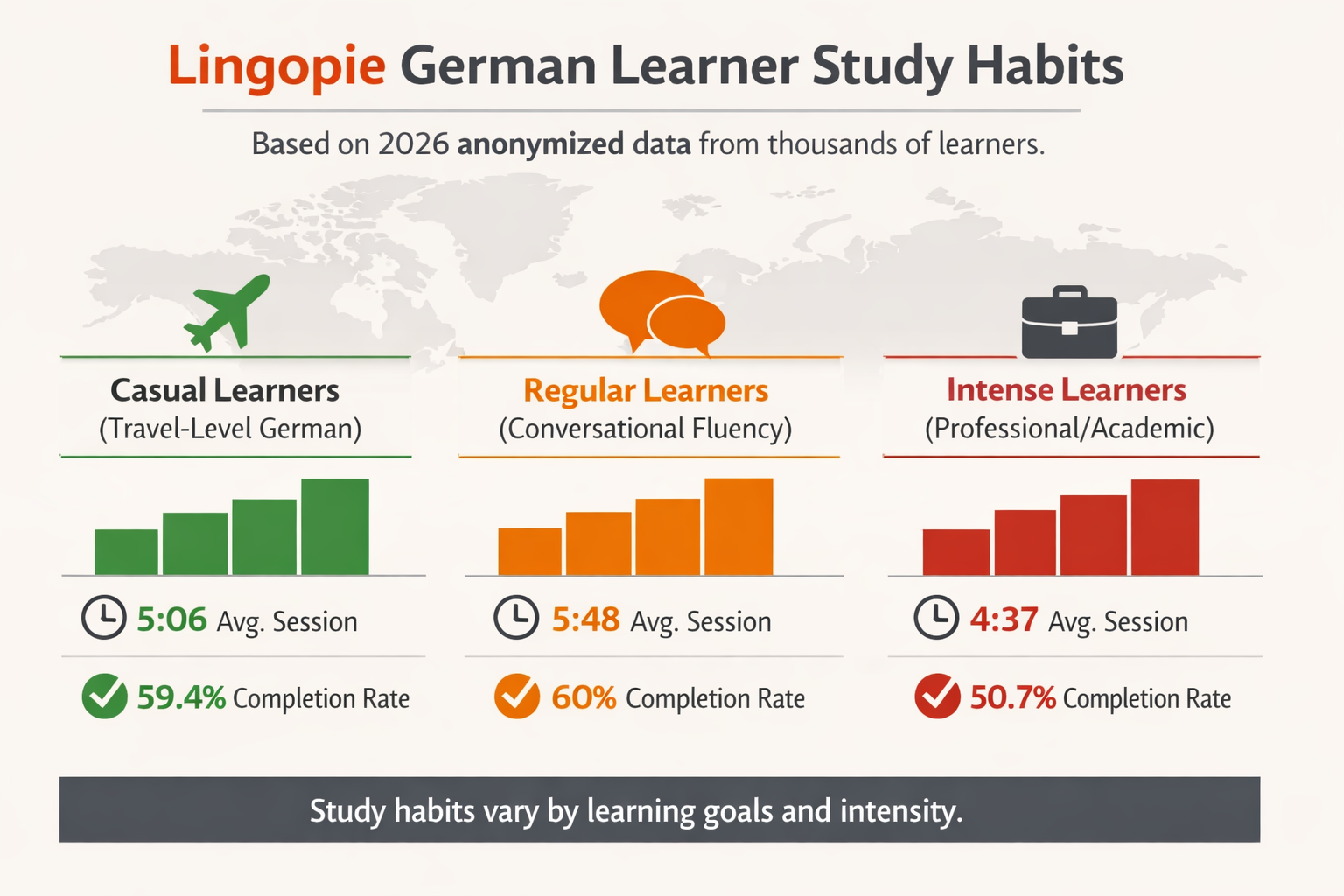
To understand what those timelines look like in practice, we looked at anonymized 2026 usage data from 14,893 Lingopie learners actively studying German.
- Casual learners (travel-level German): 5:06 average session, 59.4% completion rate
- Regular learners (conversational fluency): 5:48 average session, 60% completion rate
- Intense learners (professional or academic use): 4:37 average session, 50.7% completion rate
This data shows that different goals lead to different study patterns. Casual learners tend to explore more broadly and enjoy the content, while regular learners build steady habits that support conversational progress. Intense learners often study with a specific outcome in mind, so their sessions are shorter but more focused.
In other words, everyone is moving along the same learning path, but the pace and approach depend on the level of German they want to reach.
About this data: Anonymized 2026 platform data from 14,893 Lingopie users learning German. Learner types are based on onboarding goals; watch time and completion rate are per-session averages.
What Level of German Proficiency Do You Actually Need?
Those 750 hours from the FSI do not happen all at once, and neither does your progress. German learning moves in distinct stages, and knowing which stage you are aiming for is what turns a vague timeline into an actual plan. That is where CEFR comes in.
CEFR stands for Common European Framework of Reference, and it is the scale that German courses, exams, and employers all use to measure language ability. Think of it as a roadmap with six stops, each one representing a real shift in what you can do with the language.
CEFR Level | What You Can Actually Do | Study Hours Needed | Time at 1 Hour Per Day |
|---|---|---|---|
A1 | Introduce yourself, understand very slow speech | 75 to 100 hours | About 3 months |
A2 | Handle simple transactions, short conversations | 175 to 200 hours | About 6 months |
B1 | Travel independently, follow familiar topics | 350 to 400 hours | About 12 months |
B2 | Watch German TV, work in German, express ideas fluently | 550 to 750 hours | About 18 to 24 months |
C1 | Near-native fluency, academic and professional use | 1000 or more hours | 3 or more years |
Just note that these timelines assume active study. Having German reality shows on while you scroll your phone does not count. Structured lessons, conversation practice, or actively watching German content while genuinely paying attention is what moves the clock forward.
Is German Easy To Learn for English Speakers?
For English speakers, German is significantly more approachable than its reputation suggests. German and English are both Germanic languages, meaning they share the same linguistic roots. That shared history shows up in basic German vocabulary like "Wasser" (water) and "Haus" (house), as well as in grammatical structures like auxiliary verbs, modal verbs, and the same SVO pattern in a simple sentence.
That said, German does have features that English dropped centuries ago, particularly grammatical gender and the case system, which we cover in detail below. But these are learnable patterns, not walls. The table below shows exactly where German and English line up and where they part ways.
Feature | English | German |
|---|---|---|
Language Family | Germanic | Germanic |
Grammatical Gender | None | Three genders: masculine, feminine, neuter |
Case System | Minimal, only in pronouns | Four cases: nominative, accusative, dative, genitive |
Word Order | Fixed subject verb object | Flexible, verb shifts in subordinate clauses |
Compound Words | Occasional | Extremely common, often forming very long German words |
Pronunciation | Many irregularities | Largely consistent, fewer exceptions than English |
Shared Vocabulary | — | Over 60% of basic vocabulary has the same meaning in both languages |
Why Is German Easier Than You Think?
Most of the fear around German comes from reputation, not reality. In fact, English speakers learning German have a built-in advantage that speakers of other languages simply do not have, and it goes much deeper than a few words that look familiar.
German Vocabulary Is Close To English
Because both languages share Germanic roots, a large portion of everyday German vocabulary looks like, sounds like, or is both an English word. Words like "Arm," "Finger," "Garten," and "Musik" require zero guesswork for native English speakers.
As someone learning a language myself, having German-English cognates is a huge win. Most foreign language learners spend months building basic vocabulary from scratch. For English speakers studying German, a significant portion of that work is already done.
| German Word | English Equivalent | Example Sentence | Translation |
|---|---|---|---|
| der Arm | Arm | Mein Arm tut weh. | My arm hurts. |
| der Finger | Finger | Sie zeigt mit dem Finger. | She points with her finger. |
| das Gras | Grass | Das Gras ist grün. | The grass is green. |
| der Garten | Garden | Er arbeitet im Garten. | He works in the garden. |
| die Musik | Music | Ich höre gern Musik. | I like listening to music. |
| das Gold | Gold | Der Ring ist aus Gold. | The ring is made of gold. |
| der Wind | Wind | Der Wind ist stark. | The wind is strong. |
| warm | Warm | Es ist warm heute. | It is warm today. |
That said, watch out for false friends, German words that look like English words but mean something completely different. For example, "gift" in German means poison, not a present. "bald" means soon, not hairless. They are rare enough not to slow you down, but common enough to be aware of.
German Pronunciation Has Fewer Irregularities Than English
German pronunciation is actually more consistent than English because almost every letter makes one sound. Once you know the rules, that same German pronunciation stays consistent across every German word you encounter. This means that you can look at a word you have never seen before and pronounce it correctly on the first attempt.
The table below shows how German pronunciation rules compare to the inconsistencies English speakers are already used to navigating.
| Sound | German Rule | English Equivalent | Consistency |
|---|---|---|---|
| a | Always "ah" as in "father" | Varies: "cat," "cake," "car" | German wins |
| e | Always "eh" as in "bed" | Varies: "bed," "be," "the" | German wins |
| ie | Always "ee" as in "see" | Varies: "field," "friend," "die" | German wins |
| ei | Always "eye" as in "mine" | Varies: "eight," "either," "ceiling" | German wins |
| ch | Two sounds depending on context | Rarely appears in native English words | Learning required |
| ü | No direct English equivalent | No equivalent | Learning required |
| ß | Always a double "s" sound | No equivalent | Simple once known |
For English speakers early in their German learning journey, that consistency in pronunciation is one of the first genuinely encouraging things you will discover.
Familiar German Alphabet
The German alphabet uses the same 26 letters as English, with four additions: ä, ö, ü, and ß. For native English speakers, this means you can read German sentences because of the familiar Latin script, which is an advantage most people take entirely for granted until they try learning a foreign language with a completely different writing system, like Japanese or Chinese.
The table below shows the German alphabet additions alongside their closest English sound equivalents.
| Character | Name | Closest English Sound | Example German Word |
|---|---|---|---|
| ä | A-Umlaut | "e" as in "bed" | Mädchen (girl) |
| ö | O-Umlaut | "u" as in "burn" | schön (beautiful) |
| ü | U-Umlaut | No direct equivalent, round your lips to say "ee" | über (over) |
| ß | Eszett | Double "s" as in "kiss" | Straße (street) |
For English speakers learning German, the alphabet is genuinely one of the easiest parts of the whole learning process. It removes one of the biggest early barriers that learners of other languages face entirely.
German Grammar Shares Structural Similarties To English
A simple sentence in German follows the same subject-verb-object pattern as English. "Der Hund beißt den Mann" follows exactly the same logic as "The dog bites the man." That shared foundation means that English speakers learning German do not have to rewire their thinking about building a sentence at the most basic level.
Both languages also use auxiliary verbs to form perfect tenses. Just as English uses "have" and "be" to say "I have eaten" or "I have gone," German uses "haben" and "sein" in the same structural role. Modal verbs work the same way too. "Ich kann Deutsch sprechen" maps almost directly onto "I can speak German."
The table below further shows the key structural features that German and English share.
| Grammar Feature | English Example | German Example |
|---|---|---|
| Subject verb object | The dog bites the man | Der Hund beißt den Mann |
| Auxiliary verbs | I have eaten | Ich habe gegessen |
| Modal verbs | I can speak German | Ich kann Deutsch sprechen |
| Present tense | I go to school | Ich gehe zur Schule |
| Future with time marker | I go tomorrow | Ich gehe morgen |
The honest takeaway is that German grammar gives English speakers a recognizable foundation to build on. The similarities are real, and they carry you further than you expect in the early stages of your German learning journey.
 Sofia Garcette
Is German Hard To Learn?
German has real challenges, and there is no point pretending otherwise. The good news is that every difficulty covered in this section has a clear strategy attached to it. None of them should hinder you from learning and actually speaking German confidently.
German Has Long Complex Words
German has a habit of combining multiple words into a single one with no spaces or hyphens. This is called compounding, and it produces some spectacularly long German words. "Kraftfahrzeug-Haftpflichtversicherung," for example, means car liability insurance.
When English speakers encounter these long German words for the first time, the reaction is usually somewhere between amusement and genuine alarm. However, the trick here is to understand that they are built from smaller words that you already know or will learn.
| German Compound Word | Word 1 | Word 2 | Literal Meaning | Actual Translation |
|---|---|---|---|---|
| Kühlschrank | kühl (cool) | Schrank (cupboard) | Cool cupboard | Refrigerator |
| Handschuhe | Hand (hand) | Schuhe (shoes) | Hand shoes | Gloves |
| Flugzeug | fliegen (to fly) | Zeug (thing) | Flying thing | Airplane |
| Krankenhaus | krank (sick) | Haus (house) | Sick house | Hospital |
| Glühbirne | glühen (to glow) | Birne (pear) | Glowing pear | Light bulb |
| Zahnbürste | Zahn (tooth) | Bürste (brush) | Tooth brush | Toothbrush |
To power through these long German words, I recommend building your vocabulary from individual root words first, rather than trying to memorize compounds whole. This means you need to break each apart and identify the pieces, just as we did in the table above.
German Genders Can Be Frustrating
Every noun in German has a gender: masculine, feminine, or neuter. This affects the article in front of it, der, die, or das, and it also changes the adjectives and pronouns used with it. English speakers only use one definite article, "the," so this is a genuinely unfamiliar concept and one of the first real friction points in learning German genders.
What makes grammatical gender particularly frustrating is that it does not always follow logical rules. "Das Mädchen," meaning girl, is neuter. "Der Stuhl," meaning chair, is masculine. "Die Sonne," meaning sun, is feminine. You cannot always guess the gender from the meaning of the word, which means learning German effectively requires memorizing the gender alongside every new noun from the very beginning.
Gender | Article | Example | English Translation |
|---|---|---|---|
Masculine | der | der Hund | the dog |
Feminine | die | die Katze | the cat |
Neuter | das | das Kind | the child |
Plural (all genders) | die | die Kinder | the children |
That said, there are patterns. So to learn this properly, I recommend never learning a German word without its article. Store every noun as a three-part unit: the article, the word, and its plural form. It takes slightly longer at first and pays back significantly later.
Many experienced German learners also use color coding, assigning a color to each gender and writing new nouns in that color, which makes the association stick faster.
German Word Order Can Be Confusing
While the SVO pattern is certainly easy to follow, there will come a point when you'll need to create complex sentences. In this case, German word order starts to behave very differently from English, and it catches most English speakers learning German off guard.
There are three patterns worth knowing:
Subordinate clauses: The verb goes to the end
When you introduce a clause with a conjunction like "weil" (because) or "dass" (that), the verb moves to the very end. In English, you say "I stay home because it is raining." In German, that becomes "Ich bleibe zu Hause, weil es regnet." The verb lands last.
Verb-second rule: the verb always sits in position two
In German, the finite verb must always sit in the second position of a main clause, even if something other than the subject comes first. "Heute gehe ich in die Schule" (Today I go to school) puts "heute" first but keeps the verb in position two.
Separable verbs: one verb, two pieces
Some German verbs split in two when used in a sentence. "Anrufen" means to call, but in use it becomes "Ich rufe dich an," with "an" pushed to the very end. In longer German sentences, the two parts of the verb can be separated by many words, which creates a listening challenge that simply does not exist in English.
Limited Exposure Compared to English
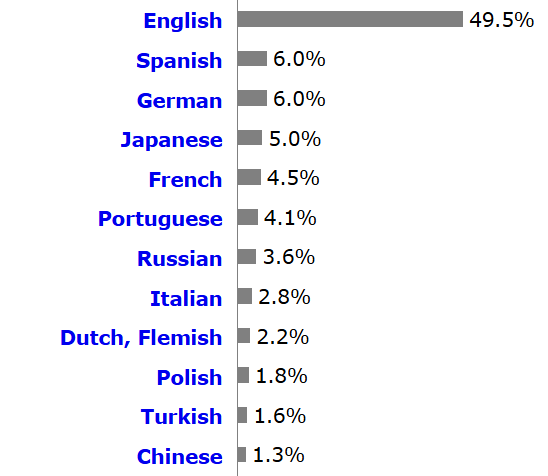
Films, music, social media, and the internet itself all run largely in English, which means English speakers absorb the language constantly without even trying. German does not have that same global presence, and for German learners living outside the German-speaking world, that gap requires active effort to close.
The most effective way to close that gap is to build German into your existing daily habits rather than treating it as separate study time. For instance, you can start by switching your phone to German, following German creators online, and start watching German content as early as your level allows.
Remember, regular exposure to real German spoken by native speakers builds the kind of intuition that textbooks alone cannot give you, and it makes every other part of the learning process move faster.
Practical Advantages For English Speakers Learning German
For English speakers, learning German is one of the most strategically useful language investments you can make. Germany is the third-largest economy in the world, and German language skills open doors across careers, academics, and an entire region that most foreign language learners overlook entirely.
On top of that, English speakers reach German fluency faster than speakers of most other languages, and the skills transfer further than most people realize.
Here are the numbers that make the case:
- 97% of jobs in Germany require German language proficiency, where the average monthly earnings sit at EUR 5,072
- German is the second most requested foreign language in European job ads after English
- Reaching B2 German gives you a significant head start on Dutch, Swedish, and Norwegian, all closely related Germanic languages
- German opens the entire DACH region, covering Germany, Austria, and Switzerland
Is German Easy To Learn For English Speakers?
German is not the easiest foreign language for English speakers, but it is far more approachable than its reputation suggests. The hard parts, particularly German genders, the case system, and word order in complex sentences, are real but learnable with consistent exposure and the right approach.
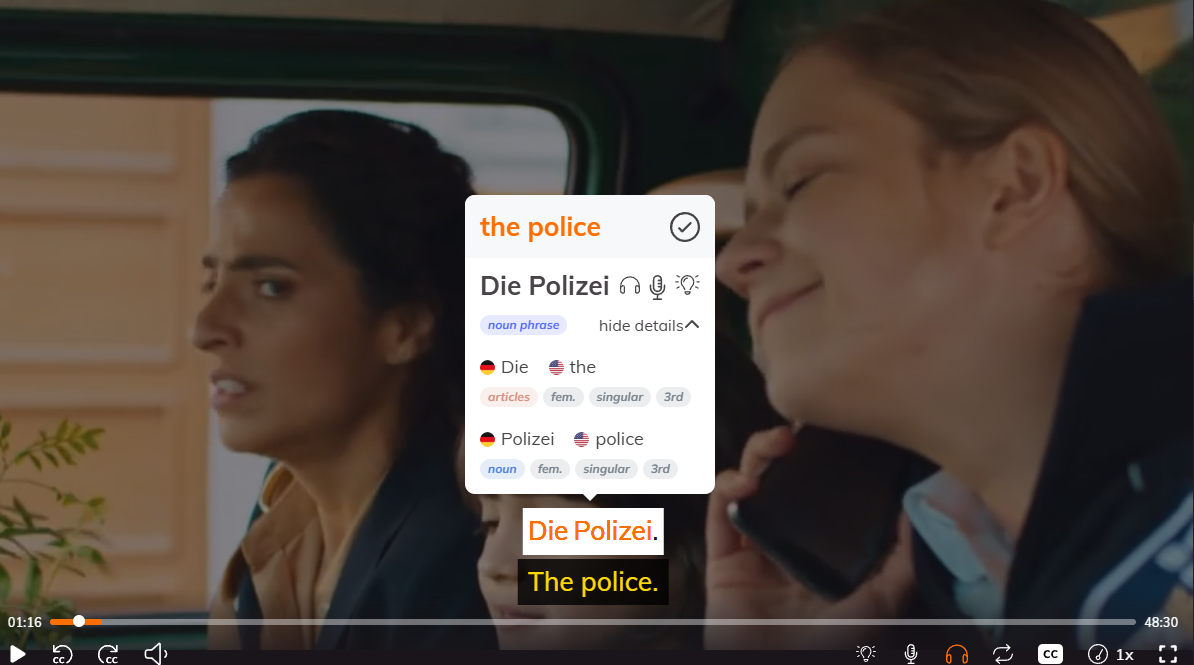
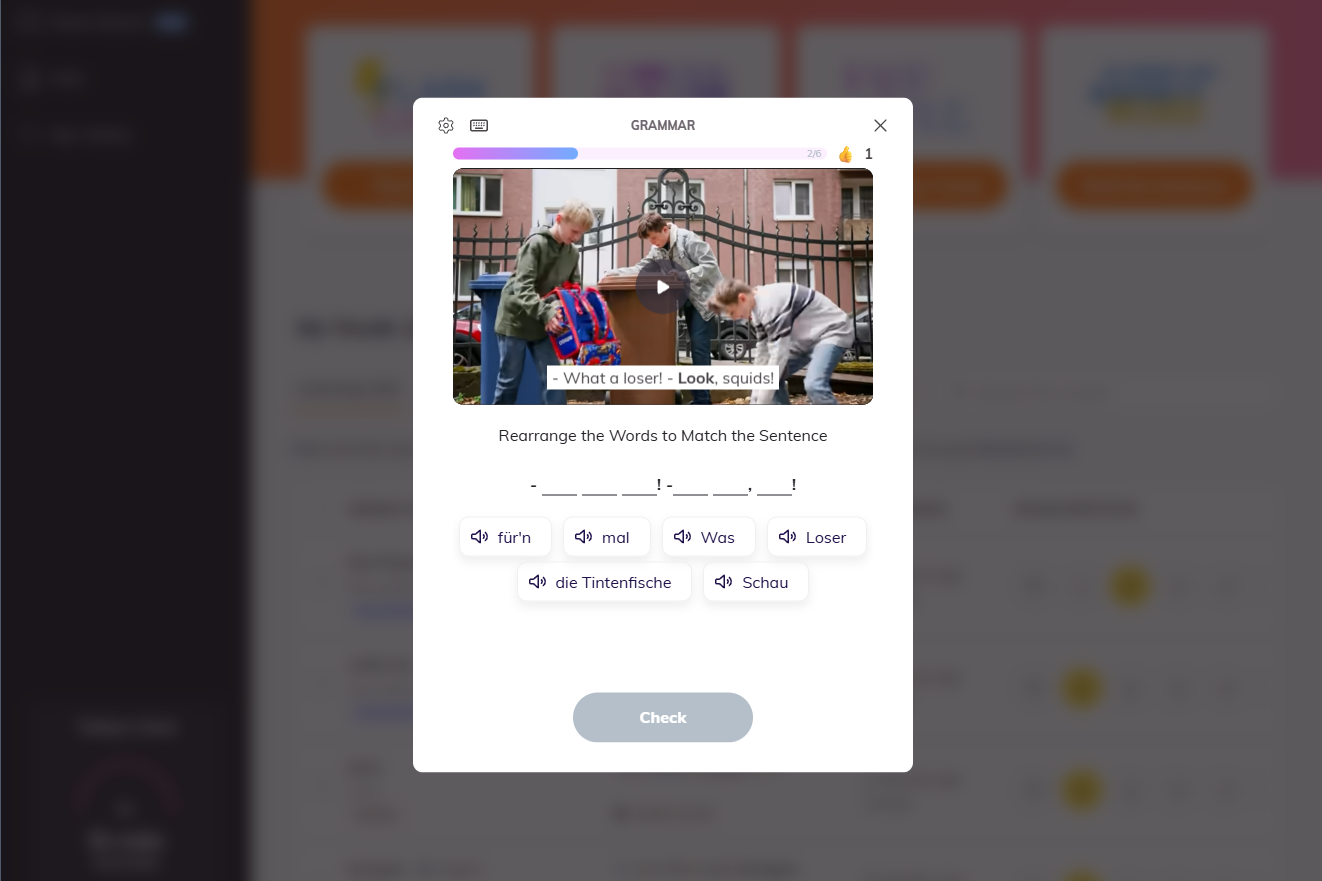
The fastest way to build that exposure is through content you actually want to watch. Lingopie lets you learn German through TV shows and films with interactive subtitles, turning every episode into an active study session.
If you are ready to stop treating German as something to get through and start experiencing it as something genuinely enjoyable, that is exactly where to start.

![Japanese vs Korean: Which Language Should You Be Learning? [2026]](/blog/content/images/size/w1200/2026/03/Japanese-vs-Korean.jpg)

![7 Best Apps To Learn German On Your Own [REVIEWED]](/blog/content/images/size/w300/2026/01/best-apps-to-learn-german-on-your-own.png)
