

So, you already know arigatō (thank you) and konnichiwa (hello). What's next? Learning how to speak Japanese doesn't mean you have to memorize hundreds of words or master all three writing systems first. Start with the five basic vowel sounds, pick up a few everyday phrases, and learn simple sentence patterns to get your first conversations going.
And there's plenty more you can say beyond "hello" and "thank you"! This guide covers 25 useful Japanese phrases, the basics of pronunciation, and how to put your own sentences together. You'll also learn when to use polite or casual Japanese and get a step-by-step speaking routine you can actually stick to.
Key Takeaways
- Master Japanese pronunciation by learning the five vowels, rhythm, and sound timing to avoid changing a word's meaning.
- Learn 25 basic Japanese phrases for greetings, introductions, questions, and everyday requests.
- Use three simple sentence patterns with desu, o kudasai, and -masu/-masen to build your own Japanese sentences.
- Start with polite Japanese and improve your speaking skills through daily listening, shadowing, and conversation practice.

Japanese Pronunciation Basics
Japanese pronunciation has three main features: five vowel sounds, rhythm, and pitch accent. Unlike English, Japanese follows a rhythm based on small timing units called morae, which help determine how long sounds last. This matters because holding a vowel longer or pausing before a consonant can change a word's meaning. Let's look at how these work and how you can practice them.
Learn the 5 Japanese Vowels
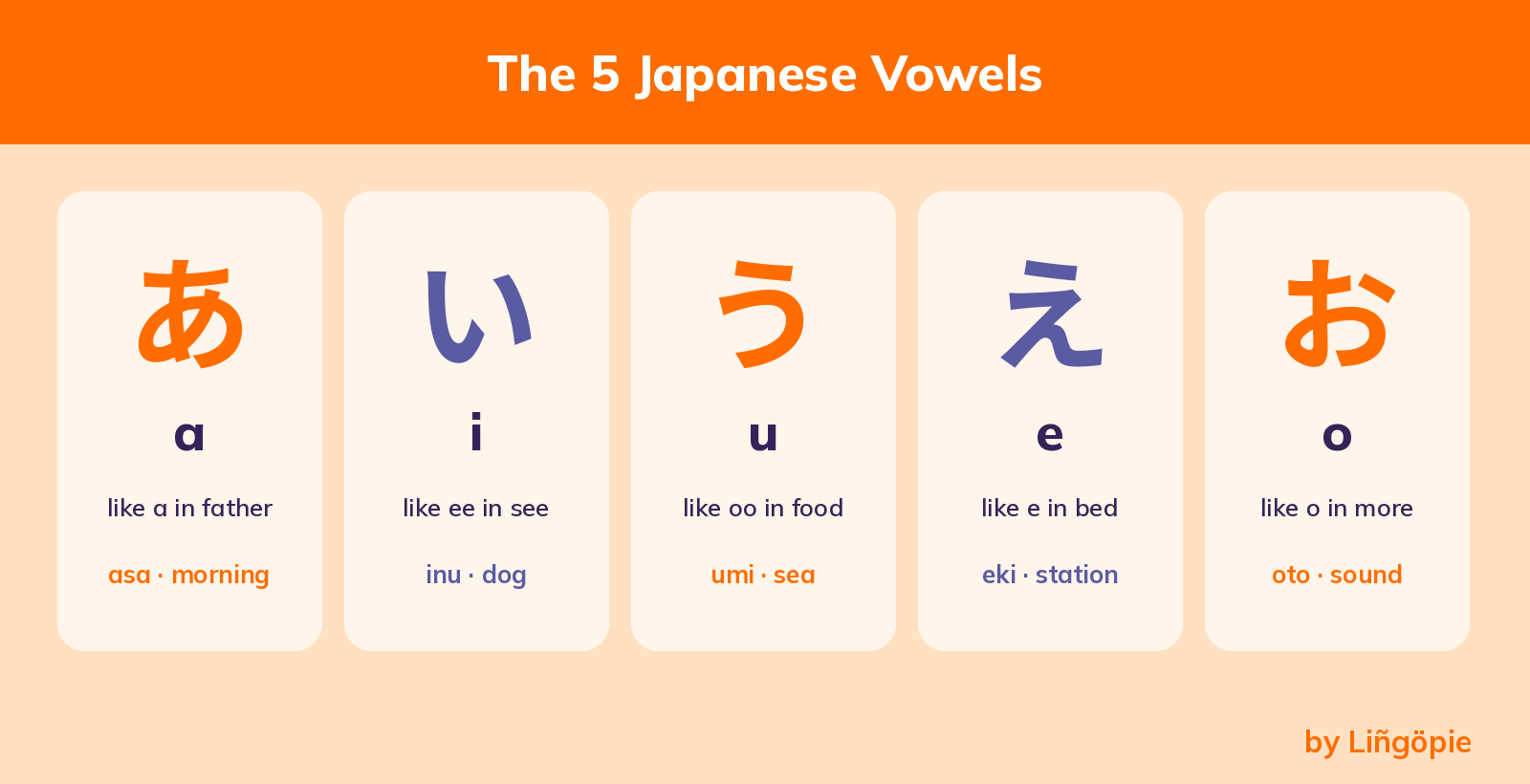
Japanese has five basic vowel sounds: a, i, u, e, and o. Unlike English vowels, which can sound different depending on the word, Japanese vowels are pronounced fairly consistently. Once you learn them, you can start combining them with consonants to make sounds like ka, ki, ku, ke, and ko.
Here's how to pronounce each vowel using familiar English sounds as a guide:
Japanese vowel | Pronunciation guide | Japanese example |
|---|---|---|
あ (a) | Like a in father | あさ · asa · morning |
い (i) | Like ee in see | いぬ · inu · dog |
う (u) | Similar to oo in food, but with less rounded lips | うみ · umi · sea |
え (e) | Similar to e in bed, but with a slightly higher tongue position | えき · eki · station |
お (o) | Similar to o in more, but without the English vowel glide | おと · oto · sound |
Understand Japanese Rhythm
In Japanese, holding a sound longer can change a word's meaning. This applies to both vowels and consonants, so paying attention to timing is essential for speaking clearly.
Short sound | Long or doubled sound | What's different? |
|---|---|---|
おばさん (obasan) — aunt | おばあさん (obāsan) — grandmother | The long ā adds one mora. |
おじさん (ojisan) — uncle | おじいさん (ojīsan) — grandfather | The long ī adds one mora. |
きて (kite) — come | きって (kitte) — postage stamp | The doubled t creates an extra beat of closure. |
さか (saka) — slope | さっか (sakka) — author | The doubled k creates an extra beat of closure. |
Long vowels last about twice as long as short vowels, while doubled consonants create a brief pause before the sound. For example, kitte (postage stamp) has a short pause before the t, while kite (come) does not.
To practice Japanese rhythm, tap your finger or clap once for each mora. Neko (cat) takes two taps (ne-ko), while sakura (cherry blossom) takes three (sa-ku-ra). For long vowels, hold the sound through the extra tap. For doubled consonants, use that beat to pause before releasing the sound.
Practice Long Vowels and Double Consonants
Long vowels can change a word's meaning. For example, koko (ここ) means "here," while kōkō (こうこう) means "high school," with both o sounds held longer.
In hiragana, the long ō sound is often written as おう or おお, while ē may appear as えい or ええ. In romaji, a line above a vowel (called a macron) shows that it's long, as in Tōkyō (東京).
Doubled consonants use a small っ (sokuon) to indicate a brief pause. In gakkō (がっこう, school), pause before the k rather than pronouncing it twice.
Recognize Japanese Pitch Accent
Japanese uses pitch accent, meaning your voice rises or falls when pronouncing certain words. Unlike English stress, these high- and low-pitch patterns can sometimes change a word's meaning. For example, hashi (はし) can mean either "chopsticks" or "bridge," depending on the pitch pattern in standard Tokyo Japanese:
Japanese word | Meaning | Pitch pattern |
|---|---|---|
箸 (hashi) | Chopsticks | High → Low |
橋 (hashi) | Bridge | Low → High |
雨 (ame) | Rain | High → Low |
飴 (ame) | Candy | Low → High |
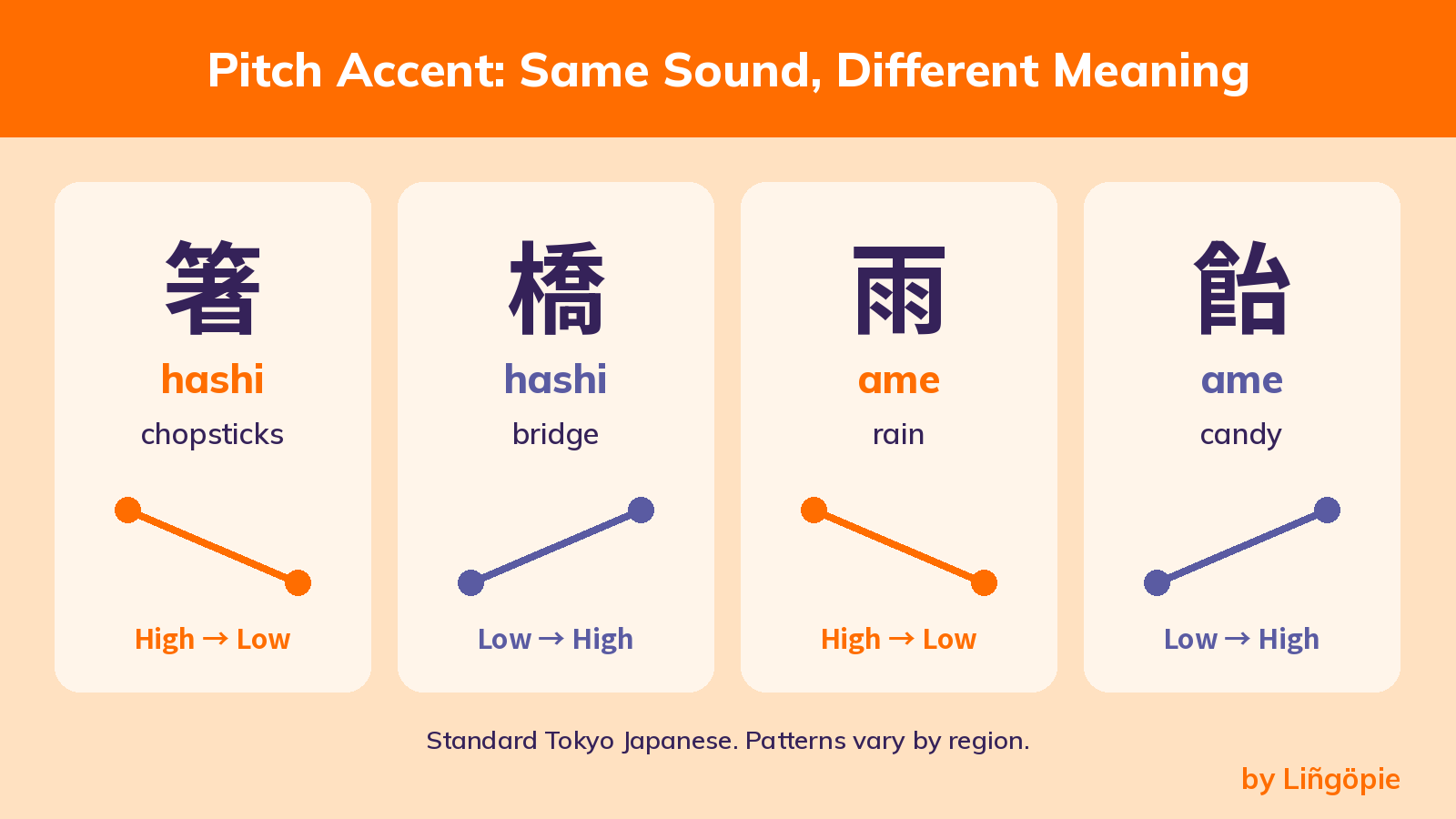
Pitch accent varies across Japan, so you may hear different patterns in other regions. As a beginner, you don't need to master it immediately. Focus on listening to native speakers and imitating their pitch, while prioritizing clear vowels and correct timing.
25 Basic Japanese Phrases to Start Speaking
Below are 25 basic Japanese phrases organized by everyday situations, with Japanese characters, romaji pronunciation, and English translations. Most use polite language, making them suitable for beginners speaking with strangers, shop staff, or people they've just met.
Greetings
In Japan, greetings often come with a small bow, especially when meeting someone for the first time or in a formal setting. A slight nod of the head is usually enough for a casual greeting, while a more noticeable bow shows respect in formal situations.
Japanese | Romaji | English meaning |
|---|---|---|
おはようございます | Ohayō gozaimasu | Good morning (polite) |
こんにちは | Konnichiwa | Hello / Good afternoon |
こんばんは | Konbanwa | Good evening |
はじめまして | Hajimemashite | Nice to meet you (first introduction) |
じゃあ、また | Jā, mata | See you later (casual) |
Looking for more greetings? Check out our guide to Japanese phone greetings!
Thanks and Apologies
Being polite is an important part of everyday communication in Japan, and knowing how to say thank you or apologize makes conversations much smoother. You'll also hear sumimasen quite often. Depending on the situation, it can mean "excuse me," "I'm sorry," or even "thank you" when someone has gone out of their way to help you.
Japanese | Romaji | English meaning |
|---|---|---|
ありがとうございます | Arigatō gozaimasu | Thank you (polite) |
どうもありがとうございます | Dōmo arigatō gozaimasu | Thank you very much |
すみません | Sumimasen | Excuse me / I'm sorry |
ごめんなさい | Gomen nasai | I'm sorry |
どういたしまして | Dō itashimashite | You're welcome |
Introductions
When introducing yourself in Japanese, it's common to share your name and end with yoroshiku onegaishimasu, a polite expression that roughly means "I look forward to getting along with you." Japanese speakers also tend to use family names and honorifics like -san when addressing someone they've just met.
Japanese | Romaji | English meaning |
|---|---|---|
私はアンナです。 | Watashi wa Anna desu. | I'm Anna. |
お名前は何ですか? | Onamae wa nan desu ka? | What's your name? |
フィリピンから来ました。 | Firipin kara kimashita. | I'm from the Philippines. |
よろしくお願いします。 | Yoroshiku onegaishimasu. | Nice to meet you / I look forward to getting along with you. |
日本語を勉強しています。 | Nihongo o benkyō shite imasu. | I'm studying Japanese. |
Requests and Questions
To make polite requests, use onegaishimasu (please) or kudasai (please give me), especially when ordering food or asking for something. For questions, Japanese often adds ka (か) at the end of a sentence. You can also adapt common phrases by replacing kore (this) with sore (that, near the listener) or are (that, over there), and use doko desu ka? (where is it?) after naming a place.
Japanese | Romaji | English meaning |
|---|---|---|
これをください。 | Kore o kudasai. | This one, please. |
メニューをお願いします。 | Menyū o onegaishimasu. | The menu, please. |
トイレはどこですか? | Toire wa doko desu ka? | Where is the toilet? |
いくらですか? | Ikura desu ka? | How much is it? |
もう一度お願いします。 | Mō ichido onegaishimasu. | One more time, please. |
Conversation Survival
If someone speaks too quickly, politely ask them to slow down: sumimasen, yukkuri hanashite kudasai (Excuse me, please speak slowly). Also, remember that hai (yes) doesn't always mean agreement. Japanese speakers sometimes use it simply to show they're listening.
Japanese | Romaji | English meaning |
|---|---|---|
はい。 | Hai. | Yes. |
いいえ。 | Iie. | No. |
わかりません。 | Wakarimasen. | I don't understand. |
ゆっくり話してください。 | Yukkuri hanashite kudasai. | Please speak slowly. |
日本語が少し話せます。 | Nihongo ga sukoshi hanasemasu. | I can speak a little Japanese. |
Related: How to Say Yes in Japanese: 5+ Easy Ways for Beginners
3 Japanese Sentence Patterns That Get You Talking
Three simple sentence patterns can help you introduce yourself, make requests, and talk about everyday activities. Japanese typically places verbs at the end of sentences and uses particles like wa (は) and o (を) to show how words relate to each other. Once you understand these patterns, you can create your own sentences by swapping in familiar words.
Pattern 1: [Noun] desu — Say What Something Is
The simplest way to introduce yourself or identify something is to place desu (です) after a noun. It works similarly to "am," "is," or "are" in English, although the grammar isn't exactly the same.
Japanese | Romaji | English |
|---|---|---|
私は学生です。 | Watashi wa gakusei desu. | I'm a student. |
これは本です。 | Kore wa hon desu. | This is a book. |
私はアメリカ人です。 | Watashi wa Amerikajin desu. | I'm American. |
The particle wa (は) marks the sentence topic and is pronounced wa, not ha. To turn a statement into a polite question, add ka (か) after desu, as in gakusei desu ka? (Are you a student?). You can also leave out the subject when it's clear from context.
Pattern 2: [Noun] o kudasai — Ask for Something
Use [noun] o kudasai (をください) when requesting an item, particularly in shops and restaurants. The particle o (を) marks the item you're asking for, while kudasai means "please give me."
Japanese | Romaji | English |
|---|---|---|
水をください。 | Mizu o kudasai. | Water, please. |
コーヒーをください。 | Kōhī o kudasai. | Coffee, please. |
これをください。 | Kore o kudasai. | This one, please. |
You'll also hear onegaishimasu (お願いします) when people make requests. Both are polite, but kudasai specifically asks someone to give you something, while onegaishimasu works in a wider range of situations.
Pattern 3: [Verb]-masu / -masen — Talk About Actions
Japanese verbs commonly end in -masu (ます) when speaking politely about everyday actions. To make the verb negative, change -masu to -masen (ません).
Japanese | Romaji | English |
|---|---|---|
日本語を話します。 | Nihongo o hanashimasu. | I speak Japanese. |
日本語を話しません。 | Nihongo o hanashimasen. | I don't speak Japanese. |
毎日勉強します。 | Mainichi benkyō shimasu. | I study every day. |
The -masu form can describe present habits or future actions, depending on context. For example, ashita benkyō shimasu (明日勉強します) means "I'll study tomorrow."
Polite vs. Casual Japanese: Which Should You Use?
Beginners should generally start with polite Japanese, using desu and -masu when speaking to strangers, teachers, colleagues, and people they've just met. Casual Japanese is more common among friends, family members, and people who know each other well.
English | Polite Japanese | Casual Japanese |
|---|---|---|
I'm a student. | 学生です (Gakusei desu) | 学生だ (Gakusei da) |
I eat. | 食べます (Tabemasu) | 食べる (Taberu) |
I don't eat. | 食べません (Tabemasen) | 食べない (Tabenai) |
Thank you. | ありがとうございます (Arigatō gozaimasu) | ありがとう (Arigatō) |
Sorry. | すみません (Sumimasen) | ごめん (Gomen) |
Are you okay? | 大丈夫ですか? (Daijōbu desu ka?) | 大丈夫? (Daijōbu?) |
Casual speech is appropriate once you've developed a comfortable relationship with someone, although age, social expectations, and context still matter. Japanese speakers also often drop da in casual statements: gakusei alone can mean "I'm a student" when the context is clear.
You may also hear about keigo, a more advanced system of respectful and humble language used in professional and formal settings. You don't need to master keigo to start speaking Japanese.
How to Practice Speaking Japanese Step by Step
To improve your spoken Japanese, practice listening, shadowing, speaking aloud, and getting feedback. Just 15 minutes of daily practice can help you improve your pronunciation, remember useful phrases, and build speaking confidence.
Step 1: Listen to Japanese Every Day
Start with short Japanese conversations, beginner podcasts, or shows with clear dialogue. Choose a 20–30-second clip and listen once without stopping. See if you can recognize a familiar word or phrase, then replay it with subtitles to check what you heard. Focus on one or two expressions rather than trying to understand every word.Captions make a measurable difference: in one study, learners who watched a TV episode with captions improved their listening scores by 16.9 percentage points, versus 7.1 without captions (Birulés-Muntané & Soto-Faraco, 2016).
Step 2: Shadow Native Japanese Speakers
Shadowing means repeating a speaker's words while following their pronunciation, rhythm, and pitch. It's particularly useful for practicing the vowel lengths and timing differences covered earlier. Use the same short clip and follow three steps:
- Listen: Play the sentence and pay attention to how the speaker says it.
- Repeat together: Play it again and speak along with the audio, matching the timing as closely as possible.
- Speak independently: Pause the recording and repeat the sentence without help.
Start with one sentence at a time. Once you can say it comfortably, move on to a longer phrase.
Step 3: Speak Japanese From Day One
Start making your own sentences using the three patterns you've learned. For example, say watashi wa gakusei desu (I'm a student), then replace gakusei with another noun that describes you. You can also practice talking about your routine using verbs like tabemasu (eat) or benkyō shimasu (study). Always practice aloud, even when you're alone.
Step 4: Get Feedback and Track Your Progress
Speaking practice becomes more useful when you know what needs improving. You can find conversation partners through HelloTalk or book lessons with a tutor on italki to get feedback on your pronunciation and sentence structure.
Record yourself speaking Japanese for 30 seconds once a week. Compare your recording with native-speaker audio, paying attention to vowel length, rhythm, and clarity. Keep your older recordings so you can hear how your pronunciation and confidence change over time.
Related: What's the Best Way to Learn Japanese? A Step-by-Step Guide
How Long Does It Take to Speak Japanese?
You can start speaking basic Japanese within days or weeks, but holding conversations confidently takes longer. The U.S. Foreign Service Institute (FSI) estimates 88 weeks or 2,200 class hours to reach professional working proficiency in Japanese, not basic conversational ability.
- First few weeks: Use greetings, introductions, and simple requests.
- After several months: Have short conversations about familiar topics with regular practice.
- Longer term: Speak more independently and understand natural conversations more easily.
These aren't fixed timelines. Your progress depends on how consistently you listen, speak, and practice.

Practice Speaking Japanese With Lingopie
Lingopie lets you learn Japanese through anime, dramas, and movies with interactive Japanese-English subtitles. Click any word for a translation, save it as a flashcard, and replay lines to shadow native speakers. Lingopie is used by more than 2 million learners and rated 4.6/5 on Trustpilot from 3,878 reviews (November 2026). Try Lingopie free and turn your next episode into speaking practice.
Frequently Asked Questions
How can I start speaking Japanese?
Start by learning basic Japanese phrases and the five vowel sounds, then practice speaking aloud for at least 15 minutes a day. Simple patterns like [noun] desu and [noun] o kudasai let you build your own sentences from the first week.
Is Japanese hard to pronounce for English speakers?
Japanese pronunciation is relatively straightforward for English speakers, with only five vowels. The tricky parts are vowel length, consonant timing, and pitch accent, which take practice.
Can I learn to speak Japanese without learning to read?
Yes, you can start speaking without reading, but learning hiragana and katakana will make studying much easier and help you avoid relying on romaji.
How long does it take to speak Japanese fluently?
Speaking Japanese fluently takes years of consistent practice. The FSI estimates about 2,200 class hours for professional working proficiency, but basic conversations come much sooner.
Can I learn to speak Japanese by watching anime?
Yes, anime can improve your listening and pronunciation, especially with subtitles and shadowing. Anime speech is often casual or exaggerated, though, so pair it with speaking practice and everyday polite Japanese.