
Examples of gamification in education include Duolingo streaks, Kahoot! quizzes, Khan Academy badges, and classroom reward systems. These activities use game elements to make learning more engaging, and interest in the approach is growing. In fact, research publications on gamification in education and training increased from just 7 in 2011 to 1,510 in 2023.
But what does gamification look like in practice, and does it actually help students learn? In this guide, we'll explore 12 gamification in education examples, including classroom activities, educational apps, and strategies for adult learners. We'll also examine what research says about their effectiveness, the potential drawbacks, and practical ways teachers can introduce gamified learning into their lessons.
Key Takeaways
- Gamification in education uses game elements like points, badges, leaderboards, and challenges to encourage student participation and make learning more engaging.
- Research shows that gamification can have small-to-medium positive effects on learning outcomes, motivation, and student engagement, although results depend on how it's implemented.
- Effective gamification starts with clear learning objectives and uses meaningful feedback, progress tracking, and collaboration rather than relying solely on competition or rewards.
Gamification in Education Examples at a Glance
Gamification can take many forms, depending on the subject, learners' ages, and learning objectives. Some approaches use digital tools to reward progress, while others turn everyday classroom activities into challenges. Here's a quick comparison of 12 examples of gamification and where they work best.
Example | Game Mechanic | Best For | Age/Level | Cost (USD) |
|---|---|---|---|---|
1. Duolingo | Streaks, XP, leaderboards | Building consistent language practice | Teens and adults | Free; paid plans |
2. Khan Academy | Points, badges, mastery levels | Tracking progress and skill mastery | K–12 and adults | Free |
3. Kahoot!, Quizlet Live, Gimkit | Live quizzes, points, competition | Knowledge review and participation | K–12 and higher education | Free options; paid plans |
4. Minecraft Education | Missions, challenges, exploration | Problem-solving and collaboration | K–12 | Paid school licenses |
5. Quest-based learning | Quests, storylines, levels | Project-based learning and teamwork | K–12 | Free DIY; platform costs vary |
6. PhET, Labster | Simulations, interactive challenges | Science and practical skills | Secondary and higher education | PhET: free; Labster: custom quote |
7. Digital badges and micro-credentials | Badges, achievement milestones | Professional development | Higher education and adults | Free DIY; platform costs vary |
8. Codecademy | Progress bars, skill paths | Self-paced learning | Teens and adults | Free options; paid plans |
9. Educational escape rooms | Puzzles, timed challenges, teamwork | Critical thinking and collaboration | K–12 and higher education | Free DIY; paid Breakout EDU options |
10. Classroom economies | Virtual currency, rewards | Financial literacy and decision-making | K–12 and higher education | Free DIY |
11. ClassDojo | Behavior points, feedback | Classroom routines | Elementary school | Free for teachers |
12. Lingopie | Vocabulary games, spaced repetition quizzes | Language learning through TV shows | Teens and adults | 7-day free trial; paid subscription |
What Is Gamification in Education?
Gamification in education is the practice of adding game design elements to regular learning activities to make them more engaging and motivating. According to a 2011 study by Deterding and colleagues, gamification involves using elements commonly found in games in non-game settings, such as classrooms and online courses.
These game mechanics can include points for completing assignments, badges for mastering skills, leaderboards for tracking performance, levels for measuring progress, and challenges or rewards for reaching learning goals. For example, a math teacher might divide a lesson into five levels, with students earning points for correct answers and badges as they master increasingly difficult problems.
But gamification isn't just about collecting points or winning prizes. It also involves understanding what motivates students to learn. There are two main types of motivation:
- Intrinsic motivation: Learning because an activity is interesting, enjoyable, or personally satisfying, such as solving a challenging puzzle out of curiosity.
- Extrinsic motivation: Learning to achieve a separate outcome, such as earning a badge, receiving a reward, or getting a good grade.
These motivations connect to self-determination theory, developed by psychologists Edward Deci and Richard Ryan. The theory identifies three basic psychological needs that influence motivation:
- Autonomy: Feeling free to make choices, such as selecting which learning challenge to complete.
- Competence: Feeling capable and recognizing improvement through feedback, skill levels, or progress tracking.
- Relatedness: Feeling connected to others through teamwork, group challenges, and shared learning goals.
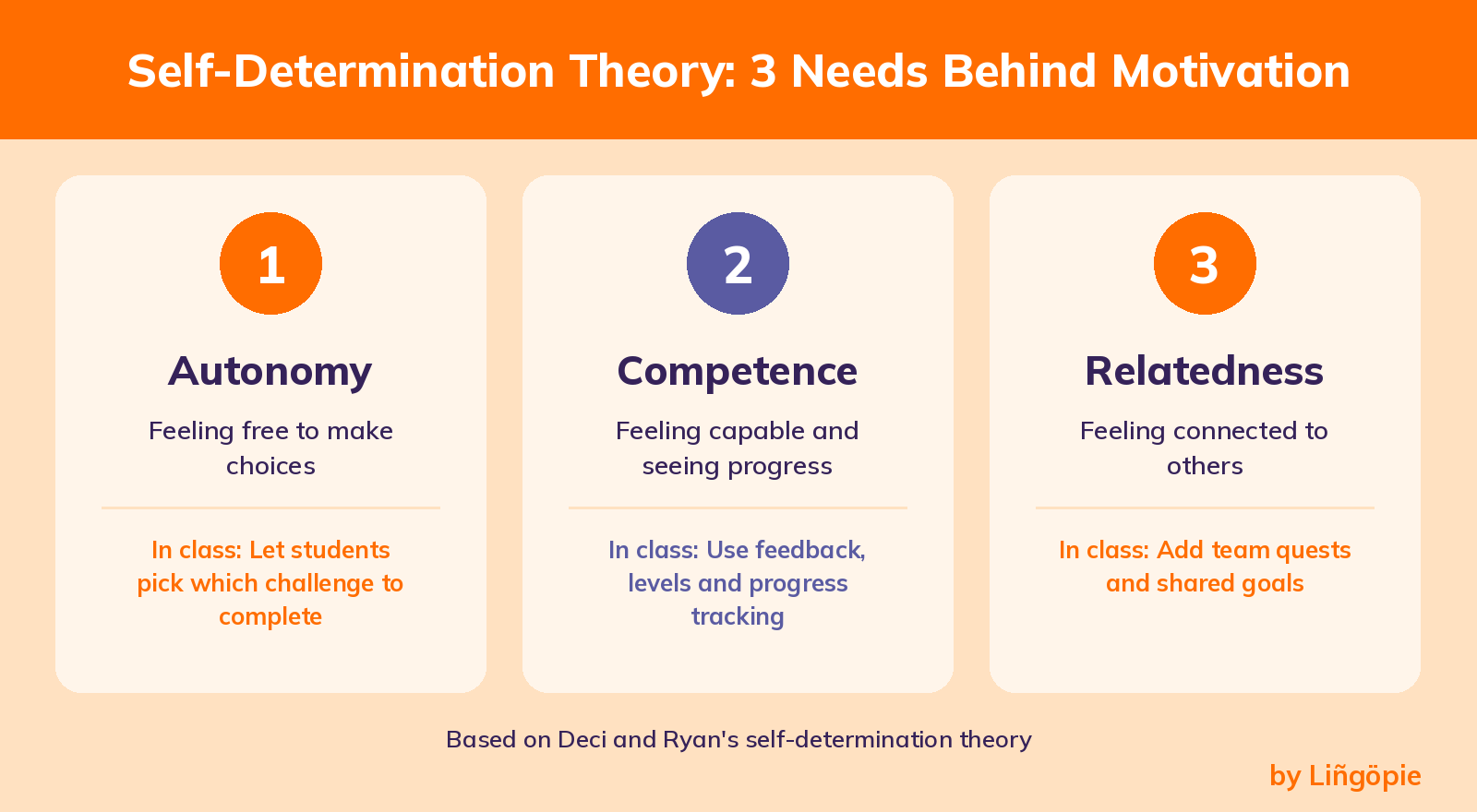
When designed around these needs, gamification can support student engagement by giving learners more control, helping them recognize their progress, and encouraging collaboration. The goal isn't simply to make the learning environment feel like a game, but to use game elements that support meaningful learning.
Gamification vs. Game-Based Learning
The main difference between gamification and game-based learning is how games are used. Gamification adds game mechanics to existing lessons, while game-based learning uses actual games as the learning activity.
For example, awarding students points for completing assignments is gamification because the lesson remains the same, but students receive rewards for their progress. In contrast, using Minecraft Education to explore geometry or a nursing simulation to practice patient care is game-based learning because students develop skills through gameplay.
Here's a quick comparison:
Gamification | Game-Based Learning |
|---|---|
Adds game elements to traditional learning activities | Uses educational games as the main learning activity |
Uses points, badges, leaderboards, and rewards | Uses serious games, simulation games, and interactive challenges |
Encourages participation and tracks learning progress | Develops knowledge and skills through gameplay |
Example: Earning points for completing math assignments | Example: Using Minecraft Education to explore geometric shapes |
Both approaches can support student engagement and learning outcomes. However, gamification changes how learners interact with existing activities, while game-based learning makes gameplay part of the educational experience.
12 Gamification in Education Examples
Gamification can be as simple as awarding points for completing assignments or as interactive as using educational apps and classroom challenges. Below are 12 practical examples showing how different game mechanics work, why they can support learning, and how you can apply them in your own classroom.
1. Duolingo: Streaks, XP, and Leaderboards
Game mechanic: Daily streaks, experience points (XP), and leaderboards.
Duolingo turns language practice into a series of daily goals and friendly competitions. Learners maintain streaks by practicing on consecutive days, earn XP for completing lessons, and compete in weekly leagues based on their scores. These features provide immediate feedback and make progress more visible.
Streaks can help learners build a regular study habit, while XP and leaderboards provide a sense of achievement and healthy competition. However, earning more points doesn't necessarily mean someone has mastered a language, so it's important to balance rewards with actual learning progress.
Teachers can apply a similar approach by creating a seven-day vocabulary challenge where students earn points for completing short daily exercises. Rather than rewarding only the highest scores, they can recognize consistency and improvement to encourage students at different skill levels.
2. Khan Academy: Points, Badges, and Mastery Levels
Game mechanic: Energy points, achievement badges, and mastery levels.
Khan Academy rewards students with energy points for completing learning activities and badges for reaching certain milestones. Its mastery system also tracks how well learners understand specific skills, allowing them to progress through different proficiency levels as they answer questions correctly.
These features can motivate students by making their achievements visible and providing a sense of accomplishment. Unlike points earned simply for participation, mastery levels reflect demonstrated understanding, helping learners focus on improving their skills rather than collecting rewards.
Teachers can use a similar approach by awarding badges when students demonstrate mastery of a topic, such as solving fractions or writing a complete paragraph. They can also create a progress chart so students can track their improvement and identify skills that need more practice.
3. Kahoot!, Quizlet Live, and Gimkit: Live Quiz Games
Game mechanic: Timed quizzes, points, leaderboards, and team competitions.
Live quiz platforms like Kahoot!, Quizlet Live, and Gimkit turn classroom reviews into interactive competitions. Kahoot! awards points for correct and timely answers, Quizlet Live encourages students to work together to match terms and definitions, while Gimkit lets learners earn virtual currency through quiz questions and spend it on in-game upgrades.
These activities encourage active participation and provide immediate feedback, helping students identify what they understand and what needs more practice. They also support retrieval practice, a learning strategy that strengthens memory by recalling previously learned information rather than simply reviewing it.
Teachers can use these platforms to run a short quiz at the end of a lesson, with students answering individually or in teams. After each round, they can review commonly missed questions and explain the correct answers to reinforce understanding.
4. Minecraft Education: Learning Through Challenges
Game mechanic: Missions, building challenges, exploration, and collaborative problem-solving.
Minecraft Education is an educational version of the popular sandbox game that allows students to explore subjects through interactive activities. Teachers can use its virtual worlds to teach geometry by having students build 3D structures, explore historical settings, or complete science-related challenges. Students can also work together to solve problems and create projects within the game.
Unlike traditional gamification, Minecraft Education is primarily an example of game-based learning because gameplay is central to the lesson. Its interactive nature encourages creativity, critical thinking, and collaboration as students apply what they've learned to complete challenges.
Teachers can start with a simple building activity, such as asking students to design a sustainable city with limited resources. Each group can explain its design choices, demonstrate how it meets the lesson's learning objectives, and discuss what they learned along the way.
5. Quest-Based Learning: Turning Lessons Into Missions
Game mechanic: Quests, storylines, levels, and team challenges.
Quest-based learning turns regular lessons into missions that students complete to reach a larger goal. For example, Quest to Learn, a public school in New York City, uses game-inspired learning principles to encourage problem-solving and collaboration. Teachers can also create their own quests by dividing assignments into smaller challenges, with each completed task bringing students closer to their final objective.
Storylines and missions can make learning activities feel more purposeful by giving students clear goals and a sense of progression. They can also encourage teamwork and critical thinking, especially when students must solve problems or make decisions to advance.
Language teachers can apply this approach by creating a fictional travel adventure where students complete different missions in their target language. They might order food at a restaurant, ask for directions, or book a hotel room, earning progress badges as they demonstrate the vocabulary and communication skills needed for each task.
6. PhET and Labster: Simulations and Serious Games
Game mechanic: Interactive simulations, experimentation, and scenario-based challenges.
PhET and Labster allow students to explore scientific concepts through virtual experiments. PhET offers free interactive simulations covering subjects like physics, chemistry, and mathematics, while Labster provides virtual laboratory experiences where learners conduct experiments, use equipment, and make decisions in realistic scenarios. These tools are particularly useful in higher education and science courses where hands-on activities may be difficult or expensive to organize.
Simulations support situated learning by allowing students to apply knowledge in meaningful contexts rather than simply memorizing information. They can also encourage critical thinking as learners test hypotheses, observe results, and learn through trial and error. However, not every simulation is a serious game or uses gamification.
Teachers can introduce a PhET simulation to demonstrate how changing variables affects an experiment, then ask students to predict and explain the results. In nursing education, instructors can use suitable clinical simulations to help students practice decision-making and patient care in a controlled environment.
7. Digital Badges and Micro-Credentials: Recognizing Learning Achievements
Game mechanic: Achievement badges, skill milestones, and digital credentials.
Digital badges and micro-credentials recognize specific skills or achievements that learners gain through courses, training programs, or professional development. For example, platforms like IBM SkillsBuild offer digital credentials for completing eligible learning activities and demonstrating skills in areas such as artificial intelligence and cybersecurity. Unlike traditional certificates, some digital badges can also include verifiable information about the skills earned and the requirements for receiving them.
Digital badges can motivate adult learners by making their achievements visible and giving them clear goals to work toward. They also support a sense of competence, one of the psychological needs identified in self-determination theory. However, badges are most meaningful when they represent demonstrated skills rather than simply completing an activity.
Educators and course designers can introduce a badge system where learners earn credentials after passing assessments or completing practical projects. For example, students in an online language course could earn badges for demonstrating conversational skills, mastering grammar concepts, or completing speaking assessments.
8. Codecademy: Progress Bars and Skill Paths
Game mechanic: Progress bars, skill paths, and achievement milestones.
Codecademy uses visual progress tracking to help learners see how far they've come and what they need to learn next. Coding lessons are organized into structured learning paths with exercises and projects, and progress bars show how much of each course is complete.Khan Academy uses a similar idea with its mastery progress across subjects.
Progress bars and skill paths can motivate learners by breaking larger learning goals into smaller, achievable milestones. They also provide a sense of competence as students see their progress, although completing lessons doesn't always mean they've mastered the material.
Teachers can use a similar approach by dividing a course into skill levels, with each level focusing on a specific learning objective. For example, a language teacher might create a progress chart covering basic vocabulary, sentence construction, grammar, and conversation, allowing students to advance as they demonstrate proficiency in each area.
9. Educational Escape Rooms: Puzzles and Team Challenges
Game mechanic: Puzzles, timed challenges, teamwork, and problem-solving.
Educational escape rooms turn classroom lessons into interactive challenges where students solve puzzles and uncover clues to complete a mission. Platforms like Breakout EDU offer physical and digital escape room activities that teachers can use across different subjects. Students might solve math problems to reveal a code, answer history questions to unlock clues, or complete vocabulary exercises to advance to the next challenge.
These activities encourage critical thinking, collaboration, and active participation because students must apply what they've learned to solve problems. Working toward a shared goal can also support motivation and teamwork, although strict time limits may create unnecessary pressure for some learners.
Teachers can create a simple escape room using envelopes, printed clues, and a series of subject-related puzzles. For example, language learners could solve vocabulary riddles, arrange sentences correctly, and decode messages in their target language to uncover a final password.
10. Classroom Economies: Learning With Virtual Currency
Game mechanic: Virtual currency, reward systems, budgeting, and decision-making.
Classroom economies use virtual currency to reward students for completing assignments, participating in activities, or demonstrating specific skills. Students can then spend their earnings on classroom privileges, learning resources, or other agreed-upon rewards. In an economics course, teachers can take this further by introducing simulated expenses, savings goals, and limited budgets to demonstrate how financial decisions work.
Earning and managing virtual currency can encourage student participation while making abstract economic concepts more practical. Students also practice budgeting, prioritizing needs, and understanding opportunity costs as they decide how to use their resources. However, rewards should support learning rather than become the main reason students complete their work.
Teachers can introduce a simple classroom economy where groups receive a fixed amount of virtual money to plan a project. Students must decide how to allocate their budgets, justify their purchases, and explain the trade-offs they made along the way.
11. ClassDojo: Behavior Points and Positive Reinforcement
Game mechanic: Behavior points, instant feedback, and achievement recognition.
ClassDojo is a classroom management platform that allows teachers to recognize positive student behaviors through a points-based system. Teachers can award points for actions such as helping classmates, participating in discussions, or showing perseverance. Students receive immediate feedback, while teachers can share classroom updates and progress with parents.
Behavior points can encourage students to practice positive habits by making expectations and achievements more visible. However, relying too heavily on rewards may shift students' attention toward earning points rather than understanding why certain behaviors matter. Teachers should also avoid public comparisons that could embarrass or discourage students.
Teachers can use ClassDojo to recognize specific behaviors that support learning, such as teamwork or active listening. For example, they might award points when students help classmates solve a problem, then explain why collaboration is valuable rather than focusing solely on the reward.
12. Lingopie: Learning Languages With TV Shows and Vocabulary Games
Game mechanic: Vocabulary games, spaced repetition quizzes, and progress tracking.
Lingopie combines TV shows and movies with gamified elements to make language learning more interactive. Learners watch content with clickable subtitles,save unfamiliar words, and then practice them in games such as Word Master (recognizing spoken words), Pop Quiz (vocabulary review), and Sentence Wizard (word order), plus spaced repetition quizzes during learning breaks.Instead of memorizing word lists, learners meet new expressions in real conversations.Lingopie is used by more than 2 million learners and rated 4.6/5 on Trustpilot from 3,878 reviews (November 2026).
This approach can help engage learners by combining entertaining content with active vocabulary practice. Watching shows provides context for how words are used, while vocabulary games encourage recall.Clickable translations have research behind them too: in a study of 227 learners, captions with word translations more than doubled word-meaning recall compared with standard captions (Montero Perez, Peters & Desmet, 2018).The combination can support intrinsic motivation through enjoyable content and extrinsic motivation through game-like activities.
Teachers can integrate Lingopie into language lessons by assigning a short TV scene and asking students to save five unfamiliar expressions. Students can then complete a vocabulary review activity and use the new words in their own sentences or conversations, making the learning experience more practical and memorable. Try Lingopie free to test it with your class.
What Does Research Say About Gamification in Education?
Research supports gamification in education, but the evidence also makes one thing clear: adding game elements isn't enough to guarantee better learning outcomes. How educators design and use them matters more than simply awarding points or badges.
Does Gamification Improve Learning Outcomes?
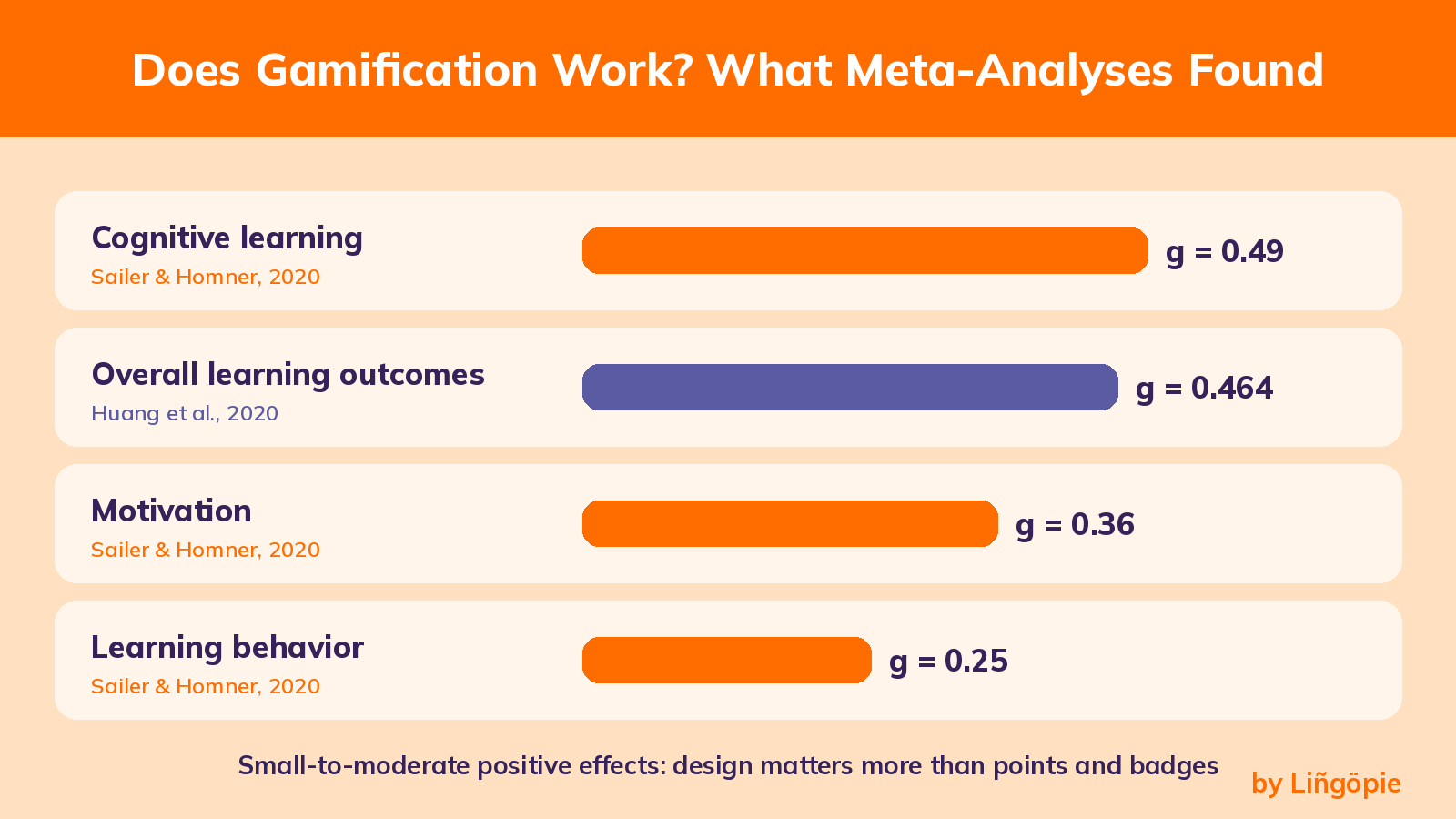
Yes, and two major meta-analyses provide evidence. A 2020 meta-analysis by Sailer and Homner, published in Educational Psychology Review, found statistically significant positive effects on three outcomes:
- Cognitive learning: g = 0.49
- Motivation: g = 0.36
- Learning behavior: g = 0.25
Similarly, Huang and colleagues (2020), writing in Educational Technology Research and Development, analyzed 30 studies involving 3,083 participants. They found an overall effect size of g = 0.464, favoring gamified instruction over non-gamified approaches.
Note that these are small-to-moderate improvements, not evidence that gamification transforms every classroom.
Which Gamification Strategies Work Best?
Sailer and Homner found that game fiction and competition combined with collaboration were particularly effective for behavioral outcomes.
Game fiction gives learning activities a meaningful narrative, such as completing missions or solving a mystery. Combining competition with teamwork allows students to pursue shared goals rather than compete entirely as individuals.
Meaningful feedback also matters. A 2020 review by Bai and colleagues identified performance feedback, recognition, and goal-setting among the reasons students enjoyed gamification. Feedback should help learners understand their mistakes and improve, not simply tell them how many points they've earned.
What Are the Limitations of the Research?
Results vary considerably between studies. Differences in age groups, subjects, educational settings, and game mechanics make it difficult to identify one universally effective approach. Sailer and Homner also found that motivational and behavioral effects were less stable in higher-quality studies.
Most importantly, increased participation doesn't automatically mean sustained knowledge retention. A student might enthusiastically complete a gamified quiz without remembering the material weeks later.The evidence above supports using gamification as a teaching strategy, not treating it as a substitute for effective instruction.
How to Gamify Your Classroom in 5 Steps
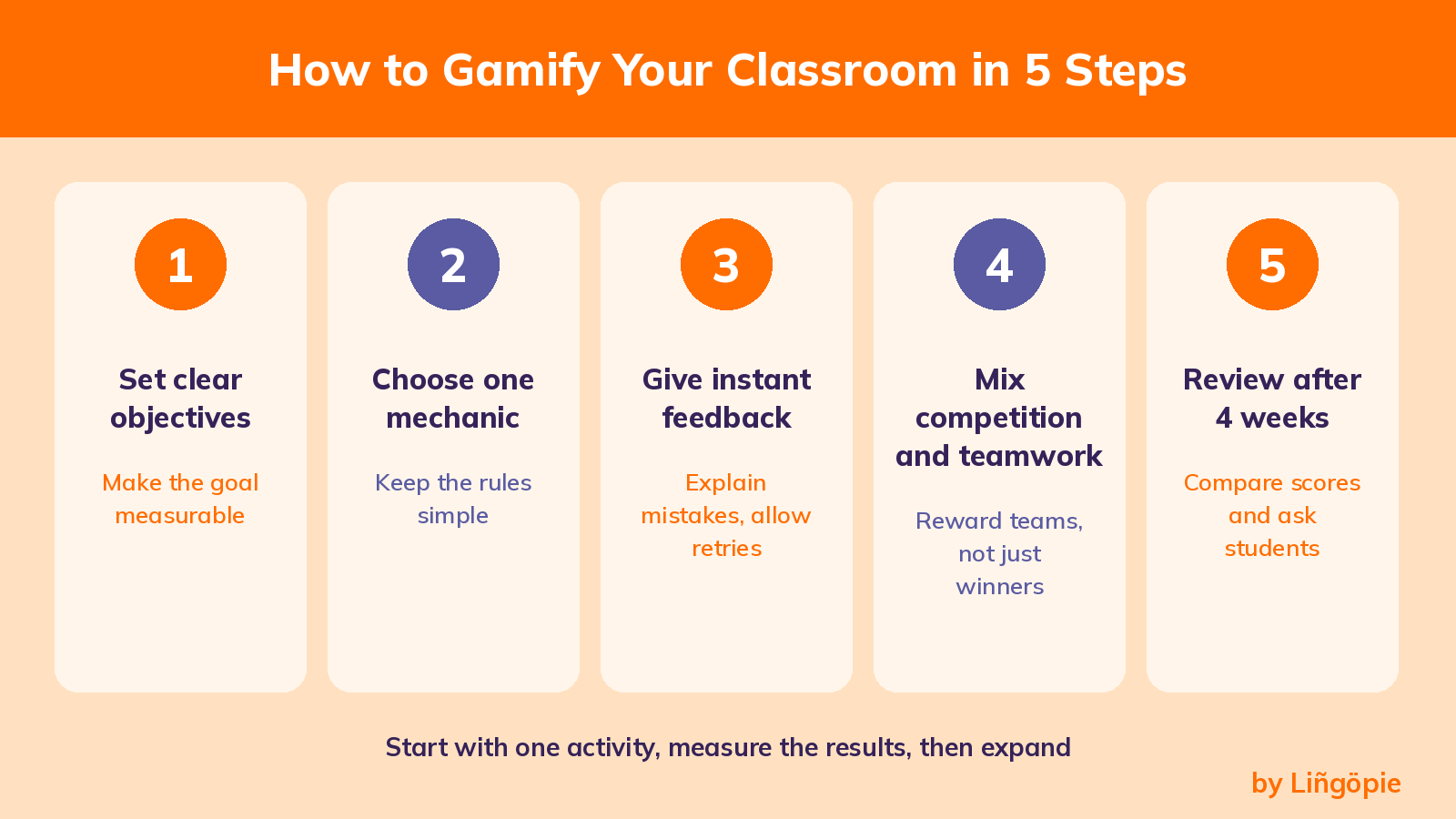
You don't need expensive software or a complicated reward system to introduce gamification into your classroom. Start with a single lesson or learning activity, choose a game mechanic that serves a purpose, and build on what works.
Step 1. Set Clear Learning Objectives
Start by identifying a specific skill or learning outcome you want students to achieve. Instead of setting a broad goal like "improve vocabulary," make it measurable: "Students should correctly use 15 new Spanish words in sentences by the end of the week."
Next, decide how you'll measure success. This could be a short quiz, a practical demonstration, or a completed assignment. Give students an initial assessment so you have a baseline to compare against later.
Step 2. Choose One Game Mechanic
Select a mechanic that encourages students to work toward your learning objective. For example, if your goal is regular vocabulary practice, introduce a five-day challenge where students complete a short exercise each day and earn a badge for meeting their weekly target.
The key here is to keep the rules simple. Explain what students need to accomplish, how they can track their progress, and what happens when they complete the challenge. You can use a classroom chart, Google Sheets, or a learning platform to manage everything.
Step 3. Provide Immediate Feedback
Don't make students wait until the end of the week to find out how they're doing. After each activity, show them which answers were correct, explain their mistakes, and give them an opportunity to improve.
For example, after a vocabulary quiz, let students review incorrect answers and attempt a second round using the same words in different sentences. Award mastery points based on demonstrated improvement rather than simply completing the activity.
Step 4. Balance Competition With Collaboration
Avoid making the entire class compete for the highest score. Instead, combine individual progress with activities that require teamwork.
For example, divide students into groups of four and give each team a language-learning mission. One student identifies vocabulary, another constructs sentences, a third checks grammar, and the fourth presents the answers. Rotate roles during the next activity so everyone practices different skills. Reward teams for completing the learning objective and working together, not just finishing first.
Step 5. Review Results After Four Weeks
Run your gamified activity for four weeks, then evaluate whether it actually helped students learn. Compare students' assessment scores with their initial results. Check how many completed the activities, whether participation improved, and which students may need additional support.
Ask students three questions:
- Did the activity help you understand the lesson?
- What motivated you to participate?
- What would you change?
Use their responses alongside assessment results to decide whether to continue, adjust, or replace the activity. Higher participation is encouraging, but improved understanding should remain the priority.
Match Your Learning Goal With the Right Game Mechanic
Not every game mechanic works for every learning objective. Use this table to choose an approach that fits what you're teaching.
Learning goal | Suitable mechanic |
|---|---|
Encourage regular practice | Streaks and daily challenges |
Track skill mastery | Badges and mastery levels |
Reinforce knowledge | Quizzes with feedback |
Improve collaboration | Team quests |
Support independent learning | Progress bars and skill trees |
Develop problem-solving | Puzzles and simulations |
Start with one activity, measure the results, and expand gradually. Effective classroom gamification should make learning more purposeful, not simply make lessons more entertaining.
Risks of Gamification in Education (and How to Avoid Them)
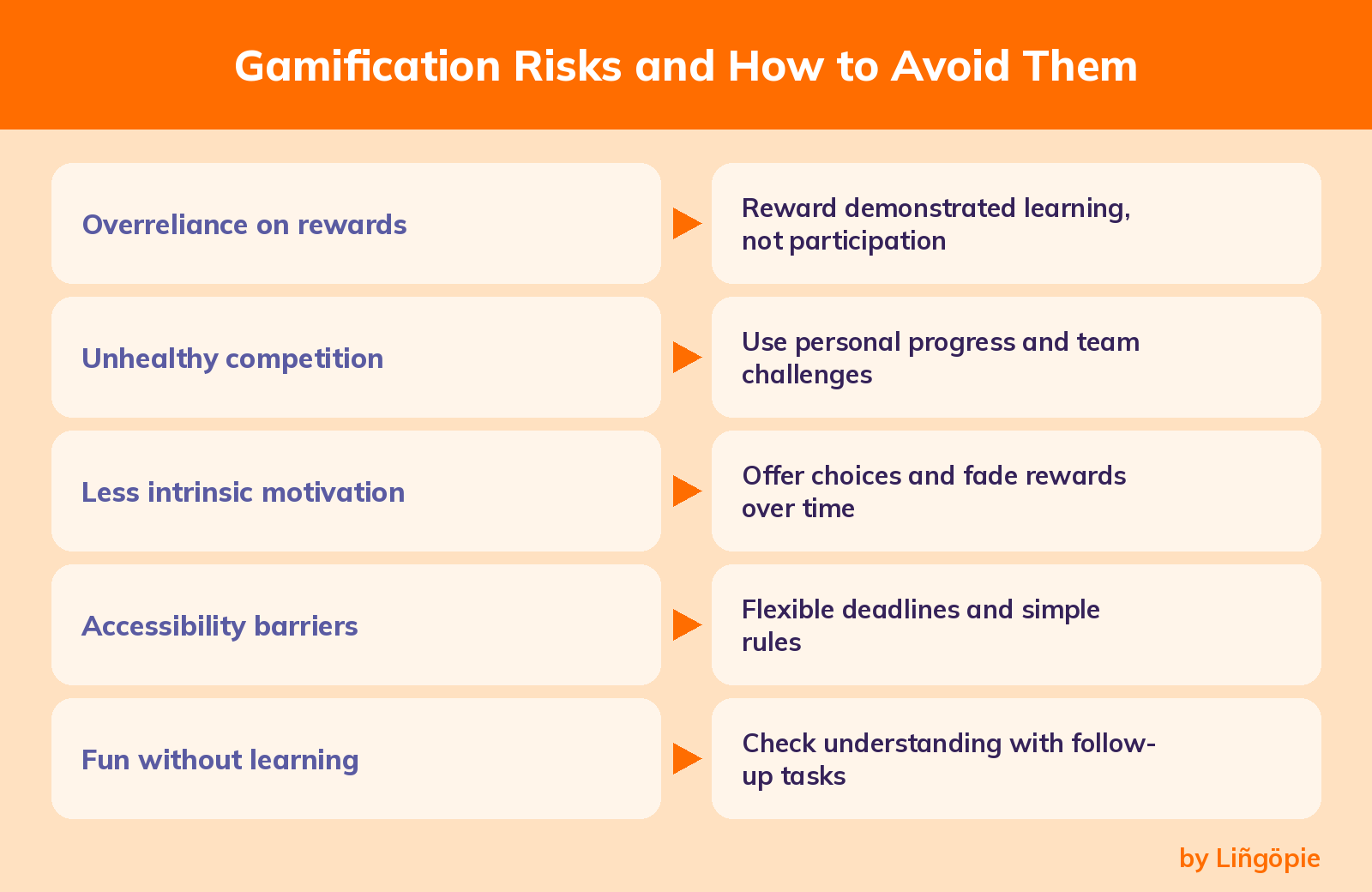
While gamification can improve student engagement, poorly designed activities may distract learners or even reduce their motivation. Before introducing game elements into your classroom, consider these common risks and how to prevent them:
- Overreliance on rewards: Students may focus on collecting points and badges instead of understanding the lesson. Reward demonstrated learning and improvement rather than participation alone.
- Unhealthy competition: Public leaderboards can discourage students who consistently rank lower. Use personal progress tracking and collaborative challenges instead.
- Reduced intrinsic motivation: Constant extrinsic rewards may make learning feel like something students only do for prizes. Give learners meaningful choices and gradually reduce rewards as their skills develop.
- Accessibility barriers: Timed challenges, complicated rules, and paid digital tools may exclude some students. Offer flexible deadlines, simple instructions, and accessible alternatives.
- Short-term engagement without learning: Students might enjoy playing games without retaining the material. Use quizzes, practical assessments, and follow-up activities to check understanding.
The goal isn't to make every lesson feel like a game. Effective gamification should support learning, not compete with it. Start with a few purposeful game elements, gather student feedback, and remove anything that creates unnecessary pressure or fails to improve learning outcomes.
Frequently Asked Questions
What are some examples of gamification in education?
Examples of gamification in education include Duolingo's learning streaks, Kahoot!'s quizzes, achievement badges, and progress bars. Teachers can also use classroom economies with virtual currency and learning quests where students complete challenges to achieve specific educational goals.
What is the difference between gamification and game-based learning?
Gamification adds game elements to traditional lessons, while game-based learning uses actual games to teach. For example, awarding points for completing math exercises is gamification, whereas using Minecraft Education to teach mathematical concepts is game-based learning.
Does gamification actually improve learning?
Yes, gamification improves learning outcomes on average, although results vary. A 2020 meta-analysis by Sailer and Homner found positive effects on cognitive learning (g = 0.49), motivation (g = 0.36), and learning behavior (g = 0.25).
What are the disadvantages of gamification in education?
Gamification can create reward dependence, unfair competition, accessibility barriers, and distractions. Students may prioritize earning points over learning, while public leaderboards can discourage participation. Teachers should focus on meaningful feedback, personal progress, and inclusive activities.
How can teachers gamify a classroom without technology?
Teachers can use paper badges, physical progress charts, team missions, and classroom currency. For example, students can earn badges for mastering skills, track their achievements on classroom charts, or complete collaborative puzzles to unlock new challenges.
Does gamification work for adult learners?
Yes, gamification can support adult learners in higher education, professional development, online courses, and language learning. Universities use simulations for practical training, while online learning platforms offer achievement badges, progress tracking, and interactive quizzes to encourage consistent practice.