
Most Italian apps treat you like a toddler pointing at pictures. You tap "mela" enough times, and supposedly you'll order confidently at a Roman trattoria. Spoiler: you won't. After testing every major app claiming to teach Italian, I've found that most either bore you with grammar drills or gamify the language until it's unrecognizable. The best apps to learn Italian actually teach you how real Italians speak, not just how to pass a multiple-choice quiz.
I've ranked these eight Italian language apps based on what matters: whether they'll get you speaking, how they handle grammar without making you hate life, and if you'll actually stick with them past week two. Some are shockingly good. Others waste your time with features that sound impressive but teach you nothing. Here's what actually works for Italian learners who want results, not just streaks.
- 6 Best Italian Translator Apps For Learners [TESTED]
- How Long Does It Take To Learn Italian? [Guide]
- How Many Italian-Speaking Countries Are Out There?

Best Apps To Learn Italian Language
If you’re just starting out with Italian, using an app is one of the easiest ways to build momentum. Apps help beginners get familiar with sounds, basic vocabulary, and simple sentence structures without feeling overwhelmed. The key is choosing one that keeps you engaged and actually helps you understand how Italian is used in real life.
Below, I’ve rounded up my recommended Italian learning apps that are especially effective for beginners—so you can find the right place to start with confidence.
Lingopie
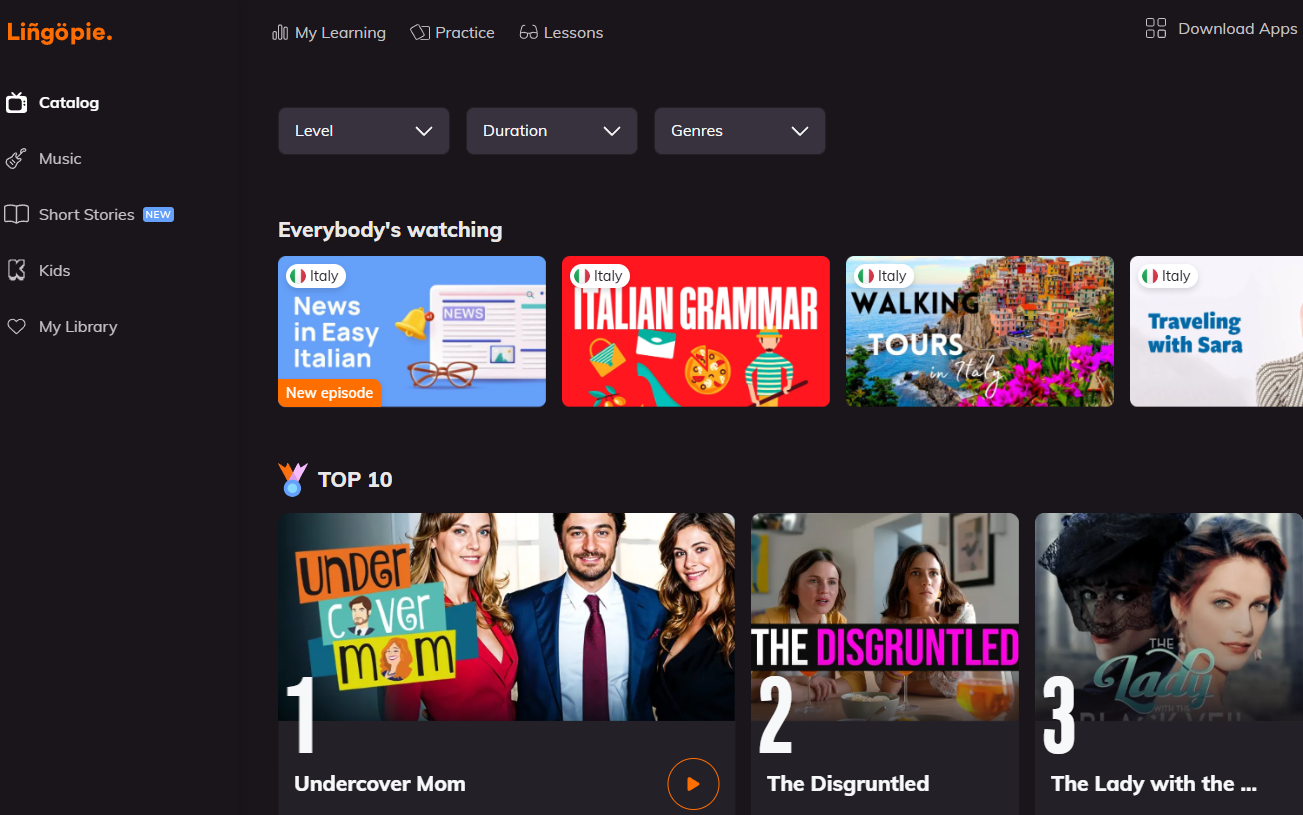
Lingopie uses real Italian TV shows and movies to teach the language. Click any word in the interactive subtitles for instant definitions and grammar explanations. You learn from native Italian speakers in actual conversations—family dinners, workplace drama, romantic comedies. The context shows you how words work in real life, not in textbook scenarios.
So in short, this Italian learning tool helps you absorb Italian culture while picking up vocabulary, slang, and pronunciation from how people actually speak.
This works better than traditional language learning apps because you're immersed in authentic content. The repetition happens naturally as you watch full episodes. The Grammar features inside also makes sense when you see it used in real situations instead of isolated drills. Most importantly, the content spans beginner to advanced levels across multiple genres.
For learners wanting conversational skills and cultural fluency instead of gamified exercises, Lingopie is the best app to learn Italian.
Pros | Cons |
|---|---|
Real Italian content teaches authentic conversation | Premium subscription needed for full library |
Context-based learning makes vocabulary stick | Requires basic Italian vocabulary to start |
Native speakers provide natural pronunciation | Limited opportunities for speaking practice |
Cultural immersion through entertainment | Smaller content selection than streaming platforms |
Grammar appears in actual usage | Progress needs consistent viewing |
Duolingo
Duolingo's the app everyone knows because it's free and relentlessly pushes notifications until you cave. It gamifies Italian learning with bite-sized lessons that feel more like mobile games than language instruction. The best feature? Its streak system actually works for building daily habits.
However, just note that Duolingo teaches you to translate sentences, not speak Italian. You'll recognize Italian words on a screen but freeze when a native Italian speaker asks you a simple question. The app focuses heavily on vocabulary acquisition through repetition, which sounds great until you realize you're learning phrases like "the bear drinks beer" instead of practical Italian conversations.
For absolute beginners who need something totally free to start their Italian learning journey, it's fine. For anyone serious about conversational skills, it's a stepping stone at best.
Pros | Cons |
|---|---|
Completely free version with full access | Zero speaking practice with native speakers |
Builds consistent daily learning habits | Grammar explanations are basically nonexistent |
Works for visual learners who like gamification | Sentences are bizarre and rarely useful |
Covers multiple languages if you want variety | Won't develop actual conversational skills |
Low-pressure way for beginners to start | Listening comprehension doesn't translate to real Italian |
Babbel
Babbel positions itself as the serious alternative to Duolingo, targeting Italian learners who want structured lessons with actual grammar explanations. The app offers interactive audio lessons designed by language experts, and honestly, the quality shows in how they teach Italian grammar rules without making you want to quit. Their best feature is the focus on practical Italian vocabulary you'll actually use when traveling or speaking with native Italians.
But Babbel's fatal flaw? The lessons feel like a language classroom squeezed into your phone. You're still doing fill-in-the-blank exercises and memorizing Italian words through repetition instead of real conversation practice. The app doesn't offer speaking exercises with native Italian speakers, so your speaking skills develop awkwardly at best. It's better than free apps for intermediate learners who need structured learning, but the paid version costs enough that you'd expect more speaking practice and cultural context.
For the price, I firmly believe that there are other Italian language learning apps deliver more.
Pros | Cons |
|---|---|
Detailed grammar instruction that actually makes sense | No conversation practice with real Italian speakers |
Structured lessons follow logical progression | Speaking skills lag behind reading comprehension |
Focuses on practical Italian phrases for travel | Expensive for what you get compared to competitors |
Audio from native speakers improves listening practice | Feels repetitive and classroom-like after a few weeks |
Good for learners who like traditional language learning | Limited cultural context beyond basic Italian culture |
Coffee Break Italian
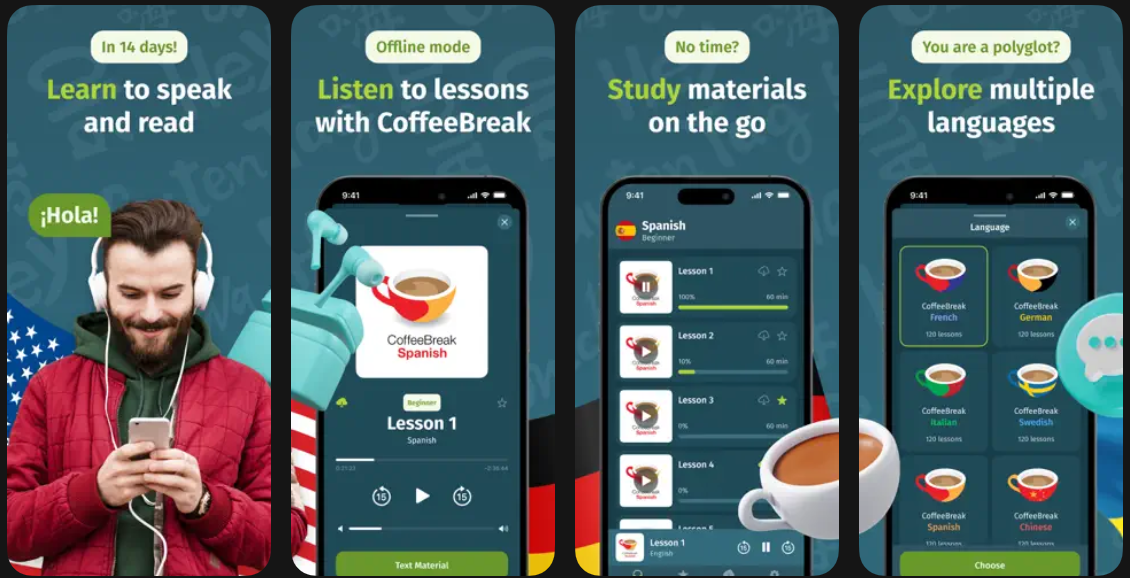
Coffee Break Italian takes the podcast approach to language learning, offering audio lessons hosted by teachers who actually explain why Italian works the way it does. The app's best feature is how it breaks down complex Italian grammar rules into digestible chunks you can absorb during your commute or workout.
Given its approach, the entire course relies heavily on listening comprehension with minimal speaking practice. You'll understand Italian conversations better than you can participate in them. The structured lessons work great for auditory learners, but visual learners and anyone who needs conversation practice will find the approach limiting.
Pros | Cons |
|---|---|
Detailed grammar explanations from actual teachers | Speaking exercises are practically non-existent |
Perfect for auditory learners who prefer podcast-style lessons | Limited practice speaking with native Italian speakers |
Downloadable audio lessons for offline learning | Visual learners will struggle without interactive elements |
Structured learning path from beginner to advanced | Free app version is extremely limited |
Cultural context woven naturally into Italian lessons | Listening skills outpace speaking skills significantly |
Busuu
Busuu combines structured lessons with community feedback from native Italian speakers who review your speaking and writing exercises. My favorite thing about this app is the video content showing real Italians pronouncing words and phrases, which helps with listening comprehension far better than synthetic voices. The app covers levels A1 to B2 with grammar lessons, vocabulary practice, and speech recognition technology that lets you practice speaking Italian without judgment.
For intermediate learners who can afford the premium subscription, Busuu offers solid structured learning and genuine interaction with Italian speakers. For beginners on a budget, the free app version will frustrate you more than help you speak Italian.
Pros | Cons |
|---|---|
Native Italian speakers provide community feedback | Free version is extremely limited and frustrating |
Video content shows real pronunciation from Italians | Feedback quality depends entirely on who reviews you |
Covers A1-B2 levels with structured lessons | Speaking practice relies too heavily on peer corrections |
Speech recognition helps practice speaking skills | Many reviewers note grammar content is locked behind paywall |
Personalized study plans keep you on track | Limited emphasis on actual conversation practice |
Lingvist
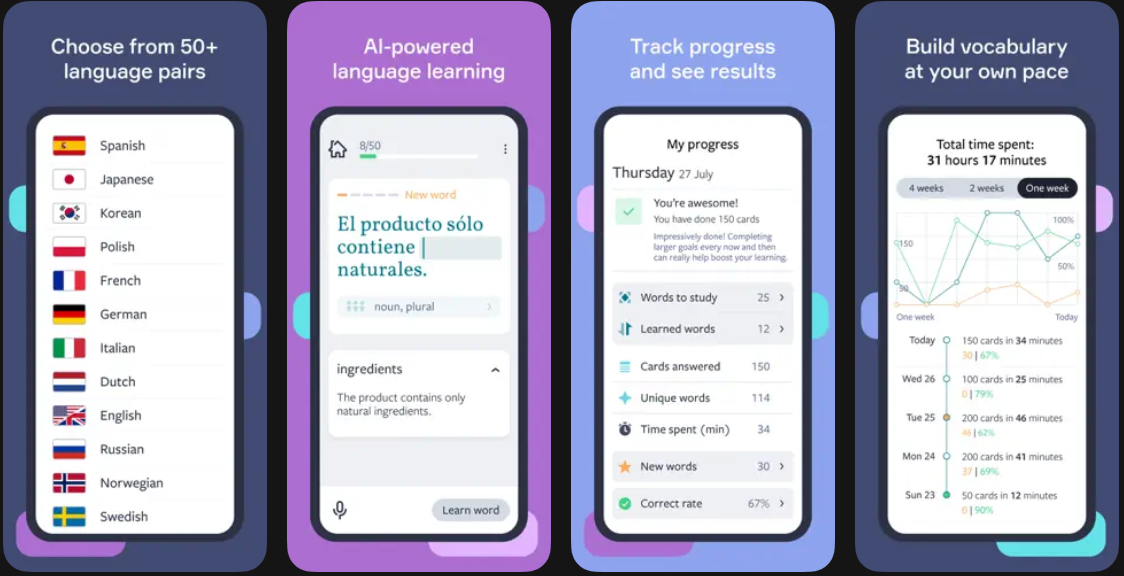
Lingvist strips language learning down to pure vocabulary acquisition through AI-powered flashcards and spaced repetition. The best feature is its adaptive algorithm that figures out which Italian words you're struggling with and drills them until they stick. Unlike apps that waste time teaching you "the bear drinks beer," Lingvist focuses on the 4,000-5,000 most frequently used Italian words that'll actually help you understand real conversations and texts.
The interface of this Italian learning app is clean and professional, perfect for learners who hate gamification and just want efficient vocabulary practice. But here's what they don't tell you: Lingvist is basically just vocabulary and nothing else. You'll build an impressive mental dictionary of Italian words but struggle to string them into actual sentences or hold conversations with native Italian speakers. The grammar explanations are minimal, there's virtually no speaking practice, and cultural context is nonexistent.
Pros | Cons |
|---|---|
AI adapts to your weak spots for efficient learning | Zero speaking practice with native speakers |
Focuses on high-frequency Italian vocabulary | Grammar explanations are practically nonexistent |
Spaced repetition actually works for retention | No cultural context or conversational skills |
Clean interface without distracting gamification | Just vocabulary—won't teach you to speak Italian |
Shows concrete progress tracking by text comprehension | Expensive subscription for limited scope |
Drops
Drops teaches Italian vocabulary through gorgeous visual matching games in five-minute sessions. You drag words to illustrations without typing or translating—pure image association. It's beautifully designed and genuinely fun for visual learners.
The problem? That's literally all it does.
Zero grammar instruction, no speaking practice, no sentence building. You'll memorize hundreds of Italian words but struggle to use them in actual conversations. The images work great for concrete nouns like "apple" but get confusing with abstract concepts. The free version kicks you out after five minutes daily, which feels cheap. Premium removes the time limit but doesn't add depth—just more vocabulary drills.
So for me, Drops works as a quick supplement to reinforce Italian words you're learning elsewhere, but it won't teach you to speak Italian or understand Italian culture.
Pros | Cons |
|---|---|
Beautiful visual design makes vocabulary stick | Only vocabulary—zero grammar or speaking practice |
Five-minute sessions work for busy schedules | Free version's daily limit feels manipulative |
No typing required, just intuitive drag-and-drop | Images confuse on abstract Italian words |
Great for visual learners and quick reinforcement | No interaction with native speakers |
Multiple topic categories available | Useless alone—must pair with real Italian courses |
LingQ
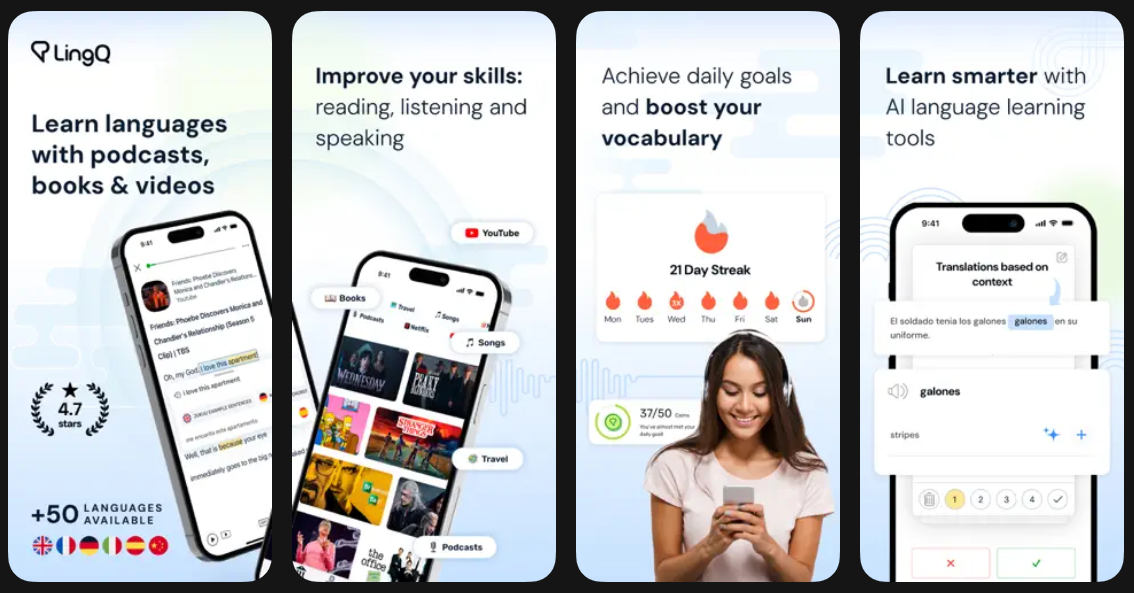
LingQ lets you import anything—YouTube videos, Netflix shows, podcasts, articles—and turn it into interactive Italian lessons where you click unknown words to save them. Founded by polyglot Steve Kaufmann, it's built on the philosophy that you acquire grammar naturally through reading and listening, not through explicit instruction. The massive content library means intermediate learners can finally consume authentic Italian media without constantly stopping to dictionary-dive.
However, LingQ is a mess for anyone below intermediate level. The interface overwhelms with features, the content feels random and unstructured, and counting every verb conjugation as a separate "new word" inflates your learning load absurdly. There's zero grammar explanation, minimal speaking practice unless you pay extra for tutors, and the free version is so limited it's basically a demo.
Personally, I think LingQ works brilliantly for independent intermediate learners who know what they're doing. For beginners needing structure or anyone wanting conversational skills, it's expensive chaos masquerading as comprehensive language learning.
Pros | Cons |
|---|---|
Import any content (YouTube, Netflix, podcasts) | Overwhelming interface confuses beginners |
Massive library for reading and listening practice | Zero grammar instruction or explanations |
Excellent word tracking motivates progress | Content feels random without structured learning path |
Perfect for intermediate learners consuming native media | Expensive premium required for basic features |
Works across 40+ languages including Italian | Counts every word form separately (inflates workload) |
 Genine Torres
Lingopie Vs Other Italian Language Apps
Lingopie Vs Duolingo
Duolingo's biggest problem is that it teaches you to translate, not speak. You'll spend months tapping through exercises and building streaks, but you won't understand native Italian speakers in real conversations. The gamification keeps you coming back, but you're not actually learning how Italians communicate.
Lingopie wins because it puts you directly into authentic Italian content from day one. You're hearing real conversations with natural pacing, slang, and cultural context. The interactive subtitles let you learn vocabulary exactly how native speakers use it. When you finally visit Italy, Lingopie prepares you for actual Italian conversations. Duolingo prepares you for more Duolingo lessons.
Lingopie Vs Babbel
Babbel structures everything like a traditional language course, which feels safe but limits real progress. You're still doing exercises and drills instead of experiencing the target language naturally. The speaking exercises can't replicate real Italian conversations because they're scripted and predictable.
Lingopie wins because immersion works better than instruction for language acquisition. When you watch Italian shows, your brain picks up grammar patterns and vocabulary usage without conscious effort. You're learning the same way kids learn their native language—through context and repetition in meaningful situations. Babbel teaches you about Italian. Lingopie teaches you Italian by surrounding you with it.
Lingopie Vs Coffee Break Italian
Coffee Break Italian delivers quality audio lessons with clear explanations, but it's entirely passive. You listen, you understand the lesson, then you move on without practicing what you learned. There's no visual component to reinforce vocabulary and no interaction with real Italian culture.
Lingopie wins because it engages multiple learning styles simultaneously. You're reading subtitles while hearing native pronunciation while watching cultural context unfold on screen. This multi-sensory approach makes vocabulary stick faster and builds listening comprehension that actually works with real Italian speakers.
Lingopie Vs Busuu
Busuu's community feedback feature sounds great in theory but fails in practice. You're depending on random native speakers to review your work, and the quality varies wildly. Some give thoughtful corrections, others barely engage. Meanwhile, most of Busuu's actual content feels generic and disconnected from real Italian culture.
Lingopie wins because every lesson comes from native Italian speakers in authentic situations. You're not waiting for feedback—you're getting constant input from professional actors speaking natural Italian in context. The cultural immersion you get from watching Italian shows beats any community feature. You learn how Italians actually live, joke, argue, and express emotions. That cultural understanding makes your Italian sound natural instead of textbook-translated.
Lingopie Vs Lingvist
Lingvist excels at one thing: drilling vocabulary into your memory through spaced repetition. But knowing what words mean doesn't mean you can use them. You'll recognize thousands of Italian words but struggle to form basic sentences because context is completely missing. Lingopie wins because it teaches vocabulary and usage simultaneously.
When you hear "Dai!" in three different scenes with three different meanings, you understand nuance that no flashcard can teach. You're learning Italian words inside the grammar structures and social situations where they naturally appear. Lingvist gives you definitions. Lingopie gives you understanding. For building actual conversational skills instead of just vocabulary recognition, immersion in native content beats flashcards every time.
Lingopie Vs Drops
Drops makes vocabulary practice feel like a gorgeous mobile game, which is both its strength and fatal weakness. The visual associations help memory, but you're learning words in complete isolation from how they're actually used. Five minutes of matching pictures to Italian words doesn't build language skills—it builds pattern recognition.
Lingopie wins because context is everything in language learning. You need to see how vocabulary fits into sentences, how tone changes meaning, how gestures accompany words. Real Italian shows give you all of that simultaneously.
Lingopie Vs LingQ
LingQ gives advanced learners incredible freedom to create their own curriculum from any content. That flexibility becomes overwhelming for most Italian learners who don't know what they should study next. The interface is cluttered, the content lacks structure, and you're paying premium prices for a tool that demands you already understand effective language learning methodology.
Lingopie wins because it removes all that friction. The content is curated specifically for language learners and organized by difficulty. You don't waste time deciding what to study—you just start watching Italian shows at your level. The interactive subtitles and Grammar Coach provide support that LingQ assumes you don't need. For most people learning Italian, guided immersion beats complete freedom. LingQ works if you're already an experienced language learner. Lingopie works for everyone because the platform does the heavy lifting while you enjoy Italian entertainment.
Learn Italian With Lingopie Today!
Stop memorizing words you never use. With Lingopie, you learn Italian by watching real TV shows and movies—just like natives do.
You’ll hear authentic conversations, pick up natural expressions, and understand the culture as you go. No boring drills. No awkward textbook Italian. Just real language, in context. If you want Italian that works outside an app and in real life, this is it. Press play, watch one episode, and start speaking Italian sooner than you think.