

Spanish commands use the imperative mood to give instructions, make requests, ortell someone what to do. For example, ¡Ven aquí! means "Come here!" The form you use depends on who you're speaking to (tú, usted, ustedes, nosotros, vosotros, or vos) and whether the command is affirmative or negative. Affirmative tú commands typically match the present tense (habla), while negative and formal commands use the present subjunctive (no hables, hable).
Key Takeaways
- Spanish commands use the imperative mood to give instructions, make requests, or tell someone what to do.
- Affirmative tú commands use the present-tense él/ella form; negative tú commands use the present subjunctive.
- The form changes with who you're addressing: tú, usted, ustedes, vosotros, or vos.
- Attach pronouns to affirmative commands (dímelo) and place them before negative commands (no me lo digas).

What Are Commands in Spanish?
Commands are verb forms used to tell someone what to do or not to do. Unlike ordinary statements, they use the imperative mood, and the verb changes depending on who you're addressing and whether the command is affirmative or negative. They can express direct orders, polite requests, advice, or instructions, depending on context and tone:
- ¡Escucha! – Listen!
- Cierra la puerta, por favor. – Close the door, please.
- No corras. – Don't run.
- Tome asiento, por favor. – Please take a seat.
-10 Must-Know Spanish Grammar Points for Beginners
-Get Started with Spanish Grammar: A Beginner's Guide
-Spanish Prepositions Made Simple: Rules, Tips, and Common Mistakes
Spanish Command Forms at a Glance
This table compares affirmative and negative commands using hablar (to speak) and comer (to eat).
Command form | Affirmative (hablar / comer) | Negative |
|---|---|---|
Tú (informal singular) | habla / come | no hables / no comas |
Usted (formal singular) | hable / coma | no hable / no coma |
Ustedes (plural) | hablen / coman | no hablen / no coman |
Nosotros (let's) | hablemos / comamos | no hablemos / no comamos |
Vosotros (informal plural, Spain) | hablad / comed | no habléis / no comáis |
Vos (informal singular, parts of Latin America) | hablá / comé | no hables / no comas |
Most command forms use the present subjunctive. The exceptions are affirmative tú, vosotros, and vos commands.
Types of Spanish Commands
Affirmative Tú Commands
Use these with friends, family, or anyone you know well. They match the present-tense él/ella form: hablar → habla (Speak!), comer → come (Eat!), escribir → escribe (Write!). For example, ¡Abre la puerta! means "Open the door!" These are among the easiest commands to learn, because the forms are already familiar to beginners.
Negative Tú Commands
Negative tú commands use the present subjunctive. Start with the yo form, drop the final -o, and add the "opposite" ending: -es for -ar verbs and -as for -er and -ir verbs.
- Hablar → hablo → no hables (Don't speak)
- Comer → como → no comas (Don't eat)
- Tener → tengo → no tengas (Don't have)
Formal Commands (Usted and Ustedes)
Use usted for one person you address respectfully and ustedes for a group. Both affirmative and negative forms use the present subjunctive: Hable más despacio, por favor (Speak more slowly, please), No toque eso (Don't touch that). In Latin America, ustedes is used for every group, formal or not.
Informal Plural Commands (Vosotros)
In Spain, informal commands to a group use vosotros. For the affirmative, replace the final -r of the infinitive with -d: hablad, comed, vivid. Negative vosotros commands use the subjunctive: no habléis, no comáis.
Nosotros Commands ("Let's...")
The nosotros form suggests doing something together and uses the present subjunctive: Hablemos (Let's talk), No salgamos todavía (Let's not leave yet). The exception is ir: Vamos (Let's go), but no vayamos (Let's not go).
Vos Commands
In Argentina, Uruguay, Paraguay, and parts of Central America, vos replaces tú. For affirmative vos commands, drop the final -r and stress the last syllable: hablá, comé, viví, vení. Ir usually becomes andá (Go!). Negative vos commands generally use the subjunctive (no hables), with some regional variation.
Irregular and Stem-Changing Commands
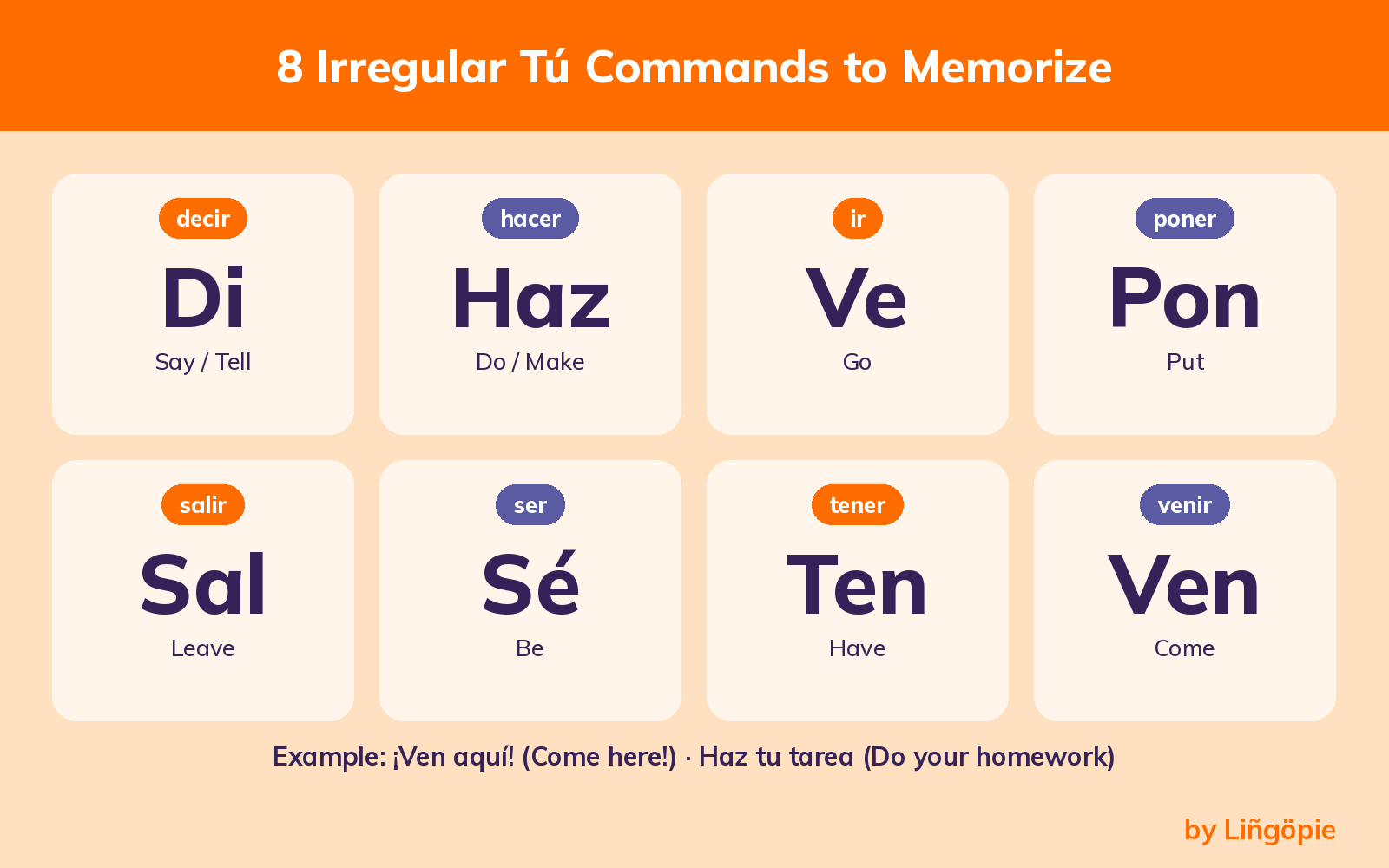
Eight common verbs have irregular affirmative tú commands worth memorizing. Note that ve is also the affirmative tú command of ver (to see):
Infinitive | Affirmative tú | English |
|---|---|---|
Decir | Di | Say / Tell |
Hacer | Haz | Do / Make |
Ir | Ve | Go |
Poner | Pon | Put |
Salir | Sal | Leave / Go out |
Ser | Sé | Be |
Tener | Ten | Have |
Venir | Ven | Come |
Stem-changing verbs keep their vowel change in commands: cierra / no cierres, duerme / no duermas, pide / no pidas. Some verbs also change spelling to keep their sound: buscar → busque, llegar → llegue, empezar → empiece.
Using Pronouns With Commands
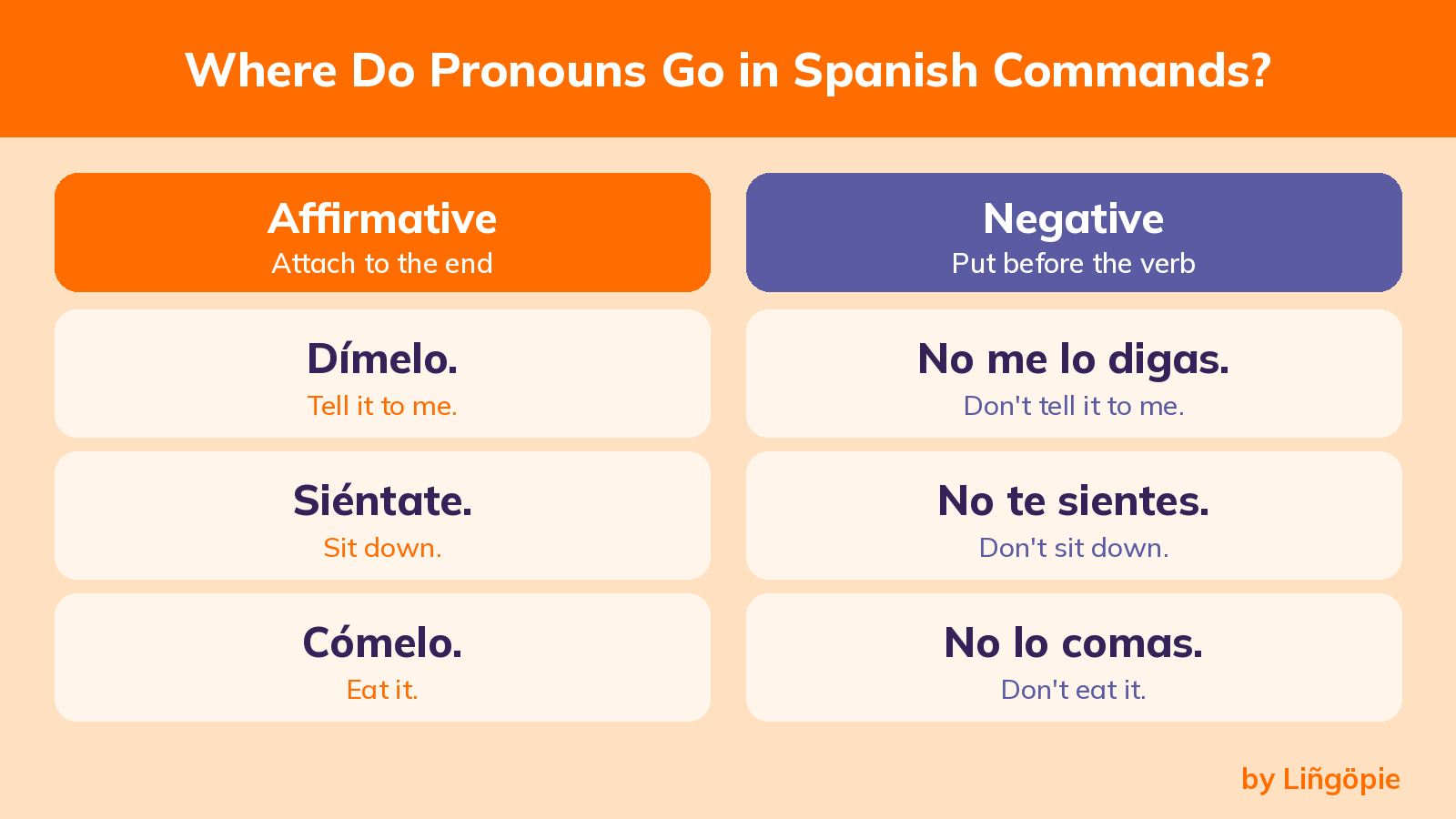
Attach pronouns to the end of affirmative commands, adding an accent to keep the original stress: Dímelo (Tell it to me), Siéntate (Sit down). In negative commands, put them before the verb: No me lo digas (Don't tell it to me), No te sientes (Don't sit down).
With reflexive nosotros and vosotros commands, drop the final -s or -d before adding the pronoun: sentemos + nos → sentémonos (Let's sit down), sentad + os → sentaos (Sit down, everyone).
Common Commands for Everyday Situations
Spanish command | English |
|---|---|
¡Ven aquí! | Come here! |
Espera un momento. | Wait a moment. |
No te preocupes. | Don't worry. |
Ten cuidado. | Be careful. |
Tráigame la cuenta, por favor. | Bring me the check, please. |
Gire a la derecha. | Turn right. |
The first four use the informal tú form; the last two use usted, which is polite with servers and strangers. Adding por favor softens any command. For groups, say ¡Vengan todos! (Everyone, come!) in Latin America or ¡Venid todos! in Spain, and use ¡Vamos! (Let's go!) anywhere.

Frequently Asked Questions About Spanish Commands
Can I use usted commands with friends or family?
In most Spanish-speaking countries, tú is more common with friends and family, and usted can sound distant. In parts of Colombia, Costa Rica, and Central America, though, usted is common even among close friends and relatives.
Can I use commands in the past or future tense?
No. Commands use the imperative mood, which has no past or future forms. Negative and formal commands borrow their forms from the present subjunctive.
When do you use ustedes vs. vosotros commands?
Use ustedes for any group in Latin America. In most of Spain, vosotros is used for informal groups and ustedes for formal ones.
How do I ask for something politely using commands?
Add por favor (please). Instead of just Dame eso (Give me that), say Dame eso, por favor. With strangers, the usted form is even more polite: Déme eso, por favor.
Learn Spanish Commands With Lingopie
Want to hear commands used naturally? With Lingopie, you learn Spanish through TV shows and movies featuring native speakers, so you hear how people really give orders, make requests and offer advice. Join more than 2 million learners on Lingopie,rated 4.6/5 on Trustpilot from 3,878 reviews (November 2026). Click unfamiliar words in the interactive subtitles for instant translations and save them as flashcards. Start learning Spanish with Lingopie.