

Whether you're booking a flight, scheduling a meeting, or filling out paperwork, months come up all the time. English is still the world's go-to language for business, travel, and international communication, so getting them right matters more than you'd think. One wrong spelling on a visa application? That's a headache nobody wants.
This guide covers everything you need to feel confident. We'll go through the correct spelling for all twelve months in English and the abbreviations people actually use. You'll also learn how to pronounce each one clearly. And we'll sort out the different ways dates get written depending on where you are. Let's begin!
- 20 Modern American Slang Words to Know This Year
- 18+ Miami Slang Words And Phrases You’ll Hear In The 305
- 12 Best TV Series and Movies to Learn English

What are the 12 months in English?
English follows a 12-month calendar, just like most of the world. The names come from a mix of Roman gods, emperors, and Latin numbers. One important grammar rule to remember is that months are always capitalized in English. It doesn't matter where they appear in a sentence. January is always January, never january. This catches a lot of learners off guard since many languages don't capitalize months at all.
Here's the full list with abbreviations and how many days each month has.
| Month | Abbreviation | Days |
|---|---|---|
| January | Jan. | 31 |
| February | Feb. | 28 or 29 |
| March | Mar. | 31 |
| April | Apr. | 30 |
| May | May | 31 |
| June | Jun. | 30 |
| July | Jul. | 31 |
| August | Aug. | 31 |
| September | Sep. or Sept. | 30 |
| October | Oct. | 31 |
| November | Nov. | 30 |
| December | Dec. | 31 |
February gets 29 days during a leap year, which happens every four years. And you'll notice May doesn't have a standard abbreviation since it's already short enough.
Where Do the Month Names Actually Come From?
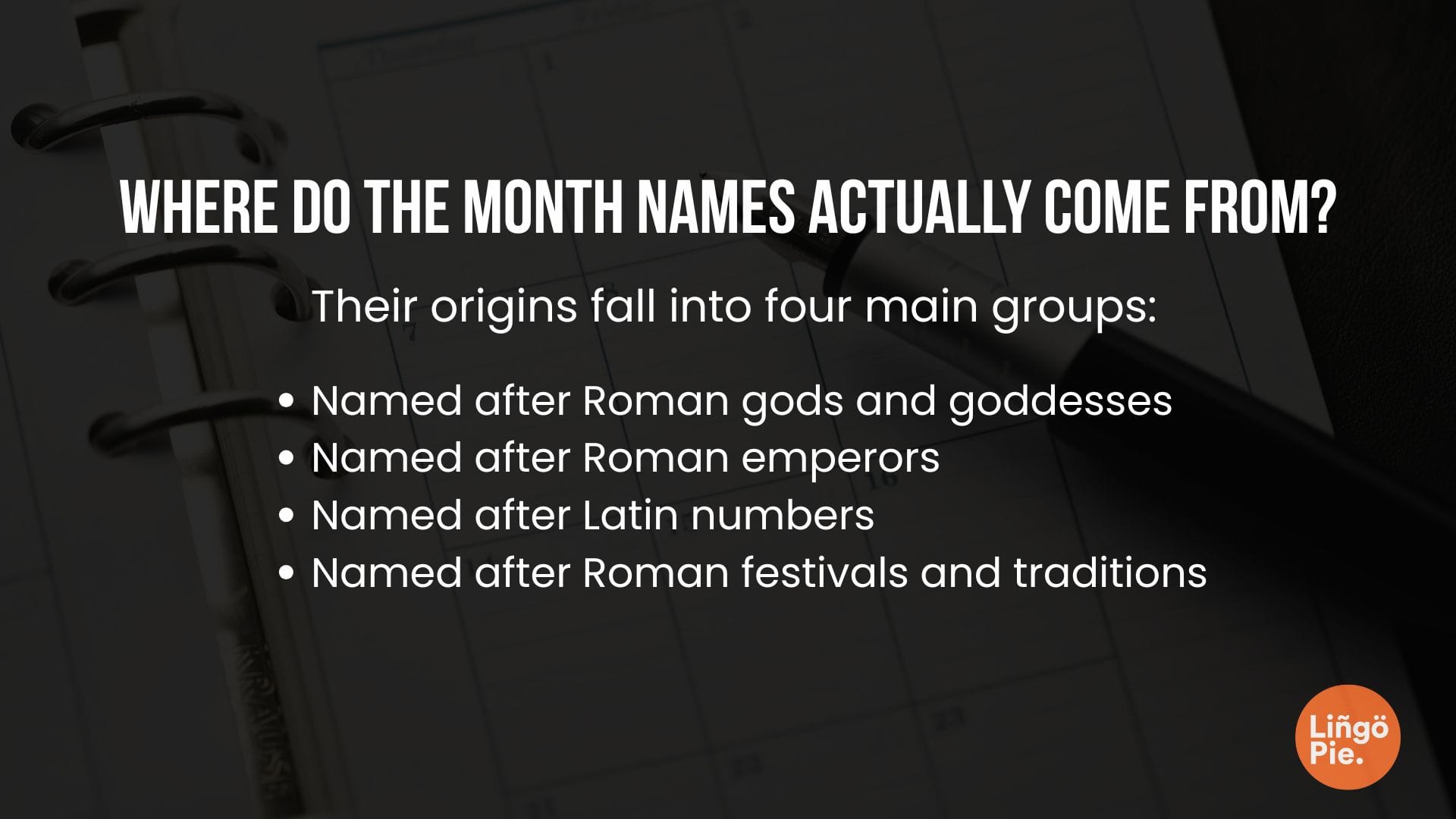
Ever wonder why September doesn't sound anything like "nine" even though it's the ninth month? That's because the names are ancient. Most go back over 2,000 years to the Roman calendar. Back then, the year actually started in March, not January. This explains why some month names don't match their current position. The origins fall into three main categories.
Named After Roman Gods and Goddesses
- January comes from Janus, the god of beginnings and doorways. He had two faces, one looking back and one looking forward. Pretty fitting for the start of a new year.
- March honors Mars, the god of war. Romans considered this the beginning of the military campaign season.
- April likely comes from Aphrodite, the Greek goddess of love. Some scholars think it's from the Latin word "aperire," meaning "to open," like flowers in spring.
- May is named after Maia, the goddess of growth and fertility.
- June honors Juno, the goddess of marriage. This is partly why June weddings became a tradition.
Named After Roman Emperors
- July was renamed to honor Julius Caesar after his death. Before that, it was called Quintilis.
- August honors Augustus Caesar, Rome's first emperor. He didn't want to be outdone by his predecessor.
Named After Latin Numbers
- September comes from "septem," meaning seven. It was originally the seventh month.
- October comes from "octo," meaning eight.
- November comes from "novem," meaning nine.
- December comes from "decem," meaning ten.
February is the odd one out. It comes from "Februa," a Roman purification festival held around that time.
How to Pronounce the 12 Months in English
Spelling the months is one thing. Saying them out loud is another challenge entirely. English pronunciation doesn't always follow logical rules, and the months are no exception. The good news is there are a few tricks to speed things up.
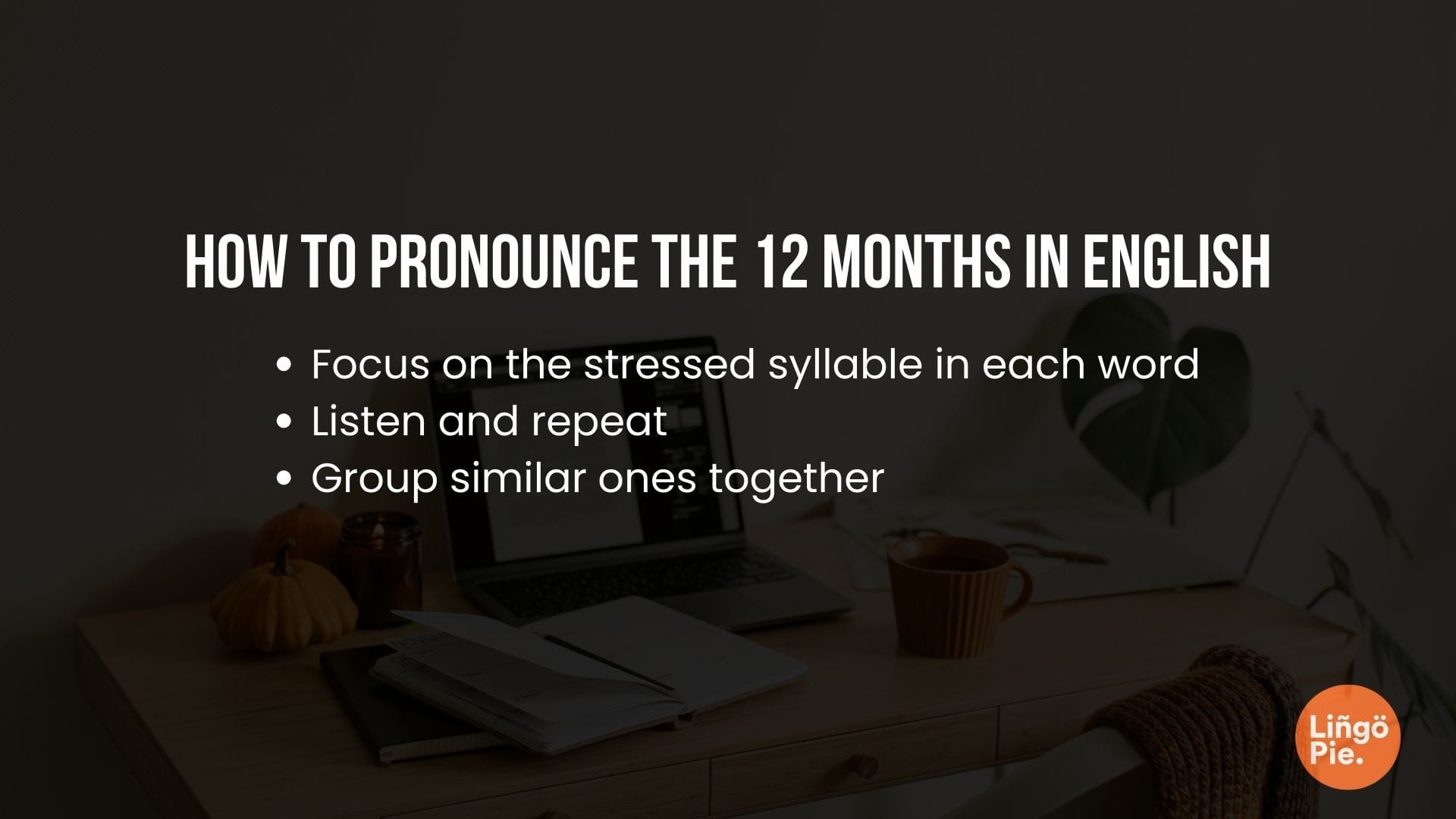
- Focus on the stressed syllable in each word: English speakers naturally emphasize one part more than the rest. Get that right, and you'll sound more natural even if other parts aren't perfect.
- Listen and repeat: Find audio clips online and mimic what you hear.
- Group similar ones together: For example, January and February both end with the same "uary" sound. March, May, and June are all one syllable, so they're easy wins.
Here's a simple pronunciation guide for each month.
| Month | Pronunciation |
|---|---|
| January | JAN-yoo-air-ee |
| February | FEB-roo-air-ee |
| March | MARCH |
| April | AY-pril |
| May | MAY |
| June | JOON |
| July | joo-LY |
| August | AW-gust |
| September | sep-TEM-ber |
| October | ok-TOH-ber |
| November | noh-VEM-ber |
| December | dee-SEM-ber |
The capitalized parts show where the stress falls. Notice how July is stressed on the second syllable, not the first. That one surprises a lot of learners. And February? Most native speakers actually skip the first "r" and say "FEB-yoo-air-ee" in casual speech. Both versions are acceptable.
Common Spelling Mistakes to Avoid
English spelling is famously inconsistent. Words often aren't spelled the way they sound, and months are a perfect example. When you say February quickly, that first "r" practically disappears. So people leave it out when writing. The same thing happens with other months where pronunciation and spelling don't line up.
Another issue is letter patterns that look right but aren't. Your brain wants to autocomplete words based on familiar combinations. That's why mixing up vowels or doubling the wrong consonant happens so often. Here are the mistakes you'll want to watch out for.
- Febuary instead of February. That first "r" is silent in speech but required in writing. This is probably the most common month spelling error.
- Janurary instead of January. People add an extra "r" because February has two. January only has one.
- Agust instead of August. The "u" after "A" gets skipped because it's not stressed when spoken.
- Septmeber or Setember instead of September. The "p" is subtle and the "e" and "m" get flipped easily.
- Ocotber instead of October. A classic letter swap that spell check might not catch.
- Novmeber instead of November. Same issue with the "e" and "m" switching places.
- Dicember instead of December. The "e" sounds like an "i" in some accents, which causes confusion.
A quick trick? When in doubt, spell it out slowly and check against the table above. Your phone's calendar is also a reliable backup.
How to Write and Say Dates in English
Americans and Brits write dates differently. Same language, completely different systems. And if you mix them up, you could end up at the airport on the wrong day.
American Format
In the United States, the month comes first. So March 15, 2025 is written as 03/15/2025. When saying it out loud, Americans typically say "March fifteenth, twenty twenty-five." The month leads, the day follows. Think of it as how you'd naturally answer "What's today's date?" Most Americans would say "It's March 15th" rather than "It's the 15th of March."
British Format
The United Kingdom and most other English-speaking countries flip it around. The day comes first. So the same date becomes 15/03/2025. When speaking, Brits usually say "the fifteenth of March, twenty twenty-five." Notice the "of" in there. That little word is a giveaway for British style.
International Format
Imagine seeing 04/05/2025 on a document. Is that April 5th or May 4th? Without context, you genuinely can't tell. International forms and travel documents often use the format DD/MM/YYYY or write the month as a word to avoid confusion. So 15 March 2025 or 15 Mar 2025 leaves no room for error.
Grammar Rules for Using Months
Knowing the months is just the start. Using them correctly in sentences requires a few grammar basics. These rules are simple once you see them in action.
Capitalization Rules
Months are always capitalized in English. Always. It doesn't matter if the month appears at the beginning, middle, or end of a sentence. January stays January. This applies to abbreviations too. You write Jan. and Feb., not jan. or feb.
Here are some examples showing correct capitalization.
- Beginning of sentence: January is the coldest month here.
- Middle of sentence: We're planning a trip in August this year.
- End of sentence: My favorite month is October.
- With abbreviations: The deadline is Mar. 15.
This trips up a lot of learners because many languages treat months like regular nouns. In Spanish, French, German, and many others, months are lowercase. English is the exception here. Think of months like names. You capitalize Michael. You capitalize March. Same logic.
One more thing. Days of the week follow the same rule. Monday, Tuesday, Wednesday. All capitalized, all the time.
Using "In" and "On" with Months
Prepositions are tricky in every language, and English is no different. When talking about months, there are two main scenarios.
Use "in" when referring to a month generally.
- I was born in July.
- We're moving to Tokyo in September.
- The project launches in March.
Use "on" when referring to a specific date within that month.
- The meeting is on March 5th.
- Her birthday is on November 22nd.
- We got married on June 15, 2019.
The pattern is pretty logical once you see it. Months are containers of time, so you're "in" them. Specific dates are points on a calendar, so something happens "on" that day.
Keep Learning with Lingopie
You've got the months down. The spelling, the pronunciation, the tricky grammar bits. That's a solid foundation. But real progress happens when you hear these words used naturally by native speakers. Textbooks won't teach you how people actually mumble February or casually say "See you in Jan."
Lingopie helps you learn English through TV shows and movies you'll actually enjoy. Whether you're coming from Spanish, Korean, Portuguese, or any other language, interactive subtitles let you click any word for instant definitions and pronunciation. Save words you want to remember, and Lingopie turns them into personalized flashcards.
No boring drills. Just real English, the way people actually speak it. Give it a try and see how much faster things click when learning feels like entertainment.

![Sushi Names In Japanese And How To Order Them [Guide]](/blog/content/images/2026/01/sushi-names-in-japanese.jpg)




![Improve Your English Listening Comprehension [2026 Guide]](/blog/content/images/size/w300/2023/12/5D8A320F-7EF3-4F0F-9EDD-0F91C9504FA0.png)
