
Look, "Wesołych Świąt" might look like someone sneezed on a keyboard, but it's actually how you say Merry Christmas in Polish and your ticket to not being That Person at the holiday party. The Polish language is having a laugh with all those squiggly letters, but once you nail this greeting, you'll get actual smiles instead of polite nods.
This guide's got how to say Merry Christmas in Polish, the Polish Christmas greetings that'll save your arse at Wigilia, and vocabulary for when someone's babcia starts asking why you're not married yet. Real talk, zero waffle, maximum holiday survival skills.
- 6 Cartoons To Watch In Polish And Why You Should Watch Them
- 25 Polish Phrases Every Beginner Should Know
- 5 Best Apps To Learn Polish As A Beginner

How To Say Merry Christmas In Polish
"Wesołych Świąt" (veh-SO-wikh SHVYONT) is the standard way to say Merry Christmas in Polish. It directly translates to "Happy Holidays," which is why Polish people use it for Christmas, Easter, and other major celebrations. "Wesołych" means happy or merry, while "Świąt" means holidays or feast days.
The Polish language loves its consonant clusters, so that "Świąt" sound takes practice. The "ł" makes a "w" sound in English, not an "l," which trips up most learners. Don't stress about perfect pronunciation. Polish speakers appreciate the attempt more than they care about your accent.
Other ways to say Merry Christmas in Polish:
- "Wesołych Świąt Bożego Narodzenia" (veh-SO-wikh SHVYONT bo-ZHE-go na-ro-DZE-nya) — The full formal version that specifically means "Merry Christmas" by adding "Bożego Narodzenia" (God's Birth).
- "Szczęśliwych Świąt" (shchen-SHLEE-vikh SHVYONT) — Another way to say Happy Holidays that's slightly less common but equally correct.
- "Radosnych Świąt" (ra-DOS-nikh SHVYONT) — Means "Joyful Holidays" and sounds more poetic. You'll see this in cards and formal greetings.
Other Polish Holiday Greetings
Polish Christmas runs for weeks, not days, and different moments need different words. Here's what actually matters.
Wesołych Świąt Bożego Narodzenia
This is the complete formal version that specifically means "Merry Christmas." "Bożego Narodzenia" translates to "God's Birth," so you're literally saying "Happy Holidays of God's Birth." It's more religious and formal than just "Wesołych Świąt," which is why it shows up in cards and formal situations. The pronunciation is (veh-SO-wikh SHVYONT bo-ZHE-go na-ro-DZE-nya).
Szczęśliwego Nowego Roku
Means "Happy New Year." "Szczęśliwego" means happy or fortunate, "Nowego" means new, and "Roku" means year. You'll use this from New Year's Eve through early January. Pronunciation: (shchen-SHLEE-veh-go no-VEH-go RO-koo).
Wszystkiego Najlepszego
Translates to "all the best" or "best wishes." "Wszystkiego" means everything or all, and "najlepszego" means the best. Polish people use this for any celebration—birthdays, name days, holidays, achievements. It's the most versatile greeting you can learn. Pronunciation: (fsheest-KYEH-go nay-LEP-sheh-go).
Spokojnych Świąt
Means "Peaceful Holidays." "Spokojnych" translates to peaceful or calm. This greeting carries a quieter, more solemn tone than the cheerful "Wesołych Świąt." It acknowledges that holidays aren't always easy for everyone. Pronunciation: (spo-KOY-nikh SHVYONT).
Polish Christmas Vocabulary
Polish Christmas traditions come with their own vocabulary that you won’t find in regular language lessons. These words show up in every conversation during the holiday season, from discussing dinner plans to explaining why there’s hay under the tablecloth. Learning these terms helps you understand what’s actually happening at Polish Christmas celebrations instead of just nodding along, confused.
Polish Word | Pronunciation | English Translation |
|---|---|---|
Wigilia | vee-GHEE-lya | Christmas Eve |
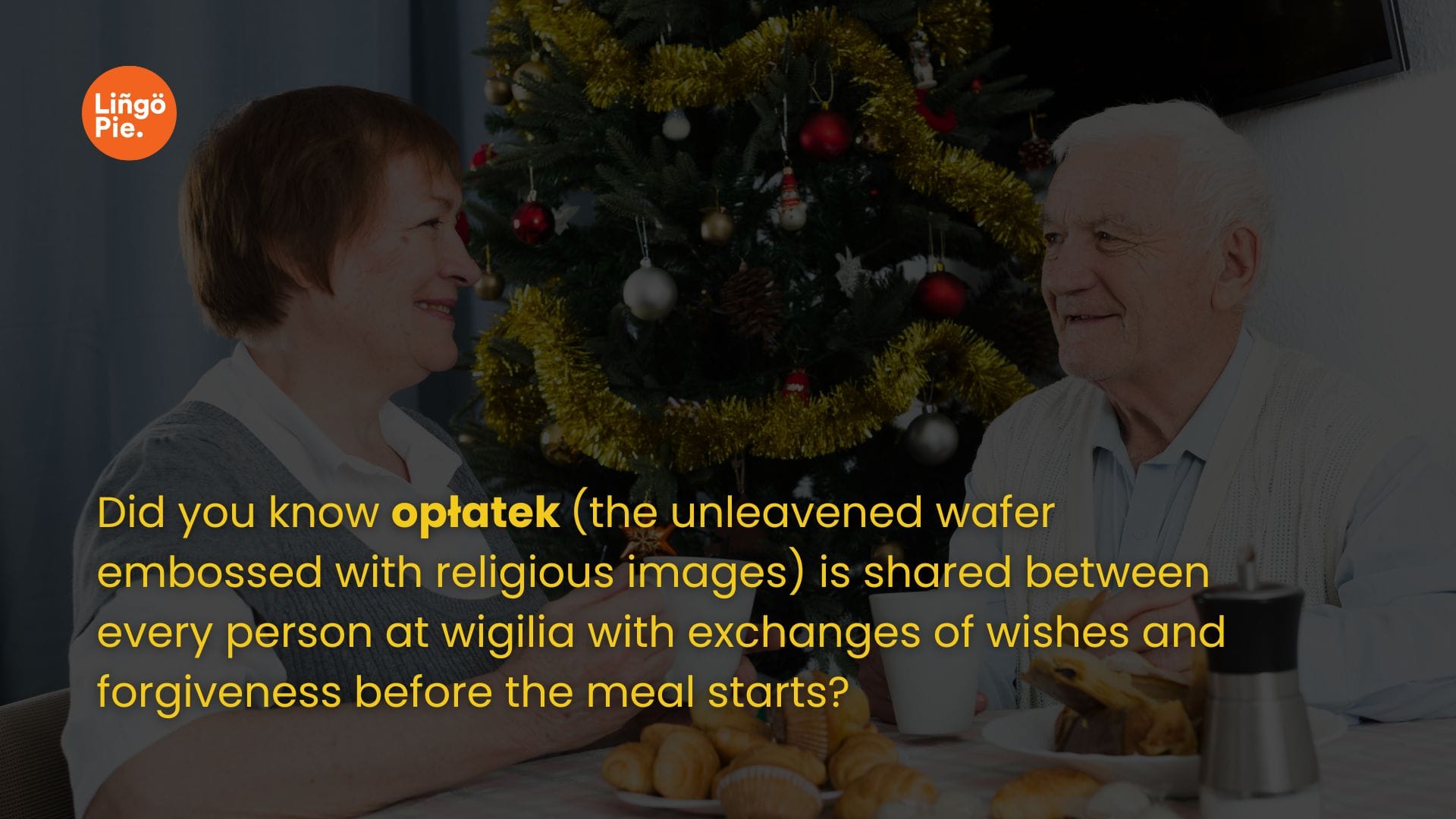
Opłatek | o-PWA-tek | Christmas wafer |
Kolęda | ko-LEN-da | Christmas carol |
Pasterka | pas-TER-ka | Midnight Mass |
Choinka | kho-EEN-ka | Christmas tree |
Gwiazdka | gvyaz-D-ka | Little star |
Szczodraki | shcho-DRA-kee | New Year's carols |
Beyond holiday vocabulary, Polish Christmas includes its own characters that differ from the English-speaking world’s Santa Claus tradition. Święty Mikołaj brings gifts on December 6th for Mikołajki, not Christmas Day. Wondering about other Polish characters? Check out the table below!
Polish Character | Pronunciation | English Equivalent | What It Means |
|---|---|---|---|
Święty Mikołaj | SHVYEN-ty mee-KO-wai | Saint Nicholas | Brings gifts on December 6th for Mikołajki, separate from Christmas |
Dziadek Mróz | JA-dek MROOZ | Grandfather Frost | Eastern European gift-bringer who appears at Christmas or New Year |
Aniołek | a-NYO-wek | Little Angel | Believed to bring Christmas presents in some Polish regions |
Gwiazda Betlejemska | gvyaz-DA bet-le-YEM-ska | Star of Bethlehem | First star that appears on Christmas Eve, signals start of wigilia dinner |
Make Polish Part of Your Christmas This Year
Learning Polish doesn’t stop at holiday greetings. This Christmas is your excuse to actually start picking up the language instead of just thinking about it. Use "Wesołych Świąt" in real conversations, try pronouncing "opłatek" without butchering it completely, and see how Polish people react when you make the effort. The holiday season gives you natural opportunities to practice without it feeling forced or awkward.
The best place to start? Try Lingopie!
Lingopie teaches Polish through actual Polish TV shows and movies, which means you’re learning the language people actually speak instead of textbook phrases nobody uses. Watch Polish Christmas films, pick up holiday vocabulary in context, and start recognizing words you heard at Wigilia dinner. One episode gets you further than a dozen grammar exercises, and you might actually enjoy the process instead of treating it like homework you're avoiding.
Start learning Polish with Lingopie today and make next Christmas the one where you actually understand what everyone's saying.

![6 Best Japanese Language Apps Worth Trying [TESTED]](/blog/content/images/size/w1200/2025/12/best-apps-to-Learn-Japanese.jpeg)
![I Love You In Polish: Romantic Phrases You Need To Know [2026]](/blog/content/images/size/w300/2026/02/I-Love-You-In-Polish.png)
![How To Say Happy New Year In Polish [15+ Useful Words]](/blog/content/images/size/w300/2025/12/how-to-say-happy-new-year-In-polish.jpeg)