

Most people don’t struggle with grammar because they’re "bad" at languages. They struggle because grammar is usually taught in the most confusing way possible. Think long rules, charts, and terms you forget the second you close the book! Then you try to watch a show or talk to someone, and suddenly none of it lines up with how people actually speak.
In this post, I’ll show you how Lingopie’s Grammar features fix that by making grammar something you can see and understand while watching real TV shows. I also asked our team why they built it and how it works behind the scenes, and their answers are surprisingly simple (and honestly, make grammar feel a lot less scary!).
- 5 Best Learn-To-Read Apps For Language Learners
- 6 Best AI Language Learning Apps For Beginners [2026]
- 5 Best Language Apps For Cultural Immersion [2026]
Why Is Grammar So Hard to Learn in the First Place?
Grammar feels hard for most people because it’s usually taught in a way that doesn’t match how we actually use language. You’re given rules, tables, and new terms to memorize, but none of it shows you how real sentences are built or why people phrase things the way they do.
So when you jump from a textbook to a TV show or a real conversation, it’s like switching to a different language altogether, and that’s when everything falls apart.
Here’s why that happens:
- Rules are easy to memorize but hard to apply in real time.
- Grammar tables don’t show how language works in everyday speech.
- Word-for-word translation hides the real meaning behind phrases and expressions.
- It’s hard to identify parts of a sentence just by looking at subtitles or text.
- What you learn in theory doesn’t line up with how native speakers actually talk.
And that’s really the heart of the issue: most learners never get to see grammar working in real conversations, so the rules stay abstract and disconnected.
What Did Lingopie Create to Make Grammar Finally Make Sense?
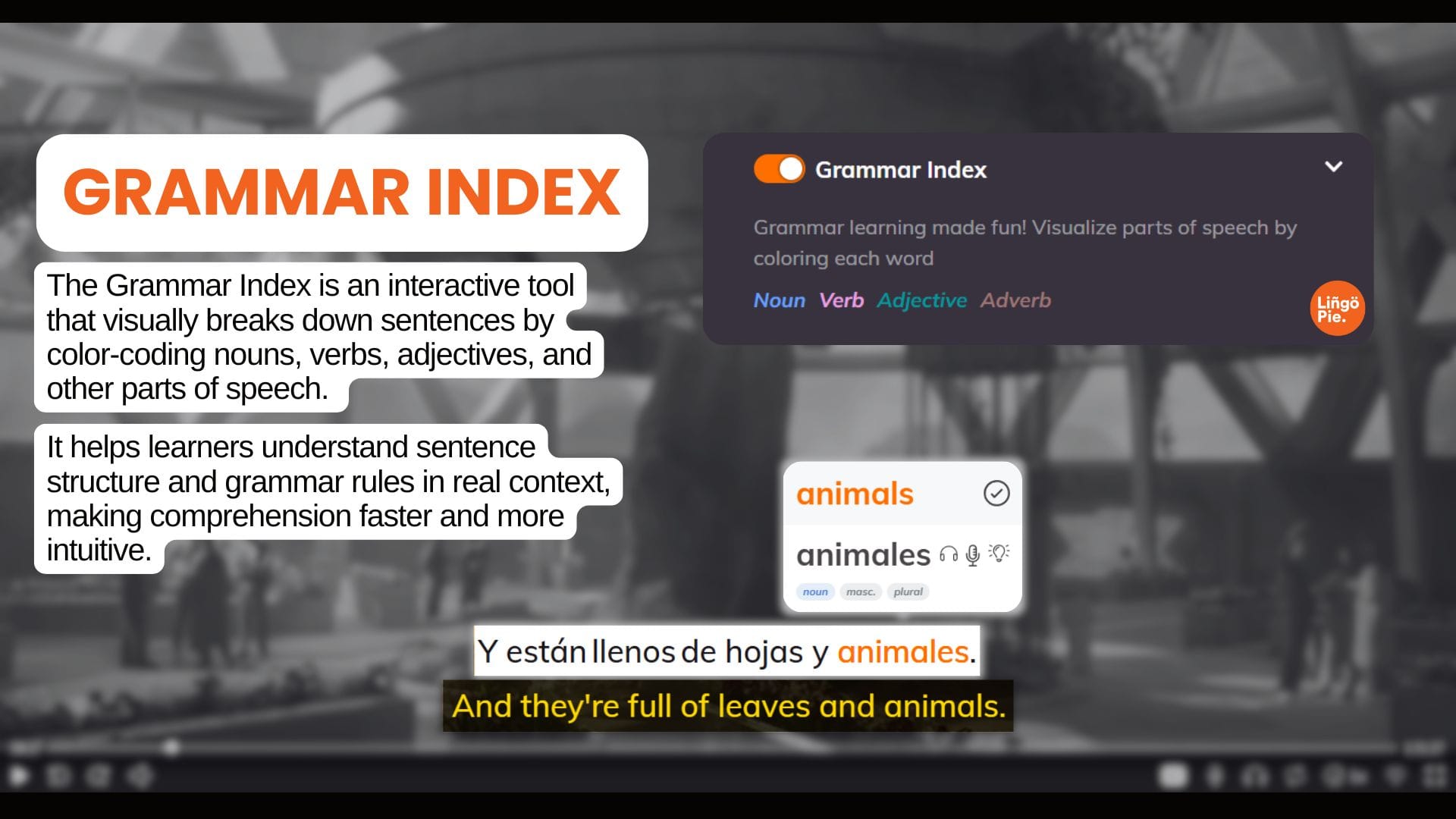
Lingopie created the Grammar Index, a tool that turns any subtitle line into a visual map of the sentence. When you turn on dual subtitles or click a subtitle line, every single word is instantly marked with a color that shows its role. It’s a simple way to see the full structure of the sentence without pausing or digging through grammar explanations.
The team built it this way because meaningful learning happens when grammar is tied to real conversation.
As Shaked from our product team explained, language learning should feel intuitive. You learn best by observing many examples and seeing patterns, not by reading tables or trying to remember rules out of context.
The Grammar Index brings that idea to life, making grammar clear and easy right when you need it on the screen, inside real dialogue.
How Does Lingopie's Grammar Index Actually Work?
The Grammar Index works by turning subtitles into a visual map of the sentence you’re hearing. Every word is color-coded based on its part of speech:
- Nouns – Blue
- Verbs – Pink
- Adjectives – Green
- Adverbs – Brown
As you watch, the structure of the sentence becomes obvious at a glance.
What makes this so effective is that grammar is explained in real-time, within real conversations. You're hearing a character speak naturally, in the tone, speed, and style of everyday life — and the Grammar Index breaks down the sentence right as it happens. This lets your brain absorb grammar the same way it learns patterns in your first language: by seeing many examples used in real situations.
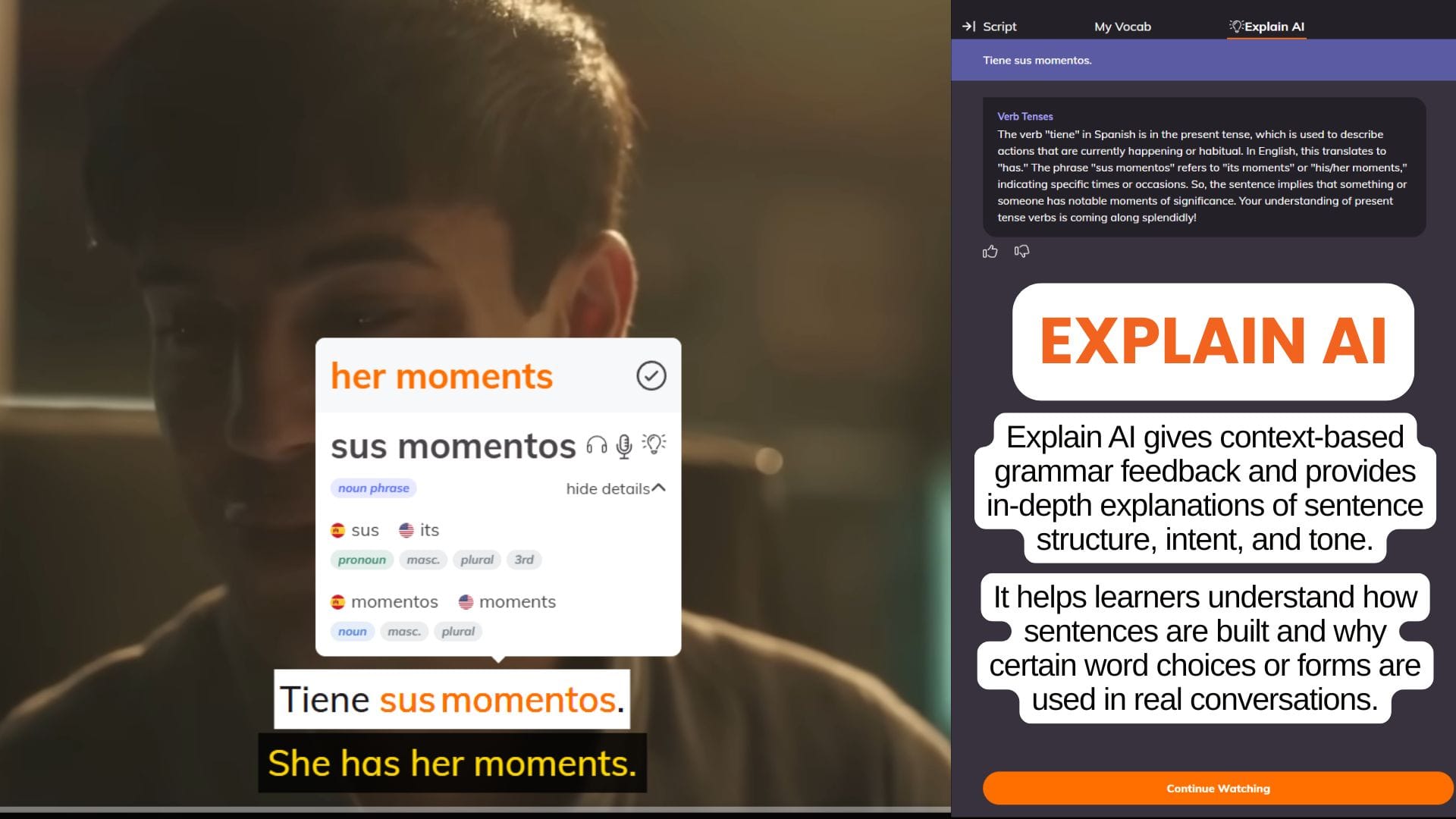
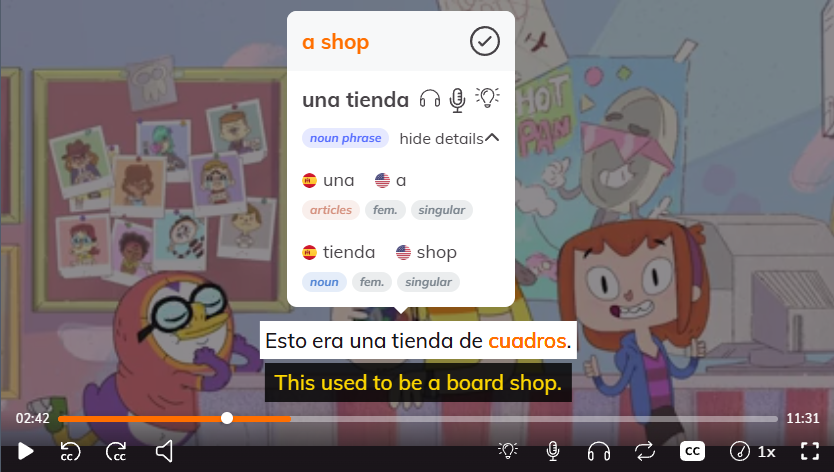
You can click on any word to see exactly what it’s doing in the sentence. If it's a verb, you’ll see how it’s conjugated. If it’s part of an expression, you’ll see how the pieces work together. This is especially helpful for slang, idioms, and regional differences — things that traditional apps almost never teach well.
As Raysa from our team explained, some words shift meaning depending on the country or context, and the Grammar Index makes those changes easy to notice.
What sets Lingopie apart from other platforms is that everything is tied to real content. Most apps teach grammar through isolated examples and repetitive exercises, which don’t prepare you for the way people actually speak. With Lingopie, you’re learning grammar from real voices using language naturally.
Why Did Lingopie Choose Color Coding?
Lingopie chose color coding because it’s the simplest way to make sentence structure visible while you’re watching a show. When each part of speech has its own color, you don’t need to stop and analyze anything — you can instantly see how the pieces fit together. It takes grammar out of your head and puts it right on the screen, which makes it much easier to understand without slowing down your learning.
This decision came from a very real issue our language team kept seeing: most learners can’t identify parts of speech just by looking at subtitles.
Mayara explained that color coding solves this by highlighting patterns the moment they appear, so you start noticing how sentences work automatically.
It’s a simple change that makes a huge difference, and it turns grammar into something visual, intuitive, and easy to follow.
Who Benefits Most From Lingopie’s Grammar Tools?
Lingopie’s grammar tools are designed for anyone who wants to understand how sentences actually work while watching real content. They’re especially helpful for learners who feel stuck between knowing grammar “rules” and being able to use them naturally in real conversations.
Here’s who gets the most out of it:
- Beginners who need a clear way to see how sentences are built.
- Intermediate learners who understand vocabulary but struggle with structure.
- Advanced learners who want to notice patterns, nuance, and regional differences.
- People who prefer learning from real shows instead of textbooks or drills.
- Anyone who wants grammar to finally feel simple, visual, and intuitive.
So, Does Lingopie Really Teach Grammar?
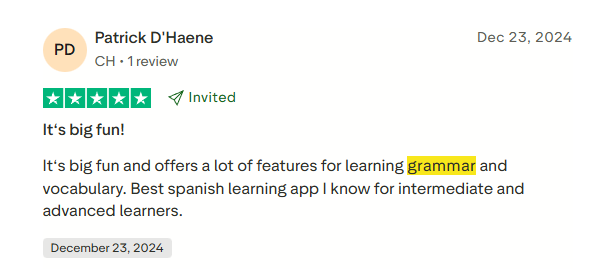
Yes. Lingopie teaches grammar by showing it to you in real-time, inside real conversations, rather than giving you long lessons or rules to memorize. You see how sentences work while you watch, and you understand grammar because it appears naturally on the screen.
However, do note that it won’t replace a full grammar textbook, but it makes understanding structure much easier and far more intuitive.
| Pros | Cons |
|---|---|
| Grammar is shown in real context, not abstract rules. | Not ideal if you want deep, technical grammar theory. |
| Color-coding makes sentence structure instantly clear. | Works best when you actively click and explore subtitles. |
| Helps you understand slang, tone, and regional usage. | Some languages have more content than others. |
| Great for visual learners and people who learn by watching. | Not a full grammar course on its own — more of a companion tool. |
| Makes grammar feel simple instead of intimidating. | You need steady exposure for the patterns to stick. |
 Genine Torres
Ready to Finally “Get” Grammar?
If grammar has always felt confusing, Lingopie makes it much easier to understand. The Grammar Index shows you how sentences work right inside the shows you already enjoy, so everything starts to make sense without extra effort or memorizing. You can try Lingopie free for 7 days and see for yourself how quickly grammar becomes clearer when you can actually watch it in action.
Start your free trial and give it a try.




![Is Lingopie Free? Plans, Pricing & Free Trial Guide [2026]](/blog/content/images/size/w300/2026/01/Is-Lingopie-Free.jpg)
![How To Gift Lingopie: One-Year vs Lifetime Subscription [GUIDE]](/blog/content/images/size/w300/2026/01/lingopie-gift-subscription.jpg)
