


You’ve probably heard that listening to music is a great way to learn Japanese. Perhaps you made a playlist of Japanese songs, hit play during work, and nodded along for an hour. Felt productive. But if someone stopped you mid-song and asked what the lyrics meant, you’d have nothing.
Well, the truth is that vibing is not the same as learning.
Actually, learning Japanese from songs works only if you’re using the right artists at the right level. Throwing any J-pop song at a beginner is like handing someone a copy of Dostoevsky to practice English.
So to help you out, this guide gives you 7 Japanese bands worth your time, what level they’re actually suited for, and a breakdown of real lyrics so you can start pulling vocabulary the moment you hit play.
- Japanese Honorifics: 10+ Titles You’ll Actually Use
- Japanese vs Chinese: Which Should You Actually Learn?
- 10 Best Japanese Karaoke Songs For Learning Japanese
Can you really learn Japanese through music
Yes, but not passively. Music alone won’t teach you grammar. What it does is burn vocabulary and sentence patterns into your memory in a way that flashcard apps can't touch. Songs repeat. You hum them in the shower. You hear the same phrase forty times without trying. That’s spaced repetition you didn’t have to schedule.
Japanese songs also expose you to natural rhythm and pitch. Japanese is a pitch-accent language, and hearing native speakers deliver words in a musical context trains your ear in ways that drilling romaji never will. The catch is that some J-pop lyrics are written to be poetic, abstract, or deliberately archaic. That’s not great for a beginner. The bands below are ranked partly by how learner-friendly their language actually is.

7 Japanese bands for learning Japanese
YOASOBI

Best for: Intermediate learners (N4-N3)
YOASOBI is a duo: producer Ayase and vocalist ikura. Every song is based on a short story published online, which is why their lyrics read more like compressed fiction than standard pop writing. Their 2019 debut 夜に駆ける (Yoru ni Kakeru / Racing Into the Night) became a generational anthem, and their 2023 track アイドル (Idol) broke streaming records across Asia.
Every YOASOBI song has a source short story, and reading it before the song is one of the most useful things you can do as a learner. You already know the narrative, so instead of decoding meaning and sound at the same time, you're only matching Japanese to a story you already understand. It cuts the cognitive load significantly and makes the vocabulary stick faster.
From 夜に駆ける (Yoru ni Kakeru / Racing Into the Night)
| Japanese | Romaji | English Meaning |
|---|---|---|
| 沈むように溶けていくように | Shizumu you ni tokete iku you ni | Like sinking, like melting away |
| ただ君と生きたいだけ | Tada kimi to ikitai dake | I just want to live with you |
| 二人だけの空が広がる | Futari dake no sora ga hirogaru | A sky just for the two of us spreads out |
Key vocabulary from this song: 沈む (shizumu, to sink), 溶ける (tokeru, to melt/dissolve), 生きる (ikiru, to live), 広がる (hirogaru, to spread/expand).
Radwimps

Best for: Intermediate to advanced learners (N3-N2)
Radwimps has been around since 2001, but most international listeners found them through the Makoto Shinkai films 君の名は (Your Name) and 天気の子 (Weathering With You). Vocalist Yojiro Noda writes all the lyrics himself, and he treats them like a second novel — dense, emotional, and not interested in being easy. Their sound sits between indie rock and cinematic pop, and the weight of the lyrics matches it.
Noda uses a lot of 〜ような (you na) and 〜たびに (tabi ni) constructions — patterns that express likeness, repetition, and emotional condition. These show up constantly in native Japanese speech and writing, but textbooks rarely give them enough space. Radwimps songs are effectively a crash course in how those patterns feel when used for real emotional weight, not just grammar drills.
From 前前前世 (Zenzenzense)
| Japanese | Romaji | English Meaning |
|---|---|---|
| 僕が生まれる前から | Boku ga umareru mae kara | Even before I was born |
| 君のことが好きだった | Kimi no koto ga suki datta | I was already in love with you |
| 何度も生まれ変わる度に | Nando mo umarekawaru tabi ni | Every time I was reborn again |
Key vocabulary from this song: 生まれる (umareru, to be born), 好き (suki, to like/love), 生まれ変わる (umarekawaru, to be reborn), 度に (tabi ni, every time).
Official HIGE DANdism

Best for: Intermediate learners (N4-N3)
Official HIGE DANdism, often shortened to Hige Dan, is a four-piece band built around pianist-vocalist Satoshi Fujihara. Their sound is tight melodic pop with jazz and soul underneath it. Pretender was inescapable in 2019, and Cry Baby — the Jujutsu Kaisen opening — pulled in a whole new international audience.
Their lyrics also use a lot of conditional and hypothetical sentence endings — forms like 〜としたら and 〜ならば that express "if" and "suppose that." These are N3-level grammar points that learners often understand in isolation but struggle to recognize in natural speech because they get compressed or blurred. Hige Dan's clean delivery makes them easier to catch in the wild.
From Pretender
| Japanese | Romaji | English Meaning |
|---|---|---|
| なれの果てがどこかにあるとしたら | Nare no hate ga doko ka ni aru to shitara | If what we've become exists somewhere |
| 僕だけが知っている | Boku dake ga shitte iru | Only I know it |
| それでも君を好きでいる | Soredemo kimi wo suki de iru | Even so, I'm still in love with you |
Key vocabulary from this song: 知る (shiru, to know), それでも (soredemo, even so/nevertheless), 好きでいる (suki de iru, to remain in love), なれの果て (nare no hate, what something has become).
King Gnu

Best for: Advanced learners (N2-N1)
King Gnu is a four-piece art rock band from Tokyo and the most musically restless act on this list. Their sound moves between folk, funk, and heavy rock within a single album — sometimes within a single track. Vocalist Daiki Tsuneta writes lyrics that pull from classical Japanese, modern slang, and literary references that would stump most native speakers. 白日 (Hakujitsu) and 三文小説 (Sanmon Shousetsu) are their best-known tracks.
One specific thing worth studying: King Gnu frequently drops the subject of a sentence entirely, which is grammatically normal in Japanese but disorienting for learners trained on complete sentences. Working out who is doing what — and why the Japanese makes it ambiguous on purpose — is a useful exercise in reading native intent rather than just parsing grammar.
From 白日 (Hakujitsu / Daylight)
| Japanese | Romaji | English Meaning |
|---|---|---|
| ねぇ白日の下に晒してよ | Nee hakujitsu no shita ni sarashite yo | Hey, expose it in the light of day |
| 今更だとしても | Imasara da to shite mo | Even if it's too late now |
| 全てを告白して | Subete wo kokuhaku shite | Confess everything |
Key vocabulary from this song: 白日 (hakujitsu, broad daylight), 晒す (sarasu, to expose/lay bare), 告白する (kokuhaku suru, to confess), 今更 (imasara, at this point/too late).
ONE OK ROCK

Best for: Beginner to intermediate learners (N5-N4)
ONE OK ROCK started in Tokyo's punk scene and built a sound that sits comfortably between J-rock and Western alternative. Vocalist Taka grew up partly in the US, and it shows — the band releases Japanese and English versions of most songs, and some tracks mix both languages within the same verse. Wherever You Are and We Are are good entry points.
Because Taka is genuinely bilingual, the Japanese versions aren't direct translations — they're rewrites. Comparing the two versions of the same song shows you how Japanese expresses the same idea differently: what gets compressed, what gets expanded, and which emotions the language handles more naturally than English does. That comparison is worth more than a textbook unit on its own.
From Wherever You Are
| Japanese | Romaji | English Meaning |
|---|---|---|
| 僕らしかいない世界で | Bokura shika inai sekai de | In a world where only we exist |
| ずっとそばにいて | Zutto soba ni ite | Please stay by my side always |
| 君だけを愛してる | Kimi dake wo aishiteru | I love only you |
Key vocabulary from this song: 世界 (sekai, world), ずっと (zutto, always/forever), そばにいる (soba ni iru, to be by one's side), 愛する (aisuru, to love).
Mrs. GREEN APPLE

Best for: Beginner to intermediate learners (N5-N4)
Mrs. GREEN APPLE is a bright, high-energy J-pop band fronted by vocalist Motoki Omori. Their sound is driving and immediate — no slow builds, no long intros. 青と夏 (Ao to Natsu / Blue and Summer) became a summer staple the year it came out, and recent tracks like ダンスホール (Dance Hall) and Magic have kept them consistently at the top of the charts.
What stands out is how often Omori uses te-form verbs to link ideas — 過ごした、終わらないで、広がって. This is one of the most common connecting structures in spoken Japanese, and Mrs. GREEN APPLE songs are full of it in natural, low-stakes context. If you're drilling te-form and want something less clinical than a textbook exercise, this is the band.
From 青と夏 (Ao to Natsu / Blue and Summer)
| Japanese | Romaji | English Meaning |
|---|---|---|
| 君と過ごした夏が | Kimi to sugoshita natsu ga | The summer I spent with you |
| まだ終わらないで | Mada owaranaide | Please don't end yet |
| 空が青くて眩しい | Sora ga aokute mabushii | The sky is blue and dazzling |
Key vocabulary from this song: 過ごす (sugosu, to spend time), 終わる (owaru, to end), 青い (aoi, blue), 眩しい (mabushii, dazzling/bright).
JO1

Best for: Beginners (N5)
JO1 is an 11-member Japanese boy group from the Produce 101 Japan franchise. Their production is K-pop in style but entirely Japanese in language, which gives you idol-level vocal clarity without having to split your attention between two scripts. BOOM BOOM BOOM, Shine A Light, and GET LOUD are their most-streamed tracks.
Pay attention to the particle usage — JO1's lyrics regularly use に、を、と、and で in short, clear phrases where the function is obvious from context. Particles are one of the harder things to internalize in Japanese because they're hard to visualize. Hearing them used simply and repeatedly in a song you already like is a more natural way to absorb them than drilling particle rules in isolation.
From BOOM BOOM BOOM
| Japanese | Romaji | English Meaning |
|---|---|---|
| 光に向かって走れ | Hikari ni mukatte hashire | Run toward the light |
| 僕たちの夢は終わらない | Bokutachi no yume wa owaranai | Our dreams won't end |
| 今ここにいるよ | Ima koko ni iru yo | I'm right here, right now |
Key vocabulary from this song: 光 (hikari, light), 向かって (mukatte, toward), 夢 (yume, dream), 今 (ima, now), ここ (koko, here).
Tips for singing in Japanese
Drop romaji as fast as you can.
It feels helpful at the start, but it trains your brain to read the wrong script. Switch to hiragana and katakana early. If you can read those while the song plays, you're building a real skill. If you're reading romaji, you're not.
Japanese runs on mora, not syllables.
This is why singing along sometimes feels off. English counts syllables; Japanese counts mora, which are smaller units. 東京 (Tokyo) is four mora: To-u-kyo-u. When a lyric doesn't sit right rhythmically, slow the song down and match each mora to a beat. It fixes itself quickly once you hear it.
Singing well doesn't mean you're speaking well.
Japanese has pitch accent — words have a specific high-low pitch pattern that changes meaning. In music, the melody overrides that, so singers take liberties that would sound wrong in conversation. Use songs to build vocabulary and rhythm. For natural pitch, you need to listen to actual speech too.
Loop one line, not the whole song.
Singing through an entire track is satisfying but not efficient. Pick the line you want to own, repeat it ten times until your mouth moves automatically, then move on. That's the line that stays with you.
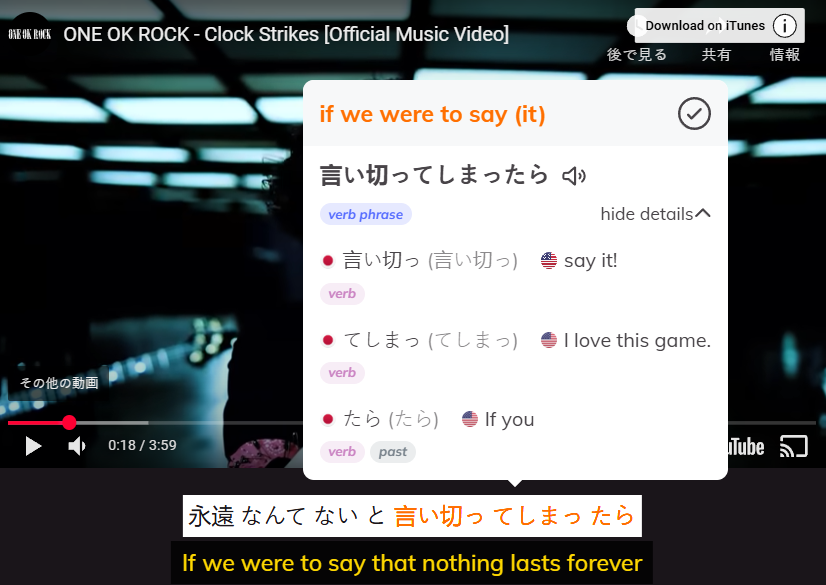
If you want all of this in one place — lyrics, translations, and vocabulary in sync with the audio — Lingopie Music does exactly that. You can tap any word in the lyrics while the song plays, get an instant translation, and save it to your vocabulary list. It's the fastest way to go from passively enjoying a song to actively learning from it.
Japanese words for music you should know
If you're going to talk about J-pop in Japanese, or search for lyrics and learn in Japanese-language spaces, these are the terms that come up constantly.
| Japanese | Romaji | Meaning |
|---|---|---|
| 音楽 | ongaku | music |
| 歌詞 | kashi | lyrics |
| 歌手 | kashu | singer |
| バンド | bando | band |
| メロディー | merodii | melody |
| サビ | sabi | chorus (the hook of a song) |
| Aメロ | A-mero | verse (first section) |
| Bメロ | B-mero | pre-chorus |
| 楽器 | gakki | musical instrument |
| 演奏する | ensou suru | to perform (music) |
| 作詞 | sakushi | lyric writing |
| 作曲 | sakkyoku | music composition |
| ライブ | raibu | live concert |
| ヒット曲 | hitto kyoku | hit song |
| アルバム | arubamu | album |
One worth knowing: サビ (sabi) is the Japanese term for what English speakers call the chorus or the hook. J-pop fans use it constantly in discussions and reviews, and it shows up in music criticism and song structure analyses. If someone says 「サビが最高」 (Sabi ga saikou), they mean the chorus is excellent.
How Lingopie Music makes this easier
Studying lyrics manually works, but it's slow. You find the song, find a transcription, open a separate dictionary tab, look up each word, and try to reassemble the context. By the time you've worked through one verse, you've lost the energy that made you want to learn from music in the first place.
Lingopie is a language-learning platform built around real Japanese content (dramas, movies, and J-pop music), all with interactive subtitles that let you tap any word for instant translation. Lingopie Music is included in the same subscription, so you’re not paying for a separate app. One account gets you Japanese TV shows, films, and the full music library. Vocabulary you pick up from a song carries over into everything else you watch.
If you're serious about learning Japanese, it's the most complete setup available.



![Japanese Honorifics: 10+ Titles You’ll Actually Use [GUIDE]](/blog/content/images/size/w300/2026/03/Japanese-honorifics.jpg)