
![How To Say I Love You In Hebrew [Guide]](/blog/content/images/size/w1200/2026/02/How-To-Say-I-Love-You-In-Hebrew-.png)
Saying "I love you" in Hebrew isn’t as simple as swapping English words for Hebrew ones. Hebrew has multiple ways to express love depending on who you’re talking to, how serious you are, and whether you’re about to get slapped or swept off your feet.
In this guide, we’ll break down each variation, explain the pronunciation, and show you how real Israelis use these phrases in context. Let's begin!
- Cooking Shows In Hebrew: 6 Best Shows To Watch On Lingopie
- 5 Best Hebrew Learning Apps For Total Beginners
- 18 Hebrew Slang Words And Phrases You Can Use Today
How to Say I Love You in Hebrew
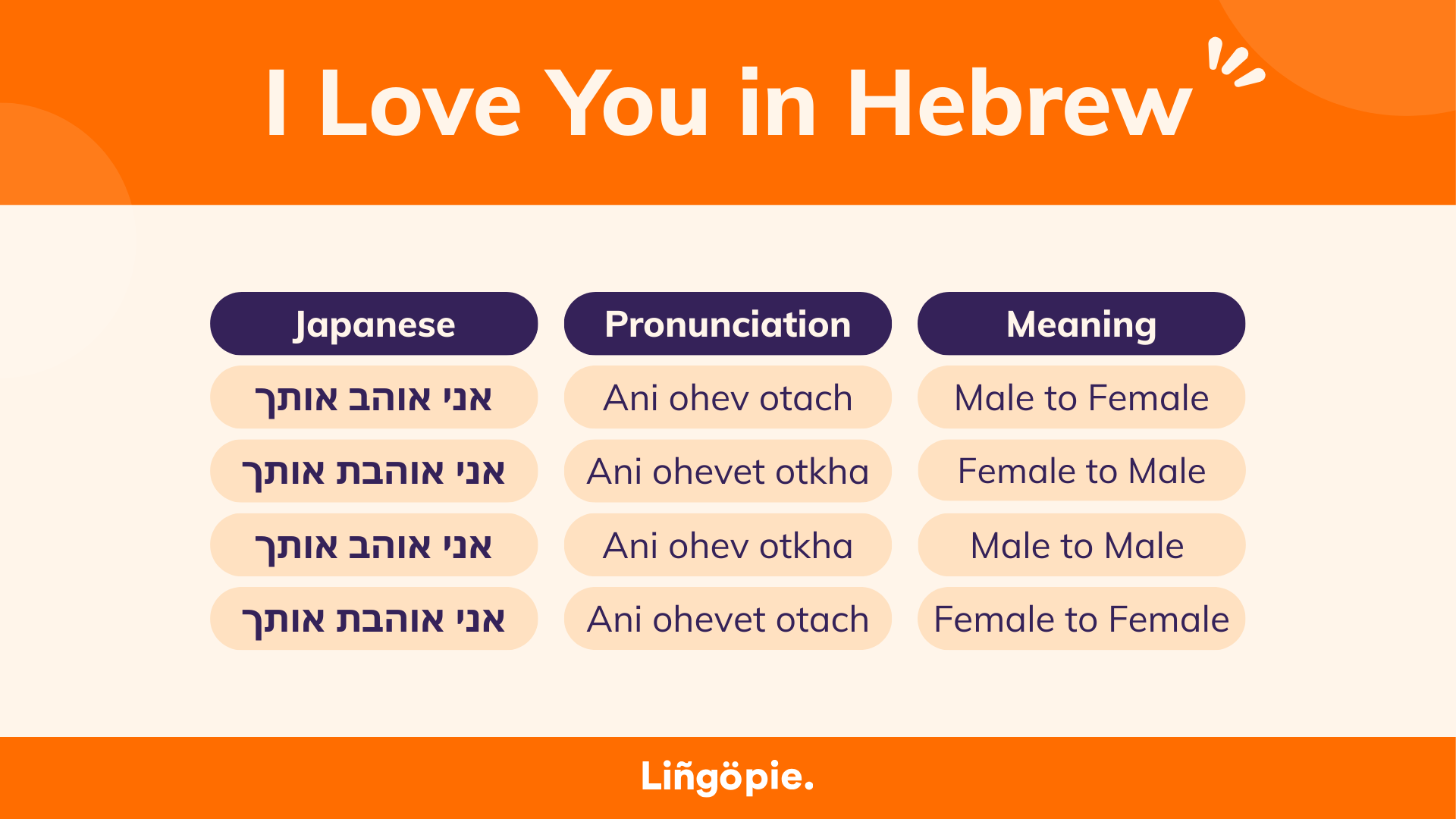
To say "I love you in Hebrew," you use the phrase "ani ohev otach" or "ani ohevet otkha" depending on your gender and who you’re speaking to. The basic grammar structure breaks down into three parts: the subject (ani), the verb (ohev or ohevet), and the object (otach or otkha).
Men say "ani ohev" while women say "ani ohevet"—the difference is the letter ת (tet) added to the feminine form. The object changes based on who's listening: "otach" when addressing a woman, "otkha" when addressing a man. This creates four possible combinations that cover every gender pairing.
| Speaker | Addressing | Hebrew | Pronunciation |
|---|---|---|---|
| Male | Female | אני אוהב אותך | Ani ohev otach |
| Female | Male | אני אוהבת אותך | Ani ohevet otkha |
| Male | Male | אני אוהב אותך | Ani ohev otkha |
| Female | Female | אני אוהבת אותך | Ani ohevet otach |
Other Ways to Say I Love You in Hebrew
Beyond saying "I love you" to one person, Hebrew has specific forms for addressing multiple people or groups. Below are some examples.
| Speaker | Addressing | Hebrew | Pronunciation | When to Use |
|---|---|---|---|---|
| Anyone | Multiple boys/men | אני אוהב/ת אתכם | Ani ohev/ohevet otchem | To sons, male friends, group of men |
| Anyone | Multiple girls/women | אני אוהב/ת אתכן | Ani ohev/ohevet otchen | To daughters, female friends, group of women |
| Anyone | Mixed group | אני אוהב/ת אתכם | Ani ohev/ohevet otchem | To kids of both genders, mixed friend group |
| Anyone | All my children | אני אוהב/ת את כולכם | Ani ohev/ohevet et kulchem | "I love you all" to children |
| Anyone | All my boys | אני אוהב/ת את הבנים שלי | Ani ohev/ohevet et habanim sheli | Specifically "I love my boys" |
| Anyone | All my girls | אני אוהב/ת את הבנות שלי | Ani ohev/ohevet et habanot sheli | Specifically "I love my girls" |

Terms of Endearment in Hebrew
Israelis use terms of endearment constantly in relationships, with family, and even with strangers in service situations. These words replace names and soften conversations, appearing far more frequently than "I love you" in daily speech.
Neshama
Neshama (נשמה) literally means "soul" and is the most common term of endearment in Israel. Anyone can call anyone neshama regardless of gender—parents use it with children, romantic partners use it with each other, and close friends use it casually.
Motek
Motek (מותק) means "sweetness" and is used primarily between romantic partners or by older people to younger ones. Women hear this more than men, and it signals affection without being overly serious.
Chamud/Chamuda
Chamud/Chamuda (חמוד/חמודה) means "cute one." Chamud addresses men while chamuda addresses women, and parents use this with children constantly while adults use it flirtatiously.
Habibi/Habibti
Habibi/Habibti (חביבי/חביבתי) comes from Arabic and means "my beloved." Habibi addresses men while habibti addresses women, and the term carries more intensity than "motek" but less commitment than "I love you."
Ahuvati/Ahuvi
Ahuvati/Ahuvi (אהובתי/אהובי) means "my beloved" and comes directly from the word "ahava" (love). This term appears almost exclusively in serious romantic relationships or marriages because it's too intense for casual dating.
Yekiri/Yekirti
Yekiri/Yekirti (יקירי/יקירתי) means "my dear" and sounds old-fashioned to most Israelis. Grandparents use it with grandchildren, and you'll see it in formal letters, but young Israelis rarely say it in conversation.
Neshama sheli
Neshama sheli (נשמה שלי) adds "my" to "neshama" and intensifies the affection. Adding "sheli" makes it specifically possessive and romantic rather than the casual friendliness of "neshama" alone.
Mammi/Tati
Mammi/Tati (מאמי/תאטי) are borrowed from Arabic and mean "mama/daddy" but used as terms of endearment between romantic partners. Women call their boyfriends "tati" while men call their girlfriends "mammi," suggesting the person takes care of you.
Compliments in Hebrew for Your Partner
Complimenting your partner in Hebrew requires changing the adjective based on whether you're addressing a man or woman. The word "at" (את) means "you" for women, and "ata" (אתה) means "you" for men. Most adjectives add a feminine ending (usually ה or ת) when addressing women and use the base form for men.
| Compliment (to women) | Compliment (to men) | Meaning |
|---|---|---|
| At yafa (את יפה) | Ata yafe (אתה יפה) | You are beautiful/handsome |
| At magniva (את מגניבה) | Ata magniv (אתה מגניב) | You are amazing/cool |
| Yesh lach eynayim yafot (יש לך עיניים יפות) | Yesh lecha eynayim yafot (יש לך עיניים יפות) | You have beautiful eyes |
| At osher le'libi (את אושר ללבי) | Ata osher le'libi (אתה אושר ללבי) | You are joy to my heart |
| At po'elet alai (את פועלת עלי) | Ata po'el alai (אתה פועל עלי) | You affect me |
| At machsheva (את מחשבה) | Ata machshav (אתה מחשב) | You are thoughtful |
| At mekomit (את מקומית) | Ata mekomi (אתה מקומי) | You are authentic/real |
| Kamah at yafa (כמה את יפה) | Kamah ata yafe (כמה אתה יפה) | How beautiful you are |
Learning "I Love You" Through Hebrew TV and Movies
Reading a list of Hebrew love phrases won't teach you how to actually use them. The real learning happens when you watch Israeli TV shows and hear these phrases in context—you start understanding why a character says "ani met alaich" on a third date but waits six months to say "ani ohev otach."
I recommend using Lingopie for this because our platform is built specifically for language learning through TV shows and movies. Every Hebrew show has interactive subtitles—click any word, and you get the translation, pronunciation, and can save it for review later. The best part is that our catalog can be filtered based on your actual level, so there's always something for everyone to watch.
Try Lingopie now and start learning Hebrew through real conversations in Israeli TV shows. Your first week is on us if you click the button below.

![How To Say I Love You In Italian Like A Native Speaker [Guide]](/blog/content/images/2025/01/I-Love-You-In-Italian.jpg)
![How To Write The Japanese Kanji For Love [+ FREE Printable]](/blog/content/images/size/w1200/2025/03/Japanese-Kanji-for-Love-1.jpg)

![How To Say Happy New Year In Hebrew [15+ Terms And Phrases]](/blog/content/images/size/w300/2025/12/how-to-say-happy-new-year-In-hebrew.jpeg)