
Look, you can Google Translate "good morning" and get "buenos días"—congrats, you're technically correct. But walk into a café in Mexico City and drop a stiff "buenos días" like you're addressing a board meeting, and you'll get polite smiles that say "okay, tourist."
Spanish greetings are way more flexible than your high school textbook let on. Spanish speakers switch between formal and casual depending on the vibe, the time, and honestly, how well they slept. This guide breaks down how to say good morning in Spanish without sounding like a robot, shows you what phrases actual people use in various social situations, and calls out the mistakes that instantly out you as a beginner.
- 9 Best Spanish Translator Apps And How To Use Them
- 80 Spanish Love Words Every Romantic Should Know
- How to Learn Spanish as An Adult [Guide]

How to say good morning in Spanish?
The most common way to say good morning in Spanish is "buenos días" (pronounced: /ˈbwe.nos ˈdi.as/). It's the standard morning greeting across all Spanish-speaking countries and works in both formal and casual settings. You'll also hear "buenas" (/ˈbwe.nas/)—a shortened, more relaxed version—and "buen día" (/bwen ˈdi.a/), which is popular in parts of Latin America. And of course, there's "hola" (/ˈo.la/), the all-day greeting that never fails.
Spanish Greeting | IPA Pronunciation | English Translation | When to Use It |
|---|---|---|---|
Buenos días | /ˈbwe.nos ˈdi.as/ | Good morning/Good day | Morning until early afternoon |
Buenas | /ˈbwe.nas/ | Hey/Hi (shortened) | Casual, any time of day |
Buen día | /bwen ˈdi.a/ | Good day | Common in Argentina, Central America |
Hola | /ˈo.la/ | Hello/Hi | Any time, any situation |
Each of these greetings carries different weight depending on context, region, and formality. Let's break down what they actually mean and when Spanish speakers reach for each one.
What does Buenos Días mean in Spanish?
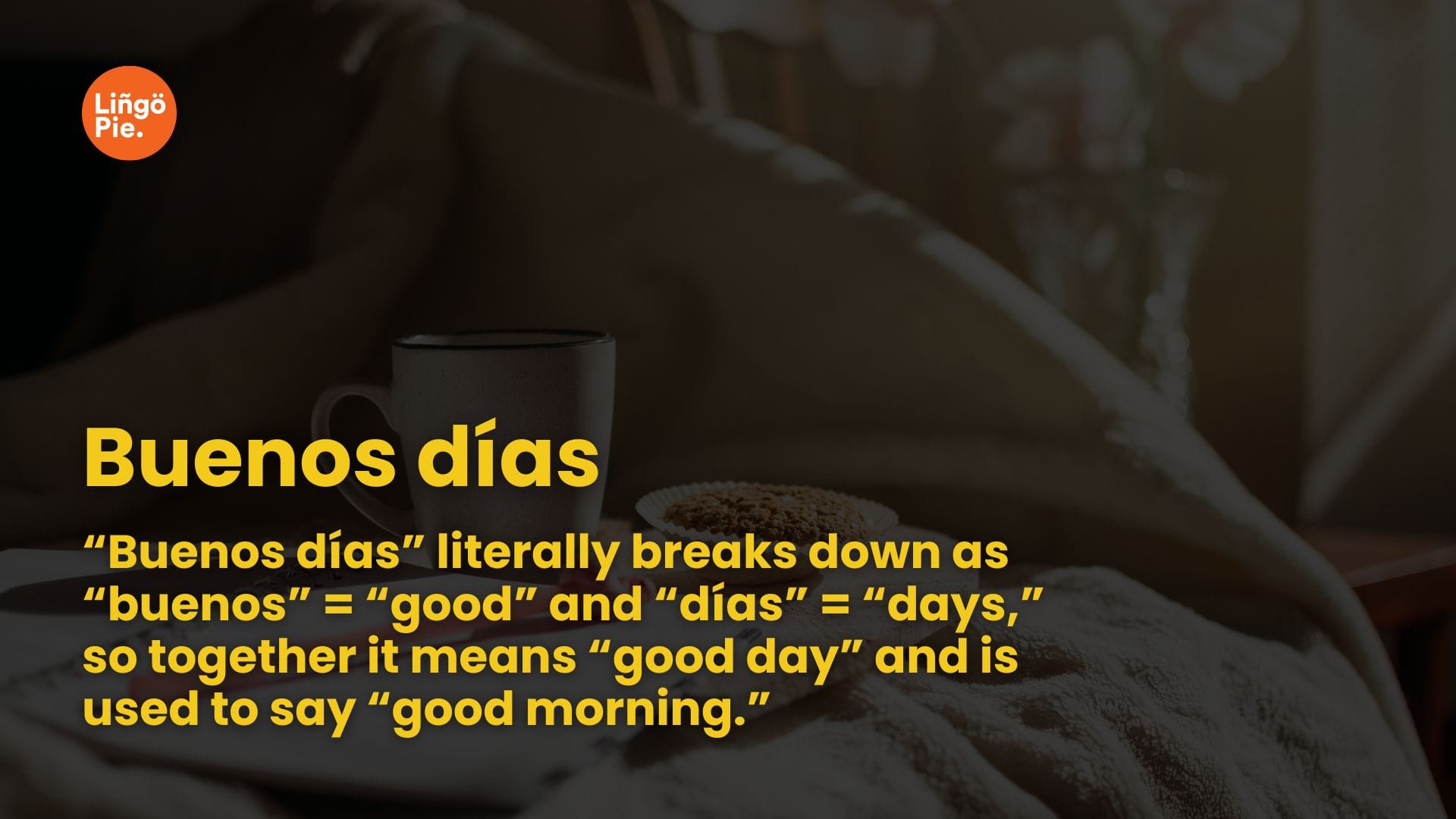
"Buenos días" literally means "good days". Technically, "Buenos" is the masculine plural form of "good," and "días" means "days." In short, saying this means you’re wishing someone multiple good days, not just one good morning. This greeting works from sunrise until roughly 2 PM, depending on the region. It's the safest, most universally accepted morning greeting, whether you’re in Spain or any Spanish-speaking country.
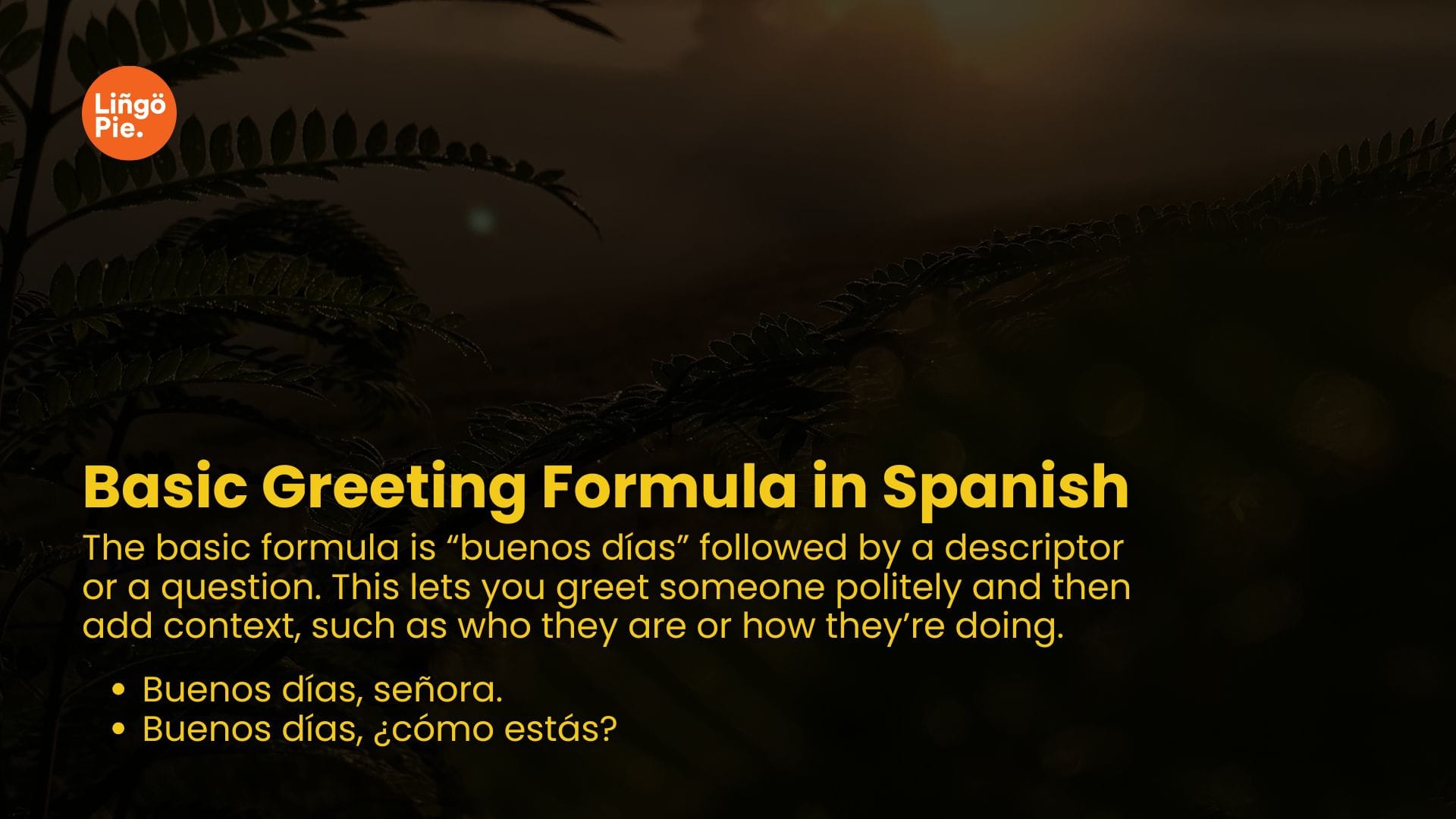
- "Buenos días, ¿cómo estás?" — Good morning, how are you?
- "Buenos días, señora." — Good morning, ma'am.
What does Buenas mean in Spanish?
"Buenas" is short for "buenas dias" (good morning), "buenas tardes" (good afternoon), or "buenas noches" (good night), but people drop the time-specific part and just say "buenas" as a catch-all greeting. Grammatically, "buenas" is the feminine plural of "good," but it only works as a standalone greeting in casual settings. You won't hear this in formal business meetings, but you'll absolutely hear it between friends, at the gym, or when someone's rushing past you in the hallway.
- "¡Buenas! ¿Qué tal?" — Hey! What's up?
- "Buenas, ¿todo bien?" — Hi, everything good?
What does Buen día mean in Spanish?
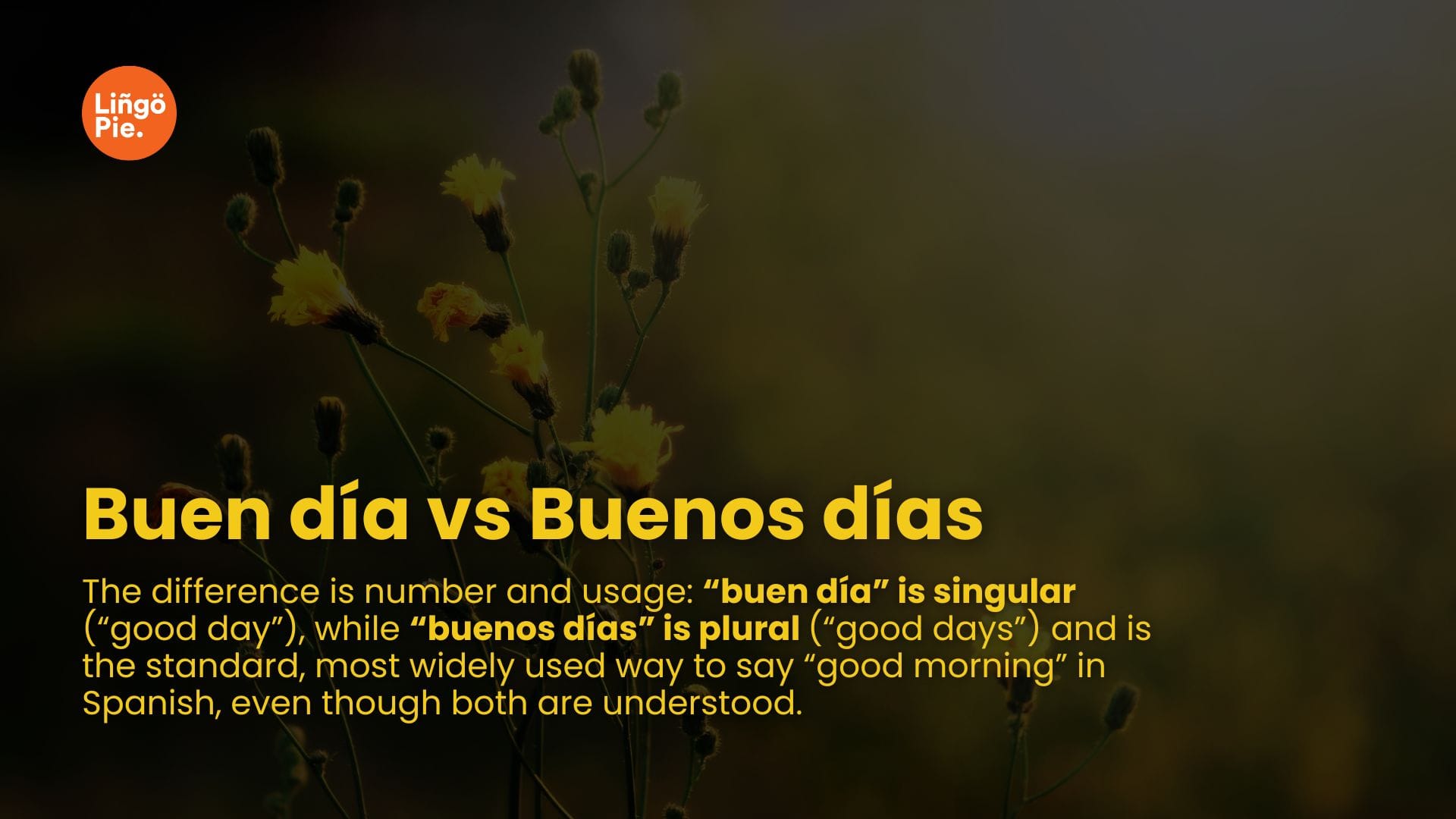
"Buen día" literally means "good day" wherein "Buen" is the masculine singular form of "good," and "día" is "day." This is where regional variations kick in. In Argentina, Uruguay, and parts of Central America, "buen día" is the go-to morning greeting instead of "buenos días." In Spain and Mexico, you'll rarely hear it.
Grammatically, it's interesting because "día" is masculine (el día), so you use "buen" instead of "buena." Some language learners mix this up and say "buena día," which is incorrect.
- "Buen día, ¿cómo andás?" — Good morning, how are you? (Argentine Spanish)
- "Buen día a todos." — Good morning, everyone.
What does Hola mean in Spanish?
"Hola" is the Spanish equivalent of "hello" or "hi," and it's the most flexible greeting in the Spanish language. Unlike "buenos días," which is time-specific, "hola" works at literally any hour. There's no literal translation beyond "hello"—it's just a straightforward, friendly greeting that fits various social situations. You can use it formally or casually, with strangers or friends, morning or night. It's often paired with other greetings for extra warmth, like "hola, buenos días" or "hola, ¿qué tal?"
- "Hola, ¿cómo estás?" — Hi, how are you?
- "Hola, mucho gusto." — Hello, nice to meet you. (Mucho gusto means "much pleasure")
How and when to say Buenos Días in Spanish
Using "buenos días" is straightforward—you say it when you first see someone in the morning, whether that's your hotel receptionist, a shopkeeper, or your Airbnb host. It's a standalone greeting, but you can also expand it to be more specific or personal.
The basic formula is "buenos días" + a descriptor or question. This makes your greeting warmer and shows you're actually engaged in the conversation, not just running through motions.
You can complete the phrase "buenos días" with any of the following:
Addition | Full Phrase | English Translation | When to Use |
|---|---|---|---|
señor/señora | Buenos días, señor | Good morning, sir | Formal, showing respect |
¿cómo está? | Buenos días, ¿cómo está? | Good morning, how are you? (formal) | Formal situations, older people |
¿cómo estás? | Buenos días, ¿cómo estás? | Good morning, how are you? (informal) | Friends, peers, casual |
¿qué tal? | Buenos días, ¿qué tal? | Good morning, how's it going? | Casual, friendly |
a todos | Buenos días a todos | Good morning, everyone | Greeting a group |
de nuevo | Buenos días de nuevo | Good morning again | Seeing someone twice in one morning |
Buenos días has a specific time window. You use it from sunrise until roughly 12 PM to 2 PM, depending on where you are in the Spanish speaking world. In Spain, people typically switch to "buenas tardes" (good afternoon) around 2 PM when lunch hits. In Latin America, the cutoff can be earlier—closer to noon in some places. Once you're past midday, buenos días sounds off.
The safest approach? Use buenos días until lunch, then switch to buenas tardes.
Polite ways to say good morning in Spanish
When you want to show extra respect or formality (like greeting your boss, a client, or someone significantly older) buenos días alone might feel too bare. Spanish speakers often pair their morning greeting with a polite follow-up question to acknowledge the person and show genuine interest.
These additions below can transform a basic greeting into a warm greeting that opens the door for actual conversation. In formal settings, using the right follow-up demonstrates cultural awareness and helps you navigate language barriers with confidence.
- ¿Cómo está? (/ˈko.mo esˈta/) — How are you? (formal, singular)
Use this with anyone you'd address as "usted"—bosses, elders, customers, or anyone in a position of authority. It's the formal and polite way to check in. - ¿Cómo están? (/ˈko.mo esˈtan/) — How are you all? (formal, plural)
Same as above, but for greeting multiple people formally, like entering a meeting room. - ¿Qué tal su día? (/ke tal su ˈdi.a/) — How's your day going?
A step beyond just "how are you"—this shows you care about how their day is unfolding. Works great in professional service settings. - Que tenga un buen día (/ke ˈten.ga un bwen ˈdi.a/) — Have a good day
Literally "may you have a good day." This is what you say when leaving, not arriving, but pairs perfectly after an initial buenos días. - Encantado/Encantada de verlo (/en.kanˈta.do de ˈβeɾ.lo/) — Pleased to see you
For when you're meeting someone for the first time or reuniting with a client. "Encantado" if you're male, "encantada" if you're female. - Mucho gusto (/ˈmu.tʃo ˈɣus.to/) — Nice to meet you
Literally means "much pleasure." Use this when being introduced to someone new in formal contexts.
In Spain and many Spanish speaking regions, adding eye contact and a slight nod or handshake reinforces the politeness. The words matter, but your body language seals the deal. Pair your formal greeting with these small gestures, and you'll navigate various social situations like you've been doing it for years.
How to greet people in Spanish throughout the day
Spanish greetings change as the day moves forward, and using the right one shows you understand the rhythm of the language. Here’s your cheat sheet!
Time of Day | Spanish Greeting | IPA Pronunciation | English Translation | Usage Notes |
|---|---|---|---|---|
Sunrise – 12/2 PM | Buenos días | /ˈbwe.nos ˈdi.as/ | Good morning/Good day | Standard morning greeting; ends at lunch |
12/2 PM – Sunset | Buenas tardes | /ˈbwe.nas ˈtaɾ.des/ | Good afternoon | Starts after lunch, runs until evening |
Sunset – Bedtime | Buenas noches | /ˈbwe.nas ˈno.tʃes/ | Good evening/Good night | Both a greeting and goodbye |
Anytime | Hola | /ˈo.la/ | Hello/Hi | Safe bet if you're unsure of the time |
Anytime (casual) | Buenas | /ˈbwe.nas/ | Hey/Hi | Shortened form, works morning/afternoon/night |
Leaving | Adiós | /aˈðjos/ | Goodbye | Standard farewell, any time |
Leaving (casual) | Chao/Chau | /tʃao/ | Bye | Borrowed from Italian, very common |
Leaving (night) | Que descanses | /ke ðesˈkan.ses/ | Rest well | Informal, used at night with friends |
Go Beyond Greetings With Lingopie
Mastering Buenos Días and other Spanish greetings is just the beginning. Real fluency comes from hearing these phrases in context—how Spanish speakers actually use them in different ways across various social situations.
That's where learning Spanish through authentic content makes all the difference. Instead of drilling Spanish vocabulary through flashcards, you absorb informal greetings like "qué hay" and "cómo te va" the way native speakers naturally use them in conversation, making the language feel second nature rather than memorized.
What you'll pick up from real Spanish content:
- When locals drop casual greetings versus formal ones
- Regional slang and expressions you won't find in textbooks
- How pronunciation shifts in different accents and speeds
- Body language and tone that make greetings feel natural
- Real-world practice through shows, movies, and conversations
Lingopie makes learning Spanish feel less like studying and more like binge-watching your favorite shows—because that's exactly what you're doing. You watch Spanish TV and movies with interactive subtitles that let you click any word for instant translations, save vocabulary, and replay scenes until the phrases stick. It's how you stop sounding like a textbook and start sounding like someone who actually lives the language.
Try Lingopie free and start learning new languages through the shows you'll actually want to watch.



![How To Say Happy Birthday In Spanish: 17+ Easy Ways [GUIDE]](/blog/content/images/size/w300/2026/03/Happy-Birthday-In-Spanish.jpg)