

Chibi characters are cute, but if your vibe leans more macabre than kawaii, horror anime is where it’s at. These shows can teach you Japanese faster than cheerful slice-of-life series because fear makes things stick. When a character screams “逃げろ!” (nigero — run!) while something grotesque charges toward them, that word stays in your brain forever.
Horror anime delivers what textbooks can’t. You hear survival phrases repeated naturally, feel the emotion behind every line, and get pulled into stories so gripping you’ll accidentally binge five episodes in one sitting. From psychological thrillers to full-on supernatural chaos, the genre exposes you to vocabulary and expressions most learners never touch.
Ready to learn Japanese the twisted way? Here are ten horror anime that might make you fluent — and slightly paranoid.
- 7 Best Japanese TV Websites You Can Watch From Anywhere
- 6 Best Japanese Language Apps Worth Trying [RANKED]
- 6 Best Japanese Translation Apps For Learners [TESTED]

Essential Japanese Horror Vocabulary You'll Actually Use
Horror anime teaches you vocabulary that textbooks skip entirely. You're picking up words for fear, danger, supernatural phenomena, and intense emotions that show up constantly in everyday conversation—not just when discussing scary content. These terms help you describe feelings, tell stories, and understand cultural references that native speakers use all the time.
| Japanese | Romaji | Meaning |
|---|---|---|
| 怖い | kowai | scary, frightening |
| 逃げる | nigeru | to run away, escape |
| 死ぬ | shinu | to die |
| 幽霊 | yuurei | ghost, spirit |
| 呪い | noroi | curse |
| 化け物 | bakemono | monster |
| 血 | chi | blood |
| 殺す | korosu | to kill |
| 助けて | tasukete | help me |
| 気持ち悪い | kimochi warui | creepy, disgusting |
| 悲鳴 | himei | scream |
| 恐怖 | kyoufu | terror, dread |
| 死体 | shitai | corpse, dead body |
| 闇 | yami | darkness |
| 危ない | abunai | dangerous |
Best Horror Anime Of The 21st Century
Yamishibai: Japanese Ghost Stories
An old man in a creepy mask appears in playgrounds to tell short horror stories based on Japanese urban legends. Each four-minute episode adapts a different folktale using paper-theater animation that feels unsettling in the best way.
The short format makes this perfect for learners. The narration is clear, the stories are self-contained, and you’ll pick up folklore vocabulary and storytelling patterns without committing your entire evening.
Parasyte
A parasitic alien fails to take over high schooler Shinichi’s brain and instead infects his right hand. Now his sentient hand, Migi, helps him fight other parasites while constantly questioning why humans feel fear, love, and guilt.
Fight scenes repeat survival language naturally, while Shinichi’s internal monologues give you introspective Japanese you rarely hear in textbooks. The human-versus-alien debates are especially useful for learning abstract vocabulary and emotional expression.
Higurashi: When They Cry
A rural village holds an annual festival where someone gets murdered, and someone disappears every single year, and transfer student Keiichi just walked into this curse. The twist: the show replays the same time period from different character perspectives, showing how events change based on who's experiencing them.
Similar scenes with different outcomes reinforce vocabulary naturally. Characters constantly theorize and explain mysteries, building psychological horror through dialogue rather than gore—suspenseful content that doesn't need visuals to terrify you.
Junji Ito Maniac: Japanese Tales of the Macabre
This anthology adapts twenty of Junji Ito’s most disturbing short stories, from floating balloon heads that hunt people to spirals that slowly destroy entire towns.
Because every episode tells a different story, you’re constantly exposed to new situations and vocabulary. One day it’s curses, the next it’s body horror, which keeps your brain adapting instead of zoning out.
Death Note
Light Yagami finds a notebook that kills anyone whose name he writes in it and decides to become the god of a new world. Detective L rises to stop him, turning every conversation into a psychological chess match.
Almost every scene is dialogue. Characters explain plans, question motives, and debate justice nonstop, giving you advanced vocabulary and sentence structures far beyond basic daily conversation.
Tokyo Ghoul
College student Kaneki's date tries to eat him because she's a ghoul, and he only survives by getting her organs transplanted into his body. Now he's a half-ghoul hybrid who can't stomach normal food, joining a café run by ghouls trying to live peacefully in a world where both sides want him dead.
Internal conflict drives every episode as Kaneki questions what he's becoming. You're hearing survival strategies, society rules, and debates about humanity versus monstrosity while action scenes drill key phrases into memory.
Mieruko-chan
High schooler Miko suddenly sees horrifying ghosts everywhere, and her survival strategy is simple: pretend she can't see them. The horror-comedy works because watching her maintain a poker face while grotesque spirits hover inches away creates perfect tension.
She's still living a normal life—school, friends, daily routines—which means every day vocabulary mixed with supernatural horror terms. Her screaming internal thoughts versus calm external voice give you both casual and dramatic speech patterns in the same scene.
The Summer Hikaru Died
Yoshiki's childhood friend Hikaru returns from the mountains, but an eldritch entity has consumed and replaced him. Yoshiki knows "Hikaru" isn't really Hikaru anymore, yet he can't let go of the thing wearing his dead friend's face.
Intimate conversations between them drive the grief-soaked horror, giving you emotionally raw dialogue about identity and belonging. The rural setting provides cultural context, and body horror punctuates quiet moments, but the real fear is watching someone choose comfortable lies over painful truth.
Uzumaki
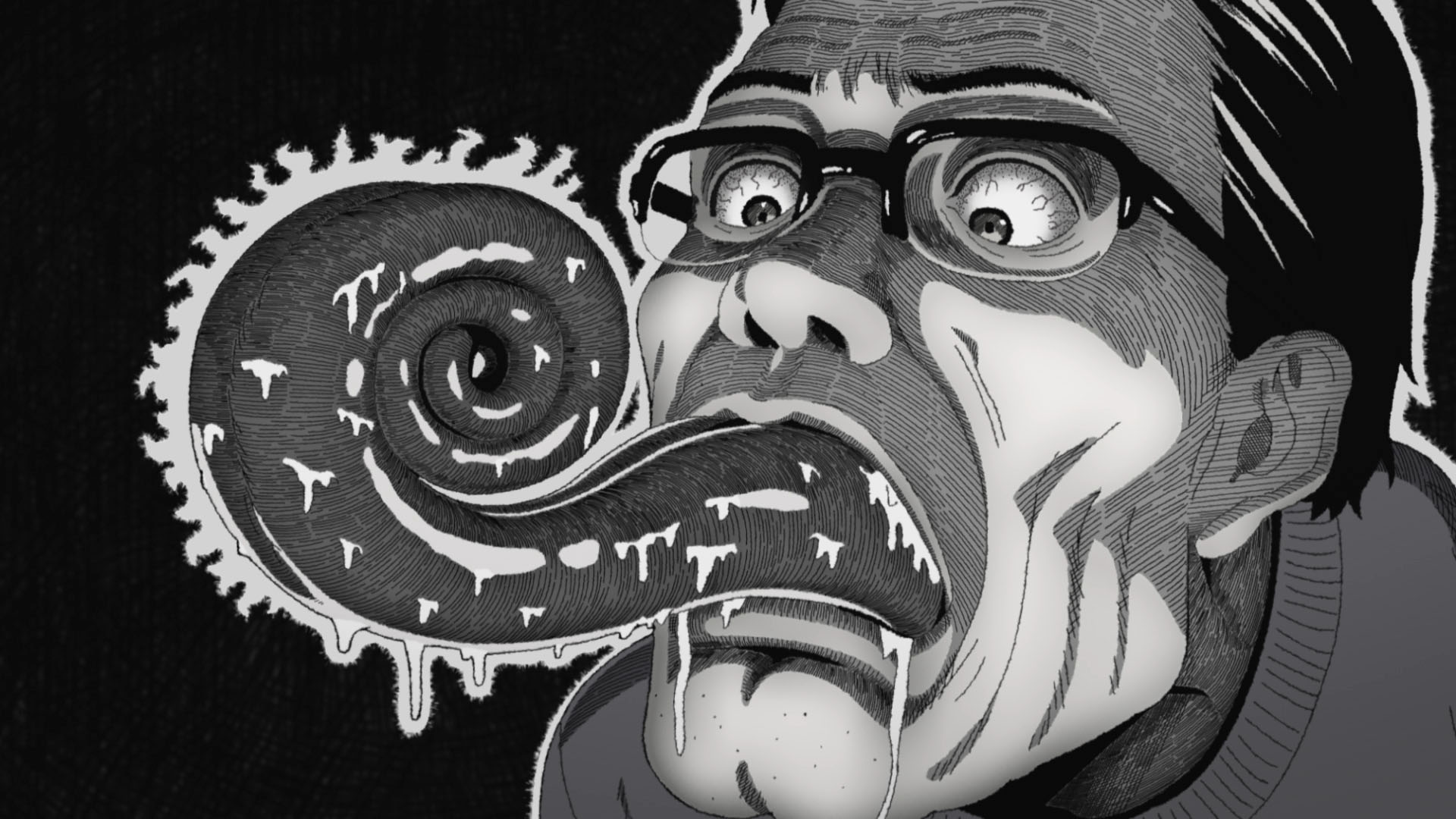
A small town becomes obsessed with spirals, and slowly everything begins to warp, twist, and collapse into geometric horror no one can escape.
The repeating spiral imagery reinforces descriptive vocabulary again and again, while the panicked conversations around the curse expose you to natural reactions, warnings, and emotional speech in tense situations.
Hell Girl
A mysterious website appears at midnight letting anyone send their enemies straight to hell through a girl named Ai Enma. The price? When you die, you're going to hell too. Each episode follows a different person seeking revenge, showing their suffering until they damn themselves for vengeance.
Hell Girl's catchphrases repeat every episode until they're burned into memory. The anthology format explores different revenge scenarios without tracking ongoing plots, and vocabulary around grudges, suffering, and moral corruption gets drilled in through pure repetition.
Ready to turn your next scare into real progress?
Horror anime shows why emotion is one of the best language teachers you can have. Fear, tension, and surprise lock new words into your memory in ways flashcards never could. When characters shout warnings, whisper secrets, or argue about life and death, you’re learning Japanese in its most natural form — fast, emotional, and impossible to forget.
That’s where Lingopie comes in. With interactive dual subtitles, instant flashcards, and shows you’ll actually want to keep watching, it turns your next horror binge into real progress. Skip the drills, embrace the scares, and start learning Japanese from stories that stay with you long after the credits roll.


![Sushi Names In Japanese And How To Order Them [Guide]](/blog/content/images/size/w1200/2026/01/sushi-names-in-japanese.jpg)


![Japanese vs Korean: Which Language Should You Be Learning? [2026]](/blog/content/images/size/w300/2026/03/Japanese-vs-Korean.jpg)