
Duolingo popularized gamified language learning, but it's not the only option. If you're looking for apps similar to Duolingo that use game mechanics to keep you motivated, you've got plenty of alternatives that might actually work better for your learning style.
These apps are also worth using if you've got that dragging feeling every now and then. In fact, studies confirm that game elements increase motivation, improve vocabulary retention, and boost engagement compared to traditional methods. However, not all apps are worth trying, okay?
In this post, I'll share with you the 5 best apps that offer different gamification types. Whether you’re looking for something that earns points for completing lessons, battling monsters with vocabulary knowledge, or learning through TV shows you’d watch anyway, this list has it all for you!
- 6 Best Japanese Language Apps Worth Trying [TESTED]
- Best Language Learning Programs: Tools That Get Results
- Levels Of Language Proficiency: 3 Common Frameworks
Is Gamified Learning Effective?
Yes, and the science backs it up. Multiple systematic reviews confirm that gamified language learning significantly improves student motivation, engagement, and actual learning outcomes. The game elements tap into intrinsic motivation by providing achievement, progress tracking, and sometimes competition. Visual learners particularly benefit since many gamified apps pair words with images, improving retention by up to 300% compared to traditional flashcards.
The effectiveness depends on the app's design quality. Well-designed gamified tools integrate pedagogy with game mechanics, while poorly designed ones just slap points onto boring drills. The best alternatives to Duolingo use spaced repetition algorithms, provide immediate feedback, and keep you practicing consistently. That daily habit formation matters more than any single feature.
Apps Like Duolingo
Lingopie: Best For Learning Through Real TV and Movies
Lingopie is the best alternative to Duolingo because of its unique approach. Instead of isolated lessons, you learn by watching actual TV shows, movies, and music videos in your target language. Every show comes with dual interactive subtitles where you can click any word for instant translation, pronunciation, and save it to flashcards with the actual video scene attached.
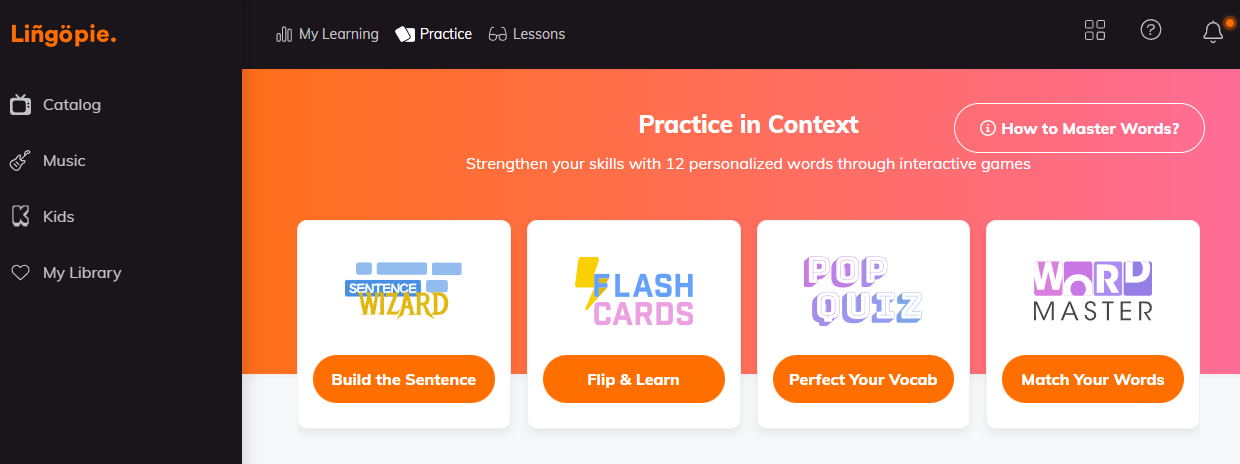
Lingopie's gamified feature can be seen once you go to the review section. For instance, it has Sentence Wizard challenges you to build sentences from the shows you've watched, Pop Quiz tests your comprehension with multiple-choice questions, and Word Master is a matching game for vocabulary practice. All of these games are built from actual dialogue you heard native speakers use, so you're reinforcing real language patterns.
What makes Lingopie different from Duolingo:
- Real entertainment content vs. artificial lesson sentences
- Context-based learning vs. isolated vocabulary drills
- Natural speech at normal speed vs. slow robot voices
- Cultural immersion through authentic media
- Better for intermediate learners who need real-world exposure
Available languages: Spanish, French, Italian, Portuguese, German, Russian, Korean, Japanese, Chinese, Dutch, Turkish, Greek, Polish, Hebrew
Lingo Legend: Best For Gamers Who Need Actual Games
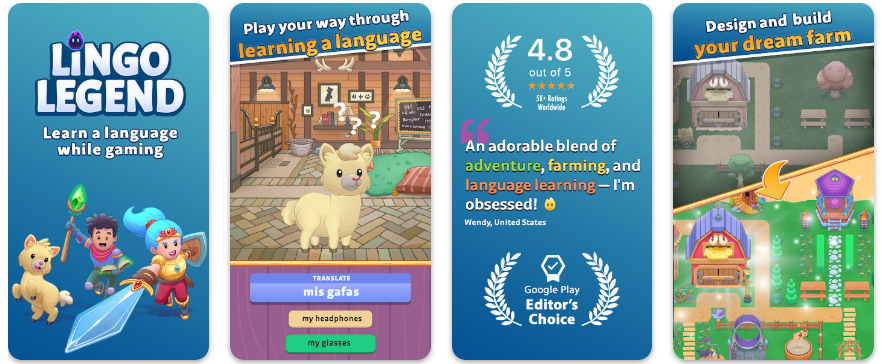
Lingo Legend is an actual RPG, not just lessons with game elements slapped on. You build a deck of ability cards and battle monsters, but you can only use those cards by correctly answering language questions. The game has two modes:
- Farm Mode for relaxed vocabulary practice while managing crops and animals
- Adventure Mode for strategic combat, where you need the right words to win battles
The gameplay keeps you engaged longer than apps that feel like studying. Reviews consistently mention it solves the motivation problem better than Duolingo because it actually feels like playing a game, not doing homework disguised as a game. The energy system limits free play, which some users dislike, but subscriptions are reasonable at $9.99 monthly or $89.99 for lifetime access.
Core features:
- Deck-building RPG mechanics with real strategy
- Spaced repetition is integrated into gameplay
- Customizable difficulty and topic focus
- Works offline after downloading content
Available languages: Chinese, Dutch, French, German, Italian, Japanese, Korean, Portuguese, Russian, Spanish
StudyCat: Best For Young Children (Ages 3-8)
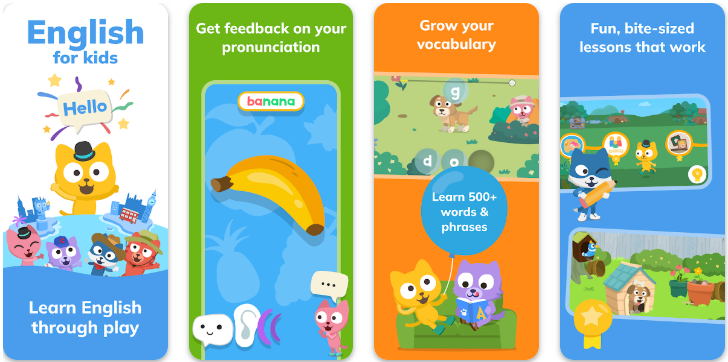
StudyCat is specifically designed for kids too young for Duolingo. The app requires zero reading ability and uses 1000+ interactive games, songs, and animated activities to teach vocabulary and basic phrases. Everything is visual and voice-based, so even preschoolers can navigate independently.
Parents choose StudyCat because it's kidSAFE certified, completely ad-free, and aligned with Cambridge English: Young Learners standards. Kids stay engaged through cartoon characters, rewards, and age-appropriate challenges that feel like entertainment. It covers English, Spanish, French, German, and Chinese with an expert-designed curriculum that builds proper foundations without overwhelming young learners.
Why it works for families:
- No reading required, fully voice-guided
- Shorter attention spans accommodated with varied activities
- Multiple learner profiles for siblings
- Offline learning for travel or restaurants
Available languages: Arabic, Catalan, Czech, Danish, German, Greek, English, Spanish, Finnish, French, Hebrew, Hindi, Croatian, Hungarian, Indonesian, Italian, Japanese, Korean, Khmer, Malay, Dutch, Norwegian, Polish, Portuguese (Brazil), Portuguese (Portugal), Romanian, Russian, Slovak, Swedish, Thai, Turkish, Ukrainian, Vietnamese, Chinese (Simplified), and Chinese (Traditional).
HelloWords: Best For Fast Vocabulary Building
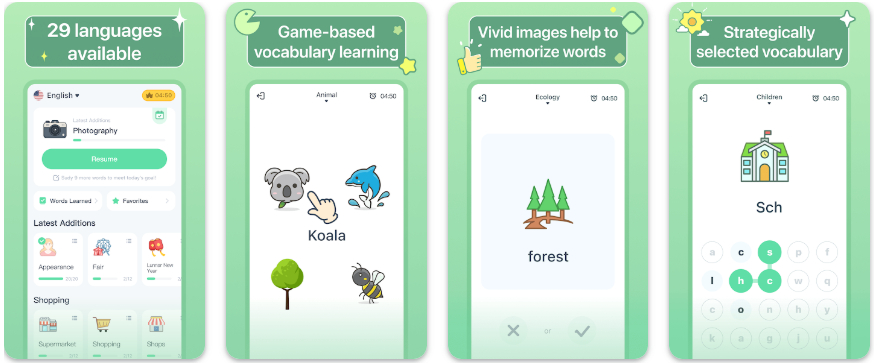
HelloWords strips language learning down to pure vocabulary acquisition with 3-minute daily sessions. The app offers 29 languages completely free, which already beats Duolingo's pricing, and focuses exclusively on the 3000 most practical words across 168 topic categories. The spaced repetition system shows words right when you're about to forget them, and the visual learning approach pairs every word with memorable images.
The tradeoff is depth. HelloWords won't teach grammar, conversation skills, or cultural nuance. It's laser-focused on building vocabulary fast, which works perfectly as a supplement to other learning methods or for travelers who need practical words quickly.
Some users report audio inconsistencies where certain words lack pronunciation, which is frustrating for languages like Japanese or Korean where hearing the word matters. But for free access to nearly 30 languages with a proven memorization system, it's hard to complain.
Best use cases:
- Supplementing grammar-focused apps or classes
- Preparing vocabulary before trips
- Quick daily practice when time is limited
- Visual learners who remember images better than text
Available languages: Key languages include English (American/British), French, Spanish (European/Latin American), German, Japanese, Korean, Chinese (Simplified/Traditional/Cantonese), Russian, and Arabic.
Drops: Best For Visual Learners With Limited Time
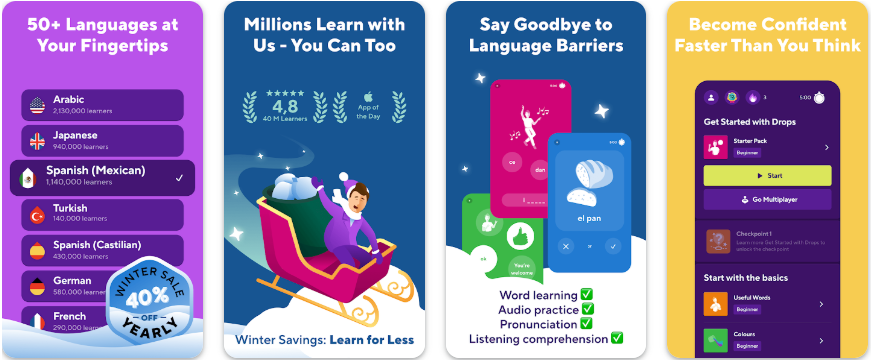
Drops built its reputation on 5-minute lessons that feel like swiping through a beautifully designed game. Every word pairs with a custom illustration, and you learn through fast-paced matching, swiping, and tapping games with zero typing required. The micro-lesson approach eliminates excuses—you always have 5 minutes—and the visual associations significantly enhance memory retention compared to text-based learning.
The app limits free users to one 5-minute session per day, which some find motivating, and others find restrictive. Premium unlocks unlimited practice, offline mode, and the Review Dojo for spaced repetition. Drops was acquired by Kahoot in 2020 and has since added multiplayer modes for competitive practice.
Honestly, it's purely vocabulary-focused like HelloWords, but the polish and design quality feel more premium, and the strict time limit actually helps some learners stay consistent rather than burning out on hour-long sessions.
Standout features:
- Gorgeous minimalist design that's genuinely enjoyable to use
- Completely gesture-based, no keyboard needed
- Works offline for premium subscribers
- Multiplayer mode for competing with other learners
Available languages: 50+ languages, including Spanish (Castilian/Mexican), French, German, Italian, Portuguese (Brazilian/European), Dutch, Danish, Norwegian, Swedish, Icelandic, Russian, Polish, Serbian, Croatian, Bosnian, Ukrainian, Romanian, Greek, Catalan, Galician.
Why Use Duolingo Alternatives
Duolingo does one thing well—making language learning accessible through gamification. But it has real limitations.
For instance, the sentences often feel artificial ("The horse drinks wine") and extremely weird; it focuses heavily on translation rather than thinking in the target language, and the competitive elements can prioritize streaks over actual learning. Many users report maintaining 500-day streaks while barely improving their conversational ability.
These alternatives address specific weaknesses:
- Context deficit → Lingopie fixes this with real TV and authentic usage
- Shallow gamification → Lingo Legend provides actual gameplay worth playing
- Wrong age group → StudyCat builds proper foundations for young children
- Time commitment → HelloWords and Drops work in 3-5 minutes daily
- Visual learning preference → Drops and HelloWords prioritize images over text
The best approach often combines multiple apps. Use Lingopie for listening comprehension and cultural context, supplement with Drops for quick vocabulary building, and practice grammar through conversation exchange. Different apps excel at different skills, and Duolingo alternatives let you customize your learning stack instead of relying on one platform's approach.
Learn With Lingopie Today
Lingopie stands out among Duolingo alternatives because it solves the biggest problem with gamified apps: they don't prepare you for real conversations with native speakers. When you learn through actual TV shows and movies, you're hearing natural speech patterns, picking up slang, and absorbing cultural context that makes you sound less like a textbook and more like a real person.
Start your free trial and pick a show in your target language. You'll be learning within minutes, and unlike point-chasing on other apps, you'll actually want to keep watching to find out what happens next. That's how language learning should feel.



![7 Best Apps To Learn German On Your Own [REVIEWED]](/blog/content/images/size/w300/2026/01/best-apps-to-learn-german-on-your-own.png)
