

Learning Spanish isn’t just about memorizing vocabulary lists or perfecting your tener conjugations. Real conversations are messy, full of slang, cultural references, and yes, Spanish curse words that you won’t find in any textbook.
Spanish profanity shows up everywhere: in movies, music, street conversations, and heated arguments. This means that if you're serious about understanding how Spanish speakers actually communicate, you can’t just stick to the basic (or should we say...sanitized?) English-to-Spanish words you learned in class.
In this guide, we’ll break down over 20 of the most common Spanish curse words, explain what they mean, when to use them (and when not to), plus cleaner alternatives for everyday use.
- Hardest Words In Spanish: 14 Pronunciation Nightmares (And How to Survive Them)
- 30 Mexican Sayings That'll Have You Sounding Like A Native Speaker
- 17 Best Shows To Watch To Learn Spanish On Netflix
- How To Gift Lingopie: One-Year vs Lifetime Subscription

How Do You Swear in Spanish?
Spanish swear words follow specific patterns that can help you understand Spanish better, even if you don't plan to use them. The most common Spanish swearing patterns include:
- Religious references
- Family-related insults
- Animal comparisons
- Scatological terms
Just like English, Spanish swear words have different intensity levels as well, including:
| Level | Type | Usage |
|---|---|---|
| Mild | "Maldita sea" (Damn it) "Rayos" (Darn) | Acceptable in casual settings |
| Medium | "Carajo" (Damn/Hell) | Used among friends, still somewhat taboo |
| Strong | [Omitted intentionally] | Very offensive, avoid in most situations |
We've intentionally left out the strongest terms and Spanish insults. If you're curious about specific words, Spanish movies and TV shows often use authentic swearing in context. Just remember that what's mild in one country might be highly offensive in another!
Mean Names & Insults in Spanish
When learning Spanish, understanding insults isn't about using them, but recognizing when you're being dissed – or when someone's just joking around. Here's your safe-for-work guide to Spanish name-calling:
Common Mild Insults
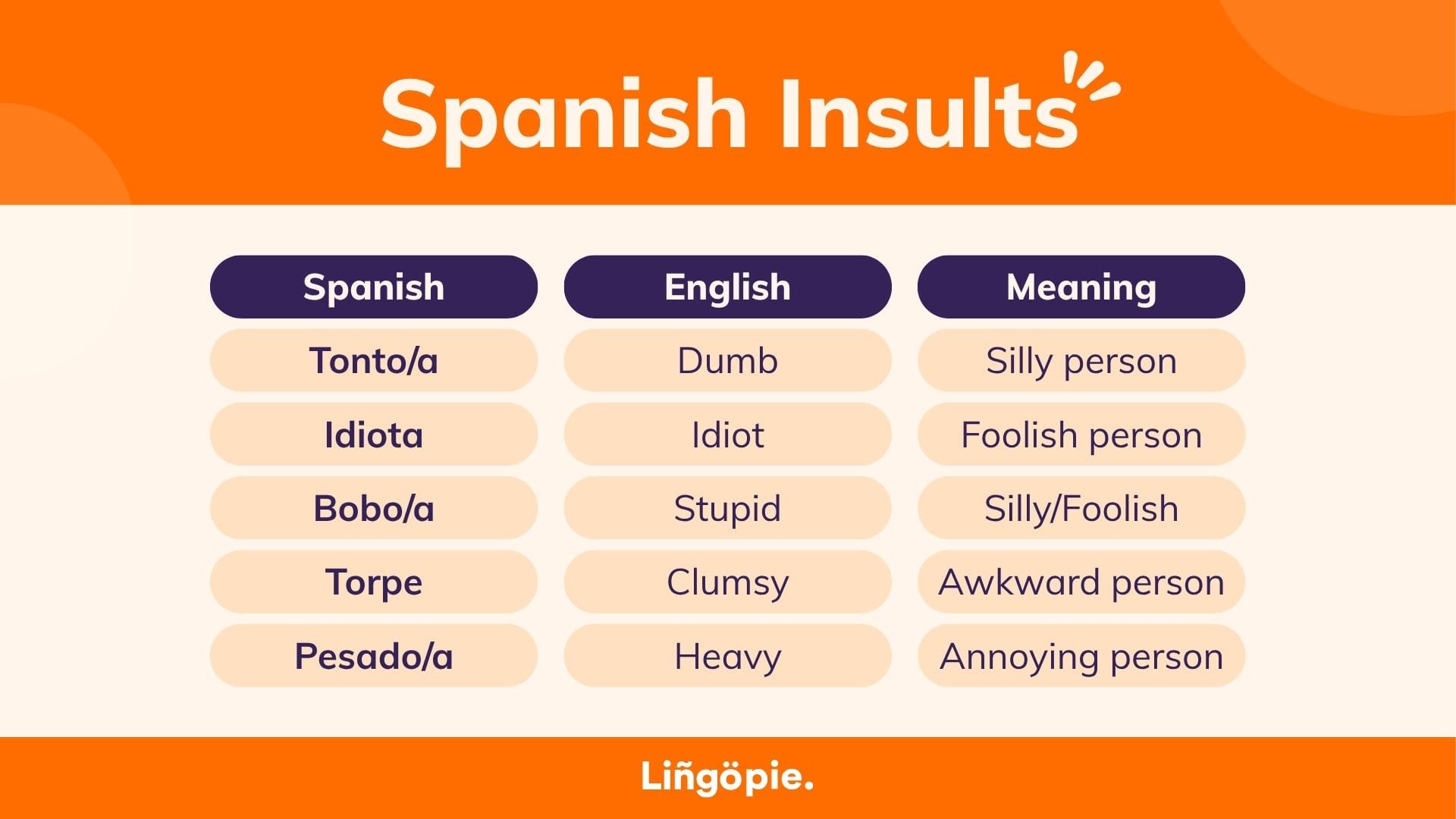
These are like saying "dummy" or "fool" in English – not nice, but not explosive:
| Spanish | Literal Meaning | Used As | Severity |
|---|---|---|---|
| Tonto/a | Dumb | Silly person | Mild |
| Idiota | Idiot | Foolish person | Mild |
| Bobo/a | Stupid | Silly/Foolish | Very mild |
| Torpe | Clumsy | Awkward person | Mild |
| Pesado/a | Heavy | Annoying person | Mild |
But wait! Please note that most native Spanish speakers consider disability-related insults (mongólico, retrasado) highly offensive and inappropriate. Stick to the terms above for more socially acceptable ways to express frustration.
Animal-Based Insults
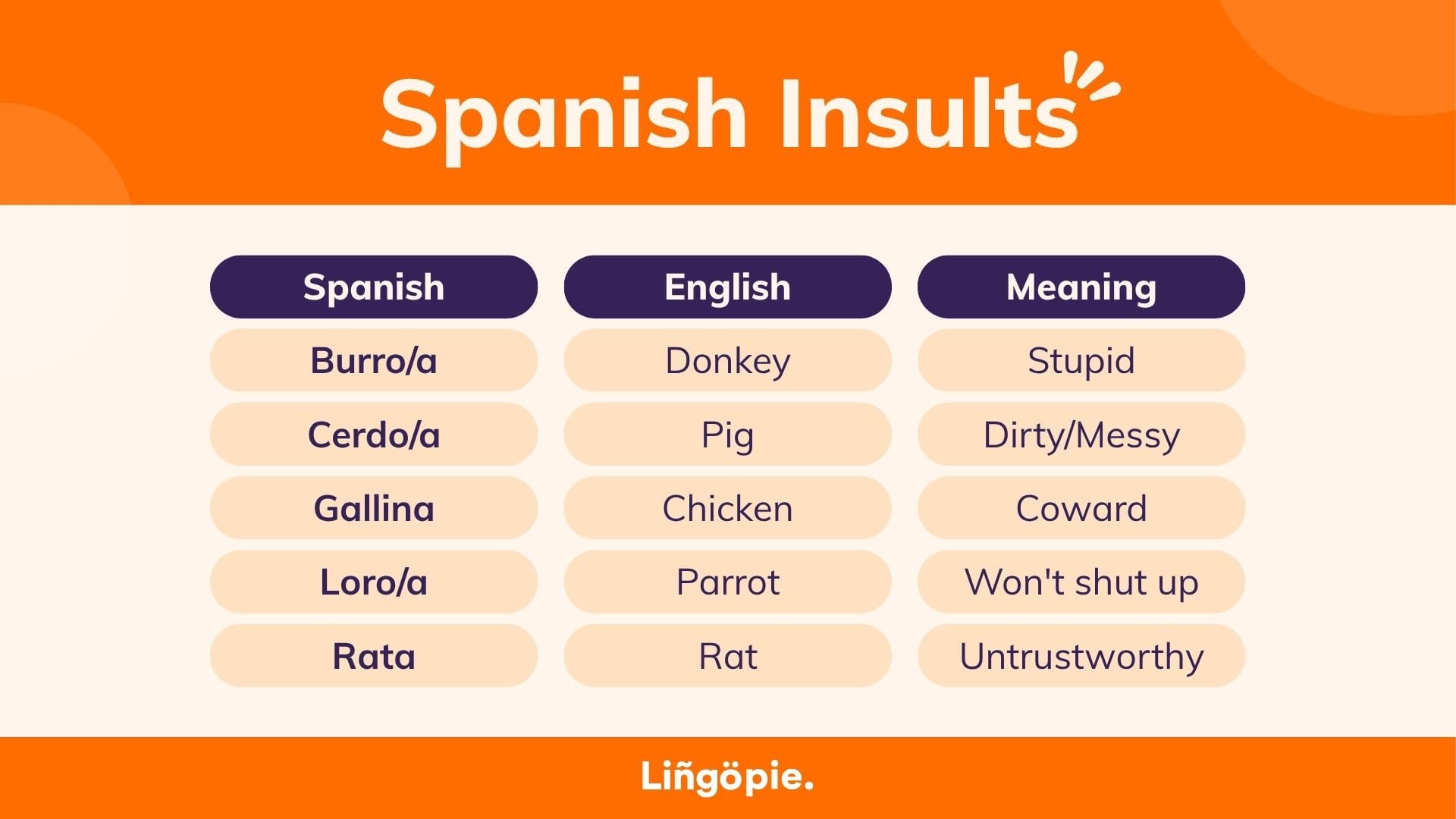
Spanish speakers love animal comparisons – some are playful, others not so much:
| Spanish | Animal | Implies | Context |
|---|---|---|---|
| Burro/a | Donkey | Stupid | Common in schools |
| Cerdo/a | Pig | Dirty/Messy | Often about habits |
| Gallina | Chicken | Coward | Like English "chicken" |
| Loro/a | Parrot | Won't shut up | For chatty people |
| Rata | Rat | Untrustworthy | About character |

Regional Variations
When you learn Spanish from scratch, you'll discover each region has its own favorite way of calling someone stupid.
| Term | Country | Meaning | Severity |
|---|---|---|---|
| Boludo | Argentina | Fool/Mate | Mild in Argentina, offensive elsewhere |
| Güey | Mexico | Dude/Fool | Casual in Mexico, can be offensive elsewhere |
| Baboso | Spain | Silly/Fool | Mild in Spain, worse in Latin America |
The golden rule? If you wouldn't say it in English at work or school, don't say it in Spanish either. When in doubt, stick to "No me molestes" (Don't bother me) or "Déjame en paz" (Leave me alone).
Best Spanish Swear Words
Spanish is a fine language to swear in. There’s not much that’s more satisfying than yelling some VERY bad words at the table you just stubbed your toe on, and doing so in Spanish is even better, due to the expressiveness of the language.
Below are some of the ultimate Spanish curse phrases and words to help you manage every situation.
Joder
"Joder" is the most versatile Spanish curse word, literally meaning "to fuck" but used as an all-purpose expletive across Spain and Latin America. It is equivalent to the English F-word and expresses frustration, surprise, or emphasis in casual Spanish conversation.
- Exclamation: "¡Joder!" (Fuck! / Damn!)
- Verb form: "No me jodas" (Don't fuck with me / Stop messing with me)
- Express frustration: "Qué jodido" (What a mess / This fucking sucks)
- Add emphasis: "Hace un jodido frío" (It's fucking cold)
- Show disbelief: "¿Joder, en serio?" (Fuck, really? / Seriously?)
Gilipollas
"Gilipollas" is a distinctly Spanish (Spain) insult meaning "idiot," "jackass," or "dumbass." While technically vulgar (combining "gilí" - stupid - with "polla" - male anatomy), it's commonly used in casual Spanish conversation as a moderate insult for calling someone foolish or annoying.
Usage examples:
- Insult someone: "Eres un gilipollas" (You're an idiot/jackass)
- Describe stupid actions: "Qué comentario más gilipollas" (What a stupid comment)
- Tell someone to stop: "No seas gilipollas" (Don't be an idiot/Stop being dumb)
- Call out behavior: "Deja de hacer gilipolleces" (Stop doing stupid shit)
- React to someone: "Menudo gilipollas" (What an idiot)
Puta
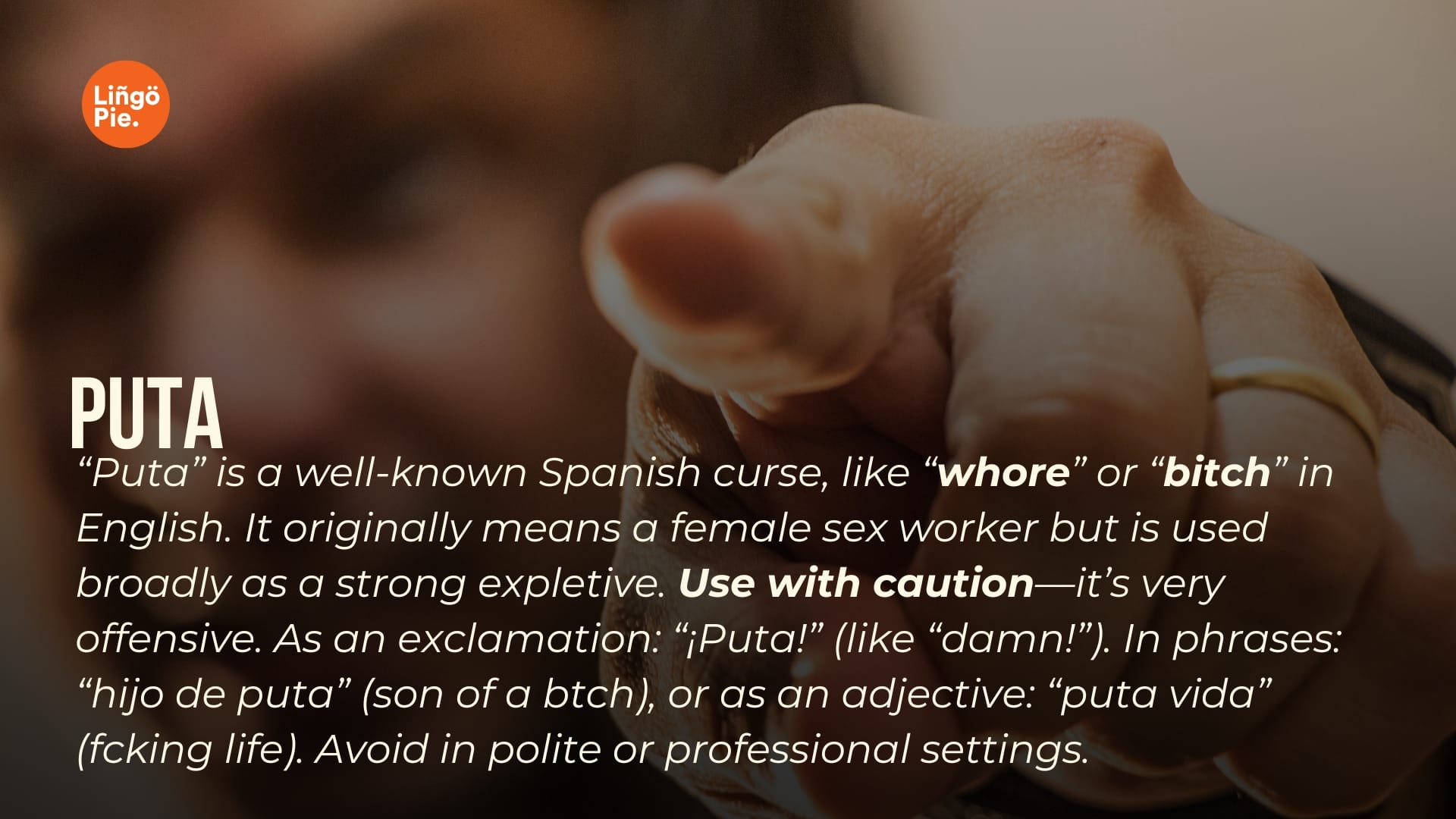
"Puta" is one of the most widely known Spanish curse words, roughly equivalent to "whore" or "bitch" in English. While technically it refers to a female sex worker (prostituta), it's commonly used as a general-purpose expletive across the Spanish language.
- As an exclamation: "¡Puta!" (similar to "damn!" or "f*ck!")
- In phrases: "hijo de puta" (son of a b*tch)
- As an adjective: "puta vida" (f*cking life)
This is considered a very strong profanity in Spanish vocabulary and should be avoided in polite company, professional settings, or when speaking Spanish with people you don't know well.
Mierda
“Mierda” means “shit” in Spanish and is one of the most common curse words in every Spanish-speaking country. It’s a mild to medium swear word people use to show frustration, describe something bad, or react when something goes wrong.
- React to bad news: "¡Mierda!" (Shit! / Damn!)
- Describe poor quality: "Esta película es una mierda" (This movie is shit/garbage)
- Express indifference: "Me importa una mierda" (I don't give a shit)
- Show frustration: "¡Qué mierda!" (What the hell! / What a mess!)
- Insult someone: "Eres una mierda" (You're a piece of shit)
Qué Cabrón
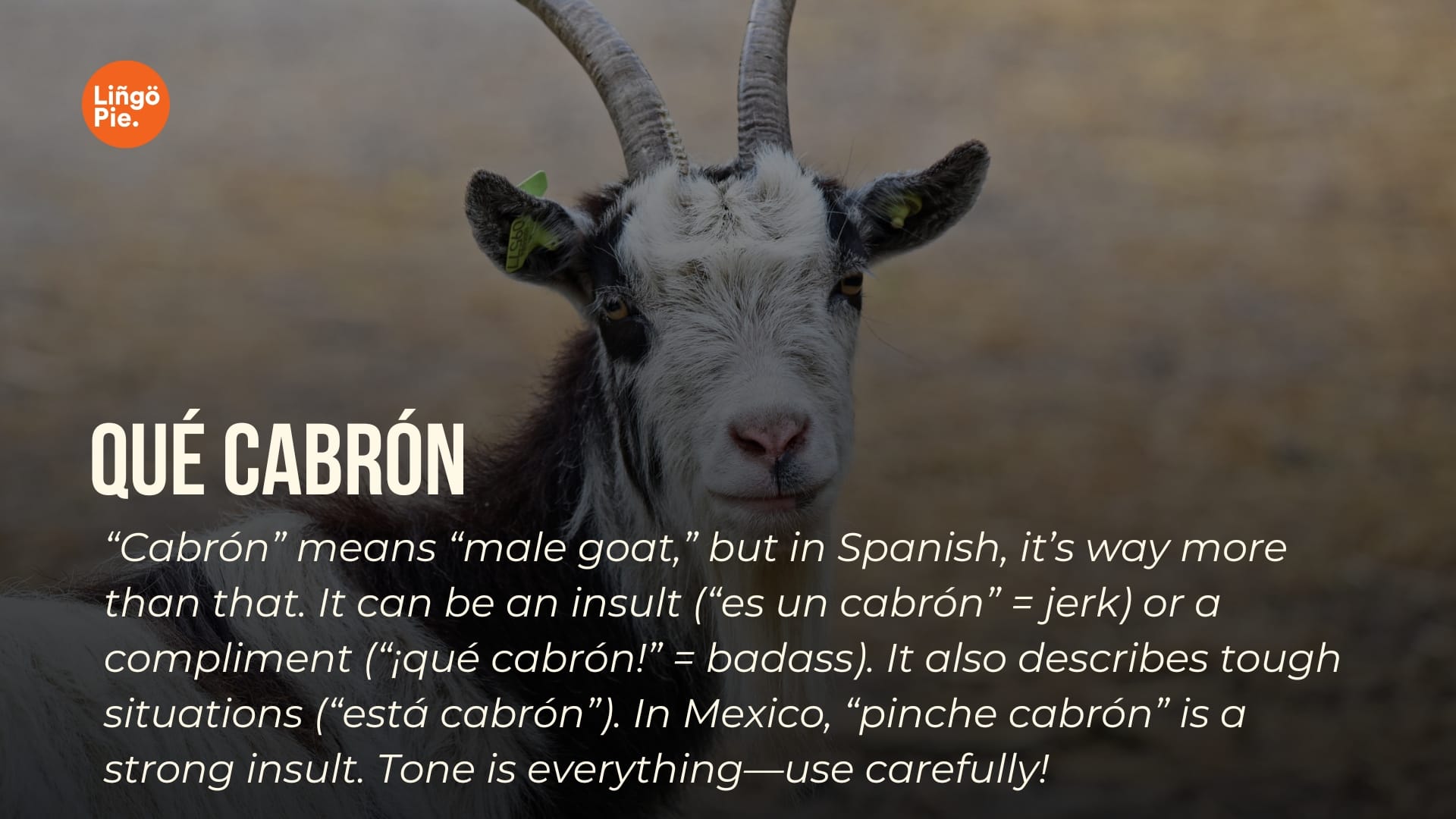
Qué cabrón” is a very context-dependent Spanish phrase. Depending on tone, it can mean “What a badass” or “What an asshole.” The word cabrón literally means “male goat,” but in everyday Spanish (especially in Mexico) it’s used to describe someone clever, tough, difficult, or annoying.
- Compliment a friend: "¡Qué cabrón eres!" (You're so badass!/You're amazing!)
- Something is hard: "Este examen está cabrón" (This test is really hard/difficult)
- Insult someone: "Qué cabrón, me mentiste" (You asshole, you lied to me)
- Show respect: "Ese tipo es bien cabrón" (That guy is really smart/tough)
- React to anything: "¡Qué cabrón!" (Wow! / Holy shit! / No way!)
La Concha de tu Madre
“La concha de tu madre” is a strong insult in Spanish, especially in Argentina and Uruguay. It literally means “your mother’s shell,” but it’s used like “motherf*er” or “damn it” to show anger, shock, or frustration.
- As an explosive exclamation: "¡La concha de tu madre!"
- Shortened version: "La concha"
- Variant: "Concha de la lora" (slightly less offensive)
Puto
“Puto” literally means “male prostitute,” but in everyday Spanish it’s used as an insult. Depending on the country and context, it can mean “jerk,” “coward,” or a slur against gay men. It’s a strong and offensive word, so it should be used with care or avoided altogether.
Boludo/boluda
“Boludo” (or “boluda” for women) is a common word in Argentina and Uruguay. It can mean “idiot” when said angrily, but among friends it often means “dude” or “buddy.” The meaning depends on tone—either playful or insulting.
- As a friendly greeting: "¡Che boludo!" (Hey dude!)
- As an insult: "No seas boludo" (Don't be an idiot)
- As filler: "Y bueno, boludo, así es la vida" (Well, dude, that's life)
- Feminine form: "Boluda" (used for women)
Boludez
“Boludez” means “nonsense” or “something stupid” in Argentine Spanish. It comes from boludo and is used to describe a silly idea, a dumb mistake, or something not worth taking seriously. It’s informal and mildly rude, but very common in casual speech.
Easy Spanish Curse Interjections
With a wide variety of one-word interjections or exclamations that convey strong emotions, Spanish is perhaps one of the most exciting languages to learn. Here are some of our favorite interjections used in everyday language.
¡Coño!
This versatile exclamation translates to "fuck!" or "cunt." It can express surprise, anger, or emphasis. Despite its literal meaning referring to female private parts, it's often used metaphorically in a less severe manner.
¡Carajo!
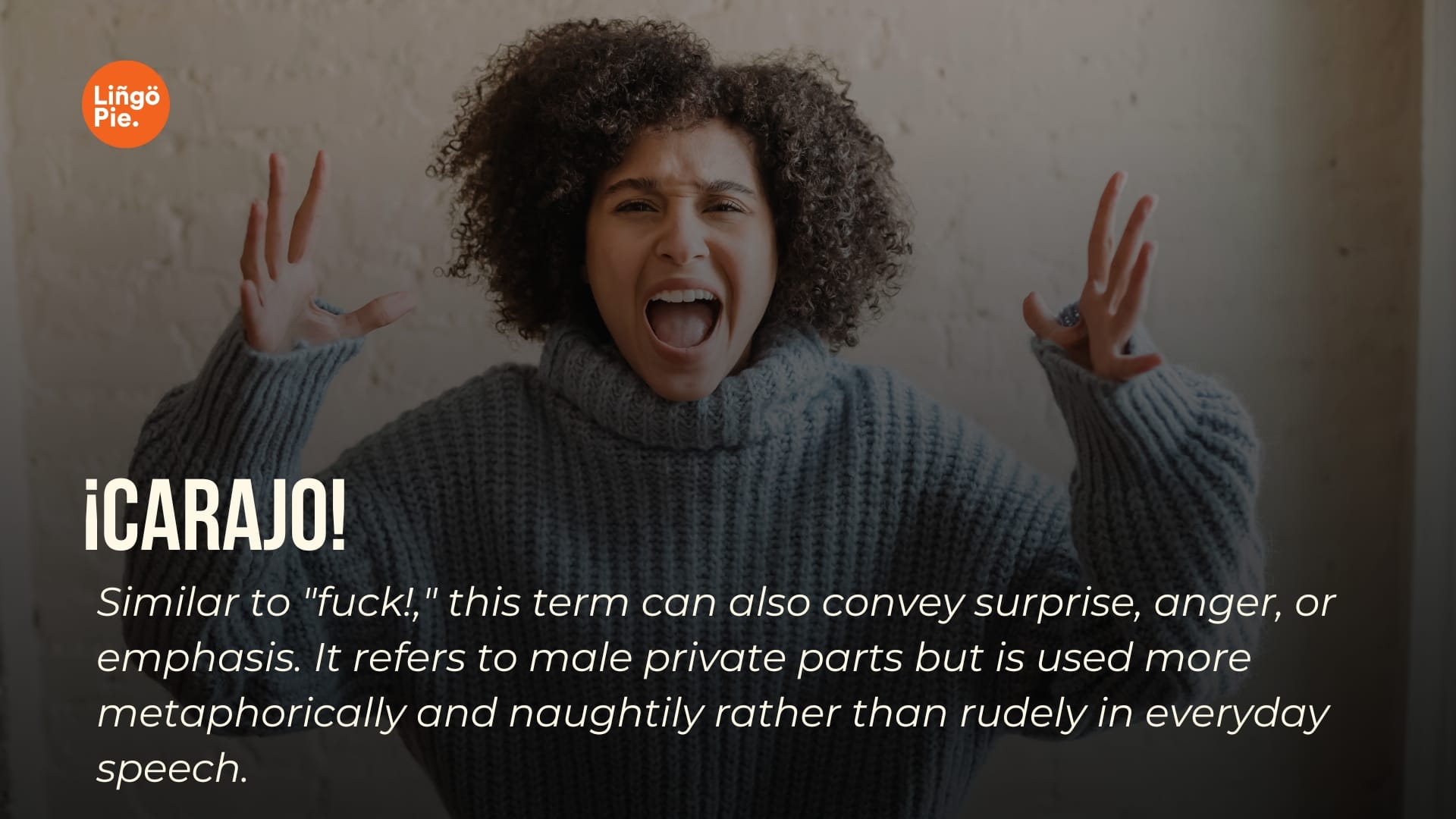
Similar to "fuck!," this term can also convey surprise, anger, or emphasis. It refers to male private parts but is used more metaphorically and naughtily rather than rudely in everyday speech.
¡Puta madre!
This phrase, translating to "goddammit!," is a strong expression of frustration or anger. It combines "puta" (whore) with "madre" (mother), making it quite emphatic in usage.
Regional Spanish Curse Words
Spanish Curse Words In Mexico
When you learn Spanish from scratch, Mexican slang hits differently.
| Word/Phrase | Literal Meaning | Used As | Severity |
|---|---|---|---|
| Chingado/a | F*cked | All-purpose curse | Strong |
| Verga | D*ck | Awesome/Terrible | Medium |
| Pinche | F*cking | Adjective | Medium |
| Güey | Ox | Dude/Idiot | Mild |
Spanish Curse Words In Spain
The Spanish language in Spain has its own distinctive curses. Latin Americans rarely use these terms - in Argentina or Mexico, saying "gilipollas" might get you laughed at rather than taken seriously.
| Word/Phrase | Literal Meaning | Used As | Severity |
|---|---|---|---|
| Gilipollas | Idiot | Insult | Medium |
| Joder | F*ck | Everything | Medium |
| Me cago en... | I sh*t on... | Strong curse | High |
| Hostia | Holy host | Exclamation | Medium |
Spanish Curse Words In Argentina
For intermediate Spanish learners, Argentine slang is unique. Uruguayans share most of these expressions, but they tend to use "bo" instead of "boludo" in casual speech.
| Word/Phrase | Literal Meaning | Used As | Severity |
|---|---|---|---|
| Boludo/a | Big balls | Dude/Idiot | Mild |
| La concha de tu madre | Mother insult | Extreme curse | Very High |
| Pelotudo | Big ball | Stronger idiot | Medium |
| Mierda | Sh*t | Frustration | Medium |
Spanish Curse Words In Chile
Chilean Spanish speakers love these expressions. Peruvians understand most Chilean slang but prefer "huevón" to "weón" and rarely use "conchetumare."
| Word/Phrase | Literal Meaning | Used As | Severity |
|---|---|---|---|
| Conchetumare | Mother insult | Strong curse | Very High |
| Weon/a | Dude/idiot | Everything | Mild-Medium |
| Culiao | F*cked one | Insult | High |
| Chucha | Vagina | Damn! | Medium |
Spanish Curse Words In Colombia
Venezuelans share some Colombian expressions but tend to use "vale" more and prefer "coño" to "gonorrea" as their go-to expletive.
| Word/Phrase | Literal Meaning | Used As | Severity |
|---|---|---|---|
| Gonorrea | STD | Severe insult | Very High |
| Malparido | Badly born | Strong insult | High |
| Hijueputa (HP) | Son of a b*tch | Strong curse | High |
| Marica | F*ggot | Friend/Dude | Mild |
Soft Alternatives To Spanish Curses
Not every moment calls for a full-on curse word. If you want to sound natural without being offensive, Spanish has plenty of softer alternatives you can use. These expressions let you show frustration, surprise, or annoyance without crossing any lines.
Here are some common ones:
Caracoles
Literally "snails." Used like "gosh" or "jeez."
¡Caracoles! Se me olvidó el teléfono.
(Gosh! I forgot my phone.)
Rayos
Literally "rays" (as in rays of light), but used like "darn" or "shoot."
¡Rayos! Perdimos el tren.
(Darn! We missed the train.)
Recórcholis
Old-fashioned but fun. Similar to "golly" or "good grief."
¡Recórcholis! Eso sí que no me lo esperaba.
(Golly! I really wasn’t expecting that.)
Maldición
Literally "curse." Softer than mierda or puta madre, and works in many settings.
¡Maldición! Esta computadora no funciona.
(Damn! This computer isn’t working.)
Demonios
Literally "demons," used like "damn it" or "hell."
¡Demonios! Se me cayó el café.
(Damn it! I dropped my coffee.)
Diablos
Literally "devils." Another safe way to express annoyance or surprise.
¡Diablos! Hace mucho calor hoy.
(Damn! It’s really hot today.)
Why Is Spanish Such A Satisfying Language To Curse In?
Spanish stands out as one of the easiest languages for English speakers to learn, which makes mastering its curse words particularly satisfying. When you learn Spanish from scratch, you'll find that familiar pronunciation rules and grammar patterns help you quickly progress from basic Spanish vocabulary to more complex expressions.
Unlike languages like Mandarin or Arabic, where curse words might take years to master naturally, Spanish profanity feels accessible and authentic relatively quickly.
- Phonetic Impact: "Perra" (bitch) with rolled R's vs. English's softer sound
- Stress Patterns: "hiJUEputa" where stress amplifies emotion
- Consonant Combinations: "Chingar" with its explosive CH
- Vowel Flow: "Cabrón" showcasing Spanish's natural rhythm
- Grammatical Flexibility: "Joder" → "jodido" → "jodidamente"
This blend of easy learning and expressive power makes Spanish cursing not just achievable, but deeply satisfying for learners at any level.
Do People Curse A Lot In Spanish-speaking countries?
Yes, cursing is notably common in many Spanish-speaking cultures, but its frequency and social acceptance vary significantly by country and context. When you learn Spanish from scratch, you'll quickly notice that native Spanish speakers often use profanity more casually than English speakers, particularly in countries like Spain, Argentina, and Mexico.
Common Cursing Contexts:
- Casual Friends: Extremely common ("¡Qué pedo, güey!" in Mexico)
- Family: Varies by region (common in Spain, less so in Colombia)
- Work: Generally avoided in professional settings
- Media: More permissive than English-language media
- Sports: Very common, especially during fútbol matches
- Social Media: Highly frequent in informal communication
Lingopie Is The Best Way To Learn Spanish (including the curses!)

Want to learn Spanish from scratch while actually enjoying yourself? Lingopie turns your favorite Spanish TV shows and movies into interactive language lessons. Instead of drowning in textbook vocabulary and grammar, you'll pick up real Spanish words – yes, including those colorful curse words – the way native Spanish speakers actually use them.
Here's what makes Lingopie different: You can click any word you hear for instant translations, save phrases for later, and actually understand what's happening in Spanish telenovelas without getting lost.
Plus, with Lingopie Music, you can expand your Spanish vocabulary through catchy songs that'll stick in your head (in a good way). Whether you’re into Spanish for beginners or tackling intermediate Spanish, you’rewhat’s learning the language as it's actually spoken – not just what's in textbooks.
Frequently Asked Questions About Spanish Curse Words
Is "tu madre" a bad word?
“Tu madre” literally means “your mother” and is not a bad word on its own. But when shouted as “¡Tu madre!” it becomes an insult, roughly meaning “screw you” or a rude way to offend someone by mentioning their mother.
Is panocha a bad word in English?
“Panocha” is not a bad word in English and usually refers to a type of Mexican brown sugar or candy. But in some Spanish-speaking regions, it’s a vulgar slang word for female genitals, so it can be offensive depending on context.
Is güey a curse word?
“Güey” (or “wey”) is not a curse word and is very common in Mexico. It can mean “dude” or “buddy” among friends, but it can also mean “idiot” if said in an angry tone.
Is pito a bad word?
“Pito” literally means “whistle” in Spanish and is not a bad word by itself. But in many countries, it’s slang for the penis, so it can be vulgar depending on how it’s used.
What are some curse words in Spanish?
Some of the most common curse words in Spanish include:
- “Carajo” – Damn / hell
- “Mierda” – Sh*t
- “Joder” – F*ck (common in Spain)
- “Pendejo” – Idiot/jerk (stronger in Mexico)
These can range from mildly rude to deeply offensive depending on region and tone.
What is the F-word in Spanish slang?
The Spanish equivalent of the F-word is usually “joder” in Spain or “chingar” in Mexico. Both are strong, vulgar expressions with many variations depending on the sentence. For example:
- “¡Joder!” – Damn it! (Spain)
- “¡Chinga tu madre!” – Extremely offensive (Mexico)
What is the most common curse word in Spanish?
“Mierda” (shit) is one of the most universally recognized and commonly used curse words in Spanish. It’s mild compared to others and often used casually—like saying “crap” in English. Another super common one is “joder” in Spain.
What does punta mean?
“Punta” literally means point or tip in Spanish. But beware—it’s often confused with “puta”, which means whore and is a strong insult. Depending on pronunciation or slang use, it can be misinterpreted, especially in heated conversations.