
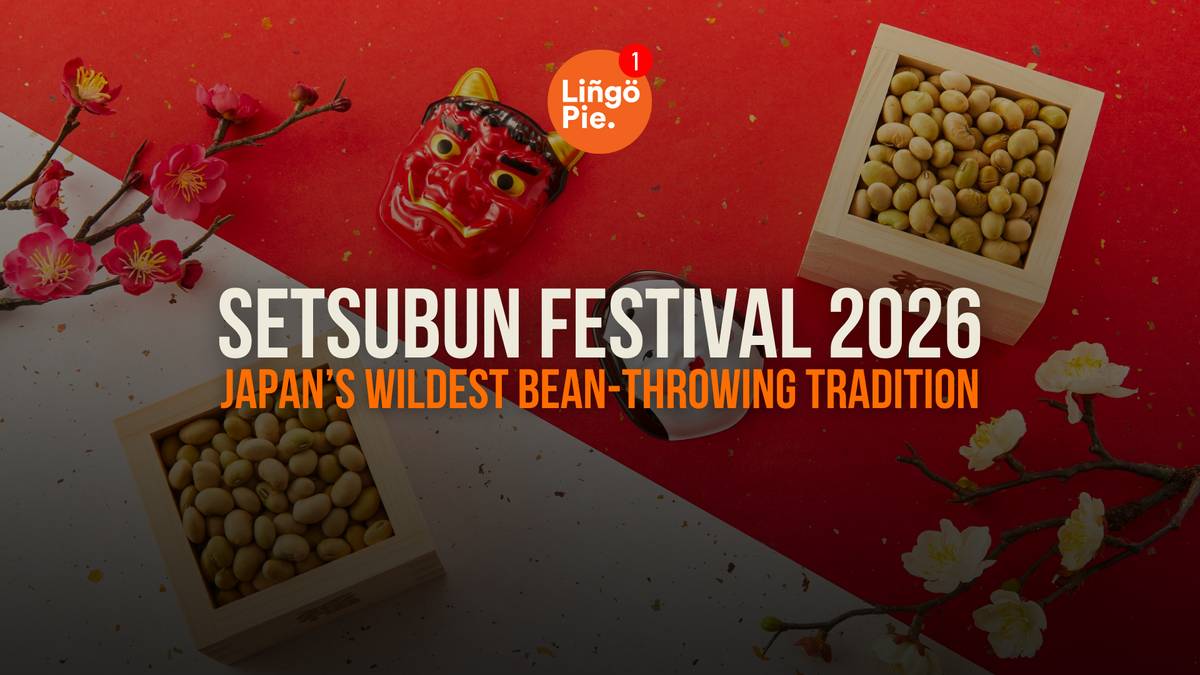
Every February 3, Japan marks the start of spring with Setsubun Festival 2026 — a lively tradition where families toss roasted soybeans while shouting 「鬼は外!福は内!」(Oni wa soto! Fuku wa uchi!), or “Out with demons! In with good fortune!” But what exactly is Setsubun?
In this guide, you’ll learn what Setsubun means, how the tradition works, key Japanese words like 豆まき (mamemaki) and 鬼 (oni), and how to recognize Setsubun scenes in your favorite shows. If you’re learning Japanese, this guide will let you in on everything you need to know!
- 10 Best Horror Anime For Learning Japanese [Guide]
- 26+ Crazy Cute Japanese Words Everyone Should Learn
- Sushi Names In Japanese And How To Order Them [Guide]

What is Setsubun Festival (節分とは?)?
The Setsubun Festival in Japan is a traditional event held every year on February 3, marking the day before the beginning of spring according to the old lunar calendar. The word 節分 (せつぶん / Setsubun) literally means “seasonal division,” and it's culturally believed to be spiritually sensitive.
During the Setsubun bean-throwing festival, families scatter roasted soybeans, called 福豆 (ふくまめ / fukumame), while chanting 「鬼は外!福は内!」(Oni wa soto! Fuku wa uchi!) — “Demons out! Good fortune in!” The “demons,” or 鬼 (おに / oni), symbolize illness, negativity, and bad energy. By throwing beans, people symbolically cleanse their homes and welcome luck for the year ahead.
Although Setsubun is not a national public holiday in Japan, it’s widely celebrated in homes, schools, shrines, and temples across the country. Major shrines often host large public events where celebrities or sumo wrestlers toss beans into the crowd.
How to Celebrate the Setsubun Bean Throwing Festival
On Setsubun, families prepare roasted soybeans and gather near the home's entrance, as doorways are traditionally seen as the point where misfortune enters. One person wears an oni (鬼) mask and stands either just outside the door or inside the entryway.
Another family member throws the beans directly toward the masked “demon” while shouting 「鬼は外!福は内!」. The beans are thrown outward toward doors and windows to symbolically drive bad luck out, and then scattered inside the home to invite good fortune in.
Setsubun Oni Mask
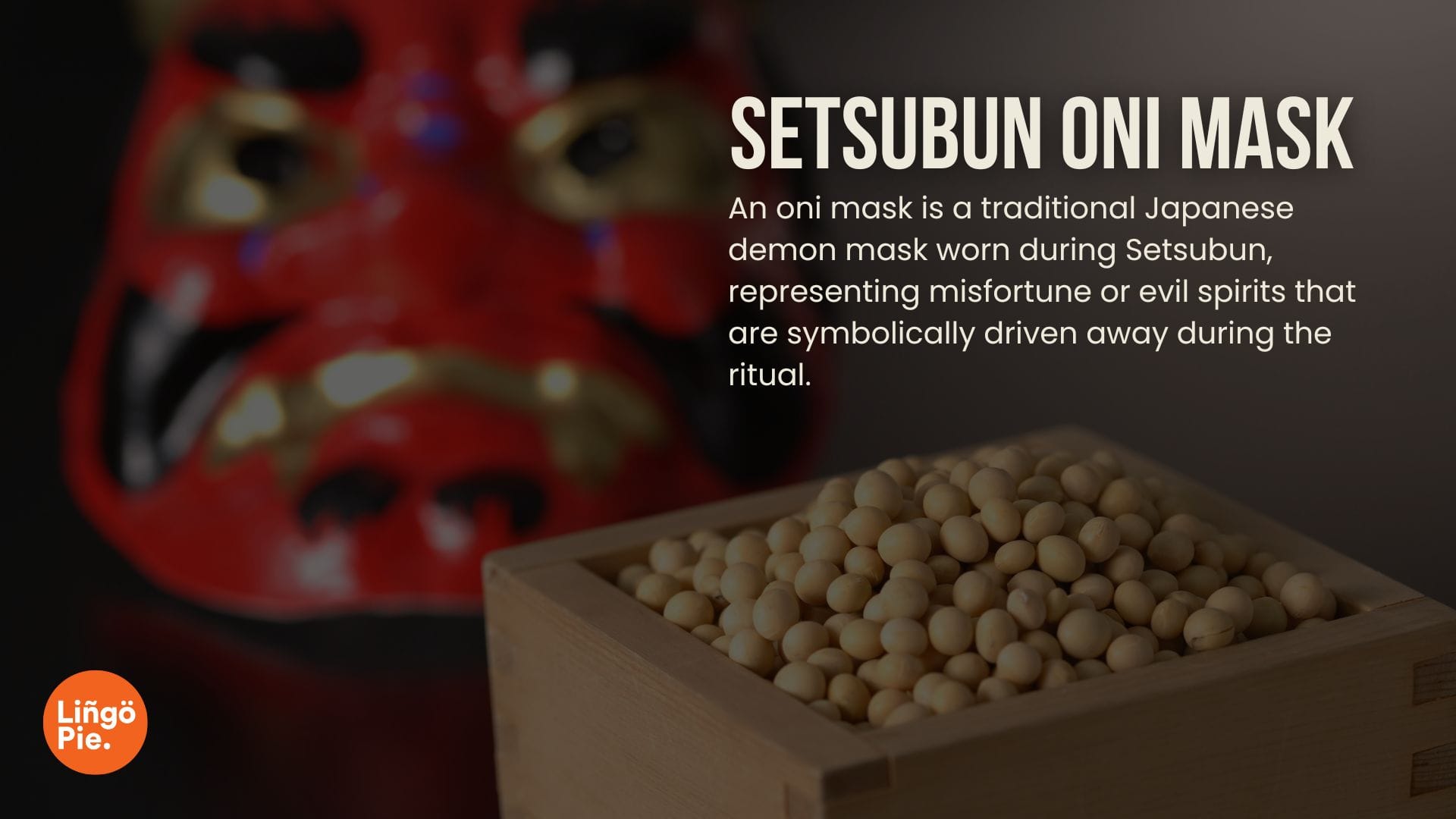
The word 鬼 (おに / oni) means demon or ogre in Japanese folklore, and お面 (おめん / omen) means mask. Traditional oni are often red or blue. A red oni (鬼) is commonly associated with anger, greed, and strong negative emotions, while a blue oni can represent jealousy or cold-heartedness.
In some Buddhist interpretations, different colors symbolize specific human weaknesses that must be driven away before spring begins. The exaggerated horns, sharp teeth, and wild hair are meant to make the demon visibly intimidating, especially for children.
In modern households, however, the masks are often playful rather than frightening, sold in supermarkets and convenience stores every February.
Mamemaki
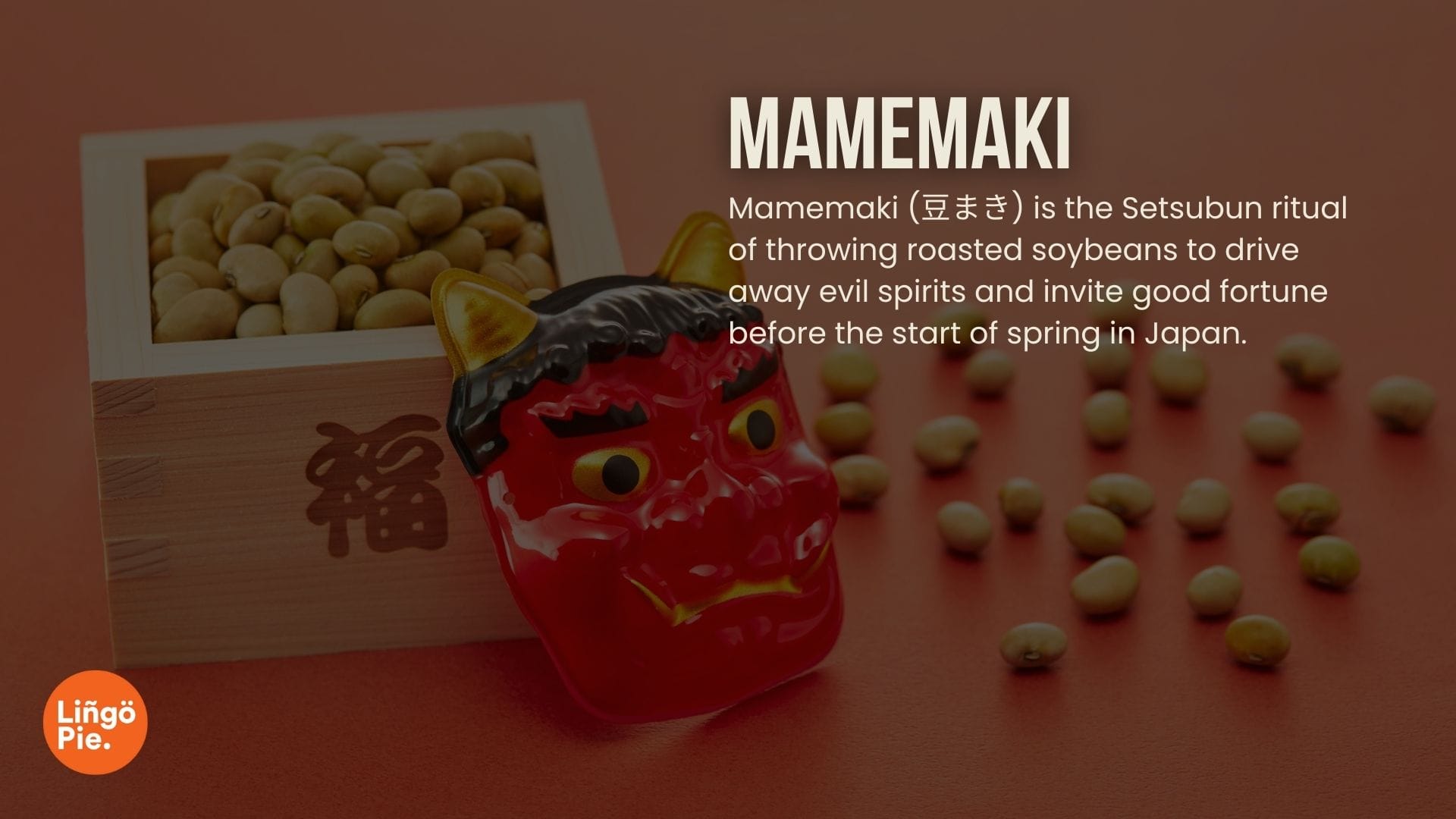
Mamemaki (豆まき) uses roasted soybeans rather than raw ones because roasting is believed to purify them. The word mame (豆) also sounds like “ma wo metsu”, meaning “to destroy evil,” which reinforces the symbolism. The beans are thrown with intention, typically starting at the main entrance and moving through the house to symbolically cleanse each space.
After the ritual, each person eats the same number of beans as their age, sometimes adding one extra for the coming year, as a way to pray for health and longevity.
Ehomaki
Ehōmaki (恵方巻) became widely popular in the late 20th century, especially after convenience stores began promoting it nationwide. Each year has a designated lucky direction called 恵方 (ehō) based on the zodiac calendar. In 2026, that direction will be determined by the traditional cyclical system used in Japan.
When eating ehōmaki, you face that direction, make a silent wish, and eat the entire uncut sushi roll without speaking. The roll is left whole because cutting it would symbolically cut off good fortune. Typical fillings include egg, cucumber, eel, and other ingredients representing prosperity or the Seven Deities of Good Fortune.
Essential Setsubun Festival Vocabulary
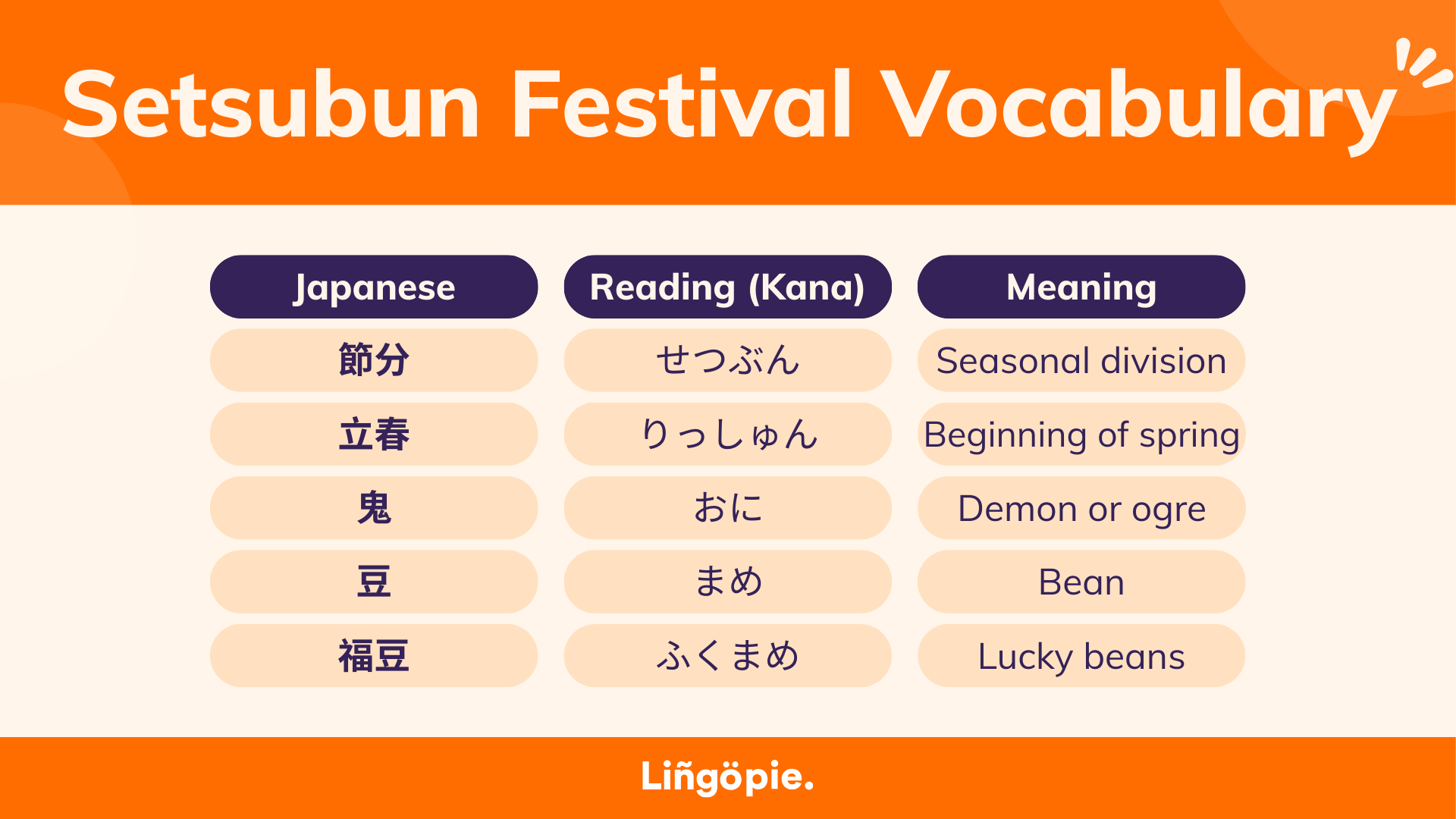
The Setsubun Festival in Japan introduces seasonal words, everyday nouns, and cultural phrases that appear in conversations, commercials, Japanese anime episodes, and variety shows every February. Many of these terms are short and highly repeatable, which makes them perfect for learners.
Below is a practical vocabulary list you can recognize and use immediately.
| Japanese | Reading | Meaning | How It’s Used |
|---|---|---|---|
| 節分 | せつぶん | Seasonal division | Refers to the day before the start of spring, celebrated on February 3 |
| 立春 | りっしゅん | Beginning of spring | The first day of spring in the traditional calendar |
| 鬼 | おに | Demon or ogre | Symbol of misfortune during Setsubun |
| 鬼は外!福は内! | おにはそと!ふくはうち! | Demons out! Good fortune in! | The chant shouted during bean throwing |
| 豆 | まめ | Bean | Roasted soybeans used in the ritual |
| 豆まき | まめまき | Bean scattering | The act of throwing beans to drive away bad luck |
| 福豆 | ふくまめ | Lucky beans | The roasted soybeans used in mamemaki |
| 年の数 | としのかず | Number of years | The number of beans you eat equal to your age |
| 恵方 | えほう | Lucky direction | The auspicious direction of the year |
| 恵方巻 | えほうまき | Lucky direction sushi roll | The uncut sushi roll eaten in silence |
| 方角 | ほうがく | Direction | Used when talking about compass directions |
| 春 | はる | Spring | The new season Setsubun welcomes |
| 邪気 | じゃき | Evil spirit or bad energy | What the ritual is meant to drive away |
| 福 | ふく | Good fortune | What you invite into your home |
Setsubun Festival In Anime And Japanese TV
The Setsubun Festival in Japan appears frequently in anime, family sitcoms, and seasonal TV specials, making it one of the easiest cultural traditions for learners to recognize on screen.
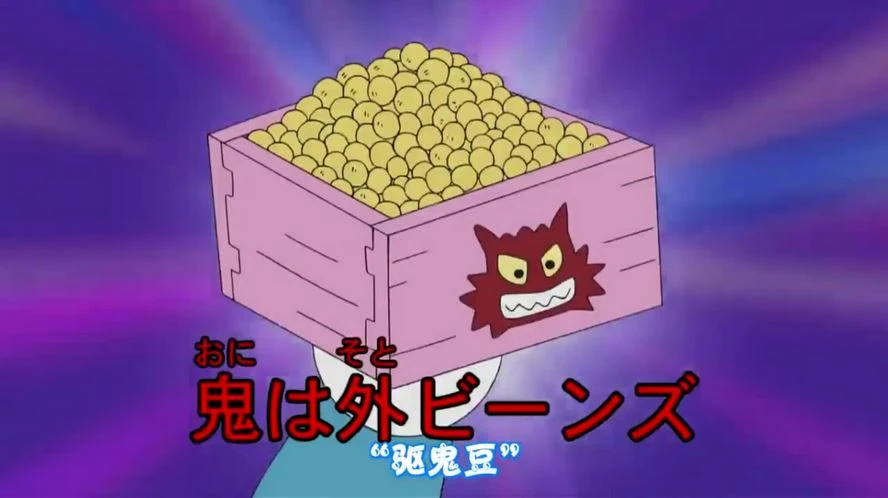
In long-running series such as Doraemon and Crayon Shin-chan, Setsubun episodes typically feature a parent wearing an oni (鬼) mask while children perform 豆まき (mamemaki) around the house, shouting 「鬼は外!福は内!」. The scene is often played for comedy, but the language used is authentic and seasonal.
Beyond anime, Japanese variety programs broadcast large-scale bean-throwing ceremonies from famous shrines, where public figures toss 福豆 (fukumame) to crowds. Supermarkets and convenience stores run extensive promotions for 恵方巻 (ehōmaki), reinforcing vocabulary related to lucky directions and seasonal customs.
Because these references recur every February, learners repeatedly encounter the same key terms in natural dialogue, advertisements, and cultural discussions, which strengthens retention and improves listening comprehension.
FAQ
Why do you throw beans at oni?
Beans are thrown at the oni (鬼) to symbolically drive away bad luck and negative energy before the start of spring.
What do kids do during Setsubun?
Children usually throw roasted soybeans at a family member wearing an oni mask while shouting the traditional chant.
What do you say during Setsubun?
People shout 「鬼は外!福は内!」 or "Oni wa soto!" which means “Demons out! Good fortune in!”
Is Setsubun a national holiday in Japan?
No, Setsubun is not a national public holiday, but it is widely celebrated across Japan every February 3.
Learn Japanese With Lingopie
If you want to understand traditions like the Setsubun Festival in Japan without subtitles doing all the work for you, the fastest way forward is to learn through real content. On Lingopie, you can watch Japanese TV with interactive subtitles that let you click any word, see the meaning instantly, and hear native pronunciation in context.
Curious what it feels like to recognize words like 鬼 (oni) in real time and actually understand a Setsubun scene without guessing? Try it yourself. Click below to start your free 7-day trial and see how quickly Japanese begins to make sense.




![Japanese Honorifics: 10+ Titles You’ll Actually Use [GUIDE]](/blog/content/images/size/w300/2026/03/Japanese-honorifics.jpg)