

Ever stared at Russian text and felt your brain completely give up? That’s because Russian is genuinely one of the hardest languages out there. The alphabet alone throws most people off.
Translation apps aren't just helpful here—they're essential. You're gonna hit roadblocks constantly, whether it's reading a sign in Moscow, understanding a text from your Russian friend, or trying to figure out what your coworker actually meant in that email. A good translation app gives you instant answers, so you don't have to guess.
Curious? Here are five that actually deliver when Russian stumps you.
- 11 Best Apps to Learn Russian Language [TESTED]
- How To Learn Russian Fast: Easy Step-by-Step [Guide]
- Russian Alphabet: Everything You Need to Know [2026]
Why Use Russian Translation Apps
Russian translation apps give you instant answers when you're stuck. That's it. They're not going to make you fluent, but they'll save you from communication breakdowns and embarrassing mistakes when you're dealing with a language this different from English.
Here's why they actually matter:
- Real-time conversations don't wait. Your Russian colleague isn't pausing mid-meeting while you look things up.
- Cyrillic stops you cold. Even if you know some Russian words, you might not recognize them in that alphabet.
- Context changes everything in Russian. Word-for-word translations miss the actual meaning.
- Russian pops up unexpectedly. Product labels, websites, random signs—you can't plan for every situation.
- They work both ways. Russian to English and back, so you don't accidentally say something completely wrong.
Russian Translation Apps
Lingopie
Publisher: Lingopie
Availability: Android | iOS
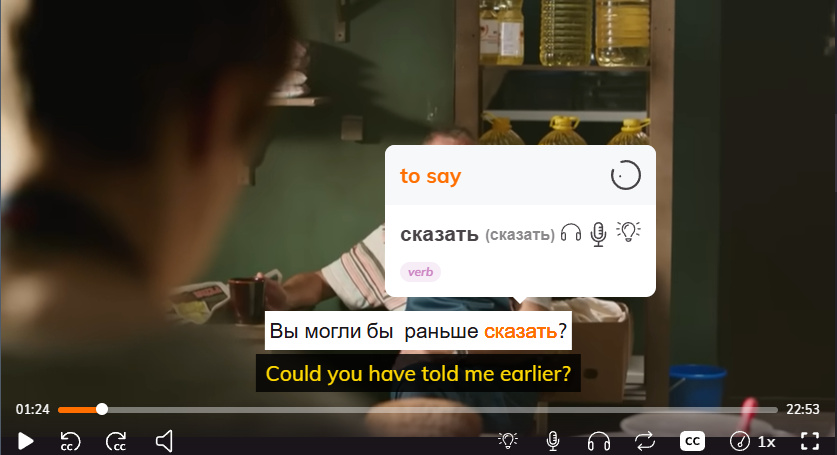
Lingopie takes a completely different approach to Russian translation and learning. Instead of just translating individual words or sentences, it drops you into actual Russian TV shows and movies with interactive subtitles. You click any word in the subtitles and get an instant translation with context.
The idea is you're learning Russian while watching content you'd actually enjoy, not grinding through boring textbook exercises. It's built for people who want to understand real Russian as it's actually spoken, not the overly formal stuff you'd find in traditional learning apps.
| Pros | Cons |
|---|---|
| Translations come with real context from actual shows | Needs a subscription (no free tier) |
| You learn how Russian is actually spoken, not textbook Russian | Limited if you just need quick one-off translations |
| Interactive subtitles let you click any word instantly | Requires time investment to watch content |
| Works as both a translation tool and learning platform | Focuses on European Russian dialects mainly |
| Way more engaging than traditional translation apps | Internet connection required for streaming |
Yandex Translate
Publisher: Direct Cursus Computer Systems Trading LLC
Availability: Android | iOS
What makes Yandex worth considering for Russian specifically is that it's built by a Russian company. They understand the language's quirks better than most Western apps. The dictionary feature gives you actual usage examples instead of just definitions, which helps you figure out context. You can also translate text directly from other apps on your phone, save your favorite translations, and even translate entire websites without leaving the app.
| Pros | Cons |
|---|---|
| Works offline for Russian and five other languages | Crashes when your favorites list gets too big |
| Camera translation overlays text on images | Flashcard feature gets glitchy with large vocabulary lists |
| Handles unofficial transliteration (huge for places like Georgia) | Collects personal data and app activity |
| Built by Russians, so the Russian translation quality is solid | Interface isn't as polished as Google Translate |
| Free with no subscription required | Some features only work online |
| Works without Google Services if you're de-Googling | Limited compared to paid apps for learning |
Papago
Publisher: Naver
Availability: Android | iOS
Papago comes from a South Korean company, so it's built with Asian languages in mind first. The name means "parrot" in Esperanto, which is kind of adorable. The real draw here is the Edu feature. You can photograph Russian text, and it creates study notes where you review passages and individual words later. Super useful if you're trying to actually learn Russian instead of just translating random stuff.
That said, the Russian translation quality isn't as sharp as Yandex or other apps built specifically for Cyrillic languages. It'll get you through basic conversations and menus, but don't expect perfect accuracy with complex Russian grammar or idioms.
| Pros | Cons |
|---|---|
| Works offline when you need it | Weaker at Russian than Asian languages |
| Edu feature creates study notes from Russian text | Speaker button vibration can't be turned off easily |
| Papago Mini auto-translates copied text in other apps | Not built for Cyrillic—better options exist for Russian |
| Conversation mode for real-time Russian chats | Shares app activity data with third parties |
| Handwriting translation if you're learning Cyrillic | Requires Android 8.0 or higher |
| Free to use | Misses nuances in Russian grammar and idioms |
Russian - English Translator
Publisher: Suvorov-Development
Availability: Android
This app does exactly what the name says—it translates between Russian and English, period. No 100+ language options, no fancy extras. Just Russian and English going back and forth. It's got the basics covered with voice recognition, camera translation for signs and menus, and an offline mode so you're not stuck when your internet dies.
There's also a built-in phrasebook for common expressions and a dictionary feature that gives you multiple translation options for single words, which helps when you're trying to pick the right nuance.
| Pros | Cons |
|---|---|
| Focused solely on Russian-English (no bloat) | Likely just uses Google Translate in the background |
| Works offline with downloaded language packs | Not accurate with complex Russian grammar |
| Camera translation for signs and documents | Contains ads (though minimal) |
| Phrasebook with common Russian phrases | Can't delete your data once collected |
| Multiple translation options for single words | Shares location and device data with third parties |
| Minimal ads compared to similar apps | Native Russian speakers report frequent mistakes |
| Free to use | Requires internet for best results despite offline mode |
Dialog - Translate Speech
Publisher: Maple Media
Availability: Android | iOS
Dialog is built for one thing: voice conversations. You tap a button, speak, and get your translation instantly. It handles 80+ languages, including Russian, and the whole interface is dead simple. No menus to dig through, no complicated setup. Just open it and start talking.
The voice recognition works in noisy places like streets and stations, which helps when you're actually trying to communicate with Russians in real situations. Automatic language detection means you don't manually switch between Russian and English during conversations. Just note that it runs on Google Translate, so you're getting the same accuracy and limitations.
| Pros | Cons |
|---|---|
| Built specifically for voice conversations | Just Google Translate with a voice interface |
| Works in noisy environments | Can't delete your data |
| Dead simple interface - tap and speak | Shares audio/video with third parties |
| Automatic language detection | Same accuracy issues as Google Translate |
| Real-time translations | No offline mode |
| 80+ languages | Only few users (less proven) |
Why Lingopie Beats Translation Apps for Learning Russian
Translation apps solve immediate problems. You're stuck, you need help, you get an answer. But you're still stuck the next time.
Lingopie gets you closer to actual fluency. You're learning Russian the way native speakers use it, not translating word by word. The difference matters when you want to actually understand Russian instead of constantly reaching for your phone.
Try it free and see for yourself.


![Is Russian Hard to Learn? A No-Nonsense Guide [2026]](/blog/content/images/size/w300/2026/03/Is-Russian-Hard-To-Learn.jpg)