
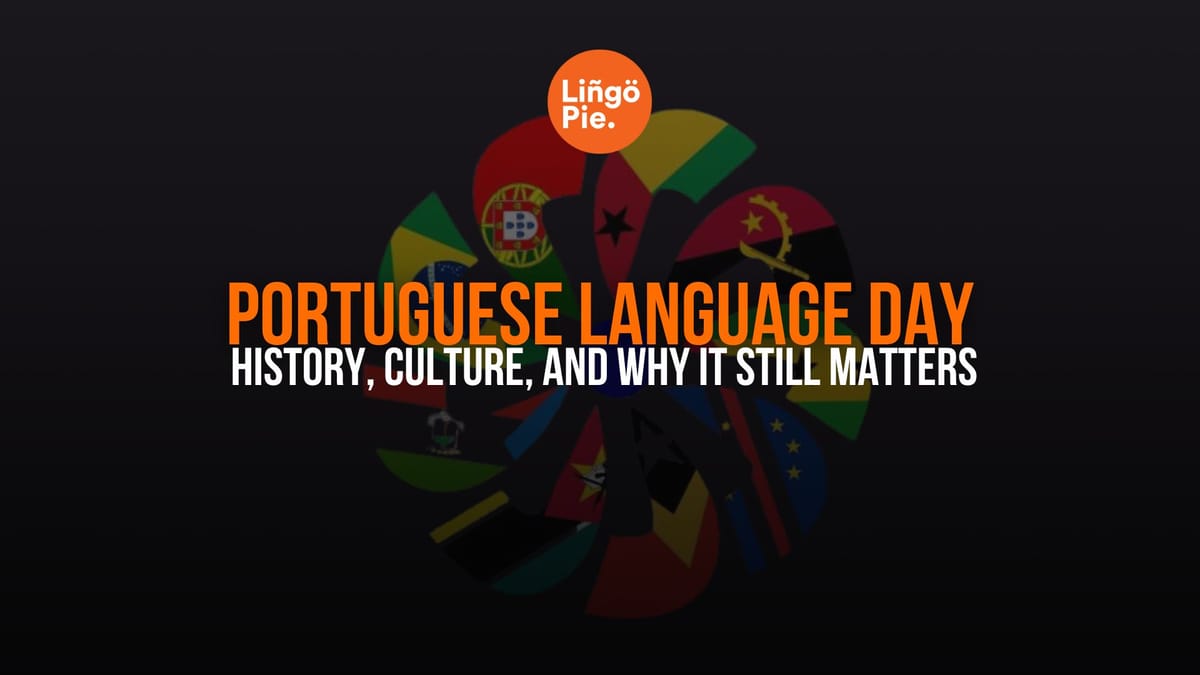
Every May 5, the world celebrates World Portuguese Language Day — a day dedicated to one of the most widely spoken languages on the planet. And if you've ever thought about learning Portuguese, this is the nudge to actually do it.
This guide covers what the day is, some fast facts about the language, and the best Portuguese shows on Lingopie to mark it properly.
How To Learn Portuguese Fast? [Best 2026 Guide]
Hello In Brazilian Portuguese: 13+ Easy Greetings To Use
6 Best Portuguese Comedy Movies Everyone Should Watch

What is World Portuguese Language Day?
World Portuguese Language Day is observed every year on May 5. It was established in 2009 by the Community of Portuguese-speaking Countries (CPLP), the intergovernmental body that unites the nine nations where Portuguese is an official language. In 2019, UNESCO officially proclaimed it an international day, with the first official celebration taking place in 2020.
The date traces back to 2005, when CPLP ministers of culture held their first-ever meeting on May 5. That gathering was declared Dia da Cultura da CPLP, and the date stuck. Today it's marked worldwide with concerts, literary events, cultural exhibitions, and language learning activities across the Lusophone world.
Portuguese language facts worth knowing
Before we get to the shows, here are some things about Portuguese that put the language in perspective.
- Around 260 million people speak Portuguese across four continents.
- It's the most spoken language in the Southern Hemisphere.
- Over 70% of Portuguese speakers live in Brazil.
- Portuguese is the fastest-growing European language after English.
- English borrowed more from Portuguese than most people realize — banana, cobra, mango, samba, and mosquito all came from Portuguese.
- Brazilian and European Portuguese are different enough that learners are usually advised to pick one accent and focus on it.
- Portuguese has two verbs for "to be": ser for permanent states, estar for temporary ones.
How to celebrate Portuguese Language Day
The best way to mark the day is to spend time with the language. Here are a few ideas:
- Watch something in Portuguese. Put on a Brazilian or European Portuguese show and actually listen, not just read the English subtitles.
- Learn words from a scene, not a flashcard deck. Pick a moment from a show you liked and pull the vocabulary from it. Context sticks better than lists.
- Listen to Fado or Brazilian music. You don't need to understand every word. Just let the language land.
- Cook something. Pull up a recipe in Portuguese — brigadeiro, pastéis de nata, moqueca. Food vocabulary sticks.
The easiest way to do all of this is on Lingopie. Every show in the Portuguese catalog comes with dual subtitles, clickable vocabulary, and a flashcard system that saves every word you look up.
Best Portuguese Shows to Watch on Lingopie
Portuguese Steakhouse

Maia's Portuguese Steakhouse is exactly what it sounds like: grilled meats, carefully selected wines, and a front-row seat to some of Portugal's best food culture. It's a short, easy watch that doubles as a crash course in Portuguese dining vocabulary.
Food language is some of the most practical Portuguese you can pick up, and this show delivers it in context. You'll hear how native speakers talk about ingredients, preparation, and flavour: the kind of conversational language that actually comes up when you're ordering in Lisbon or cooking from a Portuguese recipe.
Bass Diary
Martim takes you into his world of bass: original sounds, covers, and deep dives into the instrument. It's a niche show, but that's exactly what makes it useful for learning Portuguese.
Music content gives you something most Portuguese-language shows don't: technical vocabulary wrapped in genuine enthusiasm. Martim talks the way someone who loves their subject talks, which means natural rhythm, real slang, and zero formal register. Great for learners who absorb language better through specific interests.
The Adventures of Skilo

A Portuguese filmmaker travels across Europe documenting film festivals, hidden towns, and off-the-beaten-path destinations. The format is loose and personal, more travel diary than polished documentary.
Because Skilo is speaking naturally throughout, this is a great Portuguese TV show for training your ear to European Portuguese in an unscripted setting. You'll pick up travel vocabulary, place names, and the kind of casual narration that textbooks never teach.
Where and How I Want It: Technology and People
A Portuguese interview series exploring how technology is reshaping education, digital media, and society. Multiple guests, multiple perspectives, all in European Portuguese.
Interview formats are excellent for learning because each speaker has a different voice, pace, and vocabulary. You're not just learning one person's speech patterns — you're building real listening flexibility. The contemporary tech and social commentary angle also means you'll pick up vocabulary that's actually relevant today.
Portuguese Literature: The Classics

Some of the most celebrated pieces of Portuguese literature, read aloud by native speakers. If you want to hear the language at its most precise and deliberate, this is it.
Listening to written text read by native Portuguese speakers is one of the best ways to internalize formal sentence structure and pronunciation at the same time. Challenging for beginners, but genuinely rewarding for intermediate learners who want to go deeper into the language.
Try Lingopie This Month
World Portuguese Language Day is a good excuse to finally start. And the best way to start is to watch something you actually enjoy, in Portuguese, with the right tools around it.
Lingopie gives you access to Portuguese shows like the ones above, with dual subtitles, clickable vocabulary, and a built-in flashcard system. Every word you look up gets saved. Every scene becomes a lesson without feeling like one.
Start your free trial this May and see how far one month of watching Portuguese TV actually gets you.
FAQs About World Portuguese Language Day
What country speaks 70% Portuguese?
Brazil! Over 70% of Portuguese speakers live in Brazil, which makes it the largest Portuguese-speaking country in the world by far.
Why are Portuguese days different?
Portugal and Brazil observe different cultural and historical holidays. While both speak Portuguese, their colonial histories shaped unique traditions.
Why is Language Day celebrated?
Language Days, like Portuguese Language Day, highlight linguistic diversity and promote cultural understanding across nations and communities.
Why is Brazil's national language Portuguese?
Brazil was colonized by Portugal in the 1500s. Portuguese became the official language and remained dominant even after Brazil's independence in 1822.
What is the top 10 most spoken language in the world?
According to Ethnologue, the top 10 languages by number of speakers include English, Mandarin, Hindi, Spanish, French, Arabic, Bengali, Russian, Portuguese, and Urdu.



![Is Portuguese Hard To Learn? Honest Opinion + Tips [2026]](/blog/content/images/size/w300/2025/09/Portuguese-hard-to-learn.jpg)


![5 Best Portuguese Translator Apps For Learners [REVIEWED]](/blog/content/images/size/w300/2026/01/Best-Portuguese-Translation-Apps.jpg)
