

If your holiday agenda includes sipping Prosecco under twinkle lights and sending cute messages to that Greek guy in your DMs… you’re in the right place. Learning how to say Merry Christmas in Greek is the ultimate festive flex.
In this guide, you’ll learn the main phrase “Kala Christougenna” along with more than twenty other greetings, replies, and holiday words you can actually use. You’ll also get simple pronunciation tips, a look at why gift-giving happens on New Year’s, and even a few phrases straight from traditional carols.
- How Long Does It Take To Learn Greek?
- 18 Greek Curse Words And Insults You Should Be Aware Of
- What Is The Best Way To Learn Greek? Guide + Tips

How To Say Merry Christmas In Greek
The most common and widely used way to say Merry Christmas in Greek is “Καλά Χριστούγεννα” (pronounced kah-LAH hree-STOO-yeh-nah). The key word, Χριστούγεννα (Christoúgenna), is the Greek word for Christmas and literally means “Christ’s birth,” which is why the phrase translates to “Good Christmas.”
If you want to make it a bit warmer or more personal, you can add “με υγεία και χαρά” (meh ee-YEE-ah keh hah-RAH), meaning “with health and joy,” but the simple Καλά Χριστούγεννα is the go-to phrase for wishing someone a merry and meaningful holiday season.
Greeks often use “Xmas” informally online because the Greek letter Χ (Chi) is the first letter of “Χριστός” (Christ).
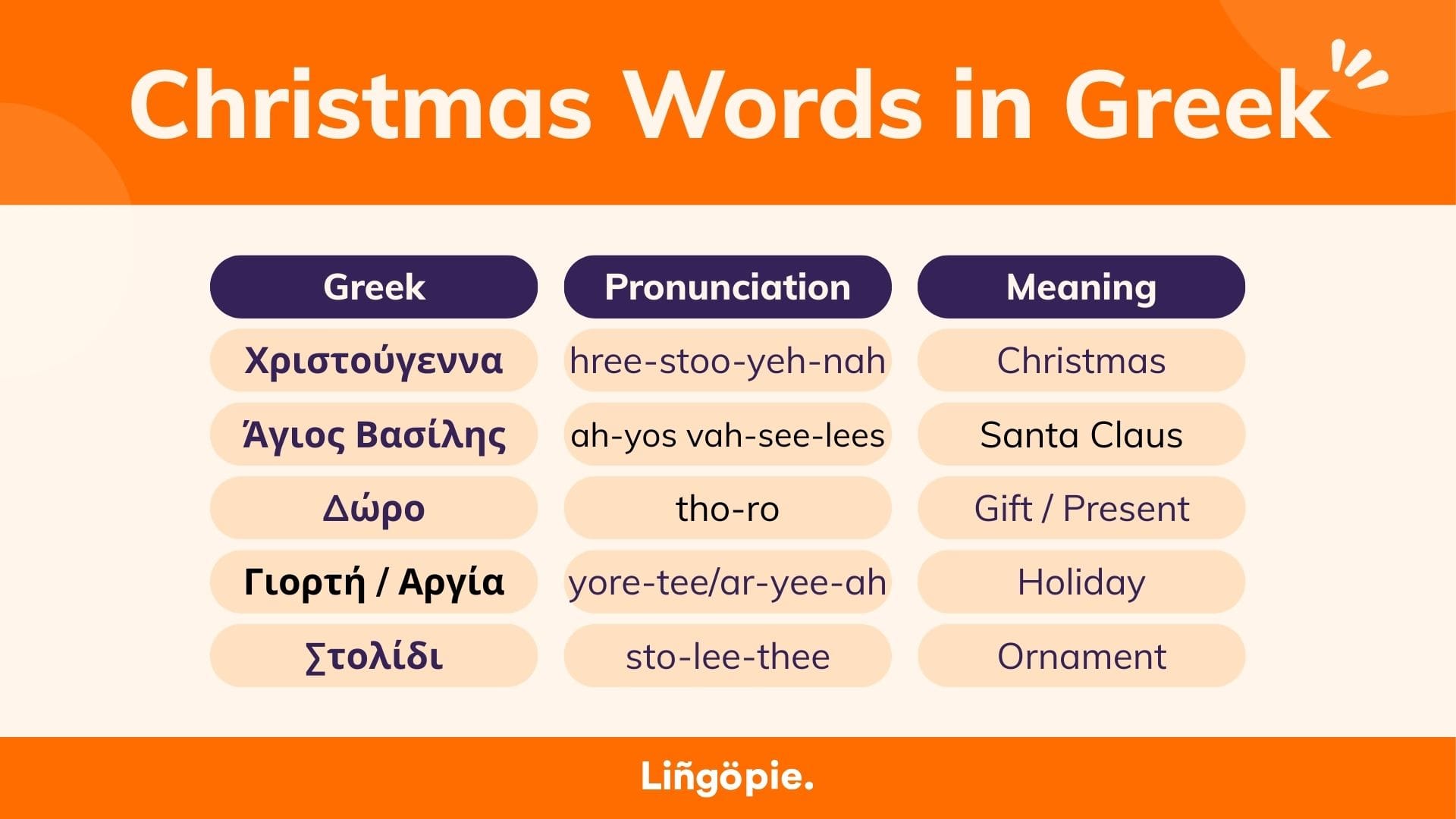
Christmas Words In Greek
Before diving into holiday phrases, it helps to know the key Greek words that bring the season to life. From decorations and traditions to festive treats and cozy winter vibes, these vocabulary essentials will help you understand conversations, read signs, and connect more naturally with Greek holiday culture.
| English Word | Greek Word | Pronunciation |
|---|---|---|
| Christmas | Χριστούγεννα | hree-STOO-yeh-nah |
| Christmas Eve | Παραμονή Χριστουγέννων | pah-rah-moh-NEE hree-stoo-YEH-nohn |
| Christmas Day | Ημέρα Χριστουγέννων | ee-ME-rah hree-stoo-YEH-nohn |
| Santa Claus | Άγιος Βασίλης | AH-yos vah-SEE-lees |
| Saint Basil (Greek Santa) | Άγιος Βασίλειος | AH-yos vah-SEE-lee-os |
| Christmas tree | Χριστουγεννιάτικο δέντρο | hree-stoo-yeh-NEE-ah-tee-ko THEN-tro |
| Gift / Present | Δώρο | THO-ro |
| Snow | Χιόνι | HEE-oh-nee |
| Star | Αστέρι | ah-STEH-ree |
| Ornament | Στολίδι | sto-LEE-thee |
| Nativity | Φάτνη | FAHT-nee |
| Carol | Κάλαντα | KAH-lahn-dah |
| Feast | Γιορτή | yore-TEE |
| New Year | Πρωτοχρονιά | pro-to-hro-NEE-ah |
| Holiday | Γιορτή / Αργία | yore-TEE / ar-YEE-ah |
Christmas Characters In Greek
While Santa Claus exists in Greek culture, he appears in a slightly different form (and on a different date) than many people are used to. Alongside him are traditional goblins, symbolic saints, and wintery spirits that give the Greek holiday season its own enchanting personality.
Here are the key Christmas characters you’ll encounter in Greek celebrations.
| English Name | Greek Name | Pronunciation |
|---|---|---|
| Santa Claus | Άγιος Βασίλης | AH-yos vah-SEE-lees |
| Saint Basil | Άγιος Βασίλειος | AH-yos vah-SEE-lee-os |
| Christmas Goblins | Καλικάντζαροι | kah-lee-KAN-tzah-ree |
| Christ Child | Χριστός | hree-STOS |
| Virgin Mary | Παναγία | pah-nah-YEE-ah |
| Angels | Άγγελοι | AHN-geh-lee |
| Three Wise Men | Τρεις Μάγοι | trees MAH-yee |
| Shepherds | Ποιμένες | pee-MEH-nes |
| Saint Nicholas | Άγιος Νικόλαος | AH-yos nee-KO-lah-os |
| Snowman | Χιονάνθρωπος | hee-oh-NAHN-thro-pos |
Famous Greek Christmas Songs
Looking for the best Christmas song to sing on your next open mic sesh? Here are some of the most popular Greek Christmas songs to get you into the Hellenic holiday mood:
- Καλήν Εσπέραν Άρχοντες (Kalín Esperan Árchontes)
- Άγια Νύχτα (Ágia Nýchta)
- Τρίγωνα Κάλαντα (Trígona Kálanta)
- Ο Μικρός Τυμπανιστής (O Mikrós Tympanistís)
- Χιόνια στο Καμπαναριό (Chiónia sto Kampanário)
- Το Έλατο (To Élato)
- Πάει ο Παλιός ο Χρόνος (Páei o Paliós o Chrónos)
How Greeks Celebrate Christmas
In Greece, Christmas is a warm, family-focused season filled with simple but meaningful traditions. Homes are decorated with Christmas trees and the traditional karaváki (lit-up boats), while children sing kalanda (carols) door-to-door on Christmas Eve.
Christmas Day is celebrated with family meals, festive breads like Christópsomo, and beloved sweets such as melomakárona and kourabiédes.
Instead of December 25, gifts are traditionally exchanged on January 1, the feast day of Agios Vasilis, the Greek Santa. The season ends on Epiphany (January 6), marked by the blessing of the waters—a symbolic ritual that closes the Greek holiday period.
Why Christmas Is a Great Time to Learn Greek
Christmas is an ideal time to start learning Greek because life naturally slows down. With time off work, school breaks, and a more relaxed schedule, it’s easier to fit in short lessons or pick up new vocabulary without pressure. Plus, holiday words and phrases are simple, fun, and instantly useful.
The season also gives you built-in immersion: you’ll hear Greek carols, see festive greetings online, and use common phrases with friends or while traveling. It’s a moment when the language feels approachable and connected to real-life traditions—making learning Greek during Christmas both effective and enjoyable.
Learn Greek With Lingopie
Learning how to say Merry Christmas in Greek and exploring the words, characters, and songs that make the season so magical is just the beginning. Greek is a beautifully expressive language, and the more you hear it spoken naturally, the faster everything clicks.
If you’re excited to learn everyday Greek, you’ve got to try Lingopie! With binge-worthy Greek shows, movies, and interactive subtitles, Lingopie makes language learning fun, effortless, and even addictive. It’s the perfect next step if you want to hear these phrases in real conversations and pick up the language.
Try Lingopie and start learning like a local today!
FAQ: Greek Christmas Culture & Language
Do Greeks celebrate Christmas or New Year more?
While Christmas is important, New Year’s (Protochroniá) is often considered the bigger celebration in Greece, marked by gift-giving, family gatherings, cutting the Vasilopita cake, and festive traditions that rival Christmas in scale.
What is the Vasilopita and why is it important?
Vasilopita is a New Year’s cake baked with a hidden coin. Whoever finds the coin in their slice is believed to have good luck for the year—a beloved Greek tradition tied to Saint Basil.
Do Greeks fast before Christmas?
Yes. Many Orthodox Christians follow a 40-day Nativity fast, abstaining from meat and dairy leading up to December 25. This tradition sets a spiritual tone before the festive meals.
What is the Blessing of the Waters on Epiphany?
On January 6, priests throw a cross into the sea, lake, or river, and swimmers dive to retrieve it. Catching the cross is considered a powerful blessing for health and prosperity in the year ahead.
Are there regional differences in Greek Christmas traditions?
Absolutely. Islands often emphasize boat decorations, northern Greece has rich folk customs and winter festivals, and areas like Crete and Epirus feature unique carols, dishes, and local rituals that vary from region to region.

![7 Best Greek TV Series You Need To Watch Today [2026]](/blog/content/images/size/w300/2026/02/Greek-TV-Shows.jpg)
![How To Say I Love You In Greek Like A Native Speaker [GUIDE]](/blog/content/images/size/w300/2026/02/How-To-Say-I-Love-You-In-Greek.png)
![How To Say Happy New Year In Greek [Guide]](/blog/content/images/size/w300/2025/12/how-to-say-happu-new-year-In-Greek-1.png)
![How Long Does It Take To Learn Greek? [Guide]](/blog/content/images/size/w300/2025/11/How-Long-Does-It-Take-To-Learn-Korean.jpg)
