

![Korean Onomatopoeia: 80+ Sounds And Mimetic Words [Guide]](/blog/content/images/size/w1200/2025/12/Korean-onomatopoeia.jpg)
When you're learning Korean, you can study grammar rules and memorize vocabulary lists all day long. But if you don't know that 멍멍 (meong-meong) is how Koreans hear a dog bark, or that 똑똑 (ttok-ttok) is someone knocking on a door, you'll miss huge chunks of what's actually being said.
When you're learning Korean, you can study grammar rules and memorize vocabulary lists all day long. But if you don't know that 멍멍 (meong-meong) is how Koreans hear a dog bark, or that 똑똑 (ttok-ttok) is someone knocking on a door, you'll miss huge chunks of what's actually being said.
- How To Speak Korean: Classes, Apps, And Immersion Tips
- Korean Aegyo: Words And Gestures To Sound Cute
- 12 Korean Myths And Legends Everyone Should Know

Understanding The Korean Language
Korean sound words are split into two categories: 의성어 (uiseongeo) for actual sounds and 의태어 (uitaegeo) for movements and feelings. Both show up constantly in Korean conversations, dramas, and comics. The distinction matters because it changes how you interpret what you're hearing.
- 의성어 imitates real sounds
- 의태어 describes things that don't make sounds at all
What is 의성어 (Onomatopoeia)?
의성어 (uiseongeo) are words that imitate actual sounds you can hear in the world. They work like English onomatopoeia (think "woof," "knock knock," "boom"), except Korean and English speakers hear the same sounds differently. These words cover animal sounds, weather noises, machinery, human sounds, and objects hitting each other.
Both types follow similar patterns: repeated syllables, double consonants for emphasis, and variations in vowels to show intensity. The key point is that 의성어 represents sounds that actually exist and can be heard.
What is 의태어 (Mimetic Words)?
의태어 (uitaegeo) are words that describe movements, textures, emotions, and visual effects that don't make actual sounds. This is where Korean diverges significantly from English. English doesn't have direct equivalents for most mimetic words.
Where English might say "my heart is pounding," Korean has a specific word that captures both the feeling and the rhythm. Mimetic words describe how something looks (sparkling, colorful), how it feels (soft, warm), or how it moves (tiptoeing, waddling). This is what makes Korean so descriptive and allows speakers to paint vivid pictures with just a few syllables.
Common Korean Onomatopoeia (의성어)
Animal Sounds
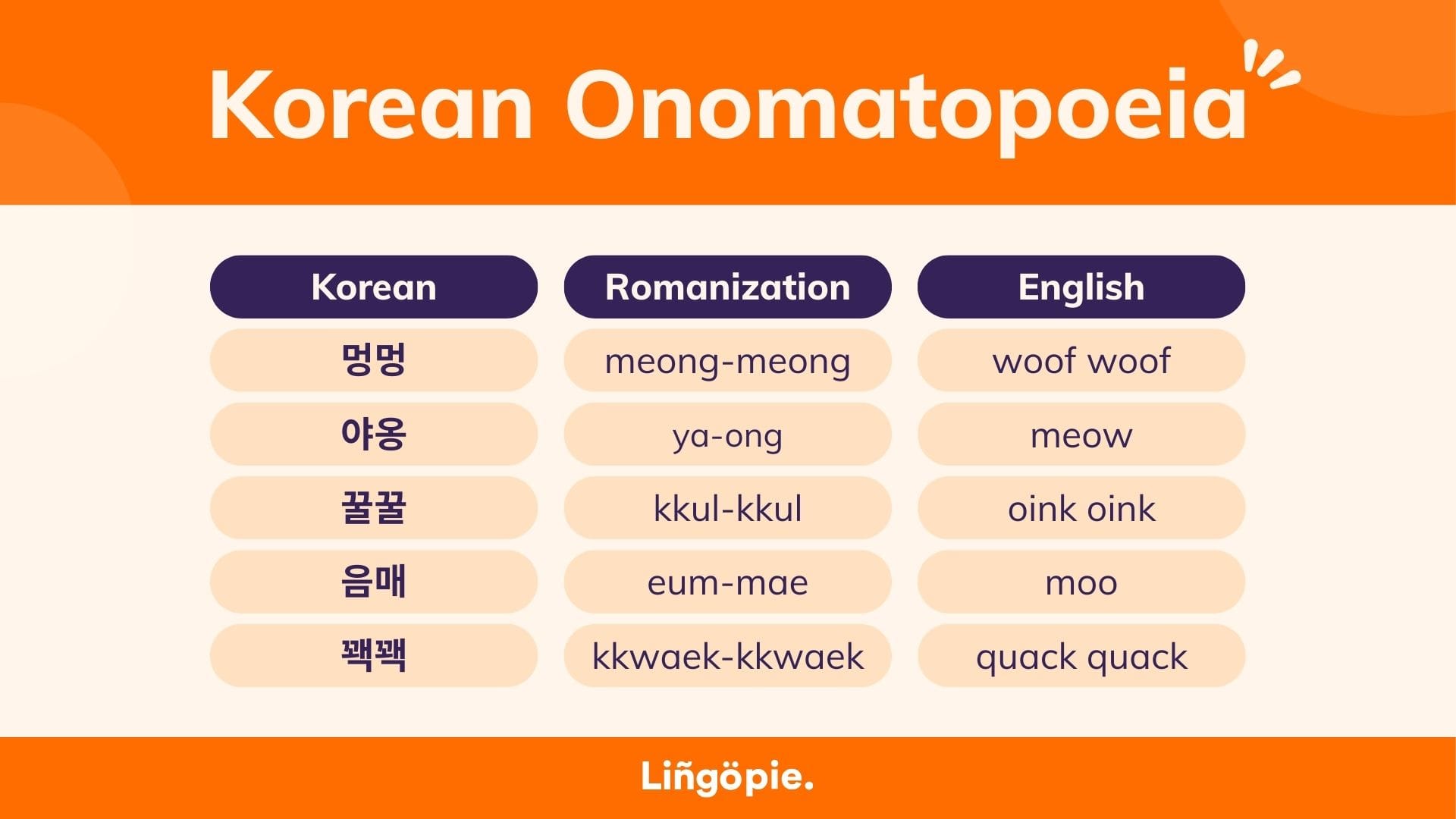
Korean animal sounds differ completely from English ones. Where English speakers hear "woof," Koreans hear 멍멍. Where we say "meow," they say 야옹. These aren't just fun trivia. If you're watching a Korean show and someone mentions these sounds, you need to know what animal they're talking about. Kids learn these first, but adults use them all the time when telling stories or describing situations.
| Korean (Romanization) | English Meaning |
|---|---|
| 멍멍 (meong-meong) | Dog barking (woof woof) |
| 야옹 (ya-ong) | Cat meowing (meow) |
| 꿀꿀 (kkul-kkul) | Pig oinking (oink oink) |
| 음매 (eum-mae) | Cow mooing (moo) |
| 꽥꽥 (kkwaek-kkwaek) | Duck quacking (quack quack) |
| 개굴개굴 (gae-gul-gae-gul) | Frog croaking (ribbit) |
| 꼬끼오 (kko-kki-o) | Rooster crowing (cock-a-doodle-doo) |
| 매애 (mae-ae) | Sheep bleating (baa) |
| 짹짹 (jjaek-jjaek) | Bird chirping (tweet tweet) |
| 찍찍 (jjik-jjik) | Mouse squeaking (squeak squeak) |
Human & Body Sounds
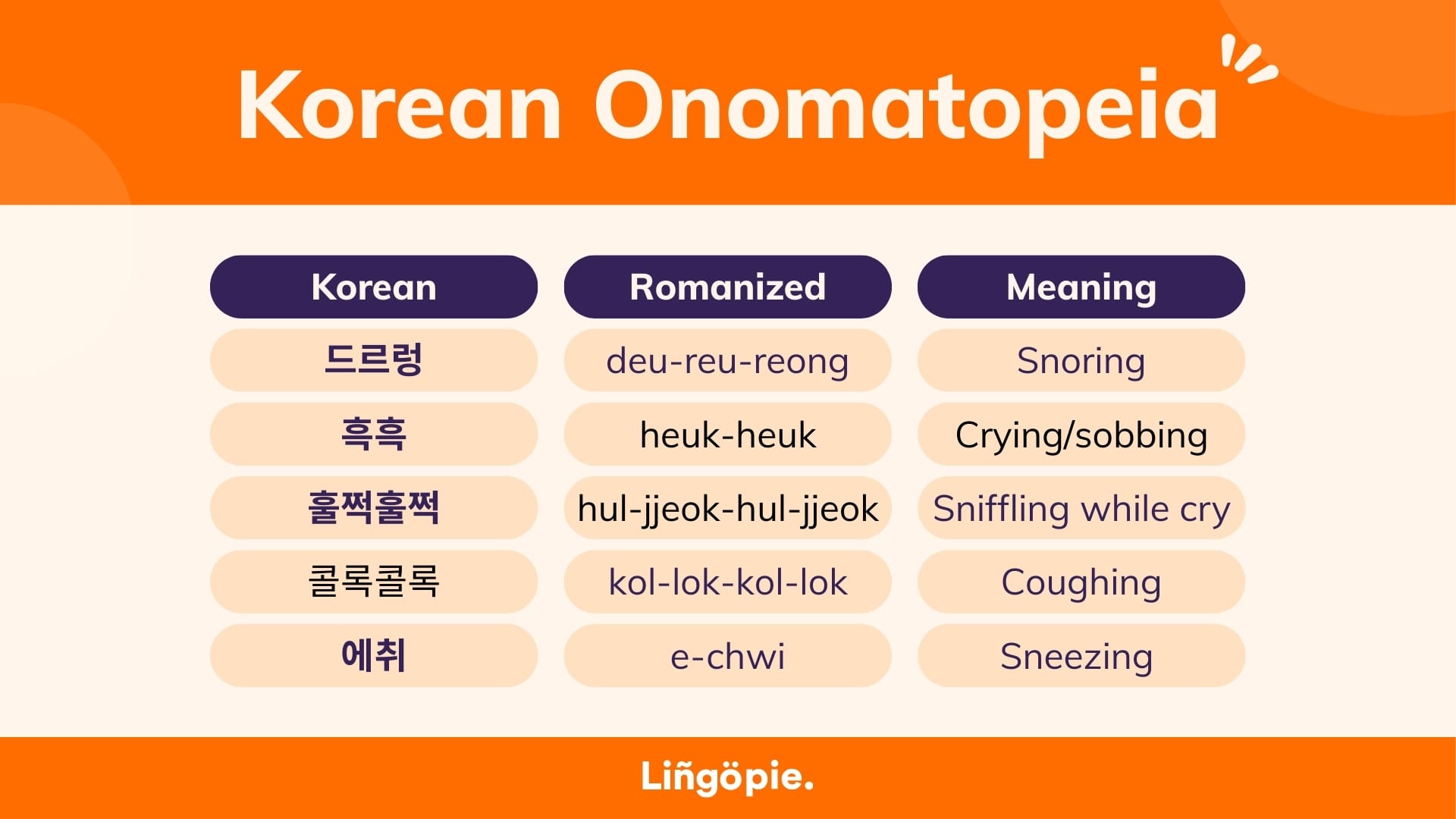
Koreans have specific words for body noises and human reactions. These show up constantly in casual conversation, especially when people are describing how they felt or reacted to something. You'll hear these in Korean dramas whenever characters are sick, surprised, or emotional.
| Korean (Romanization) | English Meaning |
|---|---|
| 하하하 (ha-ha-ha) | Laughing (haha) |
| 흑흑 (heuk-heuk) | Crying/sobbing |
| 훌쩍훌쩍 (hul-jjeok-hul-jjeok) | Sniffling while crying |
| 콜록콜록 (kol-lok-kol-lok) | Coughing |
| 에취 (e-chwi) | Sneezing (achoo) |
| 냠냠 (nyam-nyam) | Eating/chewing sound (nom nom) |
| 쩝쩝 (jjep-jjep) | Smacking lips while eating |
| 꿀꺽 (kkul-kkeok) | Gulping/swallowing |
| 킁킁 (king-king) | Sniffing/smelling |
| 드르렁 (deu-reu-reong) | Snoring |
| 휘파람 (hwi-pa-ram) | Whistling |
Everyday Objects & Machinery
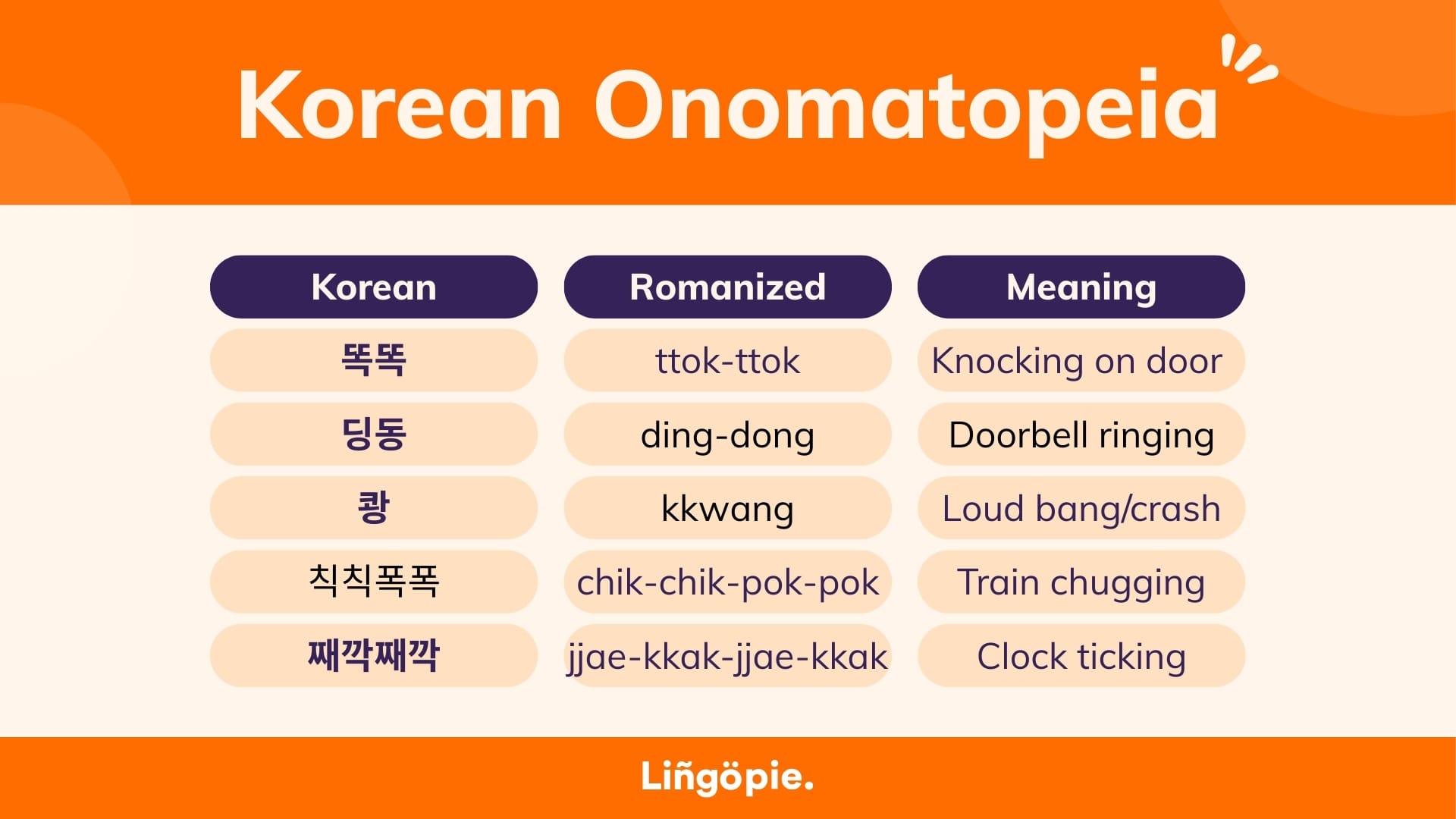
These words describe the sounds of things you interact with daily. Doors, phones, cars, and household items all have their own Korean sound words. You'll recognize these immediately once you start paying attention to Korean media.
| Korean (Romanization) | English Meaning |
|---|---|
| 똑똑 (ttok-ttok) | Knocking on door (knock knock) |
| 딩동 (ding-dong) | Doorbell ringing (ding dong) |
| 따르릉 (tta-reu-reung) | Old phone/bicycle bell/alarm ringing |
| 빵빵 (ppang-ppang) | Car horn (beep beep) |
| 부릉부릉 (bu-reung-bu-reung) | Engine running/revving (vroom vroom) |
| 찰칵 (chal-kak) | Camera shutter clicking |
| 쾅 (kkwang) | Loud bang/crash/slam |
| 삐 (ppi) | Beeping sound |
| 칙칙폭폭 (chik-chik-pok-pok) | Train chugging (choo choo) |
| 철컥 (cheol-keok) | Metal clicking/locking sound |
| 째깍째깍 (jjae-kkak-jjae-kkak) | Clock ticking (tick tock) |
Nature & Weather Sounds
Weather and nature have their own set of onomatopoeia in Korean. These words help you describe everything from gentle drizzle to thunderstorms. Korean speakers use different words for different intensities of the same weather event.
| Korean (Romanization) | English Meaning |
|---|---|
| 주룩주룩 (ju-ruk-ju-ruk) | Heavy rain pouring |
| 보슬보슬 (bo-seul-bo-seul) | Light drizzling rain |
| 우르릉 (u-reu-reung) | Thunder rumbling |
| 쏴아 (sswa-a) | Wind blowing/waves crashing |
| 번쩍 (beon-jjeok) | Lightning flashing |
| 찰랑찰랑 (chal-lang-chal-lang) | Water sloshing gently |
| 철벅철벅 (cheol-beok-cheol-beok) | Splashing through water |
| 쨍쨍 (jjaeng-jjaeng) | Sun blazing/shining intensely |
| 솔솔 (sol-sol) | Gentle breeze blowing |
| 후두둑 (hu-du-duk) | Large drops falling/sprinkling |
Impact & Collision Sounds
These words describe things hitting, breaking, or colliding. They're common in action scenes, slapstick comedy, and everyday descriptions of accidents or surprises. The intensity of the sound often matches the severity of the impact.
| Korean (Romanization) | English Meaning |
|---|---|
| 쿵 (kung) | Heavy thud/boom |
| 탕 (tang) | Gunshot/explosion (bang) |
| 펑 (peong) | Pop/explosion sound (pop/boom) |
| 탁 (tak) | Sharp hitting sound (smack/whack) |
| 와장창 (wa-jang-chang) | Crashing/shattering (crash) |
| 우당탕 (u-dang-tang) | Loud crashing/clattering |
| 쿵쾅쿵쾅 (kung-kkwang-kung-kkwang) | Heavy rhythmic banging |
| 딱 (ttak) | Snapping/clicking sound |
| 퍽 (peok) | Dull thudding sound (thud) |
| 쨍그랑 (jjaeng-geu-rang) | Glass or metal shattering |
Common Mimetic Words In Korean (의태어)
Visual & Light Effects
Mimetic words for visual effects describe how things look without making actual sounds. Koreans use these to describe sparkling, shining, flashing, or glowing. You'll hear these words when people talk about stars, jewelry, clean surfaces, or anything that catches light. They add a visual dimension that English usually needs full adjectives to capture.
| Korean (Romanization) | English Meaning |
|---|---|
| 반짝반짝 (ban-jjak-ban-jjak) | Sparkling/twinkling/glittering |
| 빤짝빤짝 (ppan-jjak-ppan-jjak) | Sparkling intensely/brightly |
| 반들반들 (ban-deul-ban-deul) | Shiny/glossy surface |
| 번쩍번쩍 (beon-jjeok-beon-jjeok) | Flashing brightly/repeatedly |
| 깜빡깜빡 (kkam-bbak-kkam-bbak) | Blinking/flickering on and off |
| 알록달록 (al-lok-dal-lok) | Colorful/multi-colored |
| 새빨갛게 (sae-ppal-gae) | Bright red appearance |
Emotions & Physical Sensations
These mimetic words capture internal feelings and sensations. Your heart pounding, feeling warm, getting nervous, or experiencing excitement all have specific Korean words. These are some of the most useful mimetic words because they describe universal human experiences that English handles with multiple words.
| Korean (Romanization) | English Meaning |
|---|---|
| 두근두근 (du-geun-du-geun) | Heart pounding/throbbing (nervous/excited) |
| 콩닥콩닥 (kong-dak-kong-dak) | Heart beating rapidly |
| 따끈따끈 (tta-kkeun-tta-kkeun) | Warm/cozy feeling |
| 후들후들 (hu-deul-hu-deul) | Trembling/shaking (from fear/cold) |
| 방글방글 (bang-geul-bang-geul) | Smiling brightly/beaming |
| 짜릿짜릿 (jja-rit-jja-rit) | Tingling sensation/thrill |
| 아슬아슬 (a-seul-a-seul) | Nerve-wracking/on edge |
Movement & Motion
Movement mimetic words describe how people or things move. Walking, rolling, hopping, waddling, or tiptoeing all have their own specific words. These show up constantly when Koreans tell stories or describe what they saw. The words themselves often sound like the movement they're describing.
| Korean (Romanization) | English Meaning |
|---|---|
| 살금살금 (sal-geum-sal-geum) | Tiptoeing/sneaking quietly |
| 깡충깡충 (kkang-chung-kkang-chung) | Hopping/jumping (like a rabbit) |
| 뒤뚱뒤뚱 (dwi-tteung-dwi-tteung) | Waddling/walking unsteadily |
| 데굴데굴 (de-gul-de-gul) | Rolling around |
| 펄럭펄럭 (peol-leok-peol-leok) | Flapping/fluttering (cloth, flags) |
| 휘청휘청 (hwi-cheong-hwi-cheong) | Staggering/swaying |
| 뚜벅뚜벅 (ttu-beok-ttu-beok) | Walking with heavy footsteps |
| 또각또각 (tto-gak-tto-gak) | High heels clicking |
| 터벅터벅 (teo-beok-teo-beok) | Trudging/walking tiredly |
Texture & Touch
Texture mimetic words describe how things feel to touch. Soft, sticky, smooth, rough, squishy, or slippery all have specific Korean words. These are particularly common when talking about food, fabric, or skin. Korean speakers rely heavily on these words to describe physical sensations.
| Korean (Romanization) | English Meaning |
|---|---|
| 말랑말랑 (mal-lang-mal-lang) | Soft and squishy/chewy |
| 보들보들 (bo-deul-bo-deul) | Soft and fluffy (like a towel) |
| 미끌미끌 (mi-kkeul-mi-kkeul) | Slippery/slick |
| 까칠까칠 (kka-chil-kka-chil) | Rough/coarse texture |
| 매끈매끈 (mae-kkeun-mae-kkeun) | Smooth/sleek |
| 쫀득쫀득 (jjon-deuk-jjon-deuk) | Chewy/bouncy texture |
| 끈적끈적 (kkeun-jeok-kkeun-jeok) | Sticky/tacky |
| 폭신폭신 (pok-sin-pok-sin) | Soft and cushiony |
Speed & Intensity
These mimetic words describe how quickly or intensely something happens. They capture the pace and energy of actions. Fast, slow, sudden, gradual, or explosive movements all have their own words. These help Korean speakers convey not just what happened, but how it felt when it happened.
| Korean (Romanization) | English Meaning |
|---|---|
| 휙 (hwik) | Swift motion/whoosh |
| 홱 (hwak) | Sudden quick movement |
| 슬금슬금 (seul-geum-seul-geum) | Slowly and sneakily |
| 성큼성큼 (seong-keum-seong-keum) | Taking big strides |
| 재빨리 (jae-ppal-li) | Quickly/swiftly |
| 느릿느릿 (neu-rit-neu-rit) | Slowly/sluggishly |
| 훌쩍 (hul-jjeok) | In one leap/bound |
| 벌떡 (beol-tteok) | Jumping up suddenly |
Start Recognizing Korean Sound Words Today
Korean onomatopoeia and mimetic words show up in every drama, conversation, and comic. Once you start noticing them, you'll realize Koreans use these words constantly to describe the world around them.
The best way to learn these isn't through flashcards, though! It's through watching Korean content. When you hear 멍멍 in a scene with a dog, or see a character's heart going 두근두근, the words stick naturally because you have context.
The good news? Lingopie makes this effortless! With interactive subtitles on Korean shows, you can click any word instantly to see what it means. Hear 쾅 as a door slams? Tap it, save it, keep watching. No pausing. No breaking your flow. Just natural learning while you're entertained.
Pick five sound words from this guide. Watch for them in your next Korean show. You'll be surprised how quickly they become second nature.
Try Lingopie for free and learn Korean the way native speakers do.





![Japanese vs Korean: Which Language Should You Be Learning? [2026]](/blog/content/images/size/w300/2026/03/Japanese-vs-Korean.jpg)
