
Every March 17, the world puts on green and raises a glass to Ireland. But behind the shamrocks and parades is a culture that takes its superstitions seriously... or at least used to. History states that most of these come from centuries of Celtic paganism, early Christianity, famine survival, and a deep suspicion of the fairy world. Many Irish people today claim they don't believe in them.
In Irish, these folk beliefs are called piseoga (singular: piseog, pronounced "pish-OGE"). They cover everything from birds and bread to death rituals and stolen babies. Some are quirky. Some are practical. Some are genuinely dark. All of them tell you something real about Irish culture that a parade never will.
- What is Lingopie? Complete Platform Guide [2026]
- How To Use Lingopie: Step-by-Step Guide For Beginners
- 5 Best Language Immersion Programs For Adults [Guide]

Common Irish Good Luck Superstitions
St. Patrick's Day is built around the idea of Irish luck, but most people celebrating it have no idea where that luck actually comes from. In this section, we'll cover the most popular Irish beliefs, including what they meant and why the Irish took them seriously.
The Four-Leaf Clover
Ireland's most famous symbol of luck. A standard shamrock has three leaves; St. Patrick reputedly used it to explain the Holy Trinity. A fourth leaf is a mutation — rare enough to feel significant, occurring in roughly 1 in 5,000 clovers. The four leaves are said to represent faith, hope, love, and luck. Finding one was considered a genuine gift, not a party trick.
The Horseshoe
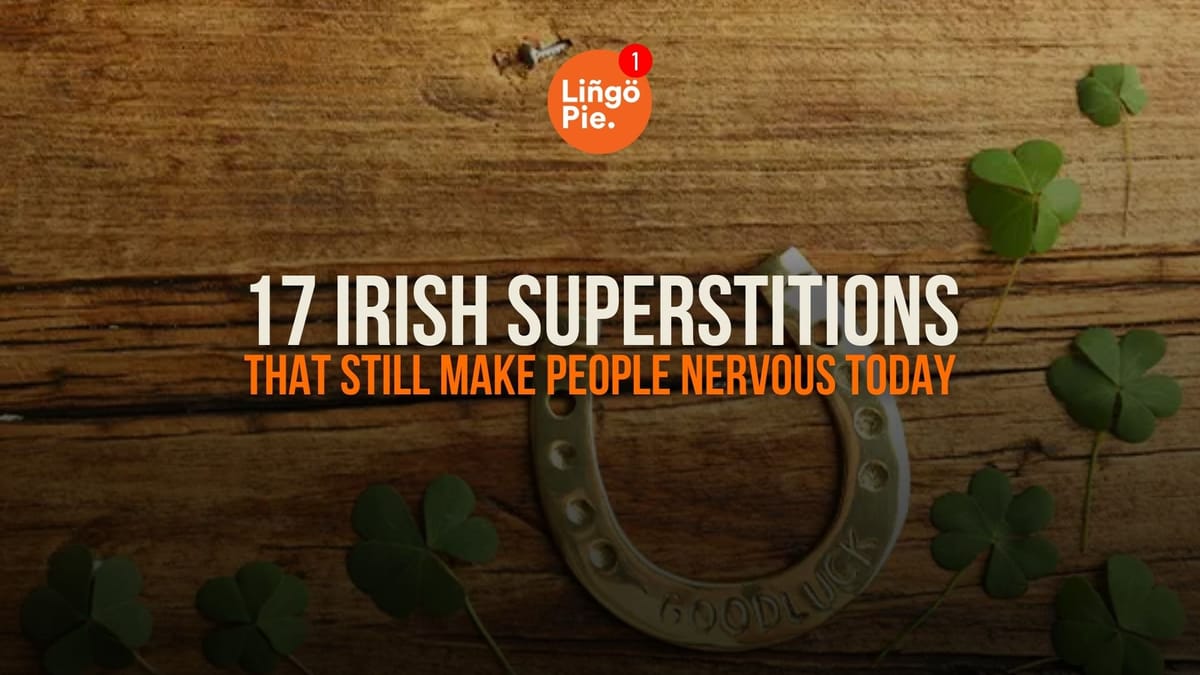
Hang one above your door, open end up. The reasoning: the crescent shape traps good luck inside the home. If you hang it open end down, the luck spills out. The horseshoe's power in Irish tradition is partly tied to iron — iron was believed to repel fairies, who couldn't tolerate the metal. A horseshoe was practical protection on two fronts.
The Magpie
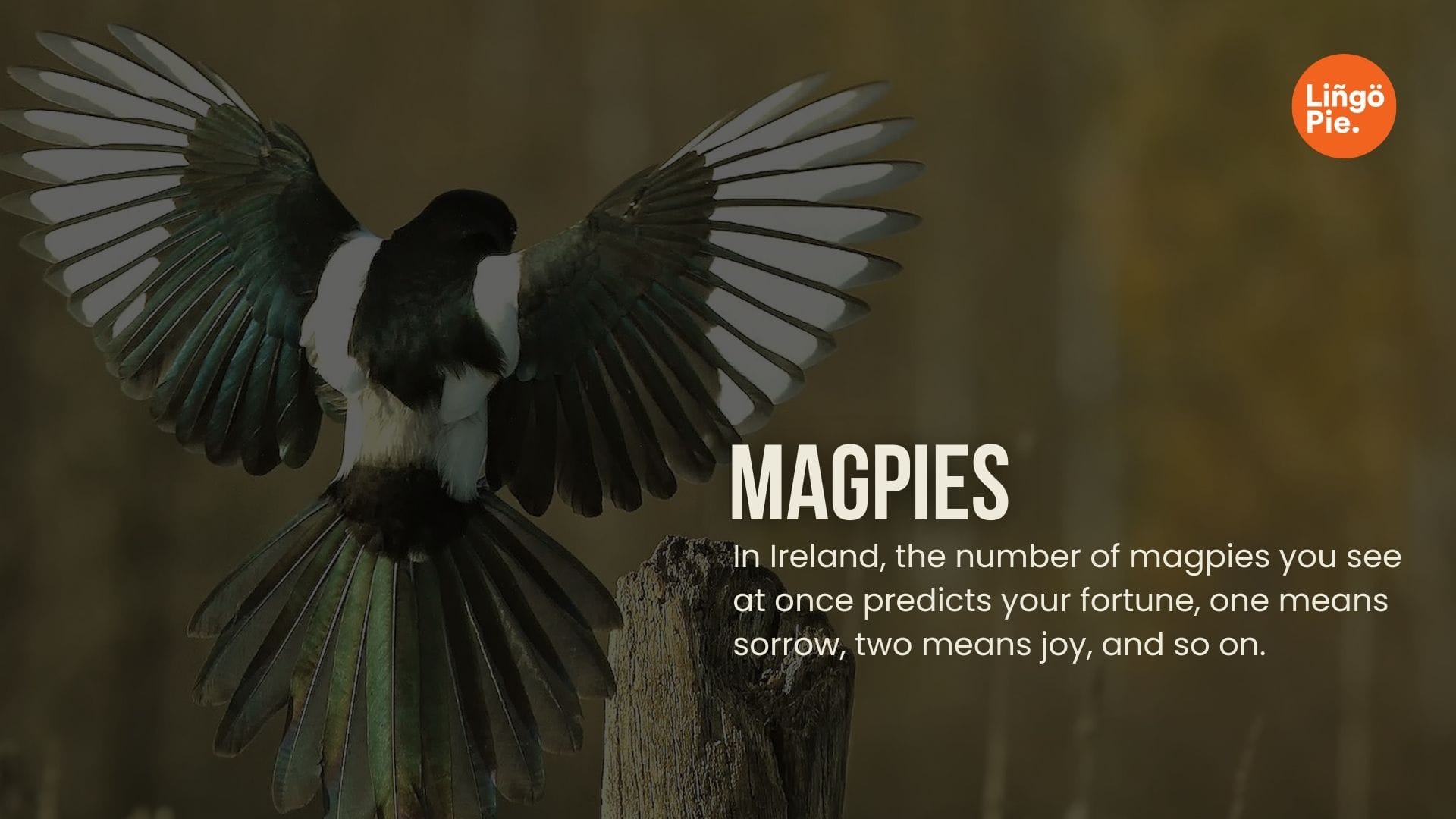
No other bird causes as much anxiety in Ireland. See a single magpie and you're in trouble. The famous counting rhyme goes: one for sorrow, two for joy, three for a girl, four for a boy, five for silver, six for gold, seven for a secret never to be told. Seeing one alone is bad enough that people salute it and say "Good morning, Mr. Magpie" or ask after its family — the idea being that politeness might offset the omen. The superstition likely traces back to the bird's black-and-white coloring being associated with the devil.
Bird Poop Is Good Luck
If a bird defecates on you, that's lucky. The practical interpretation: since birds relieve themselves randomly on people fairly often in Ireland, it made sense to frame it as good news rather than a bad day. The belief has roots in Russian tradition too, but the Irish adopted it wholeheartedly.
Irish Household Superstitions
These governed daily life inside the home — what you could put where, how to move through a space, what happened if you got it wrong.
New Shoes on the Table
Do not, under any circumstances, put new shoes on the table. This is one of the most consistent superstitions across Ireland and among diaspora communities. The origin: when someone died in a home, they were laid out on the table wearing new shoes before the funeral. Putting shoes on the table re-enacted that ritual. It invites illness, death, job loss, or at minimum 24 hours of bad luck.
Don't Leave the Way You Came In
If you enter through the front door, you exit through the front door. Entering through one door and leaving through another removes the luck from the home. This belief is so embedded that some Irish families still observe it automatically without thinking about why.
The Cross on Soda Bread
Before baking soda bread, a baker scores a cross into the top of the loaf. The spiritual explanation: it lets the devil out of the bread. The practical explanation: it helps the bread cook more evenly by allowing heat to reach the center. Both are true. The cross also protected the household from evil spirits. This practice predates Christianity in Ireland — pre-Christian Celts made similar marks in bread as offerings.
Spilled Salt
Spilling salt is bad luck. To reverse it: take a pinch of the spilled salt and throw it over your left shoulder. The logic? The devil stands behind your left shoulder waiting for misfortune. The salt goes directly into his eyes. This one appears across multiple European cultures and likely spread through trade routes — salt was enormously valuable in ancient economies.
Hat on a Bed
Never put a hat on a bed. The superstition connects to hospital and death associations — when a sick person was confined to bed, a doctor would sometimes place their hat on the bed before examining the patient. A hat on the bed meant a doctor had been called, which meant someone was gravely ill. It was also associated with placing hats on a corpse at wake time.
The Last Piece of Bread
Taking the last piece of bread from a shared plate means you'll end up unmarried. The exact framing varies — you'll be an old maid, you'll marry someone ugly, you'll never find a partner. The superstition may have evolved as social pressure against greed at communal tables.
Turning Back After Leaving
If you leave the house and realize you've forgotten something, you cannot simply go back in and continue your journey. You must sit down, count to ten, and then leave again — otherwise something bad will happen on your trip. The belief is that turning back disrupts the luck attached to the original departure.
Animal, Nature, And Body Omens In Irish
The Irish didn't separate the natural world from the spiritual one. A bird, an itch, a burning ear — all of it carried information. These beliefs covered everything from animals in your path to sensations in your own body, and knowing how to read them was considered basic common sense.
| Omen | What It Means |
|---|---|
| Robin in the house | A death warning. Robins are protected — killing one brings lifelong bad luck. Seeing one near a grave means the deceased is at peace. |
| Bird flying indoors | A bad omen. Birds near the home are positive; birds inside have crossed a threshold they shouldn't. |
| Swallow nesting in eaves | Protective. It shields the household — don't disturb it. |
| Peacock feathers indoors | Bad luck. The feather's "eye" pattern is the evil eye — a malevolent gaze that brings misfortune. |
| Black cat crossing path | Left to right = good luck. Right to left = bad luck. On ships, black cats were welcome — unless they walked off before departure. |
| Green clothing | Once considered bad luck in some regions. Green belongs to the fairies. Wearing it was a provocation — or an invitation, depending on their mood. |
| Left ear burning | Someone is saying nice things about you. "Left for love, right for spite." |
| Right ear burning | Someone is talking about you negatively. |
| Itchy right palm | Money is coming to you. |
| Itchy left palm | You're about to spend or lose money. |
| Itchy nose | A fight is coming. Cancel it: have someone slap your hand, then slap theirs back. |
| Shirt on inside out | Good luck — but only if you leave it. Fixing it cancels the luck and invites bad luck instead. |
| Ringing in right ear | The souls in purgatory are calling for your prayers. |
Negative Irish Beliefs
Not all Irish superstitions are about lucky clovers and horseshoes. Some governed the most serious moments in life like in death, illness, and the very real fear that the fairy world could reach into yours.
| Superstition | What It Means |
|---|---|
| The Banshee (Bean Sídhe) | A female spirit whose wail foretells a family death — she doesn't cause it, she announces it. Linked to families with O' or Mac surnames. Appears as an old woman, a young woman washing a shroud, or a crow. |
| Fairy Forts (ráth / lios) | Circular earthworks across Ireland are fairy dwellings. Disturbing one invites years of misfortune. Construction projects were rerouted as recently as the 2000s because workers refused to touch them. |
| Lone Hawthorn Trees | A single hawthorn in a field is a fairy tree. Same rules apply — don't cut it, don't move it. |
| Death Rituals | Windows opened to let the soul leave. Mirrors covered so the soul wouldn't get trapped. Body never left alone. Coffin taken out feet first — head first meant the deceased might look back and call someone to follow. |
| Changelings | Fairies steal healthy babies and leave a sickly substitute. It gave pre-scientific families a framework for sudden infant illness. The belief appeared in actual 19th-century court cases. |
| The Stray Sod (Fód Seachráin) | Step on it and you become disoriented — lost on roads you've walked your whole life. Only remedy: turn your coat inside out. |
Ready To Learn More?
If this St. Patrick’s Day got you curious about how cultures make sense of the world around them, you're not alone. Superstitions are one of the most revealing windows into a culture. They show you what people feared, what they valued, and how they explained the unexplainable before science could.
Every culture Lingopie covers has its own rich tradition of folk beliefs, from the evil eye in Spanish and Italian cultures to the deeply specific death rituals across French, Russian, and Portuguese-speaking countries.
The best way to actually understand these beliefs and hear them used naturally is through real content in the language. Lingopie lets you do exactly that, through TV shows and movies in Spanish, French, Italian, Portuguese, German, Russian, Korean, Hebrew, and more, with dual-language subtitles to help you pick up the language as you go.
Start learning a new language this St. Patrick's Day. Try Lingopie free today.

![Japanese vs Korean: Which Language Should You Be Learning? [2026]](/blog/content/images/2026/03/Japanese-vs-Korean.jpg)