
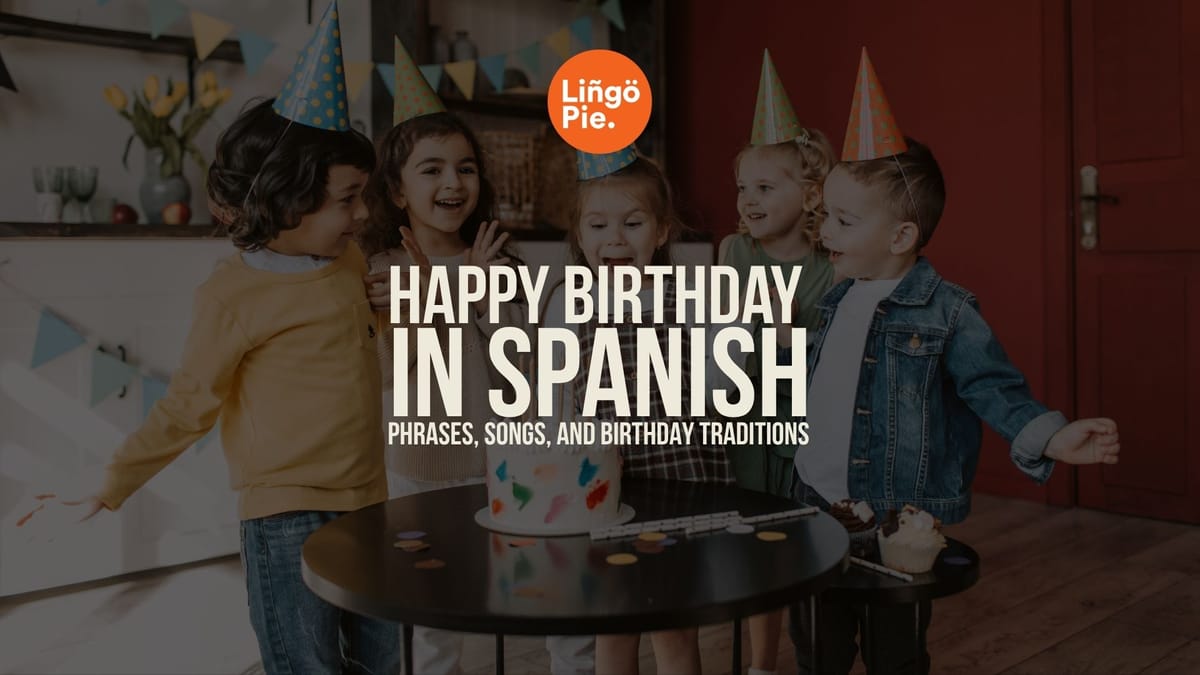
You probably already know feliz cumpleaños. What you might not know is how to personalize it, when to use the short version (feliz cumple), which birthday song Mexicans actually sing, or how to write a birthday card that doesn’t sound like it came from a phrasebook.
The good news? Well, this guide covers all of it! The phrases, the birthday song with full lyrics, the formal and informal versions, and the vocabulary you need to actually participate in a Spanish birthday celebration, not just observe it from a corner.
- Days of the Week in Spanish: The Quick Reference Guide
- Tener Conjugation in Spanish: All Tenses, Forms and Examples
- European Spanish Explained: Pronunciation, Vocabulary, and Grammar Differences

How To Say Happy Birthday In Spanish
Feliz cumpleaños is the standard way to say happy birthday in Spanish. Pronounced as feh-LEES koom-pleh-AH-nyos, it's used across every Spanish-speaking country and works in every context (SMS, birthday cards, or face-to-face).
Grammatically, cumpleaños is always plural in Spanish, even when you're talking about one birthday. Never say "feliz cumpleaño." That's not a proper greeting. If you want a shorter version, simply say feliz cumple (feh-LEES KOOM-pleh), which is equivalent to just typing "happy bday."
To personalize your birthday wish, just plug a name or term of endearment into one of these patterns:
| Pattern | Example | Translation |
|---|---|---|
| [Name], ¡feliz cumpleaños! | Elena, ¡feliz cumpleaños! | Elena, happy birthday! |
| ¡Feliz cumple para [Name]! | ¡Feliz cumple para Carlos! | Happy birthday, Carlos! |
| ¡Feliz cumple para [family member]! | ¡Feliz cumple para mamá! | Happy birthday, Mom! |
| ¡Feliz cumple, [term of endearment]! | ¡Feliz cumple, mi amor! | Happy birthday, my love! |
| Te deseo un feliz cumpleaños, [Name]. | Te deseo un feliz cumpleaños, Rosa. | I wish you a happy birthday, Rosa. |
Common terms of endearment to drop into that fourth pattern: mi amor (my love), mi bien (my dear), amigo/amiga (friend), cariño (sweetheart), or corazón (heart).
Other Ways To Wish Someone A Happy Birthday In Spanish
Feliz cumpleaños is the default, but native speakers mix in plenty of other phrases depending on the situation and how close they are to the birthday person. Here are the most common ones you'll actually hear:
- ¡Felicidades! — Congratulations on your birthday.
- ¡Muchas felicidades! — Many congratulations on your birthday.
- ¡Que cumplas muchos más! — May you have many more birthdays.
- ¡Que los cumplas feliz! — May you celebrate your birthday happily.
- ¡Felicidades en tu día! — Congratulations on your special day.
- ¡Que tengas un día especial! — May you have a special day.
- ¡Que todos tus sueños se cumplan! — May all your dreams come true.
- ¡Dios te bendiga en tu día! — May God bless you on your birthday.
- ¡Feliz cumpleaños atrasado! — Happy belated birthday.
- ¡Muchas felicidades y que cumplas muchos más! — Many congratulations and may you have many more birthdays.
How Mexicans Say Happy Birthday
Mexican birthday celebrations also use feliz cumpleaños, the only difference is the song sung. Instead of the standard "Happy Birthday" melody, Mexicans sing Las Mañanitas. This traditional Spanish song is sung to honor loved ones on occasions such as birthdays, Mother’s Day, All Saints’ Day, and the feast of Our Lady of Guadalupe.
In the context of birthday celebrations, Las Mañanitas is usually performed early in the morning, often to wake the birthday person up, and it's considered one of the most beloved birthday traditions in the Spanish-speaking world.
Here are the core lyrics and their translation:
| Spanish | English |
|---|---|
| Estas son las mañanitas | These are the morning songs |
| Que cantaba el rey David | That King David used to sing |
| Hoy por ser día de tu santo | Today, on your special day |
| Te las cantamos aquí | We sing them here for you |
| Despierta, mi bien, despierta | Wake up, my dear, wake up |
| Mira que ya amaneció | Look, the dawn has already come |
| Ya los pajaritos cantan | The little birds are singing |
| La luna ya se metió | The moon has gone away |
| ¡Qué linda está la mañana | How beautiful is this morning |
| En que vengo a saludarte | As I come to greet you |
| Venimos todos con gusto | We all come with joy |
| Y placer a felicitarte! | And pleasure to congratulate you! |
After the singing comes the cake, and with the cake comes la mordida. This is the tradition where everyone chants "¡mordida, mordida, mordida!" (bite, bite, bite!) as the birthday person leans in to take the first bite. Then someone pushes their face straight into the cake.
Formal vs. Informal Spanish Birthday Wishes
Spanish has two ways to address someone: tú (informal, used with friends, family, and peers) and usted (formal, used with elders, authority figures, or people you don't know well). This distinction changes how you phrase birthday wishes.
Informal (tú): Use with friends, siblings, classmates, and anyone you'd be on a first-name basis with.
| Spanish | English |
|---|---|
| ¡Feliz cumpleaños! ¿Cómo lo vas a celebrar? | Happy birthday! How are you going to celebrate? |
| ¡Que lo pases genial en tu día! | Hope you have a great time on your day! |
| Te deseo un cumpleaños increíble, amigo. | I wish you an incredible birthday, friend. |
Formal (usted): Use with a boss, an elder, a professor, or anyone you'd address with respect.
| Spanish | English |
|---|---|
| Le deseo un muy feliz cumpleaños. | I wish you a very happy birthday. |
| Que tenga un día especial lleno de alegría. | May you have a special day full of joy. |
| Mis más sinceras felicitaciones en su cumpleaños. | My sincerest congratulations on your birthday. |
When in doubt, start with usted. You can always switch to tú if the other person invites it, but going too casual too soon reads as rude in many Spanish-speaking cultures.
Birthday Words In Spanish
Before you show up to the birthday party, make sure you know what everything is called. Here's the essential vocabulary:
| Spanish | English |
|---|---|
| El cumpleaños | Birthday |
| La fiesta de cumpleaños | Birthday party |
| El pastel / La tarta | Birthday cake (pastel in Latin America, tarta in Spain) |
| Las velas | Candles |
| El regalo | Gift |
| Los globos | Balloons |
| La tarjeta | Birthday card |
| El cumpleañero / La cumpleañera | Birthday boy / Birthday girl |
| Soplar las velas | To blow out the candles |
| Celebrar | To celebrate |
| El brindis | Toast |
| Pedir un deseo | To make a wish |
Writing Birthday Cards In Spanish
A birthday card in Spanish follows the same basic structure you'd use in English: a greeting, a birthday message, a personal note, and a closing. Here's how each piece looks in practice:
| Card Element | Spanish Example | English Translation |
|---|---|---|
| Greeting | ¡Feliz cumpleaños, María! | Happy birthday, María! |
| Birthday message | Espero que tu día esté lleno de amor y alegría. | I hope your day is full of love and joy. |
| Personal note | Eres una persona increíble y me alegra tenerte en mi vida. | You are an incredible person and I'm glad to have you in my life. |
| Closing | Con mucho cariño, [your name] | With much love, [your name] |
A few useful closings to know: Con cariño (with affection), Con amor (with love), Un abrazo (a hug), and Con todo mi afecto (with all my affection) for something more formal.
Spanish Toast Phrases For Birthdays
The birthday toast, or el brindis, is a big deal across the Spanish-speaking world. Whether it's a glass of wine at dinner in Spain or a backyard party in Mexico, someone will raise a glass. Here are the phrases to know:
- ¡Salud! (To your health!) The universal go-to. Simple, easy, widely understood everywhere.
- ¡Salud, dinero y amor! (Health, money, and love!) A classic toast that covers all the good things in life.
- ¡Un brindis por el cumpleañero / la cumpleañera! (A toast to the birthday person!) Use this to kick off the celebration.
- ¡Que cumplas muchos más! (May you have many more!) Works perfectly as a toast or a standalone wish.
- ¡Por muchos años más llenos de felicidad! (To many more years full of happiness!) Heartfelt and appropriate for milestone birthdays.
- ¡Arriba, abajo, al centro y pa' dentro! (Up, down, to the center, and down the hatch!) A fun, action-based Mexican toast. You raise your glass, bring it down, clink with everyone, and drink.
One cultural tip for Mexico: make eye contact when you clink glasses. Skipping that is considered bad luck, specifically seven years of it. Now you know.
Learn Spanish Birthday Culture With Lingopie
Memorizing birthday phrases is one thing. Actually understanding them when a room full of native speakers is singing Las Mañanitas at full volume is another situation entirely. The fastest way to close that gap is by hearing real Spanish spoken in real contexts, not scripted textbook dialogues.
Lingopie is the world's best language-learning app that lets you watch Spanish-language TV shows and movies with interactive dual subtitles. Lingopie specializes in a pedagogical approach that teaches you, through total immersion and language practice, how people actually celebrate, argue, flirt, and toast in everyday life.
Try Lingopie free and start learning Spanish through real stories.

![Is Portuguese Hard To Learn? Honest Opinion + Tips [2026]](/blog/content/images/size/w1200/2025/09/Portuguese-hard-to-learn.jpg)