


Watching Greek TV shows is one of the fastest ways to actually pick up the language. I’m talking about the real, messy, everyday Greek people actually speak in! You'll catch slang, rhythm, and expressions that no lesson plan will ever teach you. Pair that with active learning strats, and you're basically getting a language class disguised as a Netflix binge.
In this guide, we're breaking down the seven best Greek TV series worth watching right now in 2026. Whether you're a complete beginner or already somewhere in the middle, these shows are guaranteed to give your Greek some serious real-world exposure.
- How Long Does It Take To Learn Greek? [Guide]
- 18 Greek Curse Words And Insults You Should Be Aware Of
- What Is The Best Way To Learn Greek? Guide + Tips

Best Greek TV Series For Learners
The Other Me (Eteros Ego)
A serial killer staging murders based on the mythological labours of Theseus. An eccentric criminology professor, the police can't solve cases without. Sounds interesting? Eteros Ego is the kind of Greek thriller that makes you forget you're watching with subtitles, which is exactly what makes it so good for learning!
For learners, this is a fantastic resource in formal, educated Greek. You'll hear how professionals actually argue, theorize, and reason out loud in the language. The dialogue is also sharp, intellectual, and loaded with references to ancient mythology, philosophy, and Pythagoras.
With three seasons, record-breaking ratings, and a story that never slows down, how could this not be on your watchlist?
The Great Chimera (Η Μεγάλη Χίμαιρα)

In this Greek Tv show, you'll follow the life of an Italian woman obsessed with Greek culture marries a sea captain and moves to Syros...then falls for his brother! What follows is a slow spiral of passion, betrayal, and destruction that mirrors classical Greek tragedy almost beat for beat.
Based on a beloved 1936 novel, this 2026 mini-series broke viewing records in Greece within its first week and is easily the most cinematic Greek production in years. Since this is quite new, you can expect the language to be quite expressive while staying formal, deliberate, and literary.
Maestro In Blue
Maestro in Blue became the first Greek series on Netflix, and it earned that spot. Three seasons, a 94% audience score on Rotten Tomatoes, and some of the most beautiful island cinematography you'll ever watch on a streaming platform.
If you're new to Greek, this is the obvious starting point. The Paxos island setting keeps the dialogue slow and conversational — people talking about family, shame, love, and loss the way Greeks actually do in real life. It's emotional vocabulary at its most natural. Subtitles are available on Netflix, the pacing is forgiving, and the story is just good enough that you'll keep watching even when you're technically supposed to be studying.
Serres
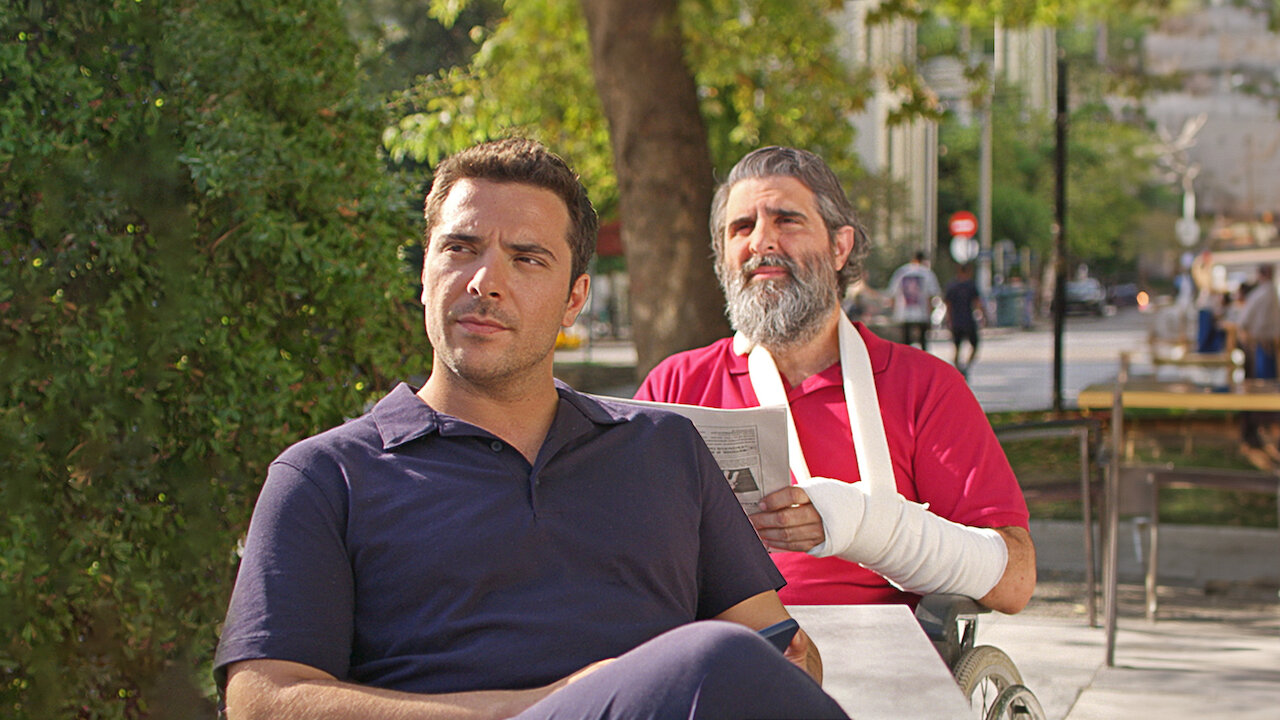
A gay man living his life in Athens gets called back to his conservative hometown of Serres to care for the father who never really accepted him. That's the whole setup — and somehow it's enough to carry two full seasons. Giorgos Kapoutzidis writes with a rare ability to make you laugh and gut-punch you in the same scene, and the result is one of the most quietly honest Greek shows made in recent years.
For language learners, Serres is pure gold for everyday spoken Greek. Family arguments, awkward silences, small-town gossip — it's all there, paced slowly enough to follow without losing the thread. You'll also notice regional speech patterns since the show is deliberately set outside Athens, which gives your ear exposure to how the language shifts across different parts of the country.
Save Me
A woman's body is found in a national park in Komotini, northern Greece — eyes removed. Detective Despina Loukidi gets sent back to her complicated hometown to investigate, and almost everyone she meets is hiding something. Save Me is dark, methodical, and the kind of thriller where you're constantly revising your suspect list. It hit Netflix's Greek top 10 for good reason.
What makes it stand out as a learning resource is the social texture of the language. Komotini has a significant Muslim minority, and the show doesn't shy away from depicting the tension, inequality, and code-switching that exist in that community. You'll hear Greek used across class lines, between institutions and individuals, and under pressure — which is a very different register from anything else on this list. Great for intermediate learners ready to push into more complex, layered territory.
To Soi Sou

Every Sunday, a married couple visits one of their two very different families — one aristocratic and restrained, the other loud, warm, and proudly working-class. Repeat for six seasons and 370+ episodes. It sounds simple because it is, and that's the whole point. To Soi Sou is the show Greeks actually quote at the dinner table, and it's been running since 2014 for a reason.
For learners, nothing on this list gets you closer to how real Greek families actually talk. You'll pick up colloquial phrases, humor timing, generational speech differences, and the particular Greek habit of arguing loudly with the people you love most. Episodes are short, the structure is repetitive, and that repetition is genuinely helpful — you'll catch more every time you watch.
Sto Para Pente
Five strangers witness a government minister die in a broken elevator. His dying words? Find out who did this to me. What follows is 49 episodes of conspiracy, dark comedy, and amateur detective work that pulled a 66% national viewership rating for its finale — still one of the most-watched episodes in Greek TV history. This show is a cultural institution.
The reason it's so valuable for learners is the range. Each of the five characters speaks completely differently — posh, village, street-smart, intellectual, chaotic — giving you exposure to multiple registers, accents, and comedic rhythms in a single episode. The wordplay is famous; Greeks who watched it as kids still quote it today.
Just note that it's from 2005, so some slang is dated, but the writing is so sharp it doesn't matter. If you want to understand how Greeks use language to be funny and specific at the same time, this is a must-watch.
Why Learn Through Greek TV Shows?

The fastest way to absorb a language is through context — hearing the same words used naturally, across different emotions and situations. Greek TV does that in a way flashcard apps simply can't. Here's why it works:
- You hear real Greek, not textbook Greek.
- Phrases stick because you heard them in a scene, not because you drilled them.
- You absorb Greek culture and social context automatically.
- Watching regularly trains your ear to different regional accents and rhythms.
- You actually want to keep watching, so you keep learning.
The catch? Watching alone only gets you so far!
To go from passively understanding to actually retaining, you need to engage with the language while you watch. That's what Lingopie is built for. Watch Greek TV shows with interactive dual subtitles, click any word to get an instant translation, save vocabulary, and review with built-in flashcards and quizzes. It turns every episode into a lesson without feeling like one.
Learn Greek With Lingopie Instead
Greek TV is having a serious moment, and there has never been a better time to learn the language through it. But if you really want the language to stick, passive watching only goes so far. Lingopie lets you watch every show on this list with interactive subtitles, instant word translations, and built-in vocabulary tools that turn your binge session into real progress.
No separate Greek language apps, no grammar drills, no boring lessons. Just you, a great Greek series, and a language you're actually picking up. Start your free trial by clicking below and pick any show from this list to begin.



![How To Say I Love You In Greek Like A Native Speaker [GUIDE]](/blog/content/images/size/w300/2026/02/How-To-Say-I-Love-You-In-Greek.png)
![How To Say Happy New Year In Greek [Guide]](/blog/content/images/size/w300/2025/12/how-to-say-happu-new-year-In-Greek-1.png)

![How Long Does It Take To Learn Greek? [Guide]](/blog/content/images/size/w300/2025/11/How-Long-Does-It-Take-To-Learn-Korean.jpg)
