


What sound does a dog make in German? If you guessed "woof woof," you're wrong—it's "wau wau." German onomatopoeia are words that sound like what they mean, but they don't always match English. Bees go "summ summ," water splashes "platsch," and phones ring "kling kling." These words show up everywhere in real German, and learning them helps you understand native speakers and sound more natural yourself.
In this post, I'll teach you 30+ German onomatopoeia words. You'll learn everyday sounds like clicks and slurps, complete animal noises with their verbs, and patterns that make these words easier to remember. I'll also explain why German captures sounds differently than English.
- 25 Pick Up Lines In German For Flirting In Style [Guide]
- How Long Does It Take To Learn German? [2026 Guide]
- How To Say Thank You In German? 18 Natural Ways

What Is Onomatopoeia?
Onomatopoeia is when a word imitates the actual sound it describes. Think "crash," “bang," or "sizzle" in English. Every language creates these words differently because people hear sounds through the filter of their native pronunciation.
What Germans call onomatopoeia:
- Lautmalerei – literally "sound painting" (most common term)
- Onomatopoesie – direct borrowing from Greek (formal/academic)
- Klangnachahmung – "sound imitation" (descriptive term)
These words matter because they appear constantly in German media, conversations, and children's books. You'll hear them in comics, TV dialogue, and everyday speech. Missing them means missing context and tone that native speakers pick up automatically.
 Milena Quaresma
Everyday German Sound Words
German sound words follow clear vowel patterns. Deep sounds use "u" and "o" vowels (brummen, donnern), while sharp or high sounds use "i" and "e" (klicken, zischen). Once you notice this pattern, German onomatopoeia becomes easier to remember and recognize.
Deep Sounds
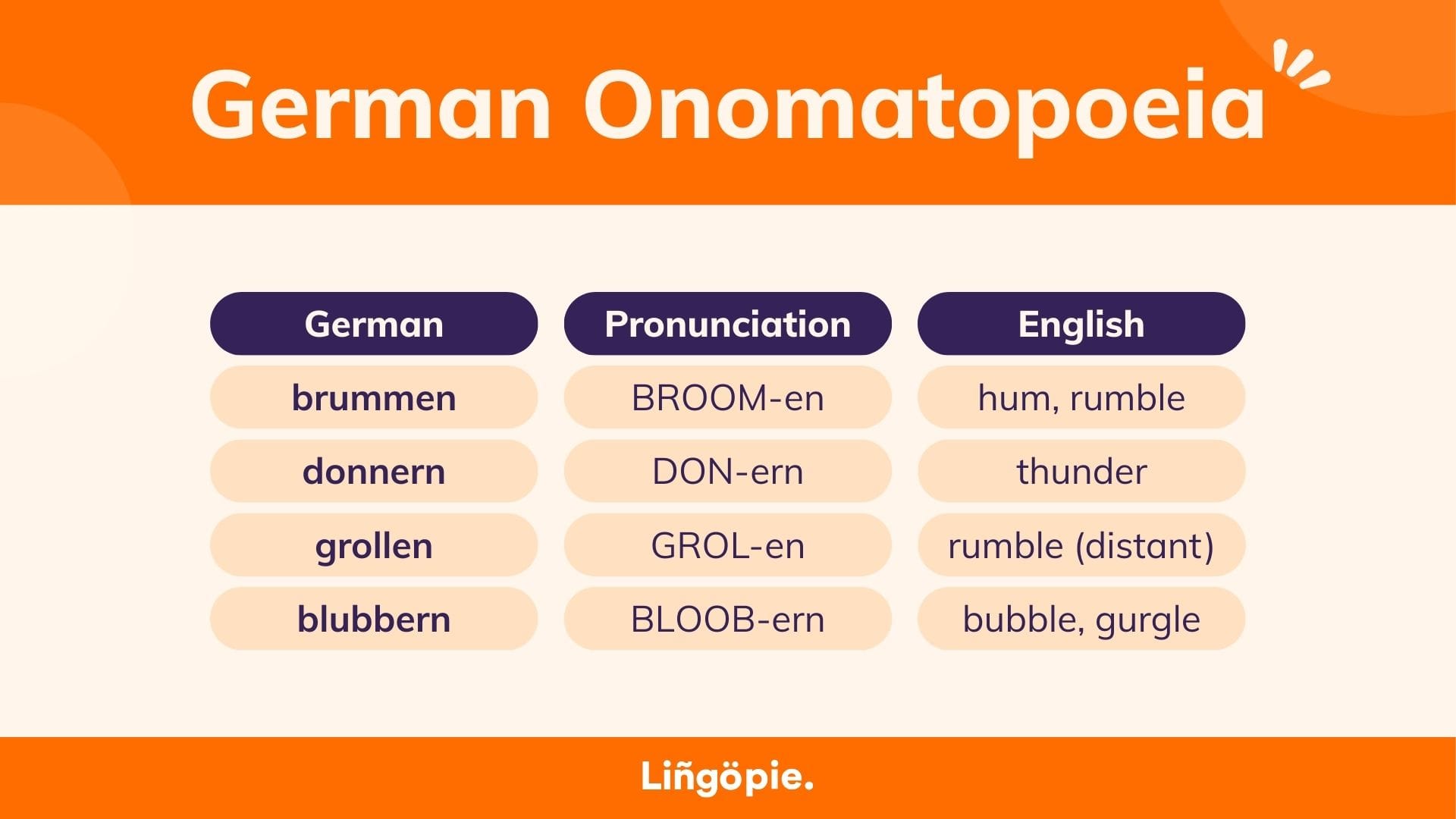
German onomatopoeia uses deep vowels like "u" and "o" for low, rumbling noises. These words often describe engines, thunder, distant sounds, or anything that vibrates or hums. The vowels themselves feel heavy in your mouth when you say them, which matches the sounds they represent.
| German | Pronunciation | English | Example Sentence |
|---|---|---|---|
| brummen | BROOM-en | hum, rumble | Der Motor brummt laut. (The engine rumbles loudly.) |
| donnern | DON-ern | thunder | Es donnert draußen. (It's thundering outside.) |
| grollen | GROL-en | rumble (distant) | Der Donner grollt in der Ferne. (Thunder rumbles in the distance.) |
| blubbern | BLOOB-ern | bubble, gurgle | Das Wasser blubbert im Topf. (The water bubbles in the pot.) |
High & Sharp Sounds
High-pitched or sharp sounds use "i" and "e" vowels. These onomatopoeia capture quick, crisp noises like clicks, rings, crunches, and hisses. The vowels create a tight, sharp feeling that matches the sounds they describe.
| German | Pronunciation | English | Example Sentence |
|---|---|---|---|
| klicken | KLIK-en | click | Klick hier, um fortzufahren. (Click here to continue.) |
| klingeln | KLING-eln | ring | Das Telefon klingelt. (The phone is ringing.) |
| knirschen | KNEER-shen | crunch, grind | Der Schnee knirscht unter den Füßen. (The snow crunches underfoot.) |
| zischen | TSISH-en | hiss | Die Schlange zischt. (The snake hisses.) |
Action Sounds
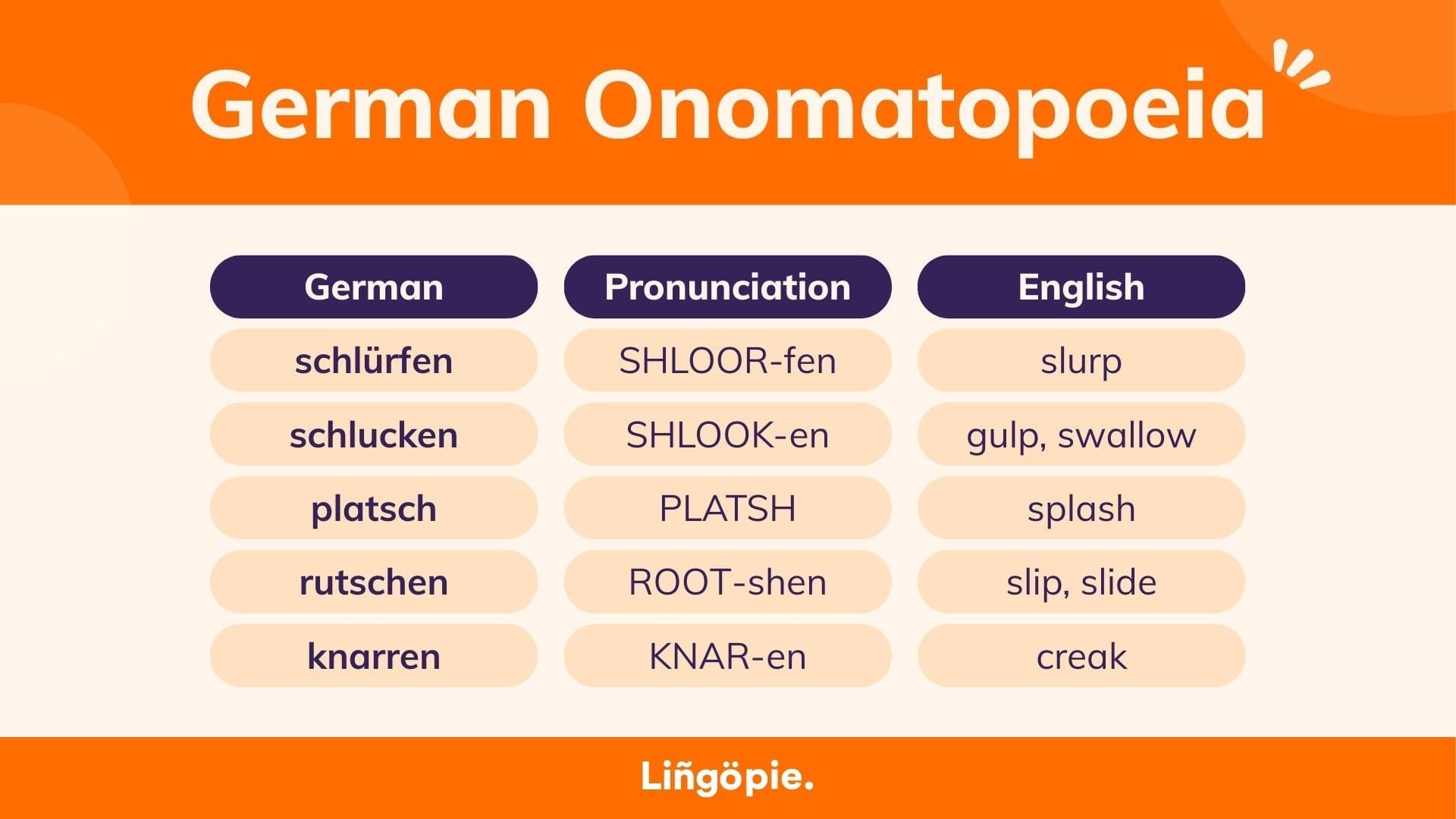
These words describe sounds that happen when something moves or acts. They're dynamic verbs that Germans use to make descriptions more vivid and specific. You'll hear these in storytelling, sports commentary, and everyday narratives.
| German | Pronunciation | English | Example Sentence |
|---|---|---|---|
| schlürfen | SHLOOR-fen | slurp | Er schlürft seinen Kaffee. (He slurps his coffee.) |
| schlucken | SHLOOK-en | gulp, swallow | Sie schluckt nervös. (She swallows nervously.) |
| platsch | PLATSH | splash | Platsch! Er fiel ins Wasser. (Splash! He fell in the water.) |
| rutschen | ROOT-shen | slip, slide | Ich bin auf dem Eis gerutscht. (I slipped on the ice.) |
| knarren | KNAR-en | creak | Die Tür knarrt. (The door creaks.) |
Eating & Drinking Sounds
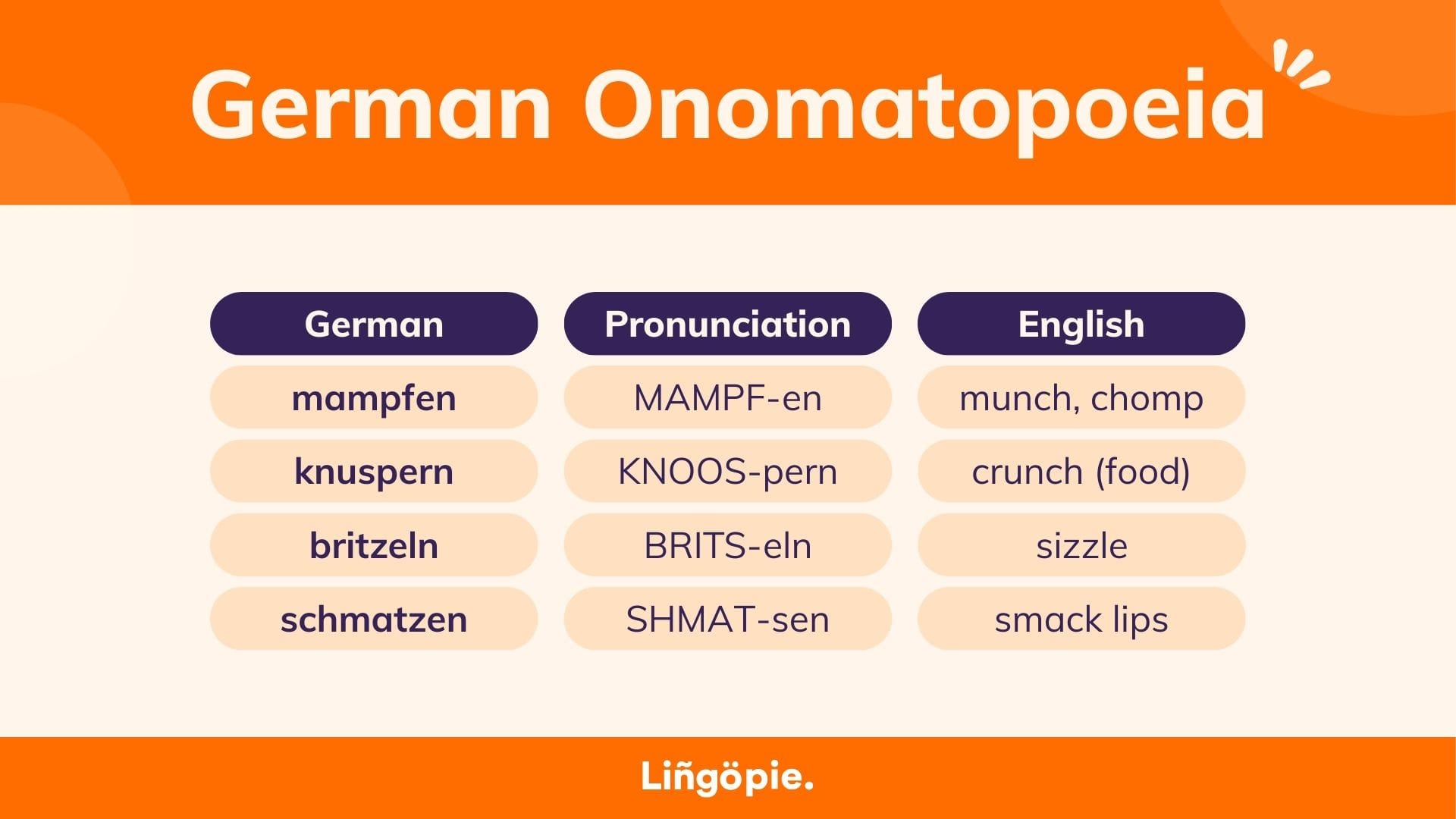
Germans onomatopoeia have specific words for eating and drinking noises. These show up often in casual conversation and food descriptions. Marketing especially loves "knuspern" because it sounds appealing and makes food seem fresh and crunchy.
| German | Pronunciation | English | Example Sentence |
|---|---|---|---|
| mampfen | MAMPF-en | munch, chomp | Die Kinder mampfen Chips. (The kids are munching chips.) |
| knuspern | KNOOS-pern | crunch (food) | Das Brot knuspert schön. (The bread crunches nicely.) |
| britzeln | BRITS-eln | sizzle | Das Fleisch britzelt in der Pfanne. (The meat sizzles in the pan.) |
| schmatzen | SHMAT-sen | smack lips | Bitte nicht schmatzen! (Please don't smack your lips!) |
Human Sounds
These German onomatopoeia describe noises people make naturally. They're common in describing daily life, health situations, and physical reactions. You'll hear them in doctor's offices, fitness contexts, and casual storytelling.
| German | Pronunciation | English | Example Sentence |
|---|---|---|---|
| schnarchen | SHNAR-khen | snore | Mein Vater schnarcht laut. (My father snores loudly.) |
| husten | HOOS-ten | cough | Sie muss husten. (She has to cough.) |
| seufzen | ZOIF-tsen | sigh | Er seufzt müde. (He sighs tiredly.) |
| schnaufen | SHNOW-fen | puff, pant | Nach dem Laufen schnaufe ich. (After running, I'm panting.) |
German Animal Sounds
Animal sounds differ wildly across languages, even though the animals make identical noises everywhere. German animal onomatopoeia follow the same vowel patterns as other sound words, but they also include verbs that describe the action of making that sound. Learning both the sound and the verb helps you use them correctly in sentences.
Common Pets
Dogs and cats are the animals you'll hear about most often in German conversations. German dogs sound noticeably different from English ones because of how the "w" is pronounced (like English "v"). Cats, surprisingly, sound almost identical across both languages.
| Animal | German Sound | Verb | English Sound | Example Sentence |
|---|---|---|---|---|
| Dog (der Hund) | wau wau, wuff wuff | bellen | woof, bow wow | Der Hund bellt laut. (The dog barks loudly.) |
| Cat (die Katze) | miau | miauen | meow | Die Katze miaut. (The cat meows.) |
Farm Animals
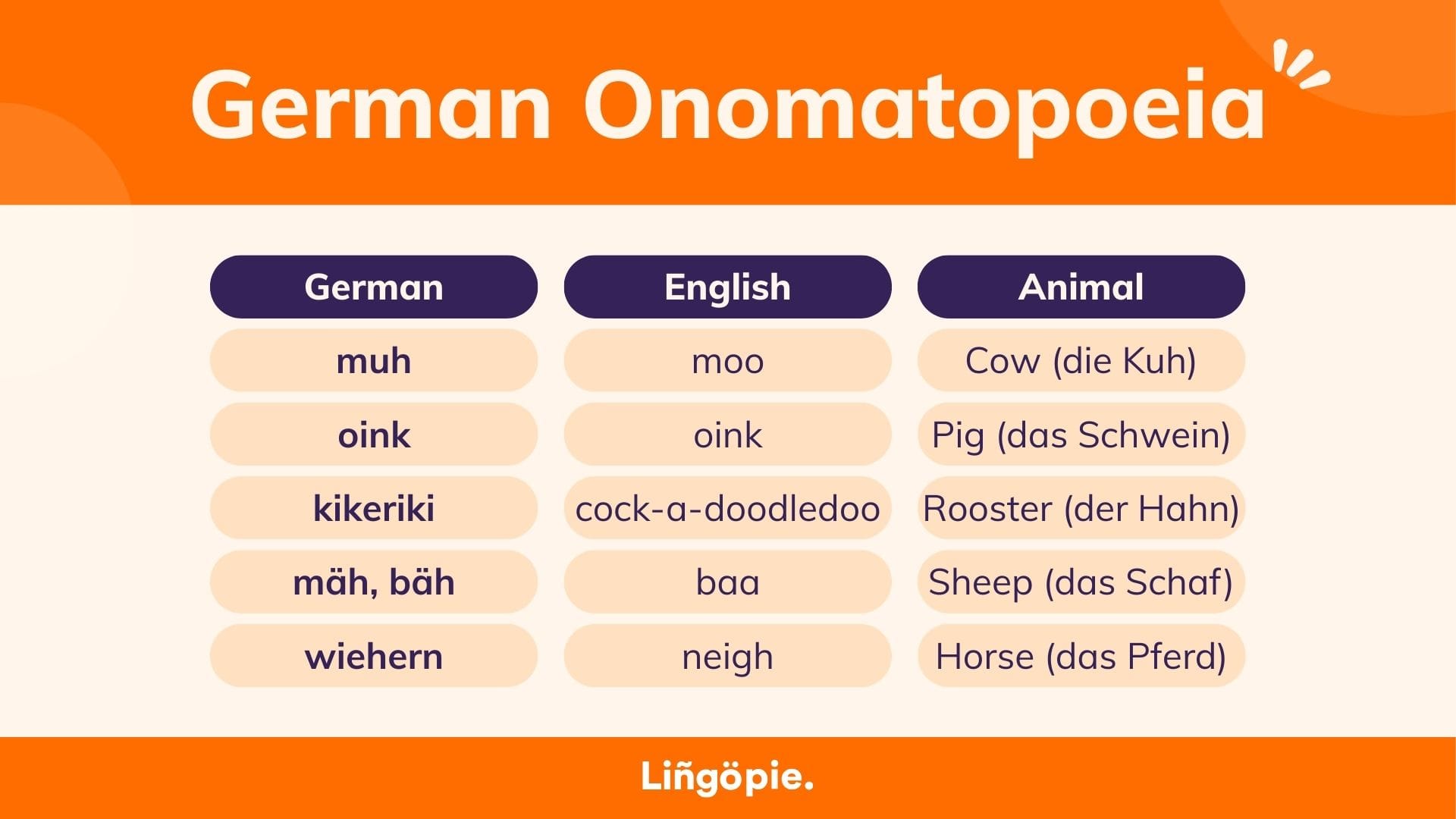
Farm animal sounds appear frequently in German children's books, idioms, and rural conversations. Roosters have one of the most distinctive sounds in German—"kikeriki" is completely different from English "cock-a-doodle-doo."
| Animal | German Sound | Verb | English Sound | Example Sentence |
|---|---|---|---|---|
| Cow (die Kuh) | muh | muhen | moo | Die Kuh muht auf der Weide. (The cow moos in the pasture.) |
| Pig (das Schwein) | oink | grunzen | oink | Das Schwein grunzt. (The pig grunts.) |
| Rooster (der Hahn) | kikeriki | krähen | cock-a-doodle-doo | Der Hahn kräht am Morgen. (The rooster crows in the morning.) |
| Sheep (das Schaf) | mäh, bäh | blöken | baa | Das Schaf blökt. (The sheep bleats.) |
| Horse (das Pferd) | wiehern | wiehern | neigh | Das Pferd wiehert. (The horse neighs.) |
| Donkey (der Esel) | i-ah | — | hee-haw | Der Esel schreit "i-ah." (The donkey brays.) |
| Chicken (das Huhn) | gack | gackern | cluck | Das Huhn gackert. (The chicken clucks.) |
| Duck (die Ente) | quak | quaken | quack | Die Ente quakt. (The duck quacks.) |
Wild Animals & Birds
These sounds come up less often but appear in nature descriptions, stories, and when discussing wildlife. Some verbs work for multiple animals—"brüllen" works for lions, bears, and even angry people.
| Animal | German Sound | Verb | English Sound | Example Sentence |
|---|---|---|---|---|
| Bird (der Vogel) | piep piep | zwitschern | tweet, chirp | Die Vögel zwitschern. (The birds chirp.) |
| Frog (der Frosch) | quak | quaken | ribbit | Der Frosch quakt. (The frog croaks.) |
| Owl (die Eule) | hu hu | rufen, schreien | hoot | Die Eule ruft in der Nacht. (The owl hoots at night.) |
| Bee (die Biene) | summ summ | summen | buzz | Die Biene summt. (The bee buzzes.) |
| Lion (der Löwe) | roar | brüllen | roar | Der Löwe brüllt. (The lion roars.) |
| Bear (der Bär) | brumm | brummen | growl | Der Bär brummt. (The bear growls.) |
| Mouse (die Maus) | piep piep | piepsen | squeak | Die Maus piepst. (The mouse squeaks.) |
| Snake (die Schlange) | zisch | zischen | hiss | Die Schlange zischt. (The snake hisses.) |
| Elephant (der Elefant) | töröö | trompeten | trumpet | Der Elefant trompetet. (The elephant trumpets.) |
Learn German Onomatopoeia the Natural Way with Lingopie
Memorizing onomatopoeia from lists is pointless. You need to hear "wau wau," "platsch," and "britzeln" in real German content where they actually belong: in conversations, sound effects, and dialogue. Lingopie lets you watch German shows and movies with interactive subtitles that turn every sound word into an instant lesson.
Click any onomatopoeia to see its meaning, save it as a flashcard, and move on with the show. No drills, no boring exercises, just German entertainment that teaches you naturally. Try Lingopie free and discover how much faster you learn when you're actually having fun.
Frequently Asked Questions
What is onomatopoeia in German?
Onomatopoeia in German are words that imitate the sounds they describe, like "wau wau" for a dog's bark or "platsch" for a splash. Germans call it "Lautmalerei" (sound painting) or "Onomatopoesie."
Why do German animal sounds differ from English?
Languages capture sounds using their own pronunciation systems and vowel patterns. A dog's bark is the same everywhere, but German speakers hear "wau" while English speakers hear "woof" because of how each language processes sounds.
How do I remember German onomatopoeia?
Don't memorize them from lists. Watch German shows, read German comics, or listen to German conversations where these words appear naturally in context.
Are German onomatopoeia used in formal writing?
Some appear in journalism and formal writing, like "donnern" (thunder) or "knirschen" (crunch). Most are more common in spoken German, children's books, comics, and casual conversations.
What's the most common German onomatopoeia?
"Scheiße" isn't technically onomatopoeia, but common sound words include "klicken" (click), "klingeln" (ring), and animal sounds like "wau wau" (woof). You'll hear these constantly in everyday German media and conversation.


![A Guide To Kansai-ben Dialect For Beginners In Japanese [2026]](/blog/content/images/size/w1200/2025/03/Kansai-ben-dialect.jpg)

![Is German Easy to Learn for English Speakers? Real Data from 14k Learners [2026]](/blog/content/images/size/w300/2026/03/is-german-easy-to-learn-for-english-speakers.jpg)